
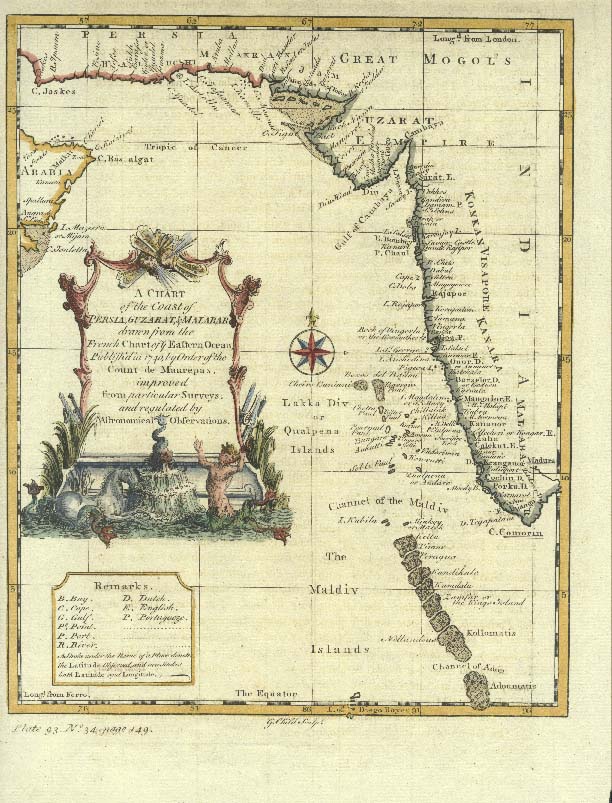
The Infamous Portuguese Cartaz

Posted by Maddy Labels: ,

In many of my previous articles, I mentioned in passing the so called Cartaz or pass system instated by the Portuguese who controlled Malabar and Indian west coast trade. Perhaps it is time now to get into some details of what exactly it was and how the Cartaz policy and system was introduced and enforced.

Its name could have been derived from the Arabic "qirtas" and may have had a previous use in both the Indian Ocean and the eastern Mediterranean seas, many centuries ago. Perhaps it even had Indian antecedants, for Ibn batuta mentioned it as present in Barkur or Faknur.

Quoting Ibn Batuta – The Hindu ruler of Barkur (“Fakanur”) “possesses about thirty warships, commanded by a Muslim called Lula , an evildoer who robs at sea and plunders merchants on the sea.” The passage continues: It is a custom of theirs that every ship that passes by a town must anchor at it and give a present to the ruler. This they call the right of the harbor [haqq al-bandar]. If anyone omits to do this, they sail out in pursuit of him, bring him to the port by force, double the tax on him, and prevent him from proceeding on his journey for as long as they wish.

As Prange explains - This system of enforced tribute can be seen as an indigenous precedent of the Portuguese Cartaz system. The similarities are striking: both systems forced ships to call at specific ports in order to tax them; both claimed a legal underpinning; and both were ultimately founded in the threat of maritime violence. Earlier studies have pointed out that the Portuguese Cartaz had indigenous precedents in safe-conduct passes issued sporadically by coastal rulers in the Red Sea and the Indian Ocean,in fact, Cartaz is likely a loanword from the Arabic qirtas, meaning “paper” or “document.

The Portuguese Cartaz system seems to have started with Vasco Da gama’s second voyage in 1502. The first two Portuguese voyages of Gama and Cabral were mainly related to reconnaissance and small trade as well as making a nuisance of themselves with the local rulers with intent to impress them with their naval might. During the second voyage, Gama defeated the king of Bhatkal and declared that the Portuguese were lords of the ocean and that anybody who used the ports controlled by the Portuguese should pay them tribute. Some other conditions were that the ports or ships should not trade in pepper, should not admit ships of Turks or ships from Calicut. The Bhatkal king agreed to pay 1500 bags of rice per annum and that was when the first Cartaz was issued to the king of Bhatkal. A series of papal bulls mainly the Romanus Pontifex of Nicholas 5 in 1454 gave Portuguese the power to impose the system.

The Cartaz was typically a permit valid for one year and obtained after paying a fee for its issue. The fee varied depending on the ships destination, and was obviously higher for overseas trade. Overseas Cartazes were issued only in Goa (after the ship reached there with a coastal Cartaz) and Cartazes for coastal trade could be obtained from any Portuguese fort or factory or possession. The Portuguese armada controlling these seas had absolute control and every king, lord or emperor followed the rules, except of course the moors of Calicut and Ponnani who never agreed with the policy (Cochin, Quilon and Cannanore agreed). The Portuguese used the system effectively on all Indian rulers, until the other western powers like the Dutch and English made their appearances in the 17th century. The Portuguese argument was that the rules were only for infidels and not for followers of Christ and thus the british and the Dutch were not required to take Cartazes ( this was actually because the Portuguese did not want to have any clashes with the other naval powers).


The Cartaz was a detailed document detailing the ship, name, masts, its owners, the tonnage, sailors and officers, guns etc. The Cartaz also detailed the rules the sailing ship had to follow such as – not to carry royal monopoly articles such as pepper and horses, Christian slaves, should not be destined to an enemy port of the Portuguese, and could not change destination. Copper and iron as well as naval stores were sometimes prohibited. In any case, an application for a Cartaz by kings were not always successful, it was quite difficult to obtain one and there are instances where Adil Shah was refused Cartazes until heavy bribing was resorted to. Sometimes the Cartaz was granted only for political expediency and as a favor for somebody whose support was desired by the Portuguese. This was common after Angre and Shivaji appeared on the scene and the Portuguese needed support from Adil Shah. Ships plying the Arabian Sea without a Cartaz were captured and frequently burnt. This set of ships that checked the others plying the sea for trade were classed as the high sea armada and the red sea armada. The Gulf armada, the Malacca armada, and a few others protecting the northern and southern ports of India were the others who patrolled the seas. So as you saw, when an escort was provided, it was in the form of a convoy or cafila while travelling to the Goan or Malabar coasts and beyond.

However, Correa states that the first Cartazes were actually issued in 1502 to ships from Quilon, Cochin, Cannaore etc, i.e. those ports friendly to Portuguese. Later, the Cartaz or permit system actually routed ships to Portuguese ports so that it became a revenue generation system (Sanjay Subramaniam – Portuguese empire in Asia) by way of customs duties. And as we saw it became a diplomatic instrument and later, even as a perquisite by officers to raise irregular incomes for themselves.

The amount charged for a Cartaz varied from nominal to exorbitant as we saw while talking about the Rahimi and other Moghul ships. The customs duty charged at Goa varied from about 6% ad valoreum until 1569 to 7.5% later. It was higher in Chaul and lower in Diu. In Malacca, a 7% amount was charged for any ship passing through the straits. The main payers of Cartaz to the Guajarati’s who without support of their rulers, decided that the amount charged was not worthy of argument. However it turned out from ledger records that this was actually the only profitable part of the Portuguese trade administration, otherwise the trade vessel was a very leaky one with corrupt officers, parallel trading and rampant dishonesty..all traits they taught the people who worked with them and we see all too often in India.

What if a ship did not have a Cartaz? It was confiscated; the crew put to death or sent o the galleys, or set afire. If indeed a ship disobeyed the conditions of its Cartaz, it was again raided and retained at the Portuguese port till penalties were paid. This was also a very lucrative trade because the captain and the crew of the ship seizing such an errant vessel were entitles to fair shares of the booty. In one case a Gujarati ship was raided because it had 6 Turks on board.

The free Cartaz was the diplomatic Cartaz that was granted to a local ruler. Some had as many as four or six, such as the king of Bijapur, whereas Akbar the emperor had just one. It is not exactly clear if a ship carrying pilgrims really needed a Cartaz, for one was needed only for merchant ships. The armada varied between about 50 ships in the early 16th century to about 120 and finally averaging to some 90 ships in the late 16th century. The cafilas or convoys were herding or escorting many hundred small ships during the 17th century.

It is apparent that while the cost of Cartazes was a few rupees in most cases, the Moguls had to pay much more. In fact in their case, even pilgrimage ships were taxed, presumably due to the fact that they carried traders who brought back returns from trade or carried even a small amount of expensive goods like gems and jewels for sale to the high and mighty in Arabia. The rate was as high as 3000-8000 mamudis. In 1573, Akbar finally got one free Cartaz after agreeing not to shelter or encourage Malabar ‘pirates’. And that was how the Portuguese patrolled over 15000 square miles of coast lines to safeguard their trade returns, mainly due to disinterest from the coastal rulers who did not quite take to the sea, perhaps due to the age old rule of staying away from the ocean waters. The losers were the Guajarati and other konkan traders as well the Arab traders of Malabar and the supporting moplah entourage and the marakkar sea captains.

The captain majors of the ships reported directly to the viceroy, and the east coast was also monitored by the armadas or harmads as they were called in the east coast. It is also sad that to administer rteh rule of the Cartaz, the Portuguese were incredibly cruel, killing, maiming the sailors in any captured ship. In one case an island names Bet off Diu was captured by the Portuguese and every person butchered. It was since then, called the island of the dead.

JR Mohammed opines - The Mohamaden ships were special objects of Portuguese fury. Even with Cartazes, their ships were not safe. The Portuguese sea-men demanded heavy bribes; if it is not given the ships were confiscated". To quote an example a ship captured at the port of Kayalpattanarn in 1526 by Manuel de Gama, then the captain of Coromandel, was confiscated and the Muslim Nagudha and his family sold to slavery.

Not that the Armada ships were fully manned by Portuguese. They had Gujarati pilots, local lascars who sometimes sailed with their family. As we saw they even had a number of Malabarese soldiers in their ranks as time progressed.

The Portuguese stronghold could have been broken with ottoman intervention, but the situation was too complex for that. While the Malabar kings such as the Zamorin petitioned their support through Arab traders, the Mughal emperor Akbar was anti ottoman. The ottoman sultans therefore were half hearted in their support for the Zamorin rebellions against the Portuguese. Akbar, as you may recall, disgusted by the disagreement between various Muslims, brought in what was known as the infallibility decree whereby the Sultan or caliph was not recognized as the absolute power. The person who had the deciding authority in Islamic matters was the emperor and not the ulma. Interestingly the ottomans sued for peace and sent a diplomatic delegation asking for his support in their fight against the Hapsburgs. However it was at a juncture where Akbar had just signed the agreement with masceranhas about the free Cartaz and not supporting Malabar. Akbar imprisoned the entire ottoman delegation and banished them to a jail in Lahore, bound in chains. However the ottoman call met with some support in Surat and some other locations and that was when the first plan to build a Suez canal came up in the ottoman council. But then that is another story.

So how did the Cartaz system survive legal requirements valid in the western world? To get to that one has to understand the Grotius 1609 Mare Clausum (the Right and Dominion of the Sea). While the world acted in general according to the Grotius theory – which argued that the sea was openly navigable by all countries for trade, British John Selden as well as the Portuguese countered that the sea was as subject to a country’s private dominion as land. Ultimately, the inexorable growth of global trade favored the cause of Grotius. Well, anyway the Portuguese by virtue of quasi possession of the maritime are of the Estadio Da India, declared the area to be mare clausum. Newitt in his accounting also mentions that before getting a Cartaz, traders had to leave a security for payment of duties on the return before the onset of the main voyage.

It is not that the Cartaz was a big problem for traders, for they were in those trading with commodity that had a ready market and thus a price increase on the account of Portuguese taxes by about 5% (or was it 20% or a fifth – I am still not sure, it sounds too excessive) did not really upset the applecart. The buyer paid up easily. The problem was only for independent ships operated by Arab owners and those in Malabar who were considered Portuguese enemies. Gujarati ships quietly agreed and purchased the Cartaz, but once outside the Portuguese armadas control operated in a way they chose. Anyway the situation was somewhat complex and with the methods of hawala, hundi and so on for effecting payments and recording values, it was not very easy at the end. Maybe that is when undervaluation became a norm.

One could summarize that the system resulted in institutionalized plunder under the legal pretext of the Cartaz system as time went by and the Portuguese at Goa became very corrupt, but on the whole, the Portuguese looked on Cartazes as giving them a right of intervention for violations (Now you can decide who was the pirate and who was pirated), a right to regulation, acknowledgement of their Sovereignty and so on over the sea. Vineeta Shankar concludes - As a result by 1530 or so a new alternative system of trading routes connecting those points not controlled by the Portuguese emerged. Hence while Portuguese ships called at Malacca, others specially the Muslim traders went to Johor or Aceh.

In 1612, however, the Mughal emperor Jahangir (1569-1627) allowed the English to establish a trading post in Surat, and in 1620 a similar concession was made to the Dutch. Then we saw that Mughals in 1632 conquered Ahmednagar, and this was to bring the Portuguese forts at Chaul, Bassein, and Daman under their protection. Later, in 1637 the English and the Dutch strengthened their presence by setting up factories in neighboring Bijapur. However, the most serious blow to the Portuguese Estadio, both in terms of finances and prestige, was the conquest in 1622 of Hormuz by Shah Abbas of Persia, who thereafter allowed English and Dutch companies to establish trading posts in Bandar Abbas, the port of Isfahan (in present-day Iran).

Interestingly, corsairs or pirates as defined then, such as Kanhoji Angre also issued Cartaz’s to ships and when he prowled the seas, it was prudent to have one of them…But Kanhoji’s story is best recounted in more detail another day.

References

Commercial Policy (Essays on Indian history – HVS Moorthy)- BS Sastry
Essays In Goan History edited by Teotónio R. de Souza
Studies in Indian History: Historical Records at Goa - By Surendranath Sen
Portuguese Empire in Asia, 1500-1700: A Political and Economic History - By Sanjay Subrahmanyam
Foundations of the Portuguese Empire, 1415-1580 - By Bailey W. Diffie, George D. Winius
Merchants and Rulers in Gujarat: By Michael Naylor Pearson
History of the Portuguese Navigation in India, 1497-1600 - By K. M. Mathew
The Ottoman Age of Exploration - By Giancarlo Casale
The First Portuguese Colonial Empire - By M. D. D. Newitt
A Trade of No Dishonor : Piracy, Commerce, and Community in the Western Indian Ocean, Twelfth to Sixteenth Century – Sebastian Prange

Text of a Cartaz (from Studies in Indian History referred above Page 64) – An example

A Pirate in Malabar

Posted by Maddy Labels:

A Scottish American privateer at Calicut and Kayamkulam

These days we have an interesting story with a couple of Italian pirate hunters killing two Kerala fishermen off the Malabar coast and spending time in prison, eating pizza and creating a lot of fodder for the TV and newspaper men. The Italians agreed to compensate the families of the dead and the case seems destined for quick closure, the cost per dead being a measly $189,000. But imagine the situation in Calicut in 1697 when news reached the sleepy town that a pirate Capn Kidd and his ship were docked close to port at Kallai..

Well, other readers must be wondering what Kayamkulam has to do with Kidd. Read on and you will also figure out the link. Many of you may not know who Captain Kidd was; he was considered a notorious pirate of the late 17th century. William Kidd was born in Scotland in about 1645 and migrated to New York very young. A man desiring high adventure, he was soon enlisted by the British authorities and American backers, to hunt down pirates and left for London in 1696. A number of unfortunate events ended up with his earning a reputation as a ruthless pirate. He returned later to New York, was imprisoned and consigned to London, deserted by his sponsors, interrogated by the British Parliament before being convicted for piracy and murder. He was hanged in 1701, coated with tar and hung out for years to be eaten away by hungry birds. Kidd was a founder of Trinity Church, which still stands near Ground Zero, in New York. Some days ago Calicut heritage forum covered him in a couple of blogs and as it was a topic that I had been researching, thought it a good idea to cover Kidd’s Malabar sojourn in a little more detail.

Some people have the most beastly luck. If you read the ‘real’ story of Captain Kidd, a New York Sea Captain, you will agree, and reaffirm that he was caught in the cross hairs of political salvos between the Mughal Empire, the British crown and the EIC. He ended up sadly a victim of vicious rumor mongering slander and political wrangling. But I will not venture into the whole story, and would recommend that anybody interested read the book by Zacks instead of the many lopsided articles out on the net. I will however provide some detail of the period when Kidd’s ship first limped into Calicut and the time they spent at the Malabar Coast between Tellichery and Cape Comorin.

But to get to the beginnings of the story, I have to remind you of my previous article about the Rahimi and the pirate activity in the seas lapping Western India. Even though history books talk less about these western pirates, they try to explain off the activity as Malabar pirate/corsair activity, implicating instead the Moors of Calicut (headed by the marakkars). In fact pirate ships flying French, Danish, British or Portuguese flags were, in those Mughal days, actually the ones preying on ‘the fat Jeddah ships’ as they were called.

Why were they called fat ships (aka Moghul ships) in Pirate parlance? These big (across the bows) and slow ships ferried as many as hundreds to a thousand pilgrims from Surat to Jeddah for the Hajj pilgrimage to Mecca and carried trade during other times. I must add of course that by the time Aurangzeb got to the throne, few of the ships were smaller, in better shape and were three masted outriggers. Some of these travelers aboard were traders who loaded their wares into those ships and sold them to other pilgrims and buyers at Mecca at a great profit. The return voyage thus had traders bringing back a good amount (perhaps they were also bringing back the payments from previous shipments) of gold and silver that was eagerly sought by the pirates. The slow ships were no match for the fast pirate ships with some 150-200 men and 20-40 guns. If raided, these pilgrim ships were destined for misery. The holds were plundered, many pilgrims were butchered and the women were molested gleefully by the lusty pirates. On shore the story was a bit different. These ships were owned by wealthy nakhudas who were well connected and in some cases, had ownership vested in the royal family as we saw in the case of Rahimi. Also a good amount of trade goods and returns sometimes belonged to nobles of the Agra court or the Mughal royal family. Thirdly it was also the emperor’s responsibility to safeguard a successful Hajj pilgrimage. So an attack on these pilgrim ships created huge uproar and the western diplomats currying for business and trade partnerships in Agra were in hot waters facing large compensation claims and threats of immediate expulsion by the Mughal emperor who believed that these pirate ships were being state sponsored.

As it turned out in the case of the Rahimi and later, ships flying the British flag or with a British master were also involved in piracy and the EIC were faced with a tough decision of keeping it in check. The British EIC and crown had two options, one to employ privateers to hound the pirates off or to launch their own anti piracy ships. It was into this situation that the enterprising Scottish American sea captain William Kidd sailed into, as a privateer with the intent to tackle pirates. As it turned out, he lost his life and fortunes in the process, for the British eventually made him the scapegoat.

Captain Kidd’s story is certainly interesting, in fact it covers all the ingredients, adventure, thrills, love, backbiting, theft, piracy, lust….. Anyway as we read, it was 1695, piracy by ships flying western flags was becoming rampant, the emperor at Agra was livid and privateers were needed to chase and capture them. Kidd formed a joint venture with American Livingston and Lord Belmont. Soon after signing the Agreement, Kidd received two special commissions. As the writer in the USS Kidd memorial site explains, one was a letter of marquee empowering him to capture any ships or goods belonging to France. The other was a commission from the King to seize pirates, but also included a warning that ". . . you do not, in any manner, offend or molest any of our Friends or Allies, their Ships or Subjects."

One of the problems that were to plague him was his choice of American crew, who were unfortunately not the honest type and who had previous connections with piracy (he had to entice them with large salaries that he could ill afford). His ship Adventure galley and the venture had bad luck all the way through and faced problems with the British government from the outset. First was the instance when they got into trouble for not saluting a navy yacht in 1696, then he had problems securing supplies and new sail at Cape Town during the run towards the Red Sea. Then he lost a number of crew to illness and not a single penny had been earned so far, not a single piracy act checked. The crew was getting mutinous, for they had dreamed of quick riches. A number of events and non events were to happen next, but we will get into none of that. It was 1697 already, over a year after they set out, with no returns. The ship hung on, only due to the sheer force of Kidd’s personality as a strict captain. But the strings holding him to his 150 or so crew were becoming tight, after the arduous sea voyage and disappointments and had to burst sooner or later. They finally decided to leave the Red Sea ports and head to Damman off the Indian coast near Goa.

At the end of August 1697 off the Malabar Coast, Kidd encountered a small Moorish twin masted ship Mary of two hundred tones headed to Bombay from Aden. The ship was commanded by an English captain – named Parker, with five Portuguese monks on board, a Portuguese navigator, and manned by Malabar crew. While Kidd and Parker were having a long desired drink, Kidd’s quarter master Walker and some of his former pirate crew ransacked the Mary and tortured the Malabar crew trying to find out if any gold was on the ship. Soon Kidd came out and put a stop to it and had everything returned. But the events were to create no end of trouble later for the Portuguese monks filed a report that Kidd was a pirate and the instigator of the crime but that the stolen goods were returned ( the latter part of the admission was not used during Kidd’s trail). Parker accompanied Kidd after the event. Soon the A Galley docked at Karwar for Kidd needed supplies and water desperately. The EIC agents at Karwar, Pattle and Harvey reported to Bombay that the pirate Kidd had berthed. Deserters from the ship meanwhile, complained about Kidd. Then again, Kidd’s men wanted to sample the famous dancing girls of Karwar but Kidd did not let anyone ashore and that made them angrier. Some of the deserters soon landed up in Goa and informed the Portuguese that Kidd’s ship was in Karwar. The Portuguese sent out two men of war to hound the Adventure Galley. Using some excellent captaincy, Kidd escaped as the Portuguese ships neared, later destroying one of his pursuers. His next port of call was the Laccadive Islands.

They had some problems there with the locals, and ended up having to flee again, this time headed for Calicut. He needed water and supplies and hoped that the agent at Calicut would supply him the required stuff. He worte his first letter of the voyage to the station chief at Calicut, one Mr Thomas Penning, requesting for food and water, in the name of the Crown, while anchored at Calicut’s post (the place was then called Calicut road). Penning having already heard rumors of piracy down the grapevine believed that Kidd was perhaps an imposter of a privateer and more a pirate, refused to supply him the supplies.

Kidd was desperate, his crew getting even more mutinous. It was during this tense period that a Dutch ship passed by. The crew wanted to attack & pillage the ship but Kidd refused permission. Kidd then had a major disagreement with the quartermaster and ringleader of the mutinous crew, the same William Moore and ended up swiping him with a bucket. The bucket hit Moore on the head and he was soon dead. He was then buried at sea in Calicut. Penning would still not provide the supplies and so Kidd finally left Calicut after a few days and sailed his ship to Tellicherry road. A cabin boy deserted and fed tales that Kidd had murdered his quartermaster and that he was forcing his crew to become pirates plus the tale that the unhappy crew wanted to create a mutiny. Kidd thus did not get any supplies from the EIC Tellicherry factory as well. His crew was parched and supplies had hit rock bottom. It was November 1697 and Kidd was now flying a French flag. Around this time they encountered a Dutch ship and captured it with the passes and permission he had, renaming it the Maiden. It had little by way of booty, and Kidd had to find a place to sell whatever he got to buy some supplies.

And that is how he set foot at Kayamkulam or Kalliquilon, popularly known as the smugglers den or Smugglers port. The goods were sold for £150 and Kidd finally managed to get some rice and supplies they desperately needed. He then spent two months based at Kayamkulam sailing back & forth on the Malabar waters, looking for pirates, but saw none. Many a merchant ship plied the routes from Bengal to Malabar ports and Surat. One such ship was the Quedgah Merchant. This time as it moved past the Kayamkulam waters, it was heavily loaded, with cloth, brown sugar, opium, silk, iron, saltpeter and a large amount of jewels. The date was January 30th, 1698. The ship owned by Armenian or Parsi merchant Corgi Baba Sulthanam with an English master John Wright (but using a French alias Pilot Rette)

Kidd was not sure what to do with the 400 tonne, 18 cannon ship flying an Armeinan flag. He followed it and caught up with it at Cochin. As he boarded the ship, it hoisted a French flag. Kidd using his British pass said that he had a right to capture a French ship and the Frenchman who was on board negotiating did not argue with Kidd who mastered a ship with 36 guns. But Kidd did not see Wright, nor did he know it was being captained by an Englishman. The ships good were valued at Rs 4 lakhs or £50,000. Kidd found in the captain’s cabin a chest full of diamonds, rubies, gold nuggets. He did not tell anybody about this find, perhaps his selfishness took over here. As the privateers were making merry, Kidd found out that the ship was actually British brokered and captained by Wright. He was thus in a quandary and in the borders of legitimacy even with the permits to privateer. So he offered to sell the captured ship back to the Armenian owners who offered Rs 20,000. Kidd’s crew did not agree. Kidd thought he could get his way through on this one as he had the French paper of the Quedgah Merchant, but what he did not know was that much of the goods actually belonged to a noble or for that matter the Mughal emperor himself. The ships were taken back to Kayamkulam.

Kidd had to pay his crew and buy his supplies, so he had no choice but to sell the booty at Kayamkulam. He sold the silk and opium at to a renegade EIC factor for £10,000, but this was just a small portion of the ships goods and to sell the rest of the goods would take him more days. But business was going well.

That was not to be, for soon Kidd espied two large EIC and two Dutch merchantmen headed towards his ships. Kidd decided to flee and thus left Kayamkulam taking with him the Quedgah merchant, never to return again to the Malabar shores. The three leaky ships fled to St Mary’s in Madagascar, water pumped out by the seven Moplah’s who were on board as the ship was being unloaded. At St Mary’s, Kidd encountered a regular pirate named Culliford. Most of Kidd’s crew abandoned him and joined Culliford for more piratical adventures. Only 13 people remained true to Kidd.

The worm eaten leaky Adventure Galley was soon scuttled and Kidd sailed to the Caribbean on the Adventure Prize and with the Quedgah merchant in tow. At about this same time, letters from the East India Company reached Britain, talking about the acts of piracy by Kidd. A squadron of vessels from the Royal Navy was dispatched to the Indian Ocean to capture him. Confident in the French passes as evidence that he did not betray his commission, he sailed for New York to contact Lord Bellomont. Prior to his meeting with Bellomont, he dispersed the remaining treasure amongst several widely scattered caches, the largest of which was buried in the orchard of Gardiner's Island at the eastern tip of Long Island. Finally by May 1699, four years after he started, he reached back in New York. But it was not the end. The Moghul king was angry; he threatened to get rid of the Englishmen from Indian trade and demanded the ship, its contents and the head of pirate captain Kidd who had pirated the Quedhgah merchant.

After interviewing the captain, Bellomont had him arrested and jailed at Stone Prison. His treasure was tracked down, recovered, and shipped back to London. He was put on trail and taken to the gallows and hanged on 23 May 1701,But bad luck followed him to the bitter end. Following tradition the crowds passed him rum and Kidd was blind drunk when he swung from the gallows" When the trap doors sprang open, Kidd fell, only to have the rope snap under his weight, and send him crashing to the ground. He was brought up the ladder once more and hanged a second time.

Whatever happened to the treasure aboard the Quedgah merchant?

Ginger Roigers from Long Island states

The Quedgah Merchant carried a vast amount of fabrics, spices, jewels, and gold rumored to be worth 400,000 British Pounds Sterling, according to Cordingly. Kidd had sold most of the goods by the time he arrived in Long Island, but many believe Kidd buried a large share of his profits while sailing around Eastern Long Island. It is known that Kidd buried some of his treasure on Gardiner’s Island, which to this day remains a privately owned island. A portion was returned to Bellomont after Kidd’s death, but many believe the majority is still hidden around Long Island. In addition to Gardiner’s Island, some of the local legends have focused on locations in Long Island such as Plum Island, Money Pond, Fisher’s Island, and along the Long Island Sound, including an undisclosed rocky place on the North Shore called Kidd’s Ledge. Some of these places embrace the legend, such a neighborhood in the town of Mattituck bearing the name "Captain Kidd Estates."

Sarah Kidd, his wife had to fight hard to retain their Manhattan house. Three weeks after his arrest, Bellomont’s men recovered the treasure Kidd buried on Gardiner’s Island. Totally, he shipped 1111 ounces of gold, 2353 ounces of silver, less than a pound of gems, 57 bags of sugar, and 41 bales of cloth to the English Treasury. The British valued it around £5000 !!

As for the ship named after a port in Malaysia, the Quedgah Merchant, which had vanished, was finally discovered in 2007 by archaeologists from the University of Indiana. Remarkably, it has turned up in 10ft of crystal clear waters just a short paddle from the shore of Catalina Island in the Dominican Republic. The winners were the English. They got some of the wealth of the ship doing little other than arresting Kidd, placed the fault on Kidd and continued on with EIC activity. We do not know if they compensated Aurangezeb or the owners. Cogi Baba got £585 as compensation, the rest of the proceeds were taken by the British admiralty as perks. But a good amount is perhaps at large, where is it? Some of what it originally carried was sold in Kayamkulam, some of it auctioned in New York and some still perhaps buried around the east coast of US. I have a niggling doubt. The only place where Kidd spent time on shore was Kayamkulam. What happened to the gem and gold chest? Did he perhaps bury this treasure chest in Kayamkulam? Maybe.. who knows…perhaps his ghost frequents the shores of Kayamkulam still watching over it…..

Why was the ruler of Kayamkulam trading pepper with Kidd as Dutch Zwaderkroon reported? Well, The Dutch tried to put up a monopoly on all pepper purchase at certain rates and that irritated some rulers and traders. It was perhaps into this situation that Kidd arrived and he found a way of making money. But I am not too sure of what actually happened. Kidd may have acquired some pepper. But we know that he had no money and possessed just the passes. So how did he buy pepper, on credit? According to Dutch documents, this went on for some time. But he was virtually on the run each day as we saw except for the two months before the Quedgah came by. If he did buy pepper, whom did he sell it to? Or did he just load the stuff into his ships for future sale in New York? This would mean that the Kayamkulam ruler must have got his returns when Kidd came back with the Quedgah merchant’s treasure. Is there a phase of Kidd’s stay in Kayamkulam that we do not know about? Perhaps…

Back to Delhi..Why was Kidd taken to task and why did the British legal system bend the rules to convict him? It appears that three ships Genj-i-sawai, Fatehi Mohammed and now the Quedgah merchant had been plundered by English pirates, so the Mughals were hopping mad..

Let us check the interview provided by leading historian Dr. Sebouh Aslanian. The first ship appears to have belonged to Mughal Emperor Aurangzeb (who ruled in 1658–1707) and was returning with pilgrims from Mecca when it was plundered by Captain Avery. The Fatehi Mohammed, also plundered by pirates on its return voyage from the Red Sea with a cargo of pilgrims and silver, was owned by the "merchant prince" Mulla Abdul Ghafur, the most influential Muslim merchant of Surat. The plunder of these ships sent shock waves in Surat's mercantile community and even provoked the ire of the Mughal court. The British factory in Surat came under intense pressure from the Muslim Governor of the city to compensate for losses and provide secure convoys for Surati shipping. Of these, however, the capture of the Quedah seems to have been the event that finally tipped the scale against the East India Company. The Quedah was no ordinary vessel. Mukhlis Khan, an eminent Mughal nobleman and a leading member of Emperor Aurangzeb's court, appears to have been heavily invested in the ship's cargo. When news of the Quedah's capture reached Surat, an Armenian merchant who had a stake in the Quedah's cargo had immediately gone to Delhi to complain to the emperor. He had informed Mukhlis Khan of the events and the fact that he had seen the English pirate's letter of marque from the English Crown. This revelation further reinforced the Mughal Court's convictions that all pirates were Englishmen (so-called "hatmen") and that, moreover, they were operating with the blessing of the English government and the East India Company. The news soon spread through the streets of Surat. The city's Muslim governor took strong measures to isolate the English factory. The mobs outside the compound began to whip up anti-European sentiment (already on the rise after rumors that pirates had violated Indian Muslim women aboard the Fatih Mohammed, returning from their hajj to Mecca). Faced with mounting opposition and violence to its presence in India, Company officials in Surat appealed to the Court of Directors in London to increase pressure on Parliament to pass strict legislation outlawing piracy.It was in this context that the High Court of Admiralty in London issued an arrest warrant for Kidd. Though the Court had offered a general pardon for pirates that same year, Kidd was exempted from this amnesty since he had become notoriously implicated in the fate of the company's trade in India.

And so Kidd met his death at the gallows, wondering how unkind fate could be. Kidd’s body was left on the scaffold for the River Thames to wash over it three times, as was the custom. Then his corpse was dipped in pitch tar and hung in an iron cage along the Thames at Tilbury point. Here it stayed for over two years, until it was totally rotted and picked clean by the birds: "As a great Terrour to all Persons from Committing ye like Crimes".

People of Kayamkulam in Aleppey may not remember Captain Kidd or the hectic activities on their shores during the end of the 17th century. However, slightly over a century later, on those very shores, another brigand was to create a legend – Kochunni aka Kayamkulam Kochunni.. Kochunni was a famed highwayman. He is said to have stolen from the rich and given to the poor (like Robin Hood). Kochunni died in a British jail in 1859. But that is another story..

References

The Pirate Hunter – Richard Zaqcks
CHF blog
Yandunts – Emil Sanamyan on the Quedgah Merchant

The story of 'The Rahimi'

Posted by Maddy Labels: ,

When the fortunes of the Portuguese nosedived

Many years back, Sheik Zainuddin, writing about the problems (created by the Portuguese) faced at Malabar wrote - The Muslim sultans and emirs did not take any interest in the Muslims of Malabar …..Generous help has been provided only by the Zamorin, from the very beginning…Why would Zainuddin say this? What could have irritated him so much? The linkage came to me only lately, when I put my head deep into the musty pages of the early 17th century documents. It actually surfaced when I researched the sorry story of the royal ship Rahimi.

Some time back we read the story of the Meri and how the Vasco Da Gama and the Portuguese pirated and plundered that ship near Calicut in 1502 and eventually set fire to it. This Portuguese arrogance was to continue even though they were only tangentially involved with Calicut after that, while focusing their efforts at Cochin. The Meri event was soon to set a trend of organized piracy in the Arabian seas by the Portuguese and later by the English and the Dutch. Mind you, I am now talking about a time before the Dutch and the English laid legal control over the terrains of India. Soon afterwards, the Portuguese introduced the system of issuing Cartaz’s or permits for safe passage, through the seas they controlled, for this helped establish their monopoly over the region and certain aspects of trade and religion. The Portuguese by virtue of this control, continued to prosper or decline, whichever way one wants to put it, centered at Goa. As the story goes, another incident took place about a century later which was to create a huge diplomatic furor, and this was during the autumn of 1613.

The North of India as we know was being ruled by the Mughals and Jahangir was on the throne. Down south the various principalities and kingdoms continued their usual ways, warring at times, or maintaining a somewhat low profile. The coastal port towns North of Malabar (except Cochin down south where the Portuguese had a presence) were controlled by the Portuguese, who had an iron grip on the shipping lanes. They controlled it, as I mentioned, with their infamous Cartaz system and their naval might.

First let us see how the Mughal relations stacked up with respect to the Portuguese. Akbar had annexed Surat in 1572 and finally got their access to the western seas. He had no intention of fighting the Portuguese and the Portuguese did not want to either. So after some negotiations (actually Akbar tried to fight the Portuguese indirectly a few times, but failed), the Portuguese accepted Mughal compromises and sent an ambassador to the Agra courts. Akbar tried to buy superior arms to counter the pressure, but could not and finally acceded to their demands for not paying customs at Cambay, and even ordered the Gujarat chieftains not to use Malabar corsairs against the Portuguese (Now you see why Zainuddin & the people of Malabar initially got irritated). In return Akbar was told that his family could go freely to Mecca every year to perform hajj and send one ship to the red sea ports without paying customs at Diu. Even so, the Portuguse hijacked a royal ship in 1577 but returned it quickly. So an uneasy treaty was in place, but by 1605 Akbar was gone and Jahangir had taken his place.

The Portuguese on the other hand were slowly and surely losing their grip and monopoly of the Indian Ocean trade. It resulted from their eagerness to claim even more territories such as Ceylon and Mozambique, but at the same time not possessing the immense military resources or the wealth to invest in the operations. So by 1600 the situation was looking more opportunistic for the British and the Dutch and the Portuguese had to contend additionally with continuing revolts from the chieftains at Malabar as well as the others up north, such as the Marathas, the Mughals and so on. By 1602 the Dutch EIC was created and their voyages to the Indies started. By 1619 the Portuguese shipping was virtually in ruins, so much so that even the rulers up North routinely used Kunhali’s Malabar flotillas ( hence their trips to Malabar hills – I was not aware of this while writing the previous article) effectively to disrupt the Portuguese shipping and policing. The Estado Da India was listing and badly at that. The heavily armed Dutch ships which came later created further havoc on the remaining Portuguese ships with their heavy 24 and 9 pounder guns. In the 17 years between 1602 and 1619, only 79 small Lisbon ships reached India and many of them did not even have trained gunners. The Portuguese were however still holding strong at their land bases and the HQ at Goa was in their firm control. By 1612 the British were also fighting sea battles with the Portuguese, intent on getting a foothold at Surat.

Jahangir continued the same policy that his father adopted. In fact one of his chief advisors was a Portuguese Friar. There were many other political issues and problems that caused Jahangir to fret, not only relating to the Portuguese but also concerning the Persian Shahs, Shia influence in Deccan, the Sultans of Istanbul, his own family etc, but we will not get into all that presently. Even the powerful Mughals had to put up with the Cartaz system as we saw and Jahangir like his father Akbar believed in keeping a balance in the name of peace and harmony, but was biding his time. The British on the other hand were looking for an opportunity to get a foothold at the Western ports. They had their eye at Calicut and Surat. About Calicut we had read about the trip by Keeling to Calicut, but as far as Surat was concerned, all their hopes rested on getting support from Jahangir. It was at about the end of the first decade that the English finally found a foothold in the region thanks to an enterprising young fella named William Hawkins who had burst upon the scene.

Captain William Hawkins led the first voyage of the English East India Company to India and sailed into the Gujarat port of Surat on 24 August 1608. He had with him 25,000 pieces of gold and a personal letter to the Mughal Emperor Jahangir from King James I seeking trade concessions. He had a perfectly miserable time at first and was quickly robbed by the franks or the Gujarat governor. Hawkins later travelled to Jahangir’s palace, impressed the emperor no end, speaking Turkish and all that and was offered an Armenian Christian wife (I will recount this story another day) in return by the pleased Badshah. Hawkins hung around in the Mughal courts for many months but failed to get a trading license for the British and finally left back for England in 1611 after getting fired by Jahangir for various reasons. But during these two years he enjoyed great rapport with Jahangir and that made the Portuguese very nervous. The Portuguese were getting worried as Hawkins was close to the emperor and there was every chance that the British would be granted trading rights, rather than temporary firmans(decrees). The Portuguese had to act to change the mind of the king.

Meanwhile, Indian merchant ships and pilgrim ships who did not comply with the cartaz requirements were routinely plundered on the high seas. But then again, a Cartaz did not always guarantee safety; often the Portuguese attacked even these ships, especially pilgrim ships, on some reason or another. As Ellisson Findly puts it, the situation had become so serious that a leading alim of Akbar's court issued a fatwa (later investigations reveal that this was only discussed but not issued) that the hajj was no longer obligatory for Indian Muslims, owing to the persecution suffered at the hands of the Persians by pilgrims going by land, and at the hands of the Portuguese by those going by sea. Perhaps that would have irritated Zainuddin even more though it is not clear if this fatwa discussion occurred after Zainuddin’s demise.

The tenth voyage (1612–1614) on behalf of the English East India Company was led by Captain Thomas Best. After reaching Surat in September 1612 Captain Best had planned to send an emissary to the Emperor asking for permission to trade and establish a factory at Surat. If refused he planned to quit the country. This may have been possibly because King James I had extended the EIC’s charter in 1609 on the basis that it would be cancelled if no profitable ventures were concluded within three years.

The attack by the nervous Portuguese went the wrong way for them for they encountered the determined Capt Best. This signaled the start of the English-Portuguese skirmishes. The first naval Battle of Swally which took place in November 1612 off the coast of Suvali (anglicized to Swally) a 7 mile beach port stretch near Surat resulted in a victory for the four English East India Company galleons over four Portuguese naus and 26 barks (rowing vessels with no armament). This relatively small naval battle turned out to be historically important as it marked the beginning of the end of Portugal's commercial monopoly over India, and the beginning of the ascent of the English East India Company's presence in India. This event sufficiently impressed the Sardar (Governor) of Gujarat, who reported it to Jahangir. Thereafter it appears that the Badshah was more favorable towards the English than the Portuguese.

On 6 January 1613, Captain Best received a letter from Jahangir ratifying the trading treaty, which was presented by the Gujarat Governor. Captain Best then ordered one of his men, Anthony Starkey, to leave for England, via land through Sind and Persia, carrying letters of their success. He and his companion, however, died shortly after, near Aleppo in Syria, their deaths being ascribed (probably without any foundation) to being poisoned by two Portuguese friars. The letters they were carrying fell into the hands of Luiz Perrera Cotta, a Portuguese (courier) and were later delivered to Spain. The Spanish king forwarded copies to Goa asking what the $%^& was going on and pressed for rigorous measures to be taken against the English and the Moguls. Multiple copies of papers had however been sent back to England by Capt Best and one set finally reached the EIC in London by Dec 1613.

But other troubling events were unfolding meanwhile, in Surat.

The Portuguese had to act. The viceroy in place was none other than Jeronimo de Azevedo de Ataíde Malafaia and he had just been moved from Ceylon to Goa. The not so wise man wanted to make his mark and foolishly decided to take on the emperor Jahangir himself. And so, one fine day, the Portuguese decided to carryout an audaciously stupid act, an act of high piracy, to blackmail the emperor. They hijacked a ship named Rahimi belonging to the Jahangir family, which naturally had a hand in the lucrative business of red sea trade & ferrying persons to Mecca.

The turning point

With this background, let us get to the story of the ship named Rahimi. Rahimi, was certainly large and conspicuous, and known as the biggest pilgrim ship (a monsoon ship as they were termed, perhaps built for the purpose of ferrying pilgrims and manned by Dutch and other sailors) of the times. It could carry 1500 passengers and displace some 1700 tons, was 52 meters long and 15 meters broad. Incidentally the tax that the ship had to typically pay each time was some 15,000 riyals. Piracy was rampant during the period and It was common practice for western pirates to attack red sea ships during their return run as they had disgorged all the goods and were laden with Gold and silver.

The significance of the piracy act was due to the ship and its ownership. So in September 1613 the Portuguese, thinking that they could blackmail Jahangir to force a decision favorable to their interests, hijacked the Rahimi, despite the fact that it possessed the required cartaz, while returning from the Red Sea with pilgrims and cargo, the value of which was estimated to be 300,000 Pound sterling or more, later arrested all the pilgrims and took the ship to Goa.

The owner of the ship was none other than the prodigious lady trader Maryam Uz Zamani, the mother of Jehangir. Maryam was the Hindu princess from Amber who had married Mughal emperor Akbar (1556-1605) in 1562 as part of a political alliance between her father Raja BiharI Mall Kachhwaha and the emperor. Many people are/were under the impression that she was a "Jodh Bai," a lady from Jodhpur, as suggested by some historians, but this is not apparently correct (Jahangir himself, however, married a Jodh Bai. She was mother to the future Shah Jahan and died in 1619.The capture of her ship was as you can imagine an insult to the reigning emperor’s family.

Findly explains - Maryam was a member of the court and the only woman to have the rank of 12,000 Calvary (suwdr), and was known to receive a jewel from every nobleman "according to his estate" each year on the occasion of the New Year’s festival. Like only a few other women at court, Maryam-uz-Zaman was granted the right to issue official documents (farmans), usually the exclusive privilege of the emperor. So you can see that she was very powerful and had the emperor’s ear at all times.

But her ship had given her no end of trouble. In February of 1609, Maryam’s ship was being readied to carry goods to Mocha, an Arabian port south of Mecca at the entrance of the Red Sea. The Portuguese threatened to confiscate the ship and take it to Diu unless she paid an enormous sum for a cartaz or pass; eventually, to forestall violence, the two sides were able to compromise on a much smaller payment. As the records put it - About this time there was a great stir about the queen mother's ship, which was to be laden for Mocha. The Portuguese fleet of twenty-two frigates then rode off the bar of Surat, and demanded 100,000 mamudies for her pass, and at last agreed to take somewhat more than 1000, together with sundry presents, which the Moguls were forced to give them.

There was trouble again in late 1610/early 1611 when Maryam-uz-Zamanl's ship was being loaded for an-other trip to Mocha. She had sent one of her agents to buy indigo in Bayana to be put aboard the ship for sale in Mocha. Just as the deal was being completed, however, the English trader William Finch arrived and did what no Indian would dare to do-he offered "a small matter more than she should have given," got the indigo, and made off with it. Then there was the English hijacking of Rahimi - Some moths before Best arrived, in 1612; six English ships hijacked about 10 ships coming from red sea ports. One of them was the Rahimi and the British promptly plundered all of them after taking them to a nearby anchorage. The Rahimi was ransomed for Pounds 4,000.

Maryam-uz-Zaman was furious about the English acts and complained to her son the emperor who made the English representative at Jahangir’s court, William Hawkins; suffer for some long time after that.

Why did the Portuguese choose Rahimi? One they knew that the English were planning to ally with the Mughals and secondly they wanted to make an example of stopping the pilgrimages to teach the Muslim Moguls a lesson. It was not for the booty, for the Rahimi’s pilgrims were not let go. As Findly explains, the outrage was compounded by the fact that the ship's owner was a woman and no one less than the revered mother of the current emperor. As a patron of such stature, the court would argue, she should have had a special immunity against such acts of piracy, rather than a special vulnerability.

The outcry at the Mughal court was unusually severe and, when it became clear that the Portuguese had no intention of returning the ship, Jahangir ordered the halt of all traffic through Surat, the major Indian port for sea-going trade, the seizure of the Portuguese town of Daman, the closing of the Jesuit church in Agra, and the suspension of all allowances to Portuguese priests in Mughal India.

So well, as you can imagine, the Portuguese played right into the English hands. When the English themselves had hijacked Rahimi earlier, they had wisely ransomed it off for a measly 4,000 Pounds. After the Portuguese seized it, they wanted the English to be thrown out and Daman returned to them. Jahangir did not agree and the matter was disputed for a long time. The fortunes of the Rahimi did not go well either, and it was never returned to the emperor’s mother. In 1614, the Portuguese frigates burnt about 120 ships in Goa and among them were 10 great ships. It appears that one of them was the queen mother’s Rahimi. A compensation of about 3 lakhs was eventually paid by the Portuguese to Jahangir, to settle the case. But the damage was done. The Portuguese were upstaged by the English in the Mughal court and the Franks ceased to be a major player. And thus the tide turned in favor of the British.

Whatever happened to the Viceroy who carried out all these audacious plans? He tried to find fresh pastures…In 1615 he backed an audacious expedition to Pegu to loot the Moon imperial treasures in Mrauk-U, an enterprise that ultimately did not succeed. Also in 1615 Azevedo led a huge fleet that tried to take on EIC ships under the command of Downton off Surat, but after a series of engagements he ultimately failed - an incident which demonstrated that Portuguese Goa had lost the capacity to protect its monopoly of trade on the west coast of India. On his return to Lisbon in 1617, Dom Jerónimo de Azevedo was held in custody and put on trial on several accusations, including that of not fighting the Dutch. He died in March 1625.

As for Surat, it became the British EIC headquarters till it was sacked by Shivaji in 1664. The British moved to Bombay after Catherine got it as a gift in 1874. After many misfortunes and turns of the tide, life stabilized in Surat and it is now a prosperous manufacturing city of India.

As for the East India Company, the threshold was finally crossed, profits were made after the extension for charter and the receipt of a trading treaty from Jahangir put a nice legal stamp on their activities. The EIC and the crown clung on for another 300 years to signify the ascendancy of the British Raj.

References

The capture of Maryam-uz-zamani's ship - Ellison B. Findly
Moguls, Ottomans, and Pilgrims: Protecting the Routes to Mecca in the Sixteenth and Seventeenth Centuries - Naim R. Farooqi
Britain and the Islamic World, 1558–1713 - By Gerald Maclean, Nabil Matar
The Military Revolution: Military Innovation and the Rise of the West, 1500-1800 - By Geoffrey Parker
A history of modern India, 1480-1950 - By Claude Markovits
Medieval India: from Sultanat to the Mughals, Volume 2 - By Satish Chandra
NurJahan, Empress of Mughal India - By Ellison Banks Findly
The Feast of Roses: A Novel - By Indu Sundaresan
Early travels in India, 1583-1619 - edited by Sir William Foster
The voyage of Thomas Best to the East Indies, 1612-1614 - By Thomas Best, William Foster
Royal Mughal ladies and their contributions- By Soma Mukherjee

Post script

I cannot marvel at how one story leads to another. As I researched this event, I stumbled upon another fascinating story, the story of the first Indian who visited England. That is some story, my friends and I will get to that one, shortly.

Thiyya’s of Malabar

Posted by Maddy Labels: ,

Exploring their origins

This was a particularly difficult topic for me and the only information I had to look at was a number of legends narrated by historians and reinterpreted by many more people along the way. I will not venture to titrate any amount of fact from it, for I realized early on that it is quite impossible. Confounding the issue was the fact that two castes Tiyya and Ezhava merged during the early part of this century or sometime in the last, under one classification called Ezahava. The Tiyyas of Malabar don’t seem to like it one bit and have been somewhat vociferous about that aspect. Further analysis and discussions resulted in theories of migrations from far flung origins like Polynesia, Kyrgyzstan and Crete as against the more established nearer locale Ceylon (today’s Sri Lanka). Some others countered by saying, well is not everybody from somewhere if you go all the way back? Medieval historians were somewhat unanimous about Lanka, but the Tiyyas themselves do not agree, as yet.

Looking at it from afar, our ancestors were perhaps originating from Africa, later possibly from up North, but yes, everybody came from somewhere, sometime. Sudden furor over reports made by somebody that they share DNA tracers with Central Asian people does not have to create any amount of surprise. Similar theories exist over Nairs originating from various parts of India, Middle Eastern, Scythian or other Northerly parts, we have Cochin Jews originating from today’s Jerusalem or thereabouts, The Nestorian Christians from Persian Syria and so on..And so, man is forever in search of his roots, some like A Haley even writing voluminous and eminently readable works of fiction about it. The discussions will go on and research will intensify as to why somebody left their zone of comfort and moved many miles to create yet another, while others will wonder why some other unfortunate types of displaced people like the Kurdish or the Romany’s never manage to settle down and find a home. I guess that is life, but let us get back to the topic at hand and try to first of all consolidate what I read.

It is important to establish first the earliest mentions of differences between Tiyyas and Ezhavas and Anthropologist LAK Iyer states the following about their classification and origins. In North Malabar as far as Calicut, they are known as Tiyyas; in South Malabar, Izhava or Thandans in Cochin and Travancore- Chovas and Izhavas. They are closely allied to the Tamil speaking Shanars of the Tinnalvelly District, to the Billavas of South Canara and to the Halepaiks of North Canara. Owing to their change in occupation, they are in some places called Velans and Urali s.

So now we establish the geographical distribution and get a general understanding of the categories. But how did they arrive in Southern India? Iyer goes on to explain that Tiyyan came from the word Dwipan which signifies ‘from an island’. In the same vein he explains that Izahvan means from Izham, an old name for Ceylon. Also stated is that both Thiyyas and Ezhavas perhaps originated from the Shanars (which he says is refuted by both communities) and made coconut cultivation their occupation. Further explained is the fact that Covan perhaps meant Sevakan and that there were many Ezhava soldiers in the Travancore Raja’s army and that they were called Chova soldiers.

Now how did they get to these regions? More legends abound. The first is attributed to some old Tamil Puranic texts where a Buddhist King Illa or Izha of Ceylon went to Chidambaram with his priests for a religious discussions presided by the Saivite priest Manikavachakar. Convinced, Izha was converted to the Saivite faith. His descendants were the Izhavas.

Yet another legend states that Alli a Pandyan princes married Narasimha from Vijayanagr and ran away to Ceylon to become the Izha perumal. Their descendants came to South India and formed the Ezhava communities.

The Cherman Perumal story is an interesting one where a washerwoman claims the carpenter’s caste due to a pollution accident (has to do with a wash cloth and a girl – no time to narrate all that now), after which she is killed by the carpenter. The washer men complain to the perumal who castigates the carpenters. They get angry and leave enmasse to Ceylon. The perumal is stumped and pleads with the king of Ceylon for the return of some of the carpenters. The carpenters offer to go back if they are provided armed protection. Accordingly four chovans of soldiers are deputed with them. These four created the community after arrival in the southern Malabar regions.

Mackenzie manuscripts mention the fanciful story of the seven gandharva women who were desired by Shiva – their sons were Ezhavas.

Barbosa, Pyrard etc mentioned about this community or caste. Barbosa described the Tiyyas as people engaging in such various trades as tending the palm-groves, quarry men, agricultural labourers, and men-at-arms; in short those who, ‘earn their living by work of all kinds. Pyrard of Laval mentioned that Such people as the Tuias (Tiyyan), Manen (Mannan), Canaquas (Kaniyan), Ageres (Asari) and the like were regarded as the higher classes among these outcastes. Francis Buchanan refers to the Tiyyas as an industrious people engaging in various trades. He also mentions that they did not pretend to be of the Sudra caste, but were content with their lowly position as panchamas.

When did the Tiyyas come to Kerala, if they were indeed from an island? The clue is in the possible arrival of the coconut tree to Kerala as recounted by LAK Iyer writing about Mysore castes. The Periplus 1AD does not mention coconuts or its derivatives as an exportable item of Malabar. But coconut produce is mentioned in the Cosmas indicopleustes in 520-550 AD. It is also stated that in the copper plate grants that he Tiyyars were an organized guild of coconut plantation professional farmers.

And then there is the study by Sadasivan, where he is sure that the original aborigines of Kerala were the Ezhavas and Thiyyas who practiced Buddhism. That the Nambuthiris and Nairs came from somewhere and destroyed the balance and kicked the Buddhist aborigines to levels below them as the conquered usually are. He also mentions that it could be so that the aborginies who agreed to the Brahmin wishes became Nairs and the others were classified as a lower caste. Perhaps he has a point about the Buddhist origins and more research has to be done around it, though he does himself much disservice in the book by straying away from the topic and voicing his personal dissatisfaction about the upper classes and decrying the other two upper castes for pages at a stretch in his book on the social history of India.

So now we note that Shanars, Chovas and Izhavas perhaps had direct Lankan origins. How about the Thiyyas? Interestingly the Arabic ‘nu tiyya’ is sailor – nu or nau is boat. Were they sailors or islanders?

Krishna Iyer in his History of Kerala states that the Thiyyas reached N Malabar via the Laccadives which had much trade with the Chirakkal rajas. He states that the Shanars came to the Travancore regions from Lanka, whereas the lot that went to Laccadives from Ceylon, drifted to N Malabar to form the Tiyya community. Perhaps the Thandan of the caste was allowed to settle on certain conditions and continue with the trade and other occupations like agriculture, palm tree cultivation (eventually toddy tapping) etc.

According to LAK Iyer, the Thiyyas of Malabar are the offspring of the Chirakkal Mannanar Raja, who was the son of an excommunicated Nambuthiri lady or a lady from the Chirakkal royal family (question I had was, whom did she marry? A Chovan from Ezham? Is that how the linkage with islands came about?)

Let us take a second look at the Mannanars. I had written about them earlier, Mannan is the old Malayalam usage for king. A Chief of Tiyya caste that was given the title of Mannanar, took care of destitute Namboothiri women who were outcastes, by either making them wives or treating them as sisters. The Raja of Chirakkal even donated land to him for this purpose. But if the Tiyyas were offspring of local women and matrilineal then they would not have been called Dweep’ars, right?

K Krishanan Ret Sub Judge Tellicherry explained to LAK Iyer that the Thiyyas belonged to eight Illams and thirty two kiriyams and are also known as ettu illakkar. The eight illams are nellika, Pullani, vangeri, kozhikalan, patayanguti, managuti, thenanguti, velakanguti. The titles they carried are Chekavar (Soldiers) Kurups (priests), Panikkars (trainers – kalari), vauydyan, Jolsyan, Asan (teachers) and finally Thandan the headman. The Thandan position was purchasable, they were the headmen and wore a gold knife on their waist bands and had somewhat the same social level as Nairs. His deputy was called a Ponamben. They ruled by council having 31 or 61 elders deciding things. They were matriarchal and women did not marry south of Korapuzha (men could – signifying together with matriliny, a shortage of women in their fold). They considered the ezhavas of the south to have mixed blood and did not intermarry.

So we get to the husband of the outcaste Kolathiri (or Namboothiri) lady. Was he a Buddhist at nearby Dharmadom? Was he perhaps from Lanka or did he come from the Lakshdweep? He obviously became the first Mannanar or Tiyya Raja if we follow Iyer’s logic. Let me take up this line using inputs provided by my good friend Premnath. Around 6th or 7th century Buddhists had established a flourishing monastery in a secure Island, which later on came to be known as Dharmadom, the place of dharma, near the present-day Thallasserry. In This area and in North Malabar the beggars are still addressed as ‘Bhishakar” & “Dharamakar”, probably the Buddhist Monks daily routine of going around for alms must have let this imprint. The present day “Andalur Kavu” was supposed to be a Buddhist Monastery. Vestiges of this culture can still be seen when they conduct the Annual festivals!! The legend goes on to say that a Sinhalese king was overthrown by his brother and he with his retinue sailed to this Island and took sanctuary. When the news of the Sinhalese king’s arrival reached the ruler of the land [Chirakal Raja?] he sent his emissaries and made all arrangements for his comfortable stay across the river. There was a head village surrounded by smaller hamlets-“Thala” head and “Cheri” village later on became “Thalasseri”. The King later on in the story narrates got back his kingdom and returned to his country. Some in his retinue preferred to stay back. The Thiyyas are supposed to be the descendants of these people from “Tivu” [Island] – “TIVU ARS”=Thiyyar.

But let us dwell on the Mannanar for a little bit more time. A confusion creeps up when we find a mention that he came from the Varakat Illam which is not listed as a mannanar illam of Chirakkal. That does not allow us to tie up the loose ends. The Thiyyas of Varakat illam now established at Chirakkal, far from having any disability arising from untouchability, were permitted to enjoy all privileges of the higher castes and moved about in palanquins, carrying their swords and shields and could even ask the local Kurumattur Namboothiri for a girl from his family. That this Varakat illam is not from Chirakkal creates an issue with the Mannanar origin theory, because the main Namboothiri Illams were in S Malabar and the Varakat Tiyyas were also from South Malabar. Were the mannanars of Chirakkal just there to serve the purpose of providing the banished women (banished beyond valluvanad borders) asylum? If that were the case why did the Tiyyas of N Malabar refuse marriages from the South malabar beyond Korapuzha? Food for thought!

Interestingly in the earlier days, it is said that Tiyyas and cekons did not have untouchability with Nairs or Sudras, but Ezhavas had. Ezhava women address their Nair counterparts as ‘Thamburatti’ wheras the Tiyya or Cekon woman address Nair women as ' ammalakkan ' which denotes an amount of equality. This shows that they had different social standing from the ezhavas, perhaps explained by the mannanar story above.

But then came the next theory which brings them from Pacific Polynesia or Indonesia. In fact one of the early propounders of this theory was PK Goplakrishnan. According to him and many others like Sardar KM Panikkar, the Thiyyas (Thirayors) , Uzhavars, Chantors and Vollor were older than the Ezhavas. Thiyaas were originally thiraiyars according to some historians. The Thirayars were sea people originally settled in the Tirupati, Kanchi locales. The early colonizers of Indonesia, the ancient Pandiyan mariners and warriors, were called Thirayars (People of waves) (Thiyyars of Kerala, a variant) Dweeparu, Deevaru, Dheevara, Devaru etc meaning Island people. (Theevu or Dheevu = Island). Ilanthirayan, who came from waves, became a Chola king. Thirayars founded many countries including Indonesia and many South Asian countries. Thiraiyars returned when Indonesia was invaded by Chinese, to populate various communities of the Southern four states. Some of them drifted to Malabar for reasons unknown.

Very confusing is it not? Well it certainly is, and the same came be said about virtually everybody other than Africans. Everybody else looks different and came from?????. People perhaps want to be seen as adventurers who are here braving a long and risky trek, so farther the locale, the ‘cooler’ it is. But somebody will come up with a differing theory now and then. So while this article was an airing of many of those theories, it came up with no conclusion, though it covered distant regions of the globe.

While Thiyas were placed at a disadvantaged position in the social ladder of the medieval Kerala, they worked diligently as soldiers, farmers and by tending to the palms of Malabar. In the fold were also many astrologers, writers, physicians and Sanskrit scholars. With the arrival of the British, their fortunes changed and when education was offered to all, many of the early scholars from the colleges in North Malabar and Madras were Thiyas. Dr Gundert's dictionary rightly defines the Tiyya as a "community which rose into prominence by serving the British in India". Many became rich as food contractors, bakers and liquor suppliers to the British and in certain regions this close relationship between the Tiyya with French and the British resulted in a group called White Thiyyas, somewhat like the Anglo Indians.

The Thiyyas continued to prosper and do well, some of the greatest writers like SK Pottekkat, OV Vijayan etc are testimony to the creative geniuses of the community. Eventually, we have a large and dynamic community in our midst that contributed and continues to do so, to our collective well being, through many fields. That is all that matters.

And so in conclusion, as Premnath words it, this is all stuff of romantic tales and these legends I am sure will keep surfacing at cocktail circuits and around bonfires for generations to come…

References

Castes & Tribes of Southern India – Thurston
Social history of India – SN Sadasivan
The ethnographical survey of the Cochin state, Volume 10 - L Anantha Krishna Iyer
History of Kerala - KV Krishna Iyer
Chekavars blog
Haris blog
Malabar manual - Logan
Mannanars of Chirakkal

The Zamorin’s Demise - 1766

Posted by Maddy Labels:

Hyder’s takeover of Calicut

April 27th 1766 - Hyder Ali and his troops are at the gates of Calicut. The rumors of his violent reprisals against the Nayars up north have reached the Zamorin’s ears. There is perhaps no hope now for Calicut and the people in the domains of the Zamorin. He decides to take his life and sets fire to his armory after locking himself into the powder room. With that comes the end of the long and unbroken 600 year reign of the Thamburan – the Tamuri or the Samoothiripad of Calicut. Soon the lands and domain go into the hands of the Mysore Sultans and some decades later, to the British, thus recording an inglorious end to the glorious fiefdom of Malabar. This is what most of us have learnt from various history books. What actually happened in those last days? There are quite a few versions, some wild stories while others are possibly closer to reality. Perhaps we should take a look.

I wished (as I have said a few times before) I could discuss this at length with KV Krishna Iyer, but in those days of his retirement, in our village of Pallavur, where he used to walk along majestically now and then on the road near our house, dhoti tied around his neck or chest (he was a little bit of an eccentric at times), I had no interest in history. But then I do have one source to refer, his oft mentioned work on the Zamorins of Calicut. So let us start with that.

The 116th Zamorin was a warring Thampuran from the Puthiya Kovilakom. The princes of Thekkamkoor, Vadakkamkoor and Kayamkulam had fled northwards to Calicut. The Cochin raja, a cause for much of the Zamorin’s problems, sent Ezekiel Rabi to Calicut for negotiations of support, and the Dutch were also in discussions with the Zamorin. The war that followed went in favor of the Travancore Raja and quickly the Cochin raja changed sides and went with the winner. Finally after the frantic efforts of captive Paliyat Komu Menon, Marthanda Varma signed a peace & friendship treaty with the Zamorin during January 1757. The Zamorin in return during the following months applied relentless pressure on the Dutch in Cochin and eventually a treaty was signed by March 1758. Finally the wars were over, the regions around Travancore, Cochin and Calicut were at relative peace…Soon the Zamorin behind all this died and the new person took over.

So they thought, for the enemies of the North, the Mysore rulers were having other ideas. Little were the Calicut rulers to know that they would soon be in full flight southwards, reversing the earlier flight from South to North.

This was the 117th Zamorin of Calicut, from the Kizhakke Kovilakom, not considered very able. He had problems at home too where his chief lieutenant Mangat Achan withdrew from the court and other commanders rebelled for some reasons. Prof MR Raghava Warrier concurs by explaining -The ruling Zamorin and his 3 sisters were all adopted from the Neeleswaram Palace and he was, thus, alien to the Calicut culture. Enough indications exist to show that the ruling bureaucracy was also reluctant to accept the ‘outsider’. The difference of opinion which arose about the engagement with Hyder’s forces and the humiliating defeat of Zamorin’s forces at the battle of Iringal, led to the ouster of Mangatt Achan, the Prime Minister-equivalent. The Zamorin came into power at a difficult juncture, for Marthanda Varma was in full swing again, trying to further his borders and the Zamorin soon lost Trichur and some other places. But the Travancore king was also under threat from the Carnatic rulers attacking from the south, so he soon concluded a treaty with the Zamorin at Padmanabhapuram in 1763. As one can imagine all these protracted wars depleted much of the Calicut treasury..

It was during this period, starting around 1756, that the Palghat Achan requested support and got it from Hyder at Dindigul. Haider sent his army to support the Palghat Achan, but the Zamorin decided to buy out Haider, due to the other wars and more pressing problems he had at hand. The settlement to pay 12 lakhs in compensation was to prove too dear very soon, as we shall see..

In the meantime, Hyder became the Sultan of Mysore and demanded the 12 lakhs owed, which the Zamorin did not have. As Hyder’s messengers (money collectors) came back with no money, Hyder moved to take Calicut in 1766. The Zamorin was soon becoming powerless for he had lost much support from other bastions such as the Moplahs after the treaties with the Portuguese and the Marakkar episodes.

So as we see, Hyder was bearing down the North with some 12,000 troops. The troops had a head on skirmish at Chirakkal where the Zamroin’s forces fought fiercely but had to withdraw for the Mysore army, infantry were too strong for their kind of fighting. The defense lines were breached, and Hyder paused to rest & recuperate. But by then he had an ally in the Ali raja of Chirakkal to carry on the cause. So he deputed the Ali raja to Calicut to take care of the Zamroin. Now we take up the story from Krishna Iyer

KV Krishna Iyer Zamorins of Calicut (pages 226-228)

Hyder sent Ali Raja by sea to Calicut. The Eralpad who was in charge of the fort refused to surrender whereupon the Aliraja infested it with the help of local Moplahs….The Zamorin tried to make peace but the demand from Hyder now was 1 crore gold mohurs (in fact Hyder was so sure even later that the Zamorin had this kind of money and spent much time hunting for it in various places at Malabar ..so where did it go? Did it go with the folk that fled to Travancore? And is that part of what you see in the temple vaults? Perhaps…for it would have been natural for the Travancore raja to demand large sums to offer asylum to the whole family and others who came there)..On April 20th Hyder arrived and made camp at Palayam in Calicut, a few hundred yards away from the fort and palace.

With his arrival the siege became more rigorous. As provisions ran short, the Zamorin sent the Eralpad and the Thampuratis to his Ponnani palace. As his position became more and more desperate, he grew more and more stubborn in his refusal to surrender. As last he resolved to put an end to his life and with it the fort which no enemy has entered as a conqueror since the first Zamorin laid the foundation (KVK was wrong here, the Portuguese had entered it during Albuquerque’s time….See my blog on this subject). On the 27th of April, corresponding to 14th medam 941 ME, Chitra the fourteenth lunar asterism, he set fire to the powder magazine with his own hand and was blown up with the fortress, from which his ancestors had marched out, to conquest & annex.

KVK bases this on Michaud’s history of Mysore, so let us see what Michaud had to say

History of Mysore - JF Michaud (pages 23-24)

The city fell under the power of Hyder Ali and the Zamorin the king of Calicut became his prisoner. This prince belonged to the religion of the Brahmins and it was his custom to feed a large number of the poor of his own religion, he sent to demand provisions from the victor so as to be able to keep up his own charities. Hyder wished to have an interview with the king of the nayars but the latter, true to his principles of his sect which did not permit holding discourse personally with the Mohamedans declined the visit of Hyder Ali. The victor remained in his camp and sent the king of Calicut a quantity of grain to feed 500 people. But later it became impossible for Hyder to deprive himself of provisions which became even more necessary for himself and his army. The poor who were living on the charities of the king of Calicut were from this moment deprived of his generous help and the cry of famine made itself heard in the palace of the chief of nayars. Hyder sent some Mysore chiefs to visit him, they returned to inform him that something extraordinary was happening, they had noticed on the kings face a somber and sinister air. He had already been fasting for three days for a religious ceremony they learned ere long that the unlucky prince had collected together all his family (how about those who were sent to Ponnai?) and after having recited prayers in the presence of principal Brahmins, had set fire to his own palace and thrown himself into the fire.

History of Ayder Ali Khan-Nabob Bahadur - Maistre de La Tour written in 1784 (Pages 62-72)

Some contemporary historians like Kareem doubt the veracity of this book and the identity of the author, which I will discuss later in another article, however this is the account written closest in time to the event.

MDLT starts with a purported massacre of 6,000 Muslims by the Zamorin’s forces whereupon they go to Hyder and Aliraja for help (Note that this MLDT account was subsequently revised by Tipu’s son, so I doubt some parts of it especially this part, for now). He confirms that Hyder started out with 12,000 troops, but just 4 (or 12 mentioned later) cannons and his fleet of (some 95) ships to support from the sea, supported by 8,000 of Ali raja’s moplahs. The Zamorin assembled 100,000 forces but they were not tactically good or well disciplined. Now we zoom in to the event itself

Hyder caused his army to halt near these settlements (Kurumbranad), and sent an offer of peace to the Samorin, and other princes, on reasonable terms. The Samorin, who was old, remained quiet in his palace, and sent word that he waited for the conqueror, and trusted to his discretion. Hyder marched for Calicut, and found no other resistance in his route but from a large pagoda built on a mountain, and fortified. In this place the nephew and presumptive heir of the Samorin had taken refuge, and found means to make his escape from thence, though it was invested after his departure, the Bramins opened the gates to Hyder. The conqueror continued his journey to Calicut, and took up his residence at the English factory, where his fleet arrived before him. He inquired for the Samorin on his arrival, and was informed that he was in his palace, without any guard, waiting the commands of the conqueror; from whom he hoped for mild treatment, as he had always formally opposed the resolution to massacre the Mapelets, and had foretold the consequences to his nephews. On this intelligence, Hyder returned into his palanquin, and gave orders to advise the Samorin of his approaching visit. He met this Prince, who came forth and threw himself at his feet. Hyder hastened to raise him, and the Samorin offered his presents, consisting of two small basins of gold, one filled with precious stones, and the other with pieces of gold, and two small cannons of gold, with carriages of the same metal. The two princes (Ravi Varma’s) having entered the palace, Hyder testified his respect for the Samarin, and promised to restore his dominions (on condition of his paying a small annual tribute) as soon as his subjects had laid down their arms, and the affair of the Mapelets was amicably settled. These two princes parted, apparently much satisfied with each other but the world was highly astonished the next day, to behold the palace of the Samarin on fire and though Hyder himself assisted in procuring help, it was impossible to save anything, the edifice being entirely wood and the Samarin, with all his family, and, as it is presumed, much treasure, perished in the flames. This prince had himself caused the palace to be set on fire, being resolved to terminate his life in that manner, on account of some letters he had received from his nephews, and the kings of Travancore and of Cochin. These letters contained the bitterest reproaches and execrations, treating him as the betrayer of his country, and apostate to his religion, which he had abandoned to the Mohumedans. The Bramin who had conveyed these letters to him; vowed to him at the same time, that he was degraded and excluded from his caste and that all the Bramins and Nayres had sworn never to have any communication with him. The tragic end of the Samarin affected Hyder extremely and he was so irritated against the nephews of that prince, that he publicly swore he would never restore their dominions. (From here continues the story of the Ravi Varmas of Calicut that I wrote about earlier)

Samoothirimaar – PCM Raja

This interesting book provides some additional clues while referring to the above accounts. It also says that the agreement between the Palghat Achan’s and Hyder was that the Zamorin would be delivered to them as a prisoner after surrender. Accordingly they proceeded to Calicut to collect the Zamorin but heard of the account of immolation. The author also (quoting Lewis Rice states that the Zamorin was prepared to sign off all his wealth to Hyder ( which Hyder agreed to) , but when he saw Hyder bearing upon him with his army and horsemen was perturbed. Later hearing that his ministers were tortured and fearing shameful death by torture or hanging, committed the immolation act. A Sreedhara Menon also concurs with this account.

PA Syed Mohammed – Kerala Muslim Charitram

Syed Mohammed provides some more depth to these accounts, he states that the Zamorin met Hyder at Kurumbranad and agreed to settle the matters for 28 lakh Rupees. The discussions went amicably and the Zamorin invited Hyder to visit him at Calicut. This discussion and settlement were opposed by certain members of the Zamorin family who threatened him of dire consequences. The aforementioned Eralpad was ready for a stiff fight until death. During this period the Travancore kings also threatened him with consequences if he reached any agreement with Hyder. This continuous pressure forced the Zamorin to commit the act of immolation and the whole episode also saddened Hyder.

Campbell - History of Hindustan

The Zamorins, or Kings of Calicut, were ascertained to entertain 1,200 Bramins in their household, and until they had first been served with victuals, he never began to eat himself: it was etiquette also, that he never spoke to, or suffered a Mahomedan to come into his presence. Hyder, after taking the palace, sent his compliments, and desired to see the Zamorin, but was refused; but the Zamorin admitted Hyder's head Brahmin to speak to him, and carry his answer back to his master, who was to be at some distance from them. After this interview was over, Hyder sent them rice for only 500 men the first day; this they dispensed with; the second day he sent enough for 300, and the third day, for only 100; after which, all further supplies were refused, nor any notice taken of the Zamorin's complaints and applications. After fasting three days and finding all remonstrance’s vain, he set fire to his own palace, and was burned, with some of his women and three Brahmins, the rest having left him.

C. K. Kareem - Malabar under Hyder & Tipu

In spite of the entreaties of the Zamorin and his plea that he had no money available for the full settlement, the conqueror was unrelenting. Driven to despair, the Zamorin sought escape from his dilemma through death. The position was such that no one can blame either the Zamorin or Haidar Ali for creating a situation leading to such a crisis.

Logan - Malabar manual

Adds to the accounts above by stating that another fear the Zamorin had was shameful death either by hanging or by blowing from a gun barrel.

Gidwani – The sword of Tipu Sultan

This book provides the most preposterous commentary, though fictional. Now, it appears Gidwani by his own admission, consulted many sources and papers (not any that I could find) before he came to these astounding conclusions, which even a lay person in Malabar can easily rubbish. Not only did he make one error, but two combining the stories of Ayaz Khan and the Zamorin’s death into one.

According to his book Chapter 3, Ayaz Khan (See my earlier blog on him for more correct details) was born as the son of Ashila banu a famous courtesan of Calicut (ugh..he now equates Calicut with Lucknow – dances, mujras and so on, even before the Mysore Sultans brought in their brand of life to Feroke). Seems it cost a handful of gold to hear her sing and two to see her dance and the only person she was freely available to was the (old) Zamorin. Apparently Ayaz was born to her after her liaison with the stable boy Maqbool or Hayat her step brother. Ashila of course declared that Ayaz was the Zamorin’s son and the Zamorin was proud about it! Anyway let us humor Gidwani’s fancy for a while and see how far he goes. Ayaz is then brought up as a Nair, becomes the chief of the palace guard (ha!) but is more interested in composing (the real Ayaz never did that) poems!! Well, Hyder is in town and the Zamorin and 30 of his chiefs go to Hyder and declare allegiance. On the fateful night in 1766, the Zamorin was drunk, Ayaz tells the Chief minister to move the treasure and the Zenana and orders the army to march to the ‘Paldha’ fortress (where on earth is that in Malabar? Maybe in Atlantis). He then goes and tells Hyder that the Zamorin has ordered the troops against him. Ayaz is gladly taken in by the furious Hyder and is asked to go and capture the (already imprisoned) Zamorin. He quietly gets into the palace (hoodwinking all the guards) and the Zamorin’s bedroom and sets fire to it. He also tortures the chief minister, finds the treasure chests and hands them over to Hyder. Ayaz later joins up with Hyder and moves on to Mysore, fearing the wrath of the Malabar Nair’s. Hyder later converts him and makes him governor of Chitaldurg.

The book incidentally is dedicated to ‘the country that lacks a historian’. Perhaps you can get away with all this by titling it a historical ‘novel’.

Henry Beveridge - History of India

Maan Vicran Raj, the zamorin, convinced that resistance would prove unavailing, and being assured that early submission would procure for him special favor, made his appearance in Hyder's camp on the 11th of April, 1766; and, after a most flattering reception, and a present of valuable jewels, was confirmed in his territories as Hyder's tributary, on agreeing to pay a military contribution of four lacs of Venetian sequins. Mutual suspicions of insincerity soon arose, and as the monsoon was approaching, while the contribution was unpaid, Hyder believed that it was intended to delay payment till the season would make it impossible for him to enforce it. In this belief he placed both the Zamorin and his ministers under restraint, and endeavored to extort treasure from the latter by subjecting them to torture. The Zamorin, to avoid similar indignity and cruelty, barricaded the doors of the house in which he was confined, and setting fire to it, perished in the flames, with many of his attendants; several of those who happened to be excluded rushing in to seek a voluntary death with their master.

Mark Wilkes -History of Mysore

Maan Vicran Raj, the Samoree (Zamorin), perceiving that resistance would be ultimately unavailing, and having heard of the peculiar favor which the Poligar of Raidroog had secured by an early submission, opened a negotiation ,and proposed, if a safe conduct should be assured to him, to pay his respects to Hyder for the purpose of adjusting the terms of submission. His proposal being heeded to, the Raja proceeded to camp, where he was received by Hyder on the 11th of April 1766, with marks of particular distinction, and presented with valuable Jewels. The terms adjusted at this interview were the confirmation of the Raja in his actual possessions as the tributary of Hyder, on his payment of four lacs of Venetian sequins as a military contribution. This arrangement being made, the army moved forward towards Calicut, accompanied by the Raja; but at the very moment that Hyder was receiving him with the honors which have been stated, a column was in motion by a circuitous route to seize the post of Calicut, the garrison reasonably concluding from this movement that the Raja was a prisoner, considered defense to be unavailing, and evacuated the place on the same night. Hyder had adopted this precaution from his experience of the deception practiced by this Raja regarding the military contribution of 1757; and the Raja apprehended from this virtual infraction of the present agreement, measures of farther circumvention on the part of Hyder. After the expiration of a few days, Hyder intimated his expectation of receiving the stipulated contribution: and the Raja consulted with his ministers regarding the proper measures for its realization. But whether from inability, or design, they appeared to make but little progress in its collection. As the monsoon was not distant, Hyder, suspecting deception, placed both the Raja and his ministers under restraint; and applied to the latter the customary Indian methods of extorting treasure. The Raja, apprised of the cruelties and inanities offered to his ministers determined to anticipate the possibility of a similar disgrace to himself; and having barricaded the doors of the house in which he was confined, set fire to it in several places, and was consumed in the ruins in spite of all the exertions made by Hyder's command to extinguish the flames. In the remembrance after a lapse of years of ‘extraordinary a scène’ that which has been related, and even in the confusion of such a moment, a spectator may have misconceived what he saw; but I have been assured by more than one eye-witness, that several of the Raja's personal attendants who were accidentally excluded when he closed the door, afterwards threw themselves into the flames, and perished with their master.

Narendra Krishna Sinha - Haider Ali

even states

Apprehending that he was no better than a prisoner, the Zamorin, with the help of 4 or 5 Pathans who were with him, had cloths soaked in oil with which he put fire to the house in which he was kept and burnt himself to death.

Galletti in Dutch in Malabar

In conquering the kingdom of the Zamorin, he captured also the king, whom he treated with contempt, kept a prisoner in his own palace, mocked and threatened to flog as a common Malabari unless he pointed out his treasures. The Zamorin was worried that he would not be cremated according to religious tradition if killed by Hyder.

So in summary one can conclude that the reigning Zamorin, a product of both the ancient Zamorin lineage and the Kolathiri princes, hailing from Neeleswaram, was a deeply troubled man during this period of strife and stress. He was pressured by the internal politics of the Kovilakom, living as a misfit and stranger in the Calicut palace, with little support. The nephews the Ravi Varma’s were against his ideas of appeasement with Hyder, to survive. He had lost the most important war against the Travancore Army, he could not marshal support from the Dutch or the English, the Mangat Achan had resigned and the situation was in a state of proper shambles. The Moplahs had thrown in their lot with the enemy. Into this scene of turmoil entered Hyder with his impossible demands. The Zamorin first decided to continue the stonewalling, but finds that he has no choice but to settle up with Hyder. Perhaps they had an amicable discussion at Kurumbranad during which the reduced 24 lakhs was arrived at as compensation.

This of course was not acceptable to the Eralpad and others who then did nothing with the collection of the 24 lakhs. The caste issues had become stronger by this time, one can see that the Zamorin would not even talk to a Muslim. The kings of Travancore & Cochin built up the pressure further asking him not to accede under any circumstance to Hyder. They actually wanted the fighting to continue at Malabar so that Hyder would not venture further southwards into their territories. So if Calicut surrendered, Hyder would have time to venture south before the monsoons. Incredible pressure build up due to these palace intrigues and the pressure from the Cochin and Travancore kings troubled the old Zamorin no end. Then again many others, perhaps close relatives wrote to him and said that he was being a traitor in agreeing to Hyder’s demands. The threat of excommunication was perhaps the proverbial ‘last straw’ which made the Zamorin take the eventual step of setting fire to the palace built of wood and immolating himself. That was the end of the 600 year reign of the Zamorins.

Haider was not to last long – he died a painful miserable death by cancer, far from home and while on a march, a few years later, in 1782. Their (Mysore sultans) attempt at empire creation was very much shorter than the 600 year reign of the Zamorin’s, an unenviable 40 years. Like Vasco Da Gama, that was perhaps his destiny, to die a painful death, far from home, for all his misdeeds.

References

Zamorins of Calicut – KV Krishna Iyer
Malabar manual – Logan
History of Kerala – A Sreedhara Menon
Malabar under Hyder & Tipu – CK Kareem
History of Mysore - JF Michaud
History of Mysore - Wilkes
History of Ayder Ali Khan-Nabob Bahadur - Maistre de La Tour
Hindu Muslim relation in N Malabar - T Gabriel
The sword of Tipu- Gidwani
Henry Beveridge states in his History of India
Dutch in Malabar – Galetti

Related articles

Ayaz Khan article 
Ravi Varmas of Calicut 
Palakkad Fort story