


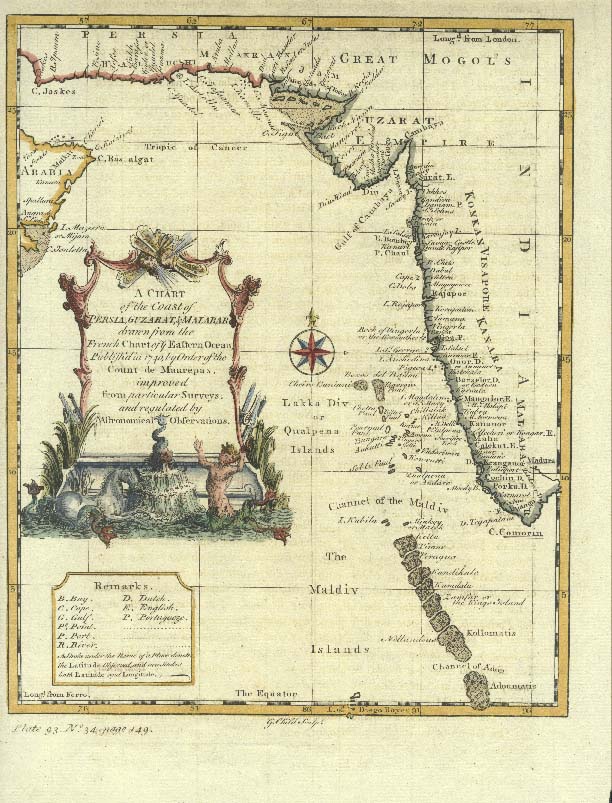
Charles (Claude) Gabriel Dellon, the Frenchman in Malabar – Part 2
Posted by Labels: Dellon Malabar, Malabar French 1720-1800
His observations about Malabar circa 1668-1672
In Part 1 we covered his travels around the South of India,
his misfortune, the connections with the Goa Governor’s mistress and the
inquisition.
Just to get a little perspective, Charles Dellon (a.k.a.
Gabriel Dellon/Dillon and Claude Dellon in various books) was a French Catholic
physician and traveler to the East Indies., A physician by training, Dellon
sailed to India in 1668 with the French Compagnie des Indes (q.v.).Dellon,
spent some time in North Malabar and was operating out of the French factory in
Tellicherry for five years after which he left the French services. Six months
later, he was in jail In Daman, labeled a heretic by the Inquisition of Goa.

Dellon is always specific and precise in his observations
and that is why they are so important to a student of history. He starts off by
defining the region termed Malabar (malavar). Stating that most people have
this impression that it stretches from Surat to the southern tip at Cape
Comorin, he clarifies that it is actually South of Mount Eli (under the 12th
degree of the North latitude) where the people assume the name Malabars or
Malavars. This two hundred leagues (each league is roughly 3 miles) long tract
of land had many petty kingdoms according to him and each of those king/lords
administered his land independently and were not tributaries of any other
prince. Note also that his writing is somewhat confined to the customs of
Kolathunad, between Balipatanam and the northern borders of the Zamorin’s
territory.
We have in the past read so much about the wars and the
difficulties faced by the people of Malabar from the Portuguese, Dutch and the
English. Few wrote about the land, though many detailed the customs they felt
curious or wrongful. Some like Van Rheede, helped by local experts documented
the flora and fauna in great detail in the Hortus Malabaricus, but Dellon wrote
freely about what he saw.
Considering that he lived in Tellichery, we can understand
it when he stated that the most powerful of them all is the king of Cannanore
or Cotitri, the most respected and dreaded of them all. The Samorin who has
more territories is considered to be inferior in strength. He goes on to say
that it is a very healthy place with clean air, reaps rice twice a year and has
a lot of different fruits. Spending a number of paragraphs to the coconut or ‘tencar’,
he errs when stating that the tree dies after the coconuts are harvested but
spends a while explaining the tapping of its liquor ‘Tary’ collected by Tieves
(Tiyyas) who are responsible for coconut husbandry.
Interestingly he observes that the toddy which is sweet to
drink, becomes sour by the day, tuning to an equivalent of cooking vinegar and
used as such (for cooking) and also further distilled to make a kind of local
brandy! The toddy with a little lime tastes as sweet as honey and is boiled to
make cane sugar called jagara (chakkara) or the Portuguese jagerry. He observes
that the young coconut provides Eliner, the tender coconut water (observe that
they are all the very same words we still use..). And of course, he does not
forget coir or hemp, used to make ropes used for ship building and also notes
that the husk is used for cooking and by goldsmiths. The oil from the tree is
used for cooking meats and burning lamps, and the waste kernel is used to feed
cattle and hogs (thenga punnak). In essence, he concludes that it is a
magnificent tree, providing so much to mankind…Oh! So true…
Other trees are mentioned, but I will skip the details and
mention that he then spends a para on the jackfruit and another on the mango
which was even in those days pickled (Achar) or eaten ripe. In fact he says
that there is a green pepper pickle based in vinegar, and pepper is sometimes
preserved in sugar. He does not fail to mention the pepper and cardamom plants
of Malabar and the resulting trade. The cinnamon of Malabar is inferior to that
from Ceylon and he notes that the Cardamom is mainly added to rice by the
people of Arabia and Persia (Foodies take note - perhaps the talassery biryani
had not arrived!!). Chewing betel with lime and areque (adekka) was popular,
and something new to our friend Dellon but something he liked and recommended
to his friends. He even notes that most Europeans living there enjoyed chewing
betel like the natives who always offer betel if you visit them.
He observes that Malabar people are not too fond or gardens
or flowers unlike the Mughals of the North. He also makes it clear that the
women of Malabar are not vain, all they use is a little coconut oil on their
hair and persona and not any kind of perfumes, unlike the women of the North. Parrots
could be found in plenty and Indians do not bother training them to speak
unlike the people of Europe and there are plenty of wild fowls and peacocks
roaming round.
He is fascinated by the elephant, whom he accords the first
rank among the beasts of the world. Considering them intelligent, he explains
that they can drench a person they bear a grudge against in a mighty sprout of
water from their trunks and he notices that they have a great memory (which he
professes to explain with a small and interesting story of a sweeper boy who
insulted the elephant and how the elephant taught him a lesson after several
days when it came back to that place).
Interestingly he also mentions the story
of the elephant that was sent to Lisbon and how the mahout scared the elephant
about its being sent to a life of slavery. The elephant would not board the
ship and the viceroy threatened to kill the mahout after which the mahout told
the elephant that it was going to live a life of great happiness with the king
of Portugal. Hearing the changed version the elephant finally boarded the ship
to cross the seas. The mahout is termed ‘cornac’ by the locals. He also
mentions that if a Malabar king is angry with somebody he lets his elephants
loose on his grounds and the resulting destruction of property a just
retaliation. He then observes that they are used in temples and in all kinds of
hard labor situations.
But what astounded me was that he observed that there were
plenty of Tigers in Malabar and notices three distinct types. The first is
cunning and not bigger than a large cat (they had one in the French quarters),
the second is the size of a calf (here is where I learned that mutton meant the
meat of a slender calf). Anybody who killed the second type got a gold bracelet
from the prince as reward and observes that people could wear a gold bracelet
only after getting it or after being permitted to wear one by the prince. The
third is the royal tiger, as big as a horse, but actually found only in parts
north of Goa. And of course he mentions oxen, civet cats, jackals and plenty of
apes. He is surprised that the men worship these monkeys and observes monkeys
robbing wares laden on the heads of women who are headed alone to the market.
The monkeys also try to drink the toddy from the tapping containers on coconut
trees. Then he notices that there are plenty of boars in Malabar and the Nairs
or gentlemen of Malabar hunt them often (panni vetta) and eat pork. The Nairs
do not eat rabbits and they sell them to the Europeans. And of course there
were snakes, plenty of them (called bambou – pampu) and he considers the natives
stupid to worship them in temples and records some of the superstitions
concerning snakes in vogue those days and is surprised they never kill a snake.
As you can see, Dellon has by now settled down famously,
observing and penning his diary with good accuracy. If you read his accounts,
you would be amazed at the seriousness with which he went about the task of
understanding his new world. His study of the flora, the fauna, the people, the
animals were outstanding, be they the Tiyas or the Nairs, or the coconut tree,
which he rightly termed the greatest tree of the universe. He observes that
pickles are called achar and toddy called exactly as it is today, but sees so
many parrots, peacocks and wild boars and so on in Malabar, now all gone. Having
observed the animals, the flora, the fauna and the region he gets to the people
of Malabar.
The working class is well shaped, brown or black, but not as
ugly as Africans, they wear their hair long. Dellon considers them treacherous,
and the Mohametans even more perfidious and notes that breach of faith is commonplace.
The working class serves the upper echelons of society which is four in number,
the first being princes, the second being Namboothiris or chief priests, the
third being normal Brahmins or assistant priests and finally the Nairs or the
gentlemen. Only the Nairs have a birthright to bear arms and bear that
responsibility without obstructing normal activities. The Tiyas take care of coconut
trees and are allowed to bear arms with prior permission. The mukkuvas of
course take care of fishing and live near the seashore and are not allowed to
take on any other employment. The weaver tribes are called mainats. The pulayas
are the despised accursed, and best avoided.
He also notes poignantly – It is a fundamental law amongst the Malabars, as well as most other
nations of the Indies, which they look upon as unalterable and never to be
neglected to wit, that nobody can rise beyond the degree of his tribe, wherein
he is born, and let his riches be never so great, neither he nor his posterity can
exclude themselves from that tribe or change their condition.
He spends a full chapter on the Nairs, that they are always
the travel guards for anybody and escorts for any group. If they were not part
of an entourage, no prince will accept any claims or complaints. As they moved
from region to region, Nairs of that particular place took over from the
previous escort. The daily going rate was 8 silver tares per diem ( ½ panam).
When a nair is guarding your house, he gets only 4 tare as salary. They are most
courageous and if a person in their care gets killed on travel, the Nair escort
also kills himself instead of surviving him as a coward. He also notes that in
case a traveller is escorted by a nair child, the child is never accosted by
robebrs as it is a custom never to harm a child. In these cases the Nair boy
carried a sharp 1 ½ foot long stick and not arms. Poor travelers used this
method and paid only a small amount to the child.
He notes that different castes did not intermingle,
especially in respect to eating and drinking, and details the caste rigors
which we already know about. He notes that if a Namboodiri or Brahman girl are
seen to transgress at this point, then the prince takes the ultimate decision
of excommunication (the older version of smarta vicharam) by selling the girl
to the highest bidder, especially foreigners who consider them the fairest of
the Malabars. He then goes onto narrate a firsthand account of meeting one such
lady who later converts to Christianity.
He notices that there are no jails, but that convicted
persons do get chained in fetters till they are discharged or executed. Larger
cases are tried by the prince and here he talks about a special type of
‘kaimukkal’ ordeal, different from the usual oil version. The person who pleads not guilty is asked to stretch his hand upon
which a banana leaf is laid and on it a red hot iron is placed till it becomes
cold. The hand is then covered with a piece of cloth dipped in gruel water
(kanji vellam) by the prince’s washer man and sealed by the prince. After three
days the seal is broken and the hand checked. If there are no marks, he is
excused and if there are any, he is punished accordingly. There is never any
appeal to any prince’s decision. Executions are conducted by Nairs, wherein
a lance is run through the accused’s person after which they are cut into
quarters and hung on trees.
He then explains the method of succession in the princely
families of Malabar where the oldest prince succeeds the dead. The next is the
most important aspect, the choice of a chief lieutenant/minister or the highest
dignitary of the state who is always chosen by the ruler and is a person of
outstanding quality, a Nair or a chetti!!! This was a bit surprising to me, for
usually these are also from the ruling family in most cases. Did Dellon err? He
notes that all matters of importance are recorded on palm leafs with iron
quills. The chief minister then takes over the management as the old titular
ruler retires to a life of comfort.
He notes that the Kolattiri king always wore a huge gold
crown weighing 200 guineas and later gets into the details of the matrilineal
kinship in Malabar. He rightfully observes that the daughters of princesses are
wedded to Nambuthiris, and notes that the Nairs and others can marry one level
below theirs, in caste. He also notes with some surprise that the women can
have multiple husbands, and that there is no jealousy in this regard with the
norm that the man leaves his arms at the door when he is with a lady. He
affirms that this is the reason why children owe their pedigree to only their
mothers and that is the reason why sister’s sons or nephews become the next
heirs. He also makes it clear that the Mohametans observe the same
(marumakkathayam) system of inheritance in Malabar and that 12 is typically the
marriageable age for girls and that there are hardly any midwives and delivery
is usually very easy compared to Europe. He explains that Malabar women are
generally well shaped and not ill featured, that the little ones are more
popular than taller girls and that Sati is not practiced in Malabar unlike the
rest of the country. Both men and women wear their hair long and are naked to
the waist, and he is surprised that the women do not try to wear finery, but
are satisfied with just pure calico cloth. The richest wear girdles of gold and
silver, even horn, but women wear just a ring. They, both men and women do have
pierced earlobes which hang down to their shoulders, and wear heavy two ounce
earrings in them. Only men favored by the king wear gold chains and all mean
are clean shaven, though some are mustachioed.
Houses are typically mud based with thatched (coconut
leaves) roofs, use mud pots for cooking and some baskets, even kings do not use
gold or silver vessels and at night just use coconut oil lamps for light. They
always eat with their backs to the lamp, and mainly based on rice. Since sauces
are not used for cooking the food is bland and very basic in taste. They sleep
on boards, and mattresses are not used even by the rich, though the upper
classes sometimes use tapestry bed sheets. Every house has its own well and
each is self-contained, with village life with shared facilities quite rare.
The temples are rich, coated with copper or silver and a
tank in front, and have in addition places for travelers to stay as well as
large tracts of land under their control ( more about that concept another
day!) for yearly revenues. These grounds are holy and any act of bloodshed in
this land sacrilege. Mentioning that the sun and the moon are revered, he notes
that eclipses are greatly feared. But what surprises him the most was the
ardent respect for elders, and that even the fiercest Nairs stand up before
their elders. The calendar was based on the moon cycles, and he describes the
temple festivals with good accuracy. He sees many training schools or kalari’s
and he mentions that the Nairs of 1670, were sharp shooters carrying both muskets
and the ball making molds, firing them with the rifle butt on the cheek, unlike
Europeans who kept the butt on the shoulder. They had other arms too like the
six foot bow and arrows, scimitars and lances. But then again, according to
Dellon, even though courageous, the Nair’s never maintained order while
marching, and were not structured or disciplined during combat. There are
frequent exhibitions of skill attended by many people and he details the ankham
or duels to settle a quarrel. Unlike the Malayali Nairs of today the Nairs then
were patient and not too jumpy or over passionate. What surprises him the most was
that after a battle most of the spoils are returned to the original owners!
In matters of commerce, Nairs are never involved and bazars
are always full of foreigners and strangers conducting the trade. He spends a
few paragraphs on the Moplah’s and notes that many of them are involved in
piracy. He also explains that a tenth of the proceeds of their piratical endeavors
were submitted to the prince of the land. Their paros carry 500 men and sail as
far as the red sea, but they stay away from European ships. Even though sailing
is somewhat unsafe due to these corsairs, traveling by land is safe, with the
conduct overseen by Nair escorts. The Mohametans live near the town center and
market.
The French factory is permitted by the prince Onotri (Kolatri)
and the place given to them in Cannanore is called Tatichery, renamed
Tellicherry by the French. Dellon and Flacour set about getting things started
up. The Zamorin facing problems with the Dutch decided to approach Falcour to
discuss an alliance. The French agreed and were provided a place at Aticote
near Cochin to conduct their business from the Zamorin’s kingdom. But as it
happened, the Zamorin lost the battle with the Dutch and the French ended up
going back to where they were before, to Tellicherry. Dellon was then deputed together
with Flacour to Srinipatanam (Srirangapatnam in Mysore) though it was the
monsoon season and not ideal for travel, with a palm tree leaf umbrella common
in Malabar. The trip was not very nice, with bad weather, leeches, and all kinds
of other issues. It was a difficult ordeal and Dellon decided to return taking
the support of Kunhali the most famous corsair of the time, at Badagara. He then
visits Calicut and Tanore and makes the usual observations, some quite
interesting.
Eventually Dellon goes back to Tellichery, but by then he
was weary and bored and asked to be relived from Malabar duty. The following January
he left Tellichery bound for Mangalore and later for Goa…
References
A voyage to
the East Indies – M Dellon
Historic
alleys – Dellon in Malabar part 1
Historic
alleys – Ankhams of Malabar
Maddy’s ramblings – Pope and the elephant