


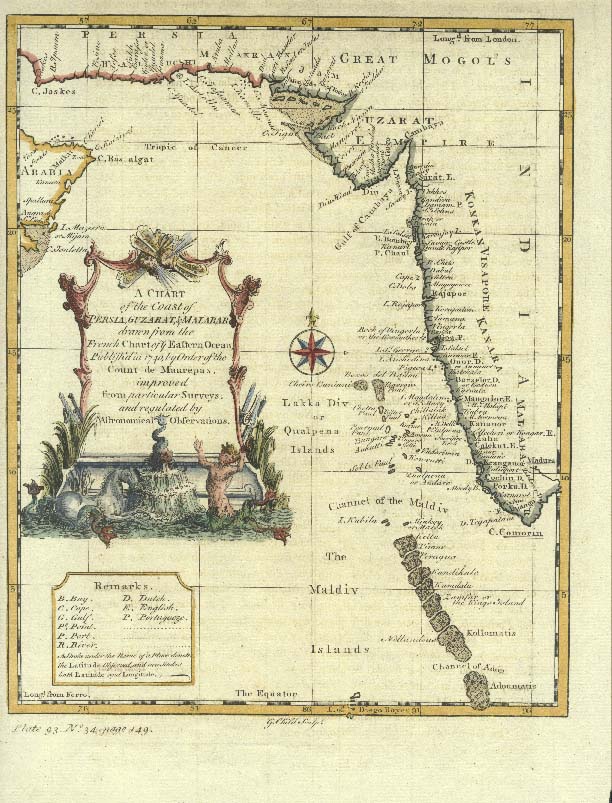
Manuel Kotta, Ayacotta, and Cranganore Fort
Contact with Malabar, and later Goa, was established by Portuguese armadas sailing to western coastal ports such as Calicut, Cochin, and Goa. The ships sailed along the west coast with the mawsim, or monsoon winds, and took shelter in these ports from May to September, when the winds were strongest. Interestingly, this was the period when the eastern coast was busy with ships plying the Southeast Asian ports and countries. As the West Coast opened for business between November and March, the seas bustled and churned with boats, dhows, and other vessels filled with sailors, traders, and supercargo dignitaries. Vasco da Gama was the first to complete the voyage between Lisbon and Calicut in 1498 and learned of the vagaries of the winds, or the lack thereof, as his ships arrived late and departed late, facing numerous problems.
Although there are mentions of primitive earthen forts built
with mud and stone, modern stone-and-mortar forts date back to Portuguese
efforts in the early 16th century. They were mainly constructed for coastal
defenses and to secure their factories (storage warehouses), and later to
prevent unauthorized trading ships from operating. After issues with Arab
traders in Calicut, which led to the destruction of their first factory, the
Portuguese settled in Cochin and built factories and fortified them. Forts and
factories were necessary because spices were harvested, dried, and stored well
before ships arrived. This delay made the establishment of secure storage
facilities essential. The factories were protected by heavy weaponry and forts
located at strategic points around Malabar, including Cochin, Calicut,
Cannanore, Quilon, and Cranganore.
Cleverly manipulating the situation and the dissent among
rival factions of the Cochin royal families, the Portuguese installed their
favored candidate after placing a golden crown and an annuity (copa) of 640
crusados on him. An attack by the Zamorin on Cochin presented Francisco de
Albuquerque with a perfect opportunity to persuade the King of the need to
build a fortress to defend the Portuguese there. In 1503, a timber fortress was
built, since stone was not allowed for any structures other than temples. As a
result, the first Portuguese fortification in India was Fort Manuel (locally
known as Emmanuel or Immanuel), near Fort Cochin, in 1503. It was sizable, with
a strong surrounding wall and about 300 soldiers. Originally made of wood, it
also housed the Portuguese administrative offices.
Manuelkotta – Manuel fort
The Viceroy asked the new King for permission to build a
strong fortress, which he seemed to do reluctantly. After its construction, the
fortress was named Fort Manuel (after the Portuguese King Manuel) or Manuel
Kotta in the local language. The fort was renovated and strengthened with
stones and laterite in 1505-06 by Viceroy Francisco de Almeida. According to
contemporary chroniclers, both Francisco de Albuquerque and Afonso de
Albuquerque oversaw the construction or renovation of this fort.

The fortress was expanded in 1512 under the leadership of
Afonso de Albuquerque, following directives from Lisbon. It was recognized as
the main factory among the Portuguese commercial establishments on the Malabar
coast, where ships were built, repaired, and coins were minted. Adjacent to the
factory and fortress, there was a hospital and a House of Mercy (Casa de Santa
Misericordia), near the King's customs house in Cochin, while the municipality
was known as Santa Cruz. A church dedicated to Saint Bartholomew was built
within the fort (now the St. Francis Church). Local historians report that
tunnels were added from various parts of the fort to facilitate quick escapes
during an attack. Little remains of the original Manuel fort (also called Fort
St. James at one time), except for a few structures. Much of it was destroyed
when the Dutch attacked and defeated the Portuguese. The Dutch built bungalows
on each of the bastions and gave them Dutch names such as Stromberg, Holland,
Zeeland, and Gelderland. By the time the British arrived, almost nothing of the
fort was left. Parts of the structure were found underwater or are part of
newer buildings.
The part of Lower Cochin (Cochim de baixo) administered by
Portugal, also known as Santa Cruz, was partly surrounded by a wall with
several bastions in the early seventeenth century. Today, it is known as Fort
Cochin. Cochin had a good deep-water harbor, but sandbanks or sandbars blocked
the entrance. As a result, larger vessels had to anchor farther out to sea,
making them vulnerable to enemy attacks. As Dutch naval power grew and
threatened Portuguese ports, trade was shifted from Cochin after the first decade
of the 17th century to Goa and Bombay. An interesting story about the fort's
defense against a Zamorin attack by Pacheco in the 16th century will be presented
in a forthcoming article.
The allied forts of Kochi or Cochin were located at
Kottapuram and Pallipuram. The Pallipuram (Ayakotta) fort was constructed
around 1503 and had a hexagonal shape. It is the oldest surviving European fort
in Kerala and served more as a watchtower than a large fortification, while the
Kottapuram (Cranganore) fort on the opposite bank was more substantial.
Pallipuram, Palliport or Ayakotta fort


Kottapuram, Cranganore fort - Fortaleza da São Tomé
North on the right bank of the river stood the more
elaborate Cranganore fort, with extensive defenses. What remains today is a
wall about 60-70 yards long, the ruins of a gateway, and remnants of a powder
magazine. This was built by the Portuguese in 1523, when they initially aimed
to make Cranganore the center of their power in Malabar. The fort now lies in
ruins, but parts of the old wall and a few barracks are still visible. The
Kottappuram Fort was also built around 1523 and occupied a strategic position
at the mouth of the Periyar River. It played a key role in many wars between
the Zamorin and the rulers of Kochi. The ruins reveal that the original fort
was 18 feet thick and constructed of laterite. Located on the invasion route to
Cochin from the North, it remained well manned during Portuguese times, with
over 100 soldiers, mostly St. Thomas Christians, as noted by Portuguese
writers.


Located about a mile inland and stretching east was the
Nedumkotta, or “the Travancore Lines," where Tipu Sultan achieved the
final breach to advance toward Travancore. This is popularly known as the
"Kottamuri." See
the article Part 1 on the Travancore lines for more details.
The Kuriapilly fort
Kuriapilly was located opposite Pallipuram and very close to
Pattanam. The fort seems to have been built by Travancore craftsmen (the
Cranganore fort was likely unusable) during the strengthening and rebuilding of
what we know as the Travancore lines. It was constructed of laterite, and from
that, a mud wall 20 feet thick and 12 feet high was built over 30 miles to the
east. This was the so-called Nedumcottah or Vittiacotta. During this period,
Sneff, the Dutch commander, raised unnecessary objections, attacked the fort,
and killed a Travancore captain in 1769, almost triggering a war between
Travancore and the Dutch. The Cochin raja intervened and had Sneff apologize to
Travancore.
Dutch period
When the Dutch attacked, approximately 100-150 Europeans and
around 200 Nairs gathered at Palliport to defend it. However, they fled across
the lake when they realized they were too weak. In later years, a leprosy
hospital was built near the site.
In February 1661, Dutch Captain Vander Mcydon captured the Portuguese-held fortress of Pallipuram (Azhikotta), handed it over to the Zamorin, and returned to Colombo. Van Goens later landed a large force at Pallipuram and, assisted by the Zamorin and the Raja of Cranganore, laid siege to the Cranganore fort on January 3, 1662. He stationed

his men in three locations, blocking both land and river approaches, and bombarded the fort. The fort was defended by Portuguese Commander Urbano Fielho Feriera. Inside the fort were also Prince Goda Varma of Vettatt (1662—63) with 400 Nairs and the Paliath Achan. During the several days of bombardment, the Achan slipped out unnoticed and joined the Dutch, spying on their plans and revealing military secrets. Later, the Dutch stormed the fort and expelled the Portuguese. A fierce battle took place, and after suffering heavy losses, the fortress was surrendered to the Dutch. The Portuguese soldiers found there were sent back to Europe. The Dutch conquest of Cranganore marked the beginning of the decline of Portuguese power in Malabar.

The Dutch then established Fort Orange nearby. Since the Cochin fort was considered too unwieldy and large for effective defense, it was downsized to about one-third of its original size. General Hustaart recommended building a small Pentagon Fort, only one-third the size of the original. When completed by the Dutch, the fort was reinforced with seven strong bastions named after the seven United Provinces—Holland, Zealand, Utrecht, Friesland, and others. It could house about 4,000 soldiers during peacetime and up to 15,000 in wartime. However, Nieuhoff mentions that the city of Cochin was fortified with a high stone wall, 18-20 feet tall, and featured eight bastions. The most significant event of his reign was the surrender of Cochin Fort on January 7, 1663, and the installation of Vira Kerala Varma of the Mootha Thavazi branch as the ruler of Cochin.
Mysorean incursions
Haider had been eyeing these forts with the aim of securing
flanking positions against Travancore, from both sea and land, with the
ultimate goal of attacking and capturing Travancore. Sirdar Khan was the first
to attack the fort in 1776 after Calicut collapsed, following Haider's demand
for the Dutch to grant his troops free passage through Dutch territory to
attack Travancore, which was refused on the grounds that Batavia had to approve
it.
Thus, in October 1776, Sirdar Khan advanced southward while
the Dutch Resident fled into the Cranganore fort, taking the VOC’s treasures
with him. After repeated attempts, Sirdar Khan succeeded in capturing the
Cranganore fort. However, he could not advance further because his march was
blocked by the Travancore lines. Hyder, realizing that it was not a good
strategy, apologized and blamed Sirdar Khan's overenthusiasm, and, acting
against orders, understood that he should not have provoked the Dutch.
Years later, when Tipu was waiting to attack the fort, on
the other side of the river, local legends say that “Our Lady” from the small church
near Pallipuram came to the rescue—causing the river to swell dramatically, and
a veil of snow to fall over the area, forcing Tipu to retreat. This miracle is
attributed to Our Lady, who was thereafter known as ‘Our Lady of Snow’ or
‘Manjumatha’.
In 1789, Tipu summoned the Raja of Cochin to Palghat to
discuss the purchase of two forts. However, the Raja excused himself due to ill
health and avoided sending his second-in-command, which infuriated Tipu. Tipu
then contacted the Dutch, but they negotiated and finalized the purchase of
these forts with the Dharma Raja for Rs 3 Lacs (Surat). Tipu objected to the
transaction and challenged its validity on the grounds that the lands where
these forts were built were sovereign territory of his tributary, Cochin. He
demanded the immediate withdrawal of Travancore troops from Cranganore, the
demolition of the ‘Travancore Lines’—which stood mainly in Cochin territory—and
the surrender of the Malabar chieftains who had taken refuge in Travancore. We
also covered all this in another article.
Responses from Travancore, the Dutch, and the EIC did not
satisfy Tipu, so he started moving his army against Travancore. An attack on
the ‘Travancore Lines’ was launched on December 29, 1789, with 7,000 men, and a
weak section near the hills was broken through. The Travancore troops fought
back bravely and pushed the invaders away. During this campaign, the Sultan
himself was disabled by a fall. Reinforcements arrived, and Tipu resumed the
attack. On April 15, 1790, the Lines were finally broken, and the Travancore
troops retreated. Within days, Tipu destroyed the Lines and moved to seize the
forts of Cranganore, Azhikotta, and Kuriapally. However, the monsoon then set
in, preventing further progress of Tipu’s forces. Meanwhile, the
Governor-General, Lord Cornwallis, sent a British force under Colonel Hartley
to support the Travancore army. He also began negotiations with the Nizam of
Hyderabad and the Mahrattas for a joint attack on Seringapatam. Concerned by
these developments, Tipu withdrew from the area. This marked the end of the
Mysorean invasion of Kerala.
Francis Day who saw the Cranganore fort much later in the
1830’s stated poetically - Now it is a ruin, moldering in the dust, with but
one solitary tower overhanging the broad expanse of the river, which rolls on
slowly, but deeply, beneath. Its old moat is the resort of the crocodile and
paddy bird, and its once well-used streets resound no more to human tread. The
solitary stranger, perhaps, disturbs a snake in his path, or an owl in the
dense overhanging trees, but rarely a mortal will meet his eye, Cranganore fort
is utterly and entirely deserted.
When I went there last week, there were no tourists or
history buffs, but it seems to be popular with young couples who wanted time
away from prying eyes. I don’t think they cared a hoot about these times long
gone, and stories long forgotten.
References
Portuguese trade with India in the sixteenth century - K.S.
Mathew
Travancore Archeological Series Vol 1
Kerala district Gazetteers, Trichur and Ernakulam
British and native Cochin - Lawson, Charles Allen
2 comments:
There's so much fascinating history here. Kochi is my own city in a way - I did my 5 years of college there. Glad to get to know here a little better here.
Thanks, Tomichan,
It has grown and changed so much !
Post a Comment