
The decline of an entrepot - Calicut

Posted by Maddy Labels: , ,

As water levels rose 1585-1700

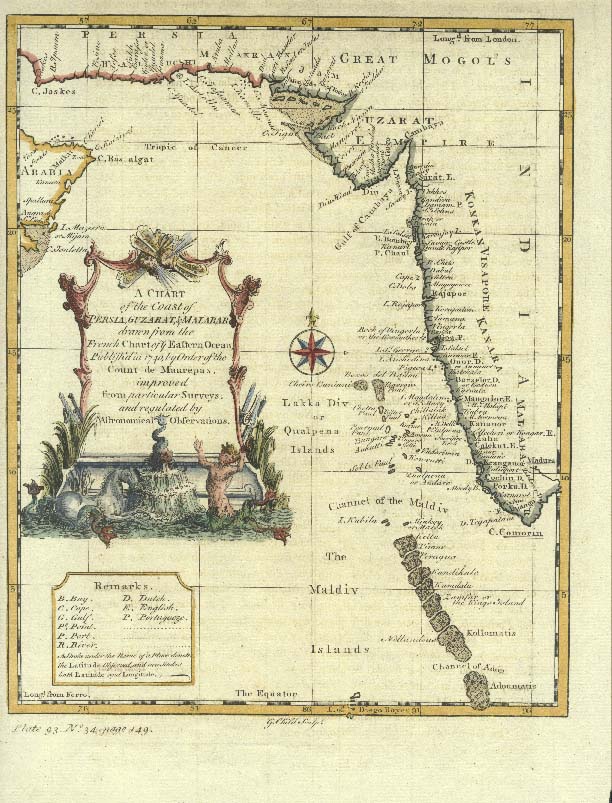
Many years ago, I wrote about the sunken ruins of Calicut, as observed by Forbes and some others, and tried to discount the myth of a sunken city. But after Nikhil’s comment, the topic did not leave my mind and I continued to search for information, mainly because more than a couple of eyewitnesses had recorded seeing underwater structures. While change could have happened gradually, it is obvious that a cataclysmic event did not swallow large tracts of the Calicut shoreline. At that time, we checked out major events and found that there were some minor earthquakes and tsunamis, but nothing of great importance. Nevertheless, it is now clear that there was a gradual rise in the coastal water levels and that major structures went underwater, affecting not only the geography of one of the most active ports of medieval times, but also its allure and popularity, resulting in alarmed traders leaving the port city. There is no doubt that there were other overriding political and economic reasons as we discussed on previous occasions, but the infrastructure issues were also an underlying reason. Let’s take a look.

The many mysteries behind a Tamil Bell

Posted by Maddy Labels: , , ,

The Marakkar Bell in New Zealand

Around 1836 or perhaps closer to 1840, a missionary Rev Colenso in New Zealand saw and acquired a broken bronze bell while touring a Maori village in Whangarei - New Zealand. The relatively small bell was being used for cooking as Colenso put it. The bell itself was damaged, with its top portion intact, while the lower portion and clapper tongue had been lost, over time. Colenso was told that the bell had been found among the roots of a large tree brought down by a heavy gale. Its owners believed that the bell had been in the possession of their iwi (tribe) for several generations. Colenso then went on to swap the bell for an iron pot, more eminently suited for cooking. After his death, he bequeathed the bell to the Colonial Museum, now the Museum of New Zealand Te Papa Tongarewa. The bell produced a lot of interest when it was exhibited, and discussions and theories abounded about its origins.

Rev Jacob Rama Varma

Posted by Maddy Labels: , ,

The converted prince

Today it may not look curious or alien, for many a person has moved across religions to find peace and solace in life, treading different paths to those they were used to or born into, some successful, whereas others reverted after a period of confusion. But in the 19th century, it was a rarity and when a person from the Cochin royal family did just that, it was much talked about. We get to read the details of Rama Varma’s life and times from the diaries of his contemporary Herman Gundert as well as some other musty sources, available at the Tubingen library.

The Shahbandar Koya – or the Kozhikottu Koya

Posted by Maddy Labels: , , , ,

And his importance in Medieval Calicut

As we peruse the many accounts of foreigners trading at or visiting Calicut, we come across the mention of a Kozhikottu Koya who became a very close ally of the ruling Zamorins. In fact, he had a very special relationship with the ruling elite of Calicut over time. But the accounts, like they did on many an occasion, tend to conflict with each other. In early accounts, the title was held by an Arab and some later accounts place the title on a Moplah of non-Arabic extract. Perhaps it would be a good idea to do a little digging to see what this bloke and title was all about. Was it just one person or one of many, was it a harbormaster, a port officer, or a consul? Let’s find out.

Hydaru Charitra – Yet another source

Posted by Maddy Labels: , ,

Additional insights - 1766 attacks, Malabar

There are many books, passages, and secondary sources covering the life and times of Hyder Ali and Tipu Sultan, and there are many books compiled by their detractors as well as supporters. While the supporters paint them as freedom fighters of enviable moral character and secular outlook, their detractors emphasize on the violent methods wrought by these individuals, driven by their Arab background and upbringing, their fighting spirit, treachery and cruel proselytization of subjugated masses. Added to all that, there was a large amount of misinformation and tainted writing by English writers who wanted to slant the Mysore rulers as the vilest of all, in order to obtain support for wars fought against them. As you can all imagine, the truth lies somewhere in between and I had been struggling for years to reconstruct the Hyder-Tipu Padayaottam in Malabar, a venture which I guess will continue for more time.

The Silent Valley Movement

Posted by Maddy Labels: , , ,

Eons ago, the slopes and plains adjoining the Sahyadri mountains separating Malayalam from Tamilakam, were home to many dense forests. Most of it is gone now, but some remain in Wynad and Nilambur as well as a region between Nilambur and Mannarghat in Palghat, near the northern rim of the Palghat Gap, the so-called Attapadi, and Silent Valley areas. That is where we are headed.

The Eminent Gundert Sayip

Posted by Maddy Labels: , , ,

Hermann Gundert (1814-1893) - His life in Malabar

I am getting back to this topic after 13 years, and without doubt, the persona of Hermann Gundert deserves that and more. My previous article covering Gundert & Logan only served to provide a brief introduction to these two great men and though there are a couple of books that provide Gundert’s life history in some detail, they are not easy to get a hold of, so I thought that I could cover Gundert’s profile here. Gundert for those who do not know, was a German national, a tutor and a missionary who came to Madras in 1836, moved to North Malabar, and left back home in 1859. In those 23 years, he achieved a lot, most notably in the field of Malayalam literature. His pioneering works helped develop and formalize the language and his transcriptions of the Keralolpathi and Keralapazhama have withstood the passage of time providing a fascinating look into the history of the land.

Quilon and its trade links with China

Posted by Maddy Labels: ,

That Quilon was well known to seafarers is not surprising, for it is well situated in the South West of the Indian coast. It was well known not only to Greek and Roman seafarers going back in time before Christ but also to later entrants such as the Arabs, Persians and Chinese into the Indian Ocean. If we dig deep into historic accounts left behind by some of the sailors or visitors, we can come up with a decent silhouette of the entrepot Quilon once was, as well as the preeminent position it held among the trading ports of Malayala, as Kerala was then known. Its name got attached to the Malayalam Calendar Kolla Varsham and for a time was reason enough to associate with a popular proverb in the Malayalam language which meant 'one who has seen Kollam, forgets his house’.

The Mamluk – Calicut - Jeddah Equations

Posted by Maddy Labels: , ,

And an event which happened ‘out there’ – at Calicut

For the Arab merchants, traders and rulers, Calicut was the place in Al Hind where they had established a lucrative trade, where they had families and representations, and a relationship with the benevolent king, the Ox-worshipper Al-Samiri. For most others who benefited from the trade in Europe, it was just a place out there. For the crusaders, it was perhaps the general region where a potential supporter, the Prestor John came from. Later authors, who never even set a foot there, equated it to Utopia. From the inimical Arabian nights story of Abu Hasan’s fart, you know that Calicut was a place where you went to in order to start afresh and make a new life. In a way it was akin to the Dubai of Malayali’s today, it was the Dubai for the Arabs those days.

We will now get into the story of two interesting individuals, one who daringly transferred trade from Aden to Jeddah and the other, a senior official of the Mamluk establishment who severely tested the diplomatic abilities of the Zamorin. And along the way, we will talk about the interesting relations between the Mamluk administration in Arabia and Calicut, while dwelling upon the interesting event which occurred some decades prior to the arrival of the Portuguese at Calicut.

The Samiri and Taj-al Din at Dhofar

Posted by Maddy Labels: , , , ,

Continuing with the Cheraman Perumal myths…

The Keralolpathi, the Zainuddin Makkhdum’s call for a jihad against the accursed Franks, the Fath ul mubiyn, they all mention of a King from the Hind who traveled to Mecca and died on the way back, at Dhofar. We talked earlier about the Cheraman Perumal legends, the Perumal and the pickle and so on, but with additional information at hand, I would like to revisit the topic and also cover the interconnected story of the al-Samiri and Taj-al din tomb’s at Dhofar in Oman.

In an area called Dhofar is buried a person, a king actually who has been venerated over centuries by the locals there. His name is purported to be Abdul Rahiman Samiri. An inscription explained that this person reached Dhofar in 212 and died there in 216 (821-831 AD). Now comes the question, who could this gent be? He has been connected to the Cheraman Perumal who converted and went to Mecca and also one of the earlier Zamorins of Calicut. We do know that the Samuthiripad or Samoothiri, a term which morphed to Samorin or Zamorin dates to the 13th century. During the 821 period or even later to 814 as Logan implies, we had a Eranadu Utyavar, not a Zamorin. But legends mention that this was a king from Malabar. Let’s try to investigate a bit to try and find out if we can get to the bottom of this myth.

Zamorin – An etymological discussion

Posted by Maddy Labels: , , ,

Malabar’s history recounted in the Keralolpathi, a Malayalam work (presumably penned by Tunchath Ezhutatchan) from the 17th century or later starts with the Parasurama epoch where he reclaims the land from the seas. The Keralolpathi, a work which elevates the importance of the Nambuthiris of Kerala, goes on to retell a version of the history of Kerala until the 19th century. Beset with inaccuracies, it was disregarded by most historians but it is now felt that the document does have many sections which are quite factual. The advent of the Zamorin is detailed in this work, and we come across the tale of the abdication of the Cheraman Perumal and the installation of various chieftains to rule over various areas. This is more on the topic of the Zamorin himself, his titles, and the advent of the well-accepted usage Zamorin.

The Mutts of Trichur and Tirunavaya – Seats of Vedic learning in Kerala

Posted by Maddy Labels: , , , ,

 Bhrahmaswom Madhoms

Sometimes you despair at how the Englishman corrupted the transliteration of a Malayalam or Sanskrit word, in this case, Mutt which actually stands for Madhom or Matha, a monastic institution for spiritual studies, certainly has nothing to do with stupid persons or mongrels. I had come across mentions of these Vedic universities while reading accounts of missionaries such as the Arnos Pathiri as well as some others and more recently when Vinod who led the conservation and renovation efforts, was in conversation with Arun at Intach Palakkad. As the discussion related to the work at the Bhramaswom madhom at Trichur, it piqued my interest, what with the connections to the Nediyirippu and the Preumpadappu, and I decided to delve deeper into it. The result of that short study follows, but I must admit that while the history of these schools interested me, I have virtually no knowledge of the Vedas themselves or their teaching methodology!