Showing posts with label Malabar Dutch. Show all posts

The Konkani’s of Cochin

Posted by Maddy Labels: , , , ,

A look at the community’s history (with particular reference to the GSB)

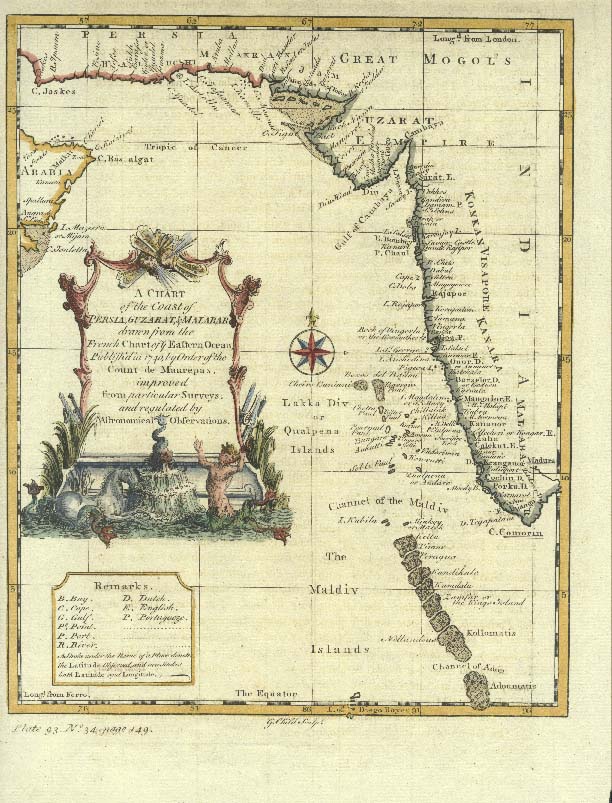
All of us have had some interaction with a GSB (Goud Saraswat Brahmin) Konkani, be it in college or at the workplace, and for people in Cochin, the community which lives there and their slightly different customs and their singsong intonation of the Malayalam language. You will remember a Pai, a Bhat, a Rao, a Kamath, a Prabhu, a Shenoy, etc. all recall the Shenoy’s theatre, and you may have seen Mammooty - Dileep’s movie on the community and the Dosa song from Kamath & Kamath. But this little article will take you back a bit and retrace their arrival in Cochin and see the ups and downs this community, which was persecuted, faced along the way.

The Zamorin – VOC treaties of 1691, 1710

Posted by Maddy Labels: , ,

A most famous document, and a turning point in the history of the Zamorins

As treaties go, the content of the two treaties signed between two reigning Zamorins of Calicut and the Dutch VOC establishment in Cochin is quite dull and uninteresting to a lay reader, but it was made at a turning point in the history of the Zamorins, as we shall soon see. From a linguistic point of view, there are some peculiarities in these works, and experts opine these early examples of written Malayalam show its development as a language. The 1691 Malayalam contract was written on a gold foil (ola) and is perhaps the longest gold scroll in the world. Over time, the scribed text has disappeared to a large extent whereas the silver foil contract made in 1710 remains a robust specimen which still (especially due to the tarnish) provides a clear view of the scribed text. Let’s try and find out some detail in these obscure documents, which have hardly been mentioned or talked about, thus far.

Guruvayur, Hydrose and the Dutch

Posted by Maddy Labels: , , , ,

Clearing up some cobwebs

The temple is well known to most people in South India. It is very popular, quite crowded these days with thousands of devotees lining to get a peek of Unnikrishnan or Guruvarurappan. True, the pandemic has affected all these quite a bit, but I am sure things will improve soon. Which takes us back in time to two occasions when the temple was threatened by marauding armies, first by the Dutch and later by those laying Malabar to waste, namely the Mysore armies sent to plunder, by Haider and later Tipu. Let’s review the record and also take a look at that interesting person, who was involved in the continuation of finances of the temple at that latter occasion. In these days with so much of divisive attitudes, it is helpful to remember that there was a time when communities also came together for the common good.

Pooku Moosa Marakkar

Posted by Maddy Labels: , , ,

And his involvement in Travancore affairs - Marthanda Varma’s reign

This is yet another interesting medieval trader who made his name and lost it after a lifetime of high-risk balancing acts between the various players at the trade scenes of Travancore during the 18th century. His rise to fame was meteoric, from a simple trader to providing military support to Marthanda Varma with his pathemari boat fleet, going on to become Marthanda Varma’s confidante, and eventually ending up as the Travancore sarvadi karyakkar in negotiations with the Dutch. His fortunes rose and ebbed like tides, till it was cruelly ended when he lost his patron. Let’s see what we can dig up about this bloke, from the deep cellars of history.

A Jewish trader in Calicut – The story of Isaac Surgun

Posted by Maddy Labels: ,

When Calicut Heritage Forum wrote about the Jew Street in Calicut, there was an animated discussion in the comments section, as to whether it was indeed right and if a second thought was needed. The person who precipitated the matter in the first place was a young chap from Cochin, who has varied interests in Calligraphy and history and who I met in Bangalore some weeks back.

For me, it was clear that a trading community like the Jews would never be missing from Calicut. It was just a question of time lining & detailing their life in Calicut. I had initially hoped to find details of their existence in Calicut and Pantalayani detailed in Prof Jussay’s book, but did not find anything other than a trace mention. So I thought it should be detailed somewhere but it was not that easy. While we do have brief mentions detailing their stay in Pantalayani, Mangalore and well documented records on Cochin, the references of their presence in Calicut and thereabouts were vague, barring the fantastic Abraham Ferrisol mentions. But to summarize,

With the coming of the Portuguese to India, travelers such as G. Sernigi (1499) refer to the Jewish association with Calicut. L. di Varthema (early 16th century) mentions a Jew in Calicut who had built a fine galley and had made four iron mortars. ... While the Portuguese historian Correa speaks in 1536 of the great number of Jews in Calicut, the Yemenite traveler Zechariah b. Saadiah (16th century) looked in vain for coreligionists there. Half a century later Pyrard de Laval lists Jews among the various religious groups in Calicut with their own quarter and synagogue. The outstanding Calicut Jew in the 18th century was Isaac Surgun (d. 1792), a wealthy merchant who hailed from Constantinople.

It was as if Calicut was reserved for Arabs and those from mainly the Middle East or those aiding the trade of the Arabs, for we read that even the Chinese were perhaps driven out. But it is quite clear that there were visiting Jews like the person I will now cover.
 
To look at his life to see what it was like, and for that we have to go to the troubled times, when the Zamorins were weak, when the Mysore sultans had laid their cursed eyes on the wealth down south. I am sure they always knew there was wealth in the temples, as you can see now from the trove at Anathapuram. I am also absolutely positive that when the Malabar rulers fled to Travancore seeking asylum, they took their riches to Anatapuram and those form part of what you see there, but all of that is not important, it was just my mind going astray..

Many years ago, when I used to live in Istanbul, I knew a Jewish family living in a place called Beyouglu near Taksim . It was a stately avenue with old high rise buildings and the location where the wealthy Jewish gentry lived. My son’s friend from the Levi family lived there, and we got to know those nice people. I had no inkling then or until recently that there was one person who actually came in the exact opposite direction to India, many years ago. He had come from Istanbul to Calicut in the 18th century. His name was Issaac Surgun and it was an act of kindness at Calicut that earned him an entry into history books.

The year is 1766. At that time, the main traders of Calicut were Isaac surgun and Moplah Haji Yusuf. In the Cochin region trade was in the hands of a group of Konkani business men and Ezechiel Rahabi. The traders were profiting immensely from the latest pepper boom after the collapse of Surat and the safvid dynasty collapse in Persia. Calicut was the port of choice, but trouble loomed ahead. The Zamorin had threatened the Palghat Raja, who appealed to Hyder. Hyder did not lose the opportunity as we all know and later invaded Malabar. However he was provided a large bribe and consequently left the traders in peace, while he and his son tormented the Nair’s and other classes.

Let us get to know this Isaac Surgun and his activities at Calicut. What did he look like? What kind of person was he? What was he upto? If he was travelling often to Calicut, did he stay amongst a group of Jews in Calicut as it usually is? But first things first…Let’s draw his caricature…To figure out how he looked, we have to check out the words of Elizabeth Fay the English lady whose ship had reached Calicut and who was imprisoned by the new Mysore governor left behind by Hyder at calicut.

Isaac, then, is a fine venerable old man, about eighty five, with a long white beard; his complexion by no means dark and his countenance being yet majestic. I could look at him till I almost fancied that he resembled exactly the patriarch whose name he bears, were it not for his eye which is still brilliant. His family, I find, according to ancient custom in the East, consists of two wives, to whom I am to have an introduction………..

Strangely I had nearly completed reading the story of Elizabeth Fay some months back, but I had glossed over an important fact, the persona of Surgun himself and his Jewish house in Cochin and the Jews of Calicut.

Back to Isac Surgun, the person who wielded a lot of influence with the rulers of Cochin, Calicut and Travancore and worked often for the Dutch VOC. The first mention of Surgun was his accompaniment with the Jewish team sent to meet Hyder and Sudder (Sardar) Khan in 1766 carrying expensive gifts on behalf of the Cochin king with an entreaty not to attack Cochin. He was the linguist in the group and this signifies that he perhaps knew Persian or Urdu as well as Malayalam and perhaps Tamil. Next he is part of a team used by VOC’s Breekpot in 1767 used for a diplomatic settlement of troop movement complainst with Srinivasa Rao and Sardar Khan administering Calicut. In compensation an agreement to supply muskets and other armamanets was made by Surgun. Seven years later, he was the go between the remaining family of the Zamorin and the VOC – as they wanted safe passage to Parur. But problems between Calicut and Travancore prevented a settlement of the issue. He is seen again in discussions with Hyder and Sardar Khan at Calicut and Mysore during 1775-1788. He is also seen in discussions with the Ali raja of Cannanore. We find out from Dutch records that Surgun had a factory in Calicut, speaks a Moorish language, apparently Persian or Urdu and has many friends among the courteris of the Mysore sultans. He even had a not so good meeting with Tipu at Calicut on April 5th 1788, and that happened to be his last diplomatic experience.

Fay meets him in 1779, under telling circumstances, but one can now understand from the previous paragraph that Isaac Surgun indeed had the required influence with Sardar Khan (Hyder’s brother in law) the Nawab of Calicut. As is apparent, Surgun is known as Isaac of Calicut, even though hailing from Cochin, signifying that much of his trade was perhaps conducted around Calicut. The delay in their release was related to Hyder’s search for foreign gunners and his need to figure out if the men in Fay’s ship were suitable for that purpose. The final release was made after the conclusion that none were fit for soldierly activities, Fay’s husband was coming to practice as an advocate at the Supreme court in Calcutta. The other issue was the friction between the EIC and the Mysore sultans with a possibility of armed conflict.

Interestingly, Isaac Surgun spoke no English (he later ensured that his son was sent to Surat for English Studies)and the conversations between Fay and Isac was through interpreters. Isaac was introduced to them by another European Jew named Franco. And it was the utterance of Franco’s name and Constantinople (and their camaraderie in that city 60 years ago) that made him help the Fay’s.

The general introductory letter which as you may recollect Mr. Franco gave us at Leghorn had remained in Mr. Fay's pocket book from that time till we reached Calicut. We had been told that Isaac, the Jewish merchant, who agreed to freight the Nathalia and received £700 as earnest on that account, was immensely rich, and had great credit with the Government of which he held several large contracts for building ships, etc., besides a very great one with Sudder Khan- Everyone also, even Ayres, spoke highly of his general character. …………Mr. Fay, therefore, petitioned the Governor for leave to go out under a guard, which being granted, he immediately delivered his letter to Isaac, who seemed highly gratified at hearing from Mr. Franco, whom he had personally known at Constantinople, where they were both young men, about sixty years ago, for, like him, he enjoys a full possession of his faculties, both bodily and mentally, being equally remarkable for temperance and sobriety. Mr. Fay could not speak to our strangely acquired friend except by an interpreter so that no confidential conversation could take place. He was apparently touched with pity for our sufferings, especially on hearing how much I was afflicted with illness.

After 15 weeks of imprisonment, the Fays were released by Sardar Khan, thanks to Surgun and taken to the Surgun house in Cochin. It is Feb 1780 now.

This morning, about eleven, we arrived at our long wished-for Port, and were landed close to the house of our good friend Isaac which is pleasantly situated by the river side, about a mile from Cochin, and rendered in every respect a most delightful residence. Here we were welcomed by the two wives of Isaac who were most splendidly dressed to receive us, rather overloaded with ornaments yet not inelegant. Indeed I think the Eastern dresses have infinitely the advantage over ours. They are much more easy and graceful; besides affording greater scope for display of taste than our strange unnatural modes. They were extremely hospitable and very fond of talking.


I mentioned before having learned a little Portuguese during my imprisonment which was of great advantage to me here; for, except Malabar, it is the only language they speak, and a miserable jargon indeed is what they call Portuguese here. However, we contrived to make ourselves mutually understood so far as to be convinced that each was kindly disposed towards the other. …….. We were entertained with all the profusion that wealth can command and generosity display. Though religious prejudices banished us from their table, ours was loaded with every delicacy—all served on massive plate. Among many articles of luxury which I had never seen before were numbers of solid silver peekdanees, which serve the purpose of spitting boxes (excuse the term,). They stood at each end of the couches in the principal room. Some of them were nearly three feet high with broad bottoms; the middle of the tube twisted and open at the top, with a wide mouth for the convenience of such as had occasion to expectorate. These are not what we should call indulgences in England, but in a country, where smoking tobacco and chewing betel are universally practised, they must be allowed to be necessary ones……….

The younger wife of Isaac attached herself to me in such a manner as I never before experienced, and really appeared as if she could not bear to part with me even when I went to see the town of Cochin, which is truly a very pretty romantic place.

Fay is effusive in praise for the efforts of Isaac at Calicut

Thus, by the indefatigable exertions of this most excellent man, we are at last released from a situation of which it is impossible for you to appreciate the horrors. To him we are indebted for the inestimable gift of liberty. No words I can find adequate to the expression of my gratitude. In whatever part of the world, and under whatever circumstances my lot may be cast, whether we shall have the happiness to reach in safety the place to which all our hopes and wishes tend, or are doomed to experience again the anxieties and sufferings of captivity, whether I shall pass all the remainder of my days in the sunshine of prosperity, or exposed to the chilling blasts of adversity, the name of Isaac the Jew will ever be associated with the happiest recollections of my life; and, while my heart continues to beat and warm blood animates my mortal frame, no distance of time or space can efface from my mind the grateful remembrance of what we owe to this most worthy of men. When we were plundered and held in bondage by the Mahometan robbers amongst whom we had fallen, when there was no sympathising friend to soothe us among our Christian fellow-captives, when there was no hand to help us, and the last ray of hope gradually forsook the darkening scene of our distress, kind Providence sent a good Samaritan to our relief in the person of this benevolent Jew, who proved himself an Israelite indeed. Oh my dear sister! How can I, in the overflowing of a grateful heart, do otherwise than lament that the name of this once distinguished people should have become a term of reproach! Exiled from the land promised to the seed of Abraham, scattered over the face of the earth, yet adhering with firmness to the religion of their fathers, this race, once the boasted favourites of Heaven, are despised and rejected by every nation in the world. The land that affords shelter denies them a participation in the rights of citizenship. Under such circumstances of mortifying contempt and invidious segregation, it is no wonder that many of the children of Israel in the present day evince more acuteness than delicacy in their transactions, and are too well disposed to take advantage of those from whom they have endured so much scorn and persecution. It gives me, therefore, peculiar pleasure to record their good deeds, and to proclaim in my limited circle, that such men as a FRANCO and an ISAAC are to be found among the posterity of Jacob. These sentiments are not overstrained but the genuine effusions of a thankful heart: as such receive them.

Now you have a vivid picture of the patriarch, who was also a scholastic and religious Jew from Cochin working in Calicut. The next reference we have is his granson’s quest for the original tribes of the Bene Israel and his discussions with a Cochin Jew settled in Cannanore and now we find that about 14-15 families traded around the English settlements there. Let us check what that quest reveals. Late in the 19th century, a study of the remains of the lost tribes of Israel was concluded and among them was a report by Surgun (this is Issac E Sargan – perhaps grandson of the person in this article). He states

I left Cochin for Cananore on the 1st of May and reached that place on the 12lh On my way I touched at Calicut where I had an opportunity of conversing with several gentlemen residing there and distributing among them a few of the Society's English tracts and where I am happy to inform you also I have been enabled to collect a few rupees in aid of the society On the 13th in the evening I walked out with a view to collect some information respecting the Beni Israel and met with a white Jew's free servant an intelligent man with whom I had a short conversation on the subject of my mission I first asked him if he was one of the Bern Israel He replied No Sir I am from Cochin and one of the white Jews free servants Q How long have you been in this place A I have been here now about fifteen years ever since the late war between the Honourable Company and the Rajah of Travancore Q Are there any of the Beni Israel here A There were about fourteen or fifteen families on my first arrival but as they met with much discouragement and ill treatment from their principal men or masters who are still here they left this purposing to go back to their native place The names of the master above mentioned Balajee or Benjamin Isaac and Mosajee…….

So we now know that a group of Jews indeed existed as a community. An important question from the prose is if Surgun was in Calicut or Cannanore on the 13th. If he was in Calicut, then we know that the Jewish community lived there.

Finally to conclude this piece on Surgun, a little bit about his family. He had 10 children from his two wives Miriam and Rachel and passed away around 1790. From reading the accounts above, one should be able to draw conclusions about the times, the communities and the relationships between foreigners and residents of Calicut and of course the 'Jew from Calicut' Issac Surgun.

Notes on the family name Sürgün and the connections to Istanbul

Those interested read this fine paper by Moshe Sourjourn – though he erroneously locates Isaac Surgun in Calcutta..........an extract on the name.....

The Turkish branch is almost certainly the older of the two and originates either with Romaniot Jews or those who came as refugees either in the wake of the Expulsion in 1492 or in subsequent smaller waves. While most of the Turkish Souroujons arrived from the city of Istanbul a smaller number came from Adrianople – Edirne.Here the name Surgun comes into the picture. There is a word in Turkish – sürgün, which means expelled or displaced. The scheme of relocating populations, which had its origins in ancient times, and which was chosen by the Turkish sultans was known as ‘the surgun system.’

References

Trade finance and power By Patrick J. N. Tuck, Pg 62
The Enigma of the Family Name Souroujon - Moshe Souroujon
Revue des études juives,, Volume 126
Critica Biblica edited by William Carpenter
The original letters from India of Mrs Elizabeth Fay


Map from Shalom Bombay restaurant home page – thanks

Itty Achutan and the Hortus Malabaricus

Posted by Maddy Labels:

It was many months ago, while trawling the internet that I came across the mention (in a search result) of a young drummer from my hometown of Pallavur. The Chenda drummer’s name is Pallavur Sreedharan. I saw his name mentioned together with a popular IMAX movie and an audio CD. Later I met him at the temple the other day and mentioned it in passing, only to see him flummoxed. He recalled the visit of an American Sayip to Trichur and talked about the two days spent getting a lot of drumming filmed, but had not heard from him ever since. After I mentioned about the movie and the CD, he tried again to contact the producer, but has not succeeded to date. I tried to help him, but the tracks had faded out by then. But naturally, I thought, this is typically what happens to the humble enthusiastic toiler from a village.

This fortunately did not happen to Itty Achutan. Not only did this Ezhava Vaidhyer (doctor) collaborate with higher caste Brahmins in the two year effort, he rose to become the lead doctor and certifier in the team led by Van Rheeede when he set out to compile the legendary Hortus Malabaricus during the 17th century. Nevertheless, one must add, without the sponsorship of Van Rheede, and his formal certification and acknowledgement of Itty Achutan’s efforts, we would never have known about this master Vaidyar. Even after all this, the results of these stupendous efforts were unknown to India for many hundreds of years after Van Rheede left, and it was only a few years back that Dr Manilal completed the English and Malayalam translations of the magnum opus after a 35 year effort, working at the Calicut university.

This blog had been pending for a long time, and though I had been communicating with Dr Manilal on other matters, I had no access to numerous articles on this specific subject and related papers authored by him. I was also not aware that Dr Manilal had written a book about Itty Achutan’s role in creating much of the text and inputs for the Hortus Malabaricus, but alas that is also not available here for reference. Anyway, I had some time today and got into the research mode, trying to dredge out at least sufficient information for a blog post. The additional stimulus came while talking to my brother in India who is suffering from Kidney stones and who complained of the resulting renal colic. I recalled my own affliction some years back and my introduction to a popular capsule that not only reduced the possibility of infection, but also aided in the flushing out of the stone. It was made entirely of herbal oils, camphor & stuff like that, in Germany and the concoction must have been prepared ages ago. I recommended it to my brother and after I hung up, got thinking about the history of spices and their introduction in Europe, which as you may recall was primarily for medicinal purposes & preservation of meat. And all this reminded me once again of Itty Acuthan, the person behind the Hortus Malabaricus.

First let us read the chastising reminder from Al Beruni many years ago – The Hindus believe that there is no country but theirs, no nation like theirs, no kings like theirs, no religion like theirs, and no science like theirs. They are haughty, foolishly vain, self-conceited, and stolid. They are by nature niggardly in communicating that which they know, and they take the greatest possible care to withhold it from men of another caste among their own people, still much more, of course, from any foreigner.
 
But then, looking at the relationship between Rheede, Achutan and their team, it was not so, they formed a group of like minded individuals who were compelled to document their knowledge for posterity. Yes, one could debate if the Dutch planned to steal the knowledge for themselves in pursuit of profit, but at least from the Indian part it was a very co-operative effort. Or if you think back to those days when the caste system rigors were at their extreme, it could have been an act of rebellion, the Ezhava Vaidyer working with the foreigner who trusted him more than the upper castes who kept him and his clan apart, never respecting his knowledge. But it must also be remembered that the Cochin king was in full support of the project and must have goaded Itty Achutan into joining the team. Van Rheede’s acknowledgment and thanks to the king (I think it was in Vol3) is testament to this.


It also resulted in another first –Malayalam text was printed (note here that a facsimile was produced on copper plates and not printed as is done today using movable type) on paper for the first time. Incidentally, Itty Achutan not only spoke Malayalam, but also a bit of Portuguese, which he used to converse with the Dutch team (and an Italian missionary Fr Matthew) while preparing the book.

So what is Hortus Malabaricus?
 

Quoting excerpts from Wikipedia with some corrections, Hortus Malabaricus (meaning Garden of Malabar) is a comprehensive treatise that deals with the medicinal properties of the flora in the Indian state of Kerala. Originally written in Latin, it was compiled over a period of nearly 15 years and published from Amsterdam during 1678-1693. The book was conceived by Hendrik van Rheede, who was the Governor of the Dutch administration in Cochin at the time. The book has since been translated by Dr. K. S. Manilal into English and Malayalam. Prominent among the Indian contributors were the Ezhava Itty Achudan and three Gouda Saraswat Brahmins named Ranga Bhat, Vinayank Pundit and Appu Bhat. The ethno medical information presented in the work was extracted from palm leaf manuscripts in the possession of Itty Achudan. The entire effort was managed, promoted and financed thanks to the Dutch governor Hendrik Adriaan van Reede tot Drakenstein. The Hortus Malabaricus comprises 12 volumes of about 500 pages each, with 794 copper plate engravings. Over 742 different plants and their indigenous sciences are considered in the book.
 
As part of the project, all the country around was diligently searched and fresh specimens brought to Cochin by Achutan and his team, where the Carmelite Fr Matthews and others sketched them, with striking accuracy. A description of each plant was written in Malayalam and thence translated into Portuguese, by a resident at Cochin, named Emmanuel Carneiro. The Secretary to the Government, Herman Van Douep, translated it into Latin. The whole seems then to have passed under the supervision of another learned individual named Casearius, a personal friend of Van Rheede.


I must also add here that the book was actually a collective effort of a number of Viadyar’s of the area, North & South Malabar and some Dutch, Portuguese and Italians. To get to the work itself and how van Rheede came about planning it, please check out an earlier blog.

Quoting historian Richard Grove - Van Reede's father had been a Chief Forester in the Netherlands and the emotional and aesthetic impact of the Malabar forest environment played a vital role, according to Van Reede himself, in encouraging him to embark on a project on the enormous scale of Hortus Malabaricus. He was astonished to find out that the medicines coming from Europe for the Company were made from the plants sent from Malabar to Europe through Persia and Arabia. These involved high expenses which he felt were a mere waste. Van Rheede was fascinated about Malabar and went on to extend the metaphor of the palace out into the garden. Indeed, he actually conceptualized Malabar as a garden. 'Every land and field' he recalls, extending into the plains abounded so much with plants and trees of every kind, and radiated such fertility, that indeed every piece seemed to have been cultivated by the careful hand of some gardener and planted in a very elegant order. Indeed even the pools, and one may wonder about this, the marshes, nay the very borders of the rivers which carried salt water displayed several plants with which they were almost completely covered. There was no place, not even the smallest, which did not display some plants. Malabar, then, was a garden for Van Rheede and, more than just that, a 'garden of the world'.


Van Rheede now looked for a man who could provide information on and help make precise drawings of these plants, describe them, including their medicinal use, since this could reduce the medical expenses of the Company. Thus he found the local expert Itty Achutan and then went on to form a team for the task.


Strangely some original western viewpoint inputs (Viridarium orientale) had come from Fr Matthews which Rheede rejected just like he had rejected Arabic classification of plants. He decided to rely instead on the local Ezhava classification as outlined by Itty Achutan. It is also quite interesting to note that Fr Matthews accepted the decision and continued on in the new team as illustrator. Rheede had also decided that the Brahmin classification was unreliable, more academic and based on re-stated and weak foundations, passed on through ancient texts (Richard Grove). When questioned, the Brahmin ‘scholars’ always depended on the vaidyars or field workers for precise answers, so Rheede decided to take the lead from Itty Achutan. You can only imagine the consternation created by this decision, but it is also interesting to note that full co-operation continued to be extended by the King of Cochin and the Zamorin of Calicut for this enterprise.

Karappuram Kadakkarappally Kollattu Veettil Itty Achuthan
The Hortus Indicus Malabaricus speaks in its preface about Vaidyar (doctor) Itty Achuthan, a reputed vaidyar of the Ezhava Chekavar community as the main force behind the book.


Richard Grove introduces Itty Achutan aptly - among them were families of Vaidyar traditional doctors, highly esteemed Ayurvedic medical practitioners, whose occupation was passed down in a lineage from father to son, along with bulky collections of books and papers (in palm leaf format) containing hundreds of years of accumulated medico-botanical knowledge. Itti Achuden was probably the best known of these low-caste Vaidyar physicians.

After having selected his field staff led by Itty Achutan, Rheede split the team (varying widely according to historians as constituting 25-100 in all) into many groups of three who were sent into the forests. Three or four illustrators (not Fr Matthews as I originally thought) stationed with Rheede made a sketch of the plant as soon as the specimen was brought to them and Van Rheede personally certified the accuracy of each of them.

Now we come to the interesting part of the team effort carried out in the two tumultuous years between 1674-1676. Rheede was under pressure to leave and Van Goens and team were ramping up the political pressure from Ceylon. The work moved at a rapid pace, as the inputs were tabulated, sketched and collated, editorial analysis was done by a board of 15 scholars, physicians and botanists. Donep who translated to Latin was also a product of the Kottayam school of 1674 that I mentioned in a previous blog (Hasencamp’s school in Kottayam where Dutch, Malayalam, Sanskrit, Latin were taught). Carnerio incidentally was a Parangi Tupas of mixed race. Rheede was very happy with his motley group which collaborated with a single purpose, Brahmins (Ranga Bhatt, Vinayaka Pandit & Apu Bhatt) and non Brahmins, each were trying to win favor with their results. They did their best to ensure that they did not disgrace themselves and the competition between them was fierce. The debates were vehement, with the Brahmins referring to old texts and quoting sages and medical works, but with the team eventually arriving at acceptable conclusions.

Mohan Ram in his paper provides the following additional information about Itty Achuden as he understood from Dr Manilal.


Itty Achudem was born in the Collada family, famous for hereditary physicians in a place called Codakkarapalli of Carappuram, situated about 25 km south of Cochin. He belonged to the Ezhava caste, who were then treated as untouchables by the Malabar Hindu community. The head of the family who practiced medicine was known as Collatt Vaidyan. When a Collatt Vaidyan died, his practice and title went to his (eldest) son. The Collatt Vaidyans maintained a family book consisting of several volumes of palm leaf manuscripts in Kolezhuthu Malayalam, in which were recorded names of medicinal plants, methods of preparation and application of drugs and the illnesses for which they were used. The family book not only served as a guide, but was in turn constantly enriched by recording the experiences of the individual physician of a new generation.

Looking at the published certifications, one may wonder …Why did Itty Achutan write in Vattezhuthu while Carneiro used the Ariezhuthu script during the same period? It appears that the Ezhava caste used traditional old script as they were not formally lettered (in those cruel days only upper castes had traditional schooling) whereas the Tupas Carneiro used the formally taught and modern Ariezhuthu. Emmanuel Carneiro, the interpreter of the VOC, was born, married and residing at Cochin, educated at the Kottayam School. The Carneiro certificate in the original book also states that the original text was dictated in both Portuguese and Malayalam by the team.


Grove opines that the selection of the plants and shrubs were made by Itty though his modest certification does not say so. This is also confirmed in Carneiro’s certificate which refers to the book in Itty Achutan’s possession. Grove points out - In practice Achuden and his team actually selected the plants that were to be drawn and so included in the book, disclosed their names for the plants, and so contributed their knowledge about the virtues and uses of the plants. The plant names also give us a considerable amount of incidental sociological material. In Onapu 'Onam' is the harvest festival in which this particular flower would be used. More importantly according to Grove The names thus preserve the true social affinities of the plant name, instead of isolating them in a context-less arbitrary category, as well as allowing, probably, a truer affinity in terms of pharmacological properties.

The plants were arranged at the University of Leiden garden exactly as prescribed by Achuden and his fellow Ezhavas in the Hortus (This recreation of the arrangement lends some credence to the rumor that Achutan went to Amsterdam). Linnaeus subsequently adopted the same Ehzava method of classification in 1740, as did many other scientists who followed.


The Itty Certificate can be translated as follows

As intended by the hereditary Malayalam physician born in Kollada house in Kodakarapalli village of Karappurma and residing therein. Having come to Cochin fort on the orders of Coomodore Van Rheede and having examined the trees and seed varieties described in this book, the descriptions of and the treatment with each of them known from our books and classified as in the illustrations and notes and explained in detail to Manuel Carnerio, the interpreter of the Hon company, clearing doubts thus supplied the information as accepted without any doubt by this gentlemen of Malabar (attested 20th April 1675)

 
Carneiro states in his certification as follows

As intended by Emmanuel Carneiro, the interpreter of the Honourable Company, born, married and residing at Cochin. According to the Command of Commodore Henrik van Rheede, the trees, shrubs, twines and herbs and their flowers, fruits, seeds, juices and roots and their powers and properties described in the famed book of the Malayalee physician born at Carrapurram, of the Ezhava caste and of the name Colladan, have been dictated separately in Portuguese language and Malayalam language. Thus, for writing this truthfully, without any doubt, my signature ... (attested 19th April I675)

Note: many translations provide the date of 20th for Carnerio's certificate but it is actually the 19th as confirmed by Dr Manilal.

However a detailed analysis of the Malayalam names from the book by Dr Manilal and Govindan Kutty actually reveal that the names came from various parts of Malabar and various Malayalam dialects, not just the understanding of Itti Achutan from the Chertalai region. Note here that a third certificate by the Bhat’s can also be found in the book.

Another famous Botanist of the past who acknowledges Achutan’s contributions is Johan Jacob Scheuchzer who lists in his book Bibliotheca Natural history an entry which starts thus - Dr Itty Achudem who in 1670 put in efforts to produce the Hortus Malabaricus.............

And as it turned out, Rheede who had also planned a Hortus Africus died in 1691 without starting this next project. The last volume of Hortus Malabaricus was published in 1693.

A few words about the illustrators - Many articles mention Fr Matthews as the illustrator or as a member of the team.While the first draft of the HM had a few pen sketches provided by Fr Mathews, they were found to be innacurate and substandard by Van Rheede and others. As Rheede himself explained, the old father provided much input and association to the work, but the pen sketches provided were woefully inadequate. The final illustrations were made by a team of artists most notably Antoni Jacobs Goedkint and Marciles Splintjer.

But whatever happened to Achutan?

Mohan Ram states in his paper – Nothing is known about the date or year of Itty Achuden’s birth or about his descendants. All efforts by Manilal to trace Itty Achuden’s life after the compilation of Hortus Malabaricus have failed. It is said that Itty Achuden put the family book in a cane (rattan) basket and passed it on to a Konkani Brahmin neighbor for safe keeping, as he was leaving his home for a long time. There is a story in his village that he was taken to the Netherlands by the Dutch. This has yet to be verified, as the Dutch kept accurate records of all passengers arriving or leaving their ports by boat. It is also believed that the Konkani family returned the cane basket and its contents to the head of the Collatt family. There were no more physicians left in the family and the priceless treasure of the documentary record of medicinal knowledge (Some say the book is titled Keralaramam) got destroyed some time in 1963 or thereabouts. Curiously the basket still survives! Manilal informs me that members of Itty Achuden’s family had maintained a small thatched hut called Vilakku Maadam for several generations, to worship their ancestors by lighting an oil lamp every evening. As Itty Achuden was probably the last of the ancestral vaidyans, a lamp continues to be lit even today in his memory.

Today Linnaeus and Burman are extolled as fathers of modern botany whereas the man behind much of it, the Vaidyer Itty Achutan has passed into oblivion. Or, maybe not since Karl Ludwig Blume, a botanist of renown decided that Achuthan should be honored and thus named an entire plant family in his name during the 19th century. The Achudemia family is named after Itty, and seems native to China and Japan, though found worldwide.
 
In Kerala, not many know of Achutan or his inputs, though the practice of Ayurveda continues with increasing awareness. There are many Ayurvedic institutions and colleges formed to pass on the knowledge to the future generations. Even so, you can find Ayurvedic herbal medicines like Dashamoolarishtam promoted by contemporary medicine houses like Dabur and advertised with popular film actresses.

So when you see Juhi Chawala chirp on TV about this medicine or when some global drug company patent a ‘kashayam’, give forgotten stalwarts like Itty Achutan a thought…..

References


Green Imperialism: Colonial Expansion, Tropical Island Edens and the Origins - Richard H. Grove
Hendrik Adriaan van Reede tot Drakenstein (1636-1691) and Hortus Malabaricus -J. Heniger
Asia in the making of Europe, Volume 3 - Donald F. Lach ((), Edwin J.Van Levy
The Dutch power in Kerala, 1729-1758 - M. O. Koshy
Asia in the making of Europe, Volume 3, Book 2 - Donald F. Lach
Indigenous Knowledge and the Significance of South-West India for Portuguese and Dutch Constructions of Tropical Nature: Richard Grove
On the English edition of Van Rheede’s Hortus Malabaricus by K. S. Manilal (2003) - H. Y. Mohan Ram

Pics

Dhatura pic – tribune
Wikipedia
Hub pages

Miscellany
Those interested can visit the Hortus Malabaricus Art Gallery designed at the Hill Palace Museum. Readers may also recall that the governor van Rheede had a laboratory in the palace during his time, which I believe is the location detailed below, by Sivadas Verma reporting for Indian Express

And of course there is the Malabar botanical garden in Calicut- The garden has a herbal garden, Hortus Malabaricus garden and `star forest’ apart from water plants. It has a total area of 40 acres and has been dedicated to the memory of Itty Achuthan Vaidyar, who helped in the compilation of Hortus Malabaricus.

Interestingly, the first volume of HM bears an engraving of a large garden and a summerhouse bearing a tablet reading `HORTUS INDICUS MALABARICUS', so much so that, the area in Fort Kochi where the garden was cultivated is still referred to as `Odatha' (Malayalam version for the word Hortha) and vestiges of the wall still remain

The Rani of Cochin, Van Reede and Hortus Malbaricus

Posted by Maddy Labels:

Let me start with a brief introduction to a soldier and botanist named Hendrik Adriaan van Reede tot Drakenstein (1636-1691). Van Reede as he is popularly referred to, wrote a 12 volume set of books under the title Hortus Malabaricus (Gardens of Malabar), still considered a magnum opus in Botanical circles. Van Reede also figured in the conducting of the conquests of the VOC Dutch and the administration of Dutch Malabar and the Cochin Kingdom.

What has Hortus Malabaricus got to do with these history discussions? It was incidentally the listings from this compendium that I referred to in order to answer a question put forward by a reader interested in Varthema’s comments about roses in Malabar. Varthema had stated that he saw a large number of red, white & yellow roses in Malabar. I was mystified. Yes, there are some roses in Malabar, but to see many in the markets would have been a strange occurrence indeed, unless the flowers came from somewhere else, e.g. The Deccan plateaus or Vijayanagara. In the course of investigations, I found that the Chola traders used to carry Malabar rose essence to trade in China as early as 1077. I learnt that the sweet Gulkhand was originally made using Malabar roses….all new to me. I even saw mentions of the possibility that Yellow roses of Europe reached there via Turkish traders from Malabar/Calicut. However I found nothing else to corroborate Varthema’s statement on Calicut roses which has been quoted far & wide by others interested in horticulture. I will get to the horticultural history of Malabar some other time, but let us go back to Van Reede now that he has entered the picture. I cannot think of any other person, Logan maybe, but not anybody else who spent so much of their life administering problems and overseeing happenings of Malabar.

While checking about Van Reede and reading Dutch history in Malabar, I gleaned about their involvement in the affairs at the Kingdom of Cochin, where the Dutch traders and VOC focused their actions. They had just managed to loosen the Portuguese grip on Malabar spice trade, in Quilon. The Cochin royal family seemed to have the accession situation still out of control. Alert readers would recall that in the Portuguese times, the viceroys had manipulated this aspect and the enmity of the Cochin Raja with the Zamorin, cleverly. In Cochin, when the ruler reached a ripe old age, he was superannuated, sent into retirement & study of godly scriptures and the next in line – the heir apparent took over.

The Portuguese were brought in by Rama Varma and reigning king Varma decided to stay on (a stand supported by the Portuguese) in power even after crossing the age. This resulted in animosity between the heir apparent (from Chazhur and Mutta Tavazhi) & the king and it continued to simmer as time went by.

Let’s get back to the Dutch. Rijkolf Van Goens had finished mopping up Portuguese resistance at Ceylon (Jaffna) and Tuticorin and had now reached Malabar (1658-1663). It took five expeditions (1658, 1660, 1661, 1662 and 1663) to subdue the Portuguese. His assistant, who later became the governor of Malabar, was Van reed, son of a prominent Dutch forester.

Heninger now takes up the story here – In that period of the 17th century, the principal rulers of greater Malabar were the Kings of Cochin, & Travancore, The Zamorin of Calicut and the Kolathiri rulers. The key position in the colonial concept was held by the Cochin Raja. Van Goens and Van reed formed a good relationship with the heir apparent, Ravi Varma of Cochin (and his brother of the same name – a hostage to the alliance). During a key battle, Goda Varma, a prince also defected to the Dutch side and informed them of the palace fortifications.

Van Goens offered Van reed the first vacant captaincy position if he could save the ageing Rani Ganghadhara Maha Lakshmi in the battle melee during early 1662 and the siege of the palace of Rama Varma. The Raja Rama varma and two of his brothers are killed in the battle. Van Reede rescued the Rani who was hiding in the temple attic and has her carried away on a Namboothiri’s shoulder. This was a key and well thought out requirement for the next step of enthroning & empowering the heir apparent, her nephew, a task left to the Rani. Until a decision was taken, the Rani is treated well by the Dutch due to specific entreaties by Ravi varma.

The notes left by the Dutch are revealing in purpose but undignified & callous in content.
Surgeon Wouter Schouten wrote – Only the old queen was taken prisoner by the ensign ‘Jonkheer’ Henderik Van Rhede, because she had favored the Portuguese as much as she had been hostile to us. But the general kept her alive and she was treated well, the more so because of the intercession of the king, our friend whose aunt she was. However she was taken into custody, because she was not trusted rather than for her beauty, for she was an ugly old woman, but adorned with gold chains and trinkets which stood out wonderfully against her black skin.

However in March 1662, Van Goens was driven out of Cochin and Van Reed, the captain retreated to Cranganore. The two brothers (both Vira Kerala Varma’s) fled to Munnar in Ceylon. Van Goens went to Batavia (Jakarta -Indonesia) for reinforcements and returned in the fall on 1662 to take back Cochin.

What about the Rani? She died at a ripe old age in 1678.

The brothers (princes) traveled to Quilon to meet Nieuhof (who himself wrote some interesting accounts of Malabar) to negotiate the return of the throne. Unfortunately the heir apparent died during the journey and the brother of the same name is proposed instead. The rani accepts his nomination. Note here that the heir apparent and his brother are actually not from Cochin, but the highlands.

The final battle in 1663 was led by Van reede. The Goda Varama claimants (supporters of the Portuguese) were expelled later by Van Reede and his friend Isac De Saint Martin. Van Reede then occupied the Bolghati Island. All the Roman Catholics and Portuguese were expelled by the Dutch (I believe they scattered around or went to Goa or back to Europe). In February the Dutch took over Cannanore from the Portuguese. The Dutch then signed a treaty with the Zamorin of Calicut and finally, on 6th March 1663, Vira Kerala Varma was crowned as the Raja by Van Goens who returned for the event. Around the 20th of March, the Dutch led by Van Goens signed a treaty of eternal alliance with the Cochin Raja.

Van Goens left Cochin & India on 22nd March, leaving behind Van Reede as Councilor of Malabar, President of the Town Council of Cochin and Dutch envoy. For three years thereafter, Van Reede served also the position of ‘Regedore Meior’ in the kings council, was treated on par with Namboothiri’s and held in high esteem by the people for his saving the queen, fighting for the king, and sticking to the king’s side during the palace intrigues & politics. Some time around March 1665, he left Cochin and John Vax, his friend in the previous battles took over.

He was thence involved in the imprisonment & eviction of compatriot Nieuhof for his corrupt activities (some say due to personal rivalry between the two) in Tuticorin and Quilon. Eventually he moved through Quilon & Tuticorin to settle down briefly in Ceylon and write his reports to his boss Van Goens.

During this tenure between 1662 and 1665 he had started to get tired of the constant rivalry between the Rajas and people of Malabar, not really understanding the reasons for these ‘false people’s’ quarrels. Nieuhof is meanwhile sent to Batavia where he gets acquitted, but is fired from the VOC services.

Opium trade had picked up in the meantime in Quilon. Van Rheede did not have a great time there and had an unsatisfactory relationship with the merchants of Quilon. Jan Van Almonde an experienced trader was asked to serve under Van reed which he refused to do considering his larger experience. The building of the Quilon fort was not progressing smoothly and finally things came to a head with Van reed resigning from the VOC. John Vax also submitted his resignation.

Van Goens stationed as VOC commander in Ceylon was embarrassed, In addition to the worsening situation in Malabar, the Anglo Dutch war was in full effect in Europe and the English were sniffing around in Malabar. Eventually Van Rheede was appointed as Commander of Ceylon and transferred to Jaffna as #2 to Van Goens.

Based in Ceylon, he undertook further disciplinary actions against other high ranking officers of the VOC in Malabar, got involved in many skirmishes and later full fledged wars against the feuding Madhura Nayaks (curiously at one time even got his diamond ring (worth 200 guilders) pinched by the Madhura Nayak!!). After the wars with the Nayak was won, he held an exalted status in the VOC and Van Goens now happy with his sergeant major, started planning possible excursions against the Zamorin & Calicut, the only untouched part of Malabar.

By now it was April 1669 and Van Reed got waylaid not by more wars but by botany. This started with requests for medicinal plants & herbs from headquarters. All this period you may be astonished to note that the entire territory of Malabar was actually administered by the VOC not from Cochin, but from Ceylon! It was thus that Reed formed a team of botanical specialists (e.g. Paul Hermann) headed by him to track down the flora & fauna of Malabar. However as we have seen before Van Goens was a very vocal person and soon interfered in the relationship between Van reed and Paul Hermann (the latter specialized in Ceylon flora). Van Goens did not want Malabar to get any prominence and tried his best to block all the Van reede efforts. The first open fighting between the two started at this time.

By 1676 Van Goens managed to get Van Rheede transferred to Batavia. It was here that the book Hortus Malabaricus took concept and the first two volumes were completed for publishing in 1678 (without Van Goens knowing it). Van Rheede then returned to Holland. By 1684 Reede was pulled out of retirement and sent back – again to root out corruption in the VOC of Asia. In 1685 Van Goens relinquished his governorship of Ceylon to his son. He was then made governor general and eventually returned to Amsterdam in 1680.

Rheede settled down in Ceylon and then came out the next 10 volumes, without any Goens to block his efforts. For Goens, Colombo was supreme and Malabar distasteful. It was on his final trip from Ceylon that Reed died onboard the ship ‘Drechterland’ that was taking him to Surat, apparently poisoned.

Strangely Van Rheede never picked up Malayalam or Sanskrit after all these years in Malabar. His main interpreter was Vinayaka Pandit and a number of Tupasses (earlier introduced as Portuguese Indian or Lusad Indians) and other Brahmins. Interestingly the King of nearby Tekkumkur had ensured to send many Brahmins to the Dutch school started in Kottayam by Van reed. It is thus that the Brahmins learnt both languages.

The Hortus Malabaricus describing some 740 Malabar plants was finally completed by 1703. The intervening period covers much more Malabar history, to be recounted on another day. What was left was Van Reed’s legacy to Malabar - the voluminous (12 vols) Hortus Malabarica – A treatise about the plants & flowers of Malabar. The fine drawings were made by Missionary Mathews; the plants were collected and sorted, described for their medicinal properties by Vaidyars, namboothiris and Ezhavas. It is truly a joint effort. The team had a total of 25 members including Itty Achutan, Appu Bhatt, Ranga Bhatt & Vinayaka Bhatt. Itty Achutan was the main contributor in the effort.

The book was in some measure the product of political rivalry between Van Reede and General Ryklof van Goens, who was bent on establishing the Dutch colonial capital at Colombo rather than Cochin. Van Reede wanted to prove Malabar's superiority in terms of ready supply of valuable spices, cotton and timber. More importantly he was able to show that many valuable drugs purchased in European cities, including those used for the treatment of Dutch officers in the Indies, were actually made from medicinal plants originating in Malabar and exported through Arabian and other trade routes. This worked. The Dutch government sided with the Cochin governor, even as his publication created a stir in Europe's scientific and political circles, further stimulating rivalry for colonies in India.

Strangely the book’s first English translation done by KS Manilal, appeared only in 2003. Can you believe that? From 1687 when the first two volumes were completed, to the next ten by 1693 (apparently not 1703 as popularly mentioned & in the title page of Vol 12 – clarification from - The botany of the Commelins - D. O. Wijnands) and now the English version in 2003, three hundred years or more had passed. This was the first European documentation of Kerala’s Ayurveda.

On Reede’s personal life, it is stated that he led an expansive lifestyle, hailing from the aristocratic Mijdrecht family; he was called Lord of Myjdrecht, that he was married and that he had a daughter Francine van Reede who lived in Ceylon and a son who died in South Africa.

Van Reede spent a while in South Africa (The Draakenstein region is named after him) and he was involved in promoting better treatment for VOC slaves. While visiting Africa he had made notes with an intention of wiring a Hortus Africus, but it never materialized. Van reed did not rest in peace in Surat – many years later the common Dutch English Burial ground sent a bill for 6000/- to repair his elaborate decagon shaped tomb with dual cupolas. Even after his death he was considered a heretic Lutheran who viciously whipped and chased the Portuguese missionaries away from Malabar.

How interesting the story is, if you think about it carefully. The fortunes of Van reede were dictated by the safety of the Rani of Cochin. The warrior turns into a botanist, mainly to prove that Malabar plants were superior to Ceylonese and to ensure that Malabar was not ruled out of Ceylon or ceded to it while at the same time preferring the uncomplicated people of Ceylon over the difficult ones in Malabar. Ironically, for 300-335 years the fine book he wrote based on age old Ayurvedic secrets (credit had been given by him to all the people who helped him) has never been translated and only in 2003 was the English translation finally completed by a KS Manilal of Cochin.How ironic that Van reede who spent a lifetime in Malabar hated the region and was entombed in Surat after being poisoned by his own people.

And finally how ironic that the man who spent a lifetime to botany, KS Manilal after all his hard work had to bequeath the rights of his work to a university and not even have his name mentioned in the Malayalam translation of his English version.


And whatever happened to the VOC or the Dutch East India Company?

With a deafening and thunderous noise the large Amsterdam warehouse at the old shipyards of the United East-Indies Company, the Verenigde Oostindische Compagnie (VOC), collapsed on the 14th of April 1822. It simply imploded, except for one wing. For almost two centuries, the landmark building had stored the riches brought by thousands of ships, waiting to be sold by Dutch auction. The VOC store was no more. The large Dutch company had died a catastrophic and wealth consuming death about twenty years before. The first truly multinational corporation in the world went bankrupt leaving a debt of 219 million Dutch guilders. The Dutch government had tried to prop it up by taking it over and dismantling it, but suffered under its debts until well into the 19th century.

Such are the ironies of life…

Reede’s soul must be saying – I always told you, the Malabari’s (South) are tricky guys
And the Rani would say – Reede, you really should have stuck to the canals of Amsterdam and tended to the tulips, like your father did…

Note: The Tekumkur, Vadakumkur highland areas cover Kottayam, Changanacherry, Todupuzha, Vaikom, Muvattupuzha, Ettumanoor etc. The latter was aligned to Cochin and the former was independent.


References
Hendrik Adriaan van Reede tot Drakenstein (1636-1691) & Hortus Malabaricus- J. Heniger
Matters of exchange - Harold John Cook
Rumphius' Orchids - Georg Eberhard Rumpf, E. M. Beekman
Cochin state manual – C Achyutha Menon

Damon – The Malabar Slave

Posted by Maddy Labels:

Read this characterization of a Slave from Malabar (Walks & Sketches – Robert Semple) – He is in all respects the best of the household slaves. Without the inactivity or the dullness of the Mozambique slave, or the penetrative genius of the Malay, he forms an excellent medium between the two. More intelligent, more industrious and more active than the former, more docile and more affectionate than the latter, he unites steadiness with vivacity, and capability of instructing to wining manners.
This story outlines the life of many slaves who were taken by the Dutch & Portuguese slave traders to Cape Town, Africa, Mauritius and many other places between the late 1600’s and early 1800’s. Cochin was a shipment point for different types of slaves by the VOC. Those who went to the far eastern countries and the West Indies integrated with the local populace to some extent, but whatever happened to the many that went to Africa? Some of them have presented us in history with tales of persistence, valor and extreme hardship. Read on.

Between 1626 and 1662, the Dutch exported with reasonable regularity 150–400 slaves annually from the Arakan-Bengal coast. Slave raids into the Bengal estuaries were conducted by Magh pirates using armed vessels (galias), joining hands with unscrupulous Portuguese traders (chatins) and operating from Chittagong outside the jurisdiction and patronage of the Estado da India. Until the Dutch seizure of the Portuguese settlements on the Malabar coast (1658–63), large numbers of slaves were also captured and sent from India's west coast to Batavia, Ceylon, and elsewhere. After 1663, however, the stream of forced labor from Cochin dried up to a trickle of about 50–100 and 80–120 slaves per year to Batavia and Ceylon, respectively
Modus Operandi (Reference Van Rensburg papers) –

Starting around 1652, the VOC started active slave trading, sourcing the slaves from Indonesia, Bengal and Malabar. Innocent children were kidnapped by the Mohammedans and sold at Cochin to the Dutch, then they were send to Batavia or the Cape, reference Adoor KK Ramachandran Nair in his book Slavery in Kerala, p 16. The VOC sent custom built ships (Fly boats or Fluyt boats) and brought back these slaves to Cape Town under miserable conditions where many died during the voyage due to sickness.

Upon arrival the slaves were sold to ‘burghers’ from Netherlands working in Cape Town. Then started the ordeal without an end where they were sold and resold. Punishment was severe for escaping, typically mutilation, whipping, death and long term incarceration wearing heavy chains. Yet many escaped to remote parts of Africa to live short periods of freedom in dense jungles, only to be caught again.

The women slaves and their daughters had no choice; they mostly became lovers of the burghers. Later, burghers as Rensburg explains, preferred marriages to women from these mixed unions, in other words these women were then classified as 'van de Kaap' (note this term did not only refer to people of black or mix ancestry). Curiously at the Cape the legal line of descent for both slaves and free citizens were matrilineal, following the Malabar practice, which is by virtue of who their mother was. If the father was free, but the mother a slave, then the child was a slave. If the mother was free, but the father was a slave, then the child was free. These Malabar slaves were also called Maroon slaves for their tawny color.

The story of Damon - Let us look at the incredible story of the slave from Malabar who is otherwise titled the ‘Damon slave’ in history (extracted from the book).

In the early 1800s, while exploring the areas of Van Plettenburg and the dense forests to the East, three high ranking officials (Col Collins, Dr Dowdray and Andries Stockenstrom stumbled on the dwelling of an escaped Malabar slave who had lived in the forests for six years before he was recaptured. This extraordinary man as the travelers described him was brought to them heavy with chains, so that they might acquire some information respecting the country. He was named Damon from Malabar for he was found near the Damon fountain. As the name suggests, he originated from Malabar.

Here is a more detailed story extracted from Col John Sutherland’s notes & other books that I perused for this purpose.

Damon the slave had a friend with him when he first came to the Zitzakamma woods (now Southern George - Storms River). However he died soon after and Damon lived in a small but hidden cave (or hut) in the woods. Later on, after over five years of solitude and after developing more confidence, he started to build a better and bigger one with his own hands. Damon had concluded that he would spend his lonely days in it in relative peace. It was while he was midway into construction (I am sure that was what kept him sane – the building work) of his humble abode that he got caught by the Kaffers (African natives or Hottentots – they were termed Kaffers by early Portuguese voyagers).

Damon was in ingenious man; for he used the skins of all the animals he caught (using pits and snares) to make fashionable ‘western style’ clothes. The bones were all carefully heaped in a spot. He had cleared at least two acres which he had planted with vegetables, tobacco and fruit trees using the dung of the numerous elephants and buffalo in the area, as manure. Our friend even made baked earthenware for cooking his food. The stream that supplied him with water lies about 16km west of the Storms River (or Doll or Kaeman River near the Outinuqua mountains) and is now called the Damon’s fountain. This man had committed no crime prior to his flight; his only desire was to be a free man, wishing trouble for no one. Collins originally decided to keep him, but fearing that Damon would inform others of the location or help them, sent him off to Cape Town

Further study revealed that the man was probably from Cochin or Malabar and knew about farming & agriculture. He must have been toiling in some wealthy landowner’s lands in Malabar before he was caught and shipped to Africa. The Kaffers caught him and turned him over to Col Collins only for the purpose of a reward. At their direction he was sent to the cape ‘there to be charged or otherwise disposed of.

He was considered very interesting and energetic by Collins, 40 years, dark and muscular, very animated, and he informed Collins that he had a fearful life, pursued often by buffaloes, which charged & destroyed his hut many times. When he ran away from enslavement, he had only a handful of seeds and the vegetable garden that Collins saw was a result of his planting and nurturing them (imagine his thought process before his flight!).

At least he was not; I believe ‘hung in chains in the open on gibbets to be eaten by birds’ as many other slaves were sentenced. Henry Rikes (Brenton memoirs) states that he was (probably on Collin’s recommendation) released from his owner Petrus Terblans in 1809 by the Colonial government who directed that this land be purchased for him and thus he became a resident of George (a place 240km away from Cape Town). Col Sutherland later heard that Damon was building a house there & that he had offspring. So that was a good end to the arduous life & travel of this 45 year old slave.

I was waylaid a bit when I found that another Damon from Malabar was banished to Robben Island 12km away from Cape Town to work in chains for 15 years more without wages (1793 Cape records). Nelson Mandela incidentally, was also interred in Robben Island for 27 years. Today Robben Island, thanks to Nelson Mandela is a tourist attraction, but many would never have heard the story of this Damon from Malabar.

A thought - Compare this slave’s life to the life led by Tom Hanks in the film Castaway and try to imagine the hardships Damon endured.

Summary of numbers -ES Reddy in his collection of Indo African papers states that some 1300 plus Indian slaves (a full 37% of the total slaves from Africa India, Indonesia and Ceylon) were brought in between 1658 and 1760 and out of this Indian total, 500 came from the Bengal area and 400 plus from Malabar!! The slaves were invariably given Christian Dutch names but their places of origin were indicated in the records of sales and other documents. Worden however concludes that between 1697 and 1750, a higher number 48% (673) of the sample of 1,401 slaves came from the Indian subcontinent (mostly Bengal and Malabar),

Read through Cape town records - There are so many slaves from Malabar mentioned in that turbulent period; slaves like Cupido, Catherine, Helena, Peter, Jan, Joaun, and most of them met violent death by hanging for trying to escape. These people lost their identity, their very names, their religion and their culture. The women got integrated into the Dutch community and some genealogy is available as in the case of Catherine.

Reddy adds - Most slaves however, dispersed and lost their identity in the course of time. The Indians became part of the "Malay" community - so called as Malayo-Portuguese was the lingua franca in the Asian ports at that time - and their descendants later came to be identified as "Cape Malays" (Cape Muslims) as the Muslim community expanded.

After looking at the numbers of slaves from India and the spread, I wondered, well, this was yet another occasion when Bengali’s and Malayali’s are grouped together. Normally they are grouped when it comes to food habits, intellect, political leanings and the such. Yes, there were contacts between the Bengali’s and Malyali’s from historical times when trade linked them, rice from Bengal and Orissa passed Calicut in the trading Chinese ships. Yes they are also well known (i.e. Malayali’s and Bengal’s) for their consciousness of individual rights wherever they are. Did it perhaps originate from the slave days? Or was it that they were brought together by the British who starting from Malabar moved on from Telicherry and Calicut to Calcutta which was their next commercial and political capital? Who knows!!! Food for thought.

Trivia - The Khoi-Khoi, for instance, developed the ramkie, a guitar with three or four strings, based on that of Malabar slaves, and used it to blend Khoi and Western folk songs. I guess it is the Paana veena that we know.

ReferencesThe Garden Route and Little Karoo - By Leon Nell Pg 100
John Sutherland Memoirs
Henry Rikes – Brenton memoirs
ES Reddy – Collection of Indo African Papers
Cape of Torments – Robert Ross
Walks & Sketches – Robert Semple
Van Rensburg site
Iziko site -
http://www.iziko.org.za/sh/resources/slavery/slavery.html

Pictures from ‘google images’ – thanks to the uploaders.