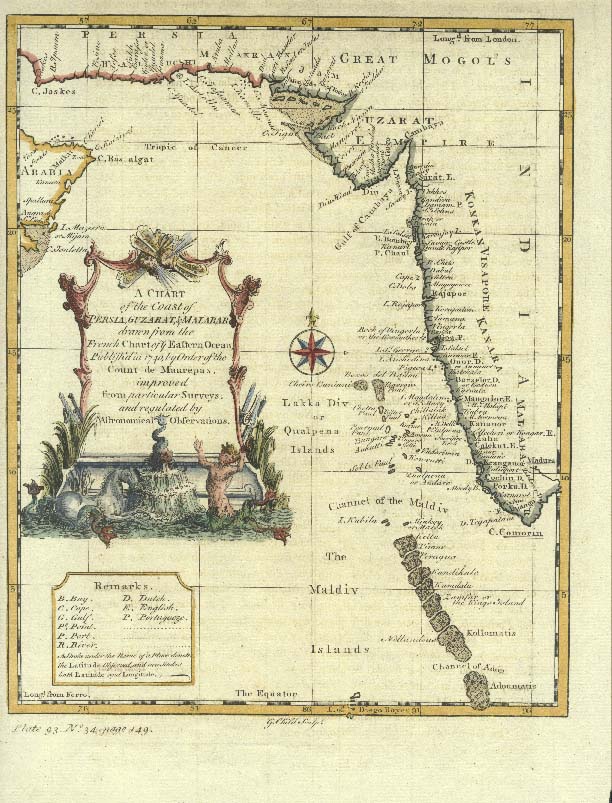
Showing posts with label Malabar French 1720-1800. Show all posts

Brown of Mahe -The Rascally Adventurer

Posted by Maddy Labels: ,

Murdoch Brown – The Valia Saheb of Anjarakandy

History enthusiasts and the inhabitants of North Malabar though familiar with this name, may not know much about this Scotsman. Many myths and legends have been connected to his name, and he has been routinely derided as an avaricious colonialist. A detailed study (a first) reveals that he was a hardcore capitalist, the first British landlord of Malabar, a keen botanist, a sharp observer of local culture and laws, and a brash and opportunistic trader, serving only himself. Like spices and provisions, people were also commodities as far as he was concerned and he was a tough slave owner, also supplying Malabar slaves to Mauritius and other French states. He would bend rules, twist arms, and resort to violence, so long as the end benefits were his and only his. Close friends remained friends for life and enemies remained enemies. Always skirting the edges of legal provisions, he changed nationalities and sides as the situation demanded, mastering foreign and several South Indian languages, along the way. To summarize, he was one heck of a man.

Charles (Claude) Gabriel Dellon, the Frenchman in Malabar – Part 2

Posted by Maddy Labels: ,

His observations about Malabar circa 1668-1672

In Part 1 we covered his travels around the South of India, his misfortune, the connections with the Goa Governor’s mistress and the inquisition.

Just to get a little perspective, Charles Dellon (a.k.a. Gabriel Dellon/Dillon and Claude Dellon in various books) was a French Catholic physician and traveler to the East Indies., A physician by training, Dellon sailed to India in 1668 with the French Compagnie des Indes (q.v.).Dellon, spent some time in North Malabar and was operating out of the French factory in Tellicherry for five years after which he left the French services. Six months later, he was in jail In Daman, labeled a heretic by the Inquisition of Goa.

Dellon is always specific and precise in his observations and that is why they are so important to a student of history. He starts off by defining the region termed Malabar (malavar). Stating that most people have this impression that it stretches from Surat to the southern tip at Cape Comorin, he clarifies that it is actually South of Mount Eli (under the 12th degree of the North latitude) where the people assume the name Malabars or Malavars. This two hundred leagues (each league is roughly 3 miles) long tract of land had many petty kingdoms according to him and each of those king/lords administered his land independently and were not tributaries of any other prince. Note also that his writing is somewhat confined to the customs of Kolathunad, between Balipatanam and the northern borders of the Zamorin’s territory.

We have in the past read so much about the wars and the difficulties faced by the people of Malabar from the Portuguese, Dutch and the English. Few wrote about the land, though many detailed the customs they felt curious or wrongful. Some like Van Rheede, helped by local experts documented the flora and fauna in great detail in the Hortus Malabaricus, but Dellon wrote freely about what he saw.

Considering that he lived in Tellichery, we can understand it when he stated that the most powerful of them all is the king of Cannanore or Cotitri, the most respected and dreaded of them all. The Samorin who has more territories is considered to be inferior in strength. He goes on to say that it is a very healthy place with clean air, reaps rice twice a year and has a lot of different fruits. Spending a number of paragraphs to the coconut or ‘tencar’, he errs when stating that the tree dies after the coconuts are harvested but spends a while explaining the tapping of its liquor ‘Tary’ collected by Tieves (Tiyyas) who are responsible for coconut husbandry.

Interestingly he observes that the toddy which is sweet to drink, becomes sour by the day, tuning to an equivalent of cooking vinegar and used as such (for cooking) and also further distilled to make a kind of local brandy! The toddy with a little lime tastes as sweet as honey and is boiled to make cane sugar called jagara (chakkara) or the Portuguese jagerry. He observes that the young coconut provides Eliner, the tender coconut water (observe that they are all the very same words we still use..). And of course, he does not forget coir or hemp, used to make ropes used for ship building and also notes that the husk is used for cooking and by goldsmiths. The oil from the tree is used for cooking meats and burning lamps, and the waste kernel is used to feed cattle and hogs (thenga punnak). In essence, he concludes that it is a magnificent tree, providing so much to mankind…Oh! So true…

Other trees are mentioned, but I will skip the details and mention that he then spends a para on the jackfruit and another on the mango which was even in those days pickled (Achar) or eaten ripe. In fact he says that there is a green pepper pickle based in vinegar, and pepper is sometimes preserved in sugar. He does not fail to mention the pepper and cardamom plants of Malabar and the resulting trade. The cinnamon of Malabar is inferior to that from Ceylon and he notes that the Cardamom is mainly added to rice by the people of Arabia and Persia (Foodies take note - perhaps the talassery biryani had not arrived!!). Chewing betel with lime and areque (adekka) was popular, and something new to our friend Dellon but something he liked and recommended to his friends. He even notes that most Europeans living there enjoyed chewing betel like the natives who always offer betel if you visit them.

He observes that Malabar people are not too fond or gardens or flowers unlike the Mughals of the North. He also makes it clear that the women of Malabar are not vain, all they use is a little coconut oil on their hair and persona and not any kind of perfumes, unlike the women of the North. Parrots could be found in plenty and Indians do not bother training them to speak unlike the people of Europe and there are plenty of wild fowls and peacocks roaming round.

He is fascinated by the elephant, whom he accords the first rank among the beasts of the world. Considering them intelligent, he explains that they can drench a person they bear a grudge against in a mighty sprout of water from their trunks and he notices that they have a great memory (which he professes to explain with a small and interesting story of a sweeper boy who insulted the elephant and how the elephant taught him a lesson after several days when it came back to that place). 

Interestingly he also mentions the story of the elephant that was sent to Lisbon and how the mahout scared the elephant about its being sent to a life of slavery. The elephant would not board the ship and the viceroy threatened to kill the mahout after which the mahout told the elephant that it was going to live a life of great happiness with the king of Portugal. Hearing the changed version the elephant finally boarded the ship to cross the seas. The mahout is termed ‘cornac’ by the locals. He also mentions that if a Malabar king is angry with somebody he lets his elephants loose on his grounds and the resulting destruction of property a just retaliation. He then observes that they are used in temples and in all kinds of hard labor situations.

But what astounded me was that he observed that there were plenty of Tigers in Malabar and notices three distinct types. The first is cunning and not bigger than a large cat (they had one in the French quarters), the second is the size of a calf (here is where I learned that mutton meant the meat of a slender calf). Anybody who killed the second type got a gold bracelet from the prince as reward and observes that people could wear a gold bracelet only after getting it or after being permitted to wear one by the prince. The third is the royal tiger, as big as a horse, but actually found only in parts north of Goa. And of course he mentions oxen, civet cats, jackals and plenty of apes. He is surprised that the men worship these monkeys and observes monkeys robbing wares laden on the heads of women who are headed alone to the market. The monkeys also try to drink the toddy from the tapping containers on coconut trees. Then he notices that there are plenty of boars in Malabar and the Nairs or gentlemen of Malabar hunt them often (panni vetta) and eat pork. The Nairs do not eat rabbits and they sell them to the Europeans. And of course there were snakes, plenty of them (called bambou – pampu) and he considers the natives stupid to worship them in temples and records some of the superstitions concerning snakes in vogue those days and is surprised they never kill a snake.

As you can see, Dellon has by now settled down famously, observing and penning his diary with good accuracy. If you read his accounts, you would be amazed at the seriousness with which he went about the task of understanding his new world. His study of the flora, the fauna, the people, the animals were outstanding, be they the Tiyas or the Nairs, or the coconut tree, which he rightly termed the greatest tree of the universe. He observes that pickles are called achar and toddy called exactly as it is today, but sees so many parrots, peacocks and wild boars and so on in Malabar, now all gone. Having observed the animals, the flora, the fauna and the region he gets to the people of Malabar.

The working class is well shaped, brown or black, but not as ugly as Africans, they wear their hair long. Dellon considers them treacherous, and the Mohametans even more perfidious and notes that breach of faith is commonplace. The working class serves the upper echelons of society which is four in number, the first being princes, the second being Namboothiris or chief priests, the third being normal Brahmins or assistant priests and finally the Nairs or the gentlemen. Only the Nairs have a birthright to bear arms and bear that responsibility without obstructing normal activities. The Tiyas take care of coconut trees and are allowed to bear arms with prior permission. The mukkuvas of course take care of fishing and live near the seashore and are not allowed to take on any other employment. The weaver tribes are called mainats. The pulayas are the despised accursed, and best avoided.

He also notes poignantly – It is a fundamental law amongst the Malabars, as well as most other nations of the Indies, which they look upon as unalterable and never to be neglected to wit, that nobody can rise beyond the degree of his tribe, wherein he is born, and let his riches be never so great, neither he nor his posterity can exclude themselves from that tribe or change their condition.

He spends a full chapter on the Nairs, that they are always the travel guards for anybody and escorts for any group. If they were not part of an entourage, no prince will accept any claims or complaints. As they moved from region to region, Nairs of that particular place took over from the previous escort. The daily going rate was 8 silver tares per diem ( ½ panam). When a nair is guarding your house, he gets only 4 tare as salary. They are most courageous and if a person in their care gets killed on travel, the Nair escort also kills himself instead of surviving him as a coward. He also notes that in case a traveller is escorted by a nair child, the child is never accosted by robebrs as it is a custom never to harm a child. In these cases the Nair boy carried a sharp 1 ½ foot long stick and not arms. Poor travelers used this method and paid only a small amount to the child.

He notes that different castes did not intermingle, especially in respect to eating and drinking, and details the caste rigors which we already know about. He notes that if a Namboodiri or Brahman girl are seen to transgress at this point, then the prince takes the ultimate decision of excommunication (the older version of smarta vicharam) by selling the girl to the highest bidder, especially foreigners who consider them the fairest of the Malabars. He then goes onto narrate a firsthand account of meeting one such lady who later converts to Christianity.

He notices that there are no jails, but that convicted persons do get chained in fetters till they are discharged or executed. Larger cases are tried by the prince and here he talks about a special type of ‘kaimukkal’ ordeal, different from the usual oil version. The person who pleads not guilty is asked to stretch his hand upon which a banana leaf is laid and on it a red hot iron is placed till it becomes cold. The hand is then covered with a piece of cloth dipped in gruel water (kanji vellam) by the prince’s washer man and sealed by the prince. After three days the seal is broken and the hand checked. If there are no marks, he is excused and if there are any, he is punished accordingly. There is never any appeal to any prince’s decision. Executions are conducted by Nairs, wherein a lance is run through the accused’s person after which they are cut into quarters and hung on trees.

He then explains the method of succession in the princely families of Malabar where the oldest prince succeeds the dead. The next is the most important aspect, the choice of a chief lieutenant/minister or the highest dignitary of the state who is always chosen by the ruler and is a person of outstanding quality, a Nair or a chetti!!! This was a bit surprising to me, for usually these are also from the ruling family in most cases. Did Dellon err? He notes that all matters of importance are recorded on palm leafs with iron quills. The chief minister then takes over the management as the old titular ruler retires to a life of comfort.

He notes that the Kolattiri king always wore a huge gold crown weighing 200 guineas and later gets into the details of the matrilineal kinship in Malabar. He rightfully observes that the daughters of princesses are wedded to Nambuthiris, and notes that the Nairs and others can marry one level below theirs, in caste. He also notes with some surprise that the women can have multiple husbands, and that there is no jealousy in this regard with the norm that the man leaves his arms at the door when he is with a lady. He affirms that this is the reason why children owe their pedigree to only their mothers and that is the reason why sister’s sons or nephews become the next heirs. He also makes it clear that the Mohametans observe the same (marumakkathayam) system of inheritance in Malabar and that 12 is typically the marriageable age for girls and that there are hardly any midwives and delivery is usually very easy compared to Europe. He explains that Malabar women are generally well shaped and not ill featured, that the little ones are more popular than taller girls and that Sati is not practiced in Malabar unlike the rest of the country. Both men and women wear their hair long and are naked to the waist, and he is surprised that the women do not try to wear finery, but are satisfied with just pure calico cloth. The richest wear girdles of gold and silver, even horn, but women wear just a ring. They, both men and women do have pierced earlobes which hang down to their shoulders, and wear heavy two ounce earrings in them. Only men favored by the king wear gold chains and all mean are clean shaven, though some are mustachioed.

Houses are typically mud based with thatched (coconut leaves) roofs, use mud pots for cooking and some baskets, even kings do not use gold or silver vessels and at night just use coconut oil lamps for light. They always eat with their backs to the lamp, and mainly based on rice. Since sauces are not used for cooking the food is bland and very basic in taste. They sleep on boards, and mattresses are not used even by the rich, though the upper classes sometimes use tapestry bed sheets. Every house has its own well and each is self-contained, with village life with shared facilities quite rare.

The temples are rich, coated with copper or silver and a tank in front, and have in addition places for travelers to stay as well as large tracts of land under their control ( more about that concept another day!) for yearly revenues. These grounds are holy and any act of bloodshed in this land sacrilege. Mentioning that the sun and the moon are revered, he notes that eclipses are greatly feared. But what surprises him the most was the ardent respect for elders, and that even the fiercest Nairs stand up before their elders. The calendar was based on the moon cycles, and he describes the temple festivals with good accuracy. He sees many training schools or kalari’s and he mentions that the Nairs of 1670, were sharp shooters carrying both muskets and the ball making molds, firing them with the rifle butt on the cheek, unlike Europeans who kept the butt on the shoulder. They had other arms too like the six foot bow and arrows, scimitars and lances. But then again, according to Dellon, even though courageous, the Nair’s never maintained order while marching, and were not structured or disciplined during combat. There are frequent exhibitions of skill attended by many people and he details the ankham or duels to settle a quarrel. Unlike the Malayali Nairs of today the Nairs then were patient and not too jumpy or over passionate. What surprises him the most was that after a battle most of the spoils are returned to the original owners!

In matters of commerce, Nairs are never involved and bazars are always full of foreigners and strangers conducting the trade. He spends a few paragraphs on the Moplah’s and notes that many of them are involved in piracy. He also explains that a tenth of the proceeds of their piratical endeavors were submitted to the prince of the land. Their paros carry 500 men and sail as far as the red sea, but they stay away from European ships. Even though sailing is somewhat unsafe due to these corsairs, traveling by land is safe, with the conduct overseen by Nair escorts. The Mohametans live near the town center and market.

The French factory is permitted by the prince Onotri (Kolatri) and the place given to them in Cannanore is called Tatichery, renamed Tellicherry by the French. Dellon and Flacour set about getting things started up. The Zamorin facing problems with the Dutch decided to approach Falcour to discuss an alliance. The French agreed and were provided a place at Aticote near Cochin to conduct their business from the Zamorin’s kingdom. But as it happened, the Zamorin lost the battle with the Dutch and the French ended up going back to where they were before, to Tellicherry. Dellon was then deputed together with Flacour to Srinipatanam (Srirangapatnam in Mysore) though it was the monsoon season and not ideal for travel, with a palm tree leaf umbrella common in Malabar. The trip was not very nice, with bad weather, leeches, and all kinds of other issues. It was a difficult ordeal and Dellon decided to return taking the support of Kunhali the most famous corsair of the time, at Badagara. He then visits Calicut and Tanore and makes the usual observations, some quite interesting.

Eventually Dellon goes back to Tellichery, but by then he was weary and bored and asked to be relived from Malabar duty. The following January he left Tellichery bound for Mangalore and later for Goa…

References
A voyage to the East Indies – M Dellon
Historic alleys – Dellon in Malabar part 1
Historic alleys – Ankhams of Malabar
Maddy’s ramblings – Pope and the elephant


A horse, a carriage and the French Loge at Calicut

Posted by Maddy Labels: ,

The complete account of the little ‘French Loge’ at Calicut and its impact on the mighty British establishment is a lengthy topic which I will not cover in detail here. Nevertheless, one can conclude that the Calicut loge was a thorn in the British flesh. This small area of Calicut created many an administrative issue for the British bureaucracy (I guess it was the French idea of fun, during their mundane stay at Malabar, sans wine, women and gaiety) some quite silly and it was only later and closer to Indian independence that affirmative action was finally taken, to close the loge once and for all. This 6-7 acre plot thus lasted as French property for all of 246 years after its establishment in 1701.

TB Seluraj in his fine book recollects - Look Westwards from the French bakery to the beach and Northwards until today’s RC road. That was the boundary of the Loge. Today’s AIR radio station, the Baby marines and so on were part of this and once upon a time, there existed a fine bungalow later called the beach bungalow in those Baby marine grounds.
Before all that, in that fishing area where the French loge was situated, the perimeter contained a small factory and some private houses as you can see from the French maps posted here.  The name of Loge was given to ‘factories or isolated establishments comprehending one house with the adjacent grounds where some commercial activity was undertaken’, especially storage and processing of pepper for shipping to Westerly locations. Not many are too sure about when it was established and some of the earliest comments about it, oft repeated by others, were provided by our esteemed collector Logan, in his manual. He states, with that English tilt stamped purposefully, thus….

The French have a Loge -Occupée par un gardien (Loge or Comptoir is an isolated factory or establishment where France had the right to fly its flag and to form factories)in Calicut. The loge consists of 6 acres on the sea shore about a half mile north of the light house and adjoins the old district Jail site. The exact facts connected with the foundation of the French factory are involved in doubt. It was apparently obtained by the French from the Zamorin, but there is nothing to lead to the supposition that the Zamorin had ever conceded to them anything more than mere commercial privileges within the limits of the Loge. The Zamorin appeared to have exercised fiscal and judicial authority within its limits – an authority which neither Hyder Ali nor Tipu Sultan ever bestowed on the French after the Zamorin’s power ceased.

Beyond the fact that the landed property and the house are untaxed, there is nothing to distinguish the Loge from the rest of Calicut. It is doubtful what rights the French government has in it. As it has been altogether omitted from the treaty of Versailles, dated the 3rd Sept 1783, it has been held that the French has no sovereign rights in it. The Loge was restored to the French on 1st Feb 1819. In the first capitulation of Mahe made by Monsieur Louet, Commander in Chief of the Garrison at Mahe, and signed on 10th Feb 1761, it was agreed in Article 9 that ‘the French factory at Calicut shall be suffered quietly to enjoy the privileges of neutrality observed there’.

MO Koshy (Dutch power in Kerala p144) points out that the Loge was first built in 1701. By 1722, the French had moved major operations to Mahe. Anyway it went on to do its business, albeit quietly in a small scale until their newfound friends the Mysore Sultans decided to venture south. That was when the French equations with the English in Malabar started to change.

The Calcutta Review (1903) article on Imperial Calicut provides the next tidbit as follows - Meanwhile, we find that in 169S the French also had managed to establish a factory in the place (Calicut), though at this time they were apparently not doing much, for Hamilton tells us they neither had money nor credit and were "not in a condition to carry on trade. The French quarter or loge, as it is called, still exists as one of the foreign dependencies of the Republic, but it yields absolutely no material return to France, and the wonder is that France should cling to it so tenaciously when she might any day obtain a fairly good price for the land from the British Government.” W Francis in his South India gazetteer also opines that it was started in 1698. He states that it went to British hands thrice during the wars and was reinstated to the French in 1819 and was located south of the pier. So we can perhaps infer that a pier (perhaps the Calicut landing) existed well before the British built one in the mid1800’s. Murkot Ramunny in his book Ezhimala states that the French Calicut factory of 1698 was started after their unsuccessful experiments at Tellicherry. However Shantini in her doctoral thesis re- confirms that 1701 was the year when it was established.

I recounted some events related to the French in Malabar during the Mysorean interludes in an earlier article, but therein, you would have noted that decisions came from Pondicherry and Mahe, in spite of a factor residing at Calicut. This was around 1773-1774 and the person involved was Duprat (In summary, the power of the Zamorin was snuffed when Hyder walked over the territories in 1764/66 and the events recounted, happened when a new Zamorin came back to take his place at Calicut in 1768. He then requested French assistance against the Mysore Sultans and it did not quite work out). But as we see it, the Loge at Calicut had little to do during all these events and is hardly mentioned. So we have little information about the loge during the period between 1701 and 1774.

During the Hyder - Tipu Interlude, an interesting event involving the Zamorin and the French Loge took place, and is recounted by Maistre de La Tour.  It appears that the English had destroyed the French estate and buildings at Pondicherry and the French were looking for good wood to rebuild their property. As it happened, a Moplah trader of Calicut who owed a lot of money to the French got a consignment of wood released by Hyder Ali. The French requested the trader to provide the wood in order to pay off the monetary debt. As the wood was on its way, the English hearing of the deal pressured the Rajah of Coimbatore (Satyamangalam palayakar??) to seize it. The French complained to Hyder who opined that the Dutch, Portuguese and Danish factors should meet, discuss and decide on the next course of action. They did so and decided in favor of the French. The English not in agreement, and taking matters into their own hands (with the connivance of the Coimbatore raja), sawed up the wood into small pieces and made it useless for any rebuilding work. Now it was fit for use only as firewood. The French again complained to Hyder and the Coimbatore Raja seeing immense trouble looming, offered monetary compensation to the wood trader who then paid back the French, whatever money he owed them. Hyder observing this smelt a rat and saw that the raja had paid the French money that was actually due to him as some kind of tax and that the compensation to the French did not actually originate from the English. The enraged Hyder imposed a penalty of 4 lakhs on the raja for the deceit and applied further pressure by ensuring that water was not delivered to his palace. The raja who was a Brahmin (perhaps Kshatriya), could not take his mandatory baths and so finally dug into his secret treasure trove (apparently under the very seat of Hyder – i.e. in the house where Hyder was then residing) and paid Hyder the penalty. That was the first salvo fired by the French from the Calicut Loge against the British.
Following the transfer back to French hands, the Loge was a source of continuous irritation to the British and many an argument rested on Abkari or spirit sale rights as well as commerce undertaken from the French premises. The British had a spirit monopoly in Calicut and when the French opened shop, it was an affront to both the meager profits from Calicut but also to their sovereignty. They took offence and a number of missives were launched at each other. Let us take a look at some of those amusing episodes, but note here that the Calicut Loge was administered from Mahe and the Adhikari or man responsible for the outfit at Calicut was referred in French terms as the concierge. By mutual agreement no taxes were collected by the French or the English.

The most alarming was when the French planned to open a French port in front of the loge in 1865. Even though it was not a real possibility, the British were overly worried of competition, with the threat of the French sponsored opening of the Suez Canal as a backdrop (already the biggest global challenge to British supremacy over the ocean trade). This was when the British decided that from then on, sovereign rights would not be accorded to the Loge’s. The British argument was that the British inherited the rights from the Mysore sultans and the Zamorin and that the French only had commercial rights.

But by and far, the incident that provides most amusement is the one recounted by Akhila in her absorbing paper titled L’Inde retrouvee, Loss and sovereignty in French Calicut 1867-1868. I will provide an overview with all acknowledgements to her and many thanks for telling us the story.

As you can see, this takes us to French Loge in Calicut during 1867 with people of all types involved. There is D’Souza and D’Mello of Portuguese heritage, a Saldanha also of Portuguese extract, a Mr Bass of unknown (perhaps Portuguese) heritage, the Volkart brothers a Swiss company, the English bureaucracy and the residents of Calicut. As the story goes, Mr Bass lent some money to Mr R D’Souza, his brother in law. In lieu of the money, D’Souza gave Bass a horse, a carriage and some furniture as a payoff. These were sizeable objects and Bass did not have a place to put them in, nor as it appears, did he want to sell it. Let us not try to get to their motives (to me they were ulterior as you will soon agree), but Bass parked the carriage in the compound of a house belonging to one D’Mello and the furniture and horse in the house of one Saldanha (both these people being residents in the premises of the French Loge at Calicut). The horse ate its grass in a new location, munching away happily I suppose, the carriage rusted in the sea air in D’Mello’s shed and the furniture gathered dust. But events otherwise kicked into the next gear quickly.

Now comes along the Volkart brothers (agents and exporters), who if you will recall had a warehouse along the beach, perhaps adjoining the French. They were owed money by this D’Souza (It looks like he made a habit of borrowing money and not returning it) and as Volkart did not get it back, filed suit. D’Souza rushed to Cochin and Madras to argue and settle the case during this messy period.

Volkart’s attorney, Mr Ansell also sued M/s Bass, D’Mello and D’Mello’s father (hmm…wonder why!!) for having evaded the course of justice by acquiring the horse and carriage. The horse and carriage were seized and brought to the magistrate in Calicut. The furniture seizure did not take place because by then the Ameen pointed out that the property was in French territory. Ansell taking matters into his own hands moved the furniture from Saldanha’s (and with his connivance) house to Andre& Co’s house a mile away, in British territory. Now you know why Ansell did not sue Saldanha amongst the parties.
The court decided that what Ansell did was wrong and stated that the property attachment was illegal as they were located in French boundaries where British law was not exercisable. However even though Bass was able to provide evidence that he acquired this property from D’Souza legally, he was sentenced to 6 months simple imprisonment. Soon D’Souza returned and he was also caught and dumped in the nearby jail on similar charges. D’Mello and his father however, had to be released soon, as they were residents within French boundaries.

The D’Mello case came up again in appeal in Jan 1868. This time the court did not support the


French territory ruling on the grounds that it did not matter since the property was actually conveyed to a part of Calicut where Bass, a British Indian territory resident,  did not ordinarily live, and so the property seizure as such was still pursuant under British law.
D’Mello was indignant as he was being tried by the British and repeatedly asked the authorities in Mahe & Pondicherry to intervene and provide proof that the Loge residents indeed had French rights. It does not appear he got any real support. But he also quietly tried to use the declining situation to his own advantage. He told the people in Mahe that the problems were due to a weak and powerless Adhikari the French had appointed to oversee French rights and that he D’Mello, would be a better candidate instead, for the future, perhaps in an elevated role as a resident.

Bontemps in Pondicherry then took up the case in Madras as another instance of British disregard for international treaties. He also specifically complained about the British disregard for proprietorship in the case of Calicut.

Anyway as the authorities argued on, we come to the end of this interesting event, so what would have happened to D’Mello case? After the sentence was passed, the horse and the carriage were returned to him. D’Mello knew what odds were stacked against him. He refused to take them back and insisted that since the British had unlawfully seized them, they themselves had to return it to him.  Think about it, the property was still up for seizure in British territory, but not from French territory.  The court was in British territory, and so if D’Mello sat on the carriage himself, he would set himself up for re-arrest. The magistrate refused to deliver them back to him and D’Mello had no choice but to take possession of the horse and the carriage. As soon as he did it, the police seized the carriage and this time promptly sold it off. What happened to the horse is not known; perhaps it languished in eth Zamorin’s stable sin Kuthiravattom. Nothing more is known about the people involved. Maybe they or their descendants eventually moved on to Goa ort Bombay….

What is interesting is that D’Souza and Bass got sentenced rightfully, for knowingly relocating their property after facing imminent seizure, to the French loge. Perhaps D’Mello’s got financially compensated for renting their space out, but Saldanha quietly colluded with the British when faced with trouble. The D’Mello’s saw opportunity in the face of justice at courts and tried to further their personal advancement.

The problems continued…….

A report in the Pondicherry Progress of 1893 implored that the French flag had to be flown at the Loge as the practice had been discontinued and the British were not allowing the Loge’s existence to be a profitable one. In fact the British also did not provide proper police security t Calicut and also refused repair of the French premises. In the past (in 1859-1860)it seems that the French Governor  Mr Boutemps had to put pressure on the British by putting up the Abkarai rights at French Calicut (together with the Mahe bidding)for auction and got bids for it. The British who had a good and profitable sales (they had 5 canteens and a shop selling liquor in Calicut in 1860) inebriating the people of Malabar (yes, it was indeed the case even then!!)  were alarmed and apologized for the delay. But of course, they delayed it again and nothing came out of the nullified threat and so the writer was reminding the public again of the issue. The other idea was to sell the Loge to the British but the French had a nostalgic attachment to the plot of land.
Next to be reported was the continuation of the above dispute in 1906, this time reported in the Straits Times of 18th July. The French finally got fed up and granted a native of Mahe permission to open a Beer shop on the French Loge premises. The other beer sellers of Calicut protested to the British Collector and the AC of Salt & Abkari. The British maintained that the French did not have Sovereign rights, but only Landlord rights (but if that were so, commercial rights were then admissible and wanting to sell beer is a commercial right). The Madras mail first reporting this story opined that it would be best if the French sold off the land to the British and stopped this never ending cause of friction between the two countries.

And we have the interesting story recounted by TB Seluraj in his fascinating book ‘Kozhikodinte Paithrukam’. This takes us to 1924 or so, when a Mahe resident, a poor fisherwoman named Kappiriparambil Kotha decided to sell fish near the municipality office. She was promptly arrested by E Achythan the inspector, on grounds that a French national could not sell fish in English territory. She was sentenced by the court, fined Rs 5/- and big sum for a fisherwoman. The indignant Kotha returned to Mahe pledging never to come back to Calicut. But her place was soon taken up by another Mahe resident, one Kanaran, who actually built a shed to conduct his business. The police demolished the shed, and the legal wars soon began, now between the French Mahe administrator and the British Malabar collector. The Mahe man pointed out that both the fisher folk had been within French boundaries, and not in British land, so the entire episode was without merit. He also threatened escalation if this continued and demanded Rs 24/- compensation. The matter went to Madras and maps were compared. The British established that according to the 1895 map, Kanaran’s shed was within British territory. The decision thus rested in favor of the British.
In 1933, we had the Matticolly issue, nicely written about by P Anima in the Hindu issue of Dec 28, 2012. The French Government ordered in November 1932 from Pondicherry “forbidding the use in French waters on the Malabar coast of a fishing instrument called ‘matticolly’.” The English had no idea what the French were talking about and frantically went about trying to find out what a matticolly was. They alerted the Malabar district magistrate and informed him that the French also were insisting  that the Loge was their western boundary in India, so a careful eye had to be kept of the French goings on in Calicut. After a while the French governor himself is asked by the British to provide a description of the said matticolly with an illustration, which he does. “A matticolly consists of small mesh nets from 25 to 30 meters long, made of cotton or hemp threads…with nets of cord.” The practice of sardine fishing involves using the matticolly net (maybe mathi vala) and making a lot of noise to get the scared fish rush into the said nets. This noise scared away other fish and so the other affected fishermen were complaining as their revenues declined. Whether the practice was stopped or the fishermen went elsewhere, I do not know… but the matter appears to have reached an amicable solution and was closed.

Later, there were attempts by the Madras authorities to demarcate the seaward boundary of the French loge as the high water mark together with  a number of other complaints about improper taxation and nonpayment of taxes. Records where the Madras authorities had levied distress warrants against residents of the Calicut loge for nonpayment of municipal taxes can also be encountered. Petty cases of fines against tea sellers in the French compound were also recorded in 1939.

Finally things came to a close. The independence of India in August 1947 gave impetus to the union of France's Indian possessions with former British India. The lodges in Machilipatnam, Kozhikode and Surat were ceded to India in October 1947.
The declaration read - The French Government sincerely wishing to tighten the bonds of friendship already existing between India and France, have decided, as a token of their will to settle all questions pending between the two countries in the most friendly and comprehensive manner, to hand over to India the existing French "loges"

Volkart who became Carrier AC agents, went on to create Voltas together with the Tatas. The British left in 1947 and the Calicut AIR radio station started its broadcast from where the French once traded, broadcasting in MW in May 1950. The French Loge together with all the intrigues was soon gone, and the only remnant is the French bakery at its periphery, which now serves nothing French to my knowledge. I do not know how long it will last, and I still remember how they would deliver mutton cutlets and coffee to your car window – the only place of its kind in the Calicut of the 70’s and 80’s.

References
Pondicherry Progress Dec 24th 1893 – retold in Jan 27, 1894 Colonies and India news
Straits times 18th July 1906, Page 9, French India
HinduArticle P Anima
French maps – From and this
Anglo-French sovereignty disputes in India, 1918-1947: Attempts at peaceful settlement - Geoffrey Marston
France's Lost Empires: Fragmentation, Nostalgia, and la Fracture Coloniale -  edited by Kate Marsh, Nicola Frith, (L’Inde retrouvee -  Article by Akhila Yechuri)
Kozhikodinte Paithrukam – TB Seluraj (Meenkari Kothayum Antharashtra Athirthiyum)
The history of Ayder Ali Khan, Nabob-Bahader:  By Maistre de La Tour (M.)


Accession to India
The administrative declaration by the Government of India


Under Section 290, Government of India Act, as amended, to clear all doubts the Government of India issued a notification which is styled the Madras (Enlargement of Area and Alteration of Boundaries) Order, 1948. It reads: Now, therefore, in exercise of the powers conferred on him by the said section and of all other powers enabling him in that behalf, the Governor-General is pleased to make that following order: 1. This order may be cited as the Madras (Enlargement of Area and Alteration of Boundaries) Order, 1948. 2. The areas specified in the schedule to this order, which were known as the French Loges at Masulipatam and Calicut, are hereby declared to be included in the territories of the Dominion of India and shall be deemed always to have been included in the said territories. 3. The said areas shall form part of the Province of Madras and shall be deemed always to have formed part of the said Province and the boundaries of the said Province shall be deemed always to have been so altered as to comprise within them the said areas. 4. (i) The area comprised in the loge at Masulipatam shall form part of Bandar town in Kistna district and the area comprised in the loge at Calicut shall form part of Calicut town in Malabar district and the said areas shall be administered accordingly.

Charles (Claude) Gabriel Dellon, the Frenchman in Malabar

Posted by Maddy Labels: , ,

On his travails and misfortune – Also the governor’s mistress and the inquisition

Dellon was certainly an interesting person, one who was subjected to much misfortune because he was rumored to have seduced another’s wife, a lady who was at the same time the mistress of the Governor of Goa and lusted after by a Goan priest. There lies the story of the person and the only one who recorded to paper his personal experiences related to the dark days of the Goan inquisition, after he finally got back to his hometown in France around 1677 (10 years after he set out to Malabar)and got his mind set to the task.

But nothing is as simple as it looks, for the intrigue behind it covered the rivalry between the Estadoa Da India and the French East India Company and the race for supremacy in the Oceans and the Spice trade. And above all, if Dellon is to be believed, all this was mainly was due to the Governor Furtado’s (and perhaps his) ‘sangue nas guelras’, or super active libido……….

Charles Dellon (a.k.a. Gabriel Dellon/Dillon and Claude Dellon in various books) was a French Catholic physician and traveler to the East Indies. As his bio goes, he was a physician by training, and in 1668 Dellon sailed to India with the Compagnie des Indes (q.v.), travelling by way of Madagascar and the Seychelles. But let us go back a little and see how the French came to Malabar. The Compagnie Française des Indes Orientales was established by Jean-Baptiste Colbert, finance minister to King Louis XIV. It had difficulty gaining the financial support of French merchants, and by 1668 the King himself was the biggest investor, and the company was to remain under his control.

The company sent expeditions to the Indes which were often harassed and seized by the Dutch. The French East India Company flourished briefly from 1670 to 1675; nevertheless was not very profitable and by 1680 did not look very healthy, even the ships were in need of big repair. Our friend Dellon was with them during those hey days, the days when they were the biggest threat to the Dutch and the Portuguese.

Dellon, a physician spent some time in North Malabar and was operating out of the French factory in Tellicherry for five years after which he left the French services. Six months later, he was in jail In Daman, labeled a heretic by the Inquisition of Goa. How did that happen? Let us take a detailed look

Dellon though complaining of sea sickness and a troubled voyage followed by a brief stay in Madagascar, had no difficulties at Malabar. He settled down famously, observing and penning his diary with good accuracy. If you read his accounts, you would be amazed at the seriousness with which he went about the task of understanding his new world. His study of the flora, the fauna, the people, the animals were outstanding, be they the Tiyas or the Nairs, or the coconut tree, which he rightly termed the greatest tree of the universe. He observes that pickles are called achar and toddy called exactly as it is today, but sees so many parrots, peacocks and wild boars and so on in Malabar, now all gone.

He is surprised that the Malabar Nair lady does not use perfumes and uses just coconut oil for the hair, not even adorning flowers unlike the women of Surat. He is mystified that North Malabar men eat animals like boar, but never a rabbit. The elephant amazes him, with its intelligence and he testifies to the same with a couple of interesting stories. Some of the aspects of his account especially the guard/escort systems provided by the Nairs, excommunication and outcastes, the Zamorin’s chief lieutenant etc. have been hardly mentioned in such detail by other writers so I will perhaps cover them later in a more factual essay. In fact he mentions that the Nairs of 1670, were sharp shooters carrying both muskets and the ball making molds, firing them with the rifle butt on the cheek, unlike Europeans who kept the butt on the shoulder. They had other arms too like the six foot bow and arrows, scimitars and lances. But then again, according to Dellon, even though courageous, the Nair’s never maintained order while marching, and were not structured or disciplined during combat. He spends a few paragraphs on the Moplah’s and states clearly that a tenth of the proceeds of their piratical endeavors were submitted to the prince of the land.

An interesting story of his stay pops up in an article (SG Goodrich) about tigers - It appears that Dellon kept a tiger for several months, which was secured by a strong chain. This animal was cunning enough to scatter a portion of the rice that was set before him, as far round the front of his den as possible. This enticed the poultry to come and pick it up. The tiger pretended to be asleep, in order to induce them to approach nearer, when he suddenly sprang upon them, and seldom failed to make several of them his prey.

The French factory is permitted by the prince Onotri (Kolatri) and the place given to them in Cannanore is called Tatichery, renamed Tellicherry by the French. Dellon and Flacour set about getting things started up. The Zamorin facing problems with the Dutch decided to approach Falcour to discuss an alliance. The French agreed and were provided a place at Aticote near Cochin to conduct their business from the Zamorin’s kingdom. But as it happened, the Zamorin lost the battle with the Dutch and the French ended up going back to where they were before, to Tellicherry. Dellon was then deputed together with Flacour to Srinipatanam (Srirangapatnam in Mysore) though it was the monsoon season and not ideal for travel, with a palm tree leaf umbrella common in Malabar. The trip was not very nice, with bad weather, leeches, and all kinds of other issues. It was a difficult ordeal and Dellon decided to return taking the support of Kunhali the most famous corsair of the time, at Badagara. He then visits Calicut and Tanore and makes the usual observations, some quite interesting. Eventually Dellon goes back to Tellichery, but by then he was weary and bored and asked to be relived from Malabar duty. The following January he left Tellichery bound for Mangalore and later for Goa…

As he passes Goa, he mentions ‘Just opposite to the Cathedral in a great square stands that famous house, whose very name makes many thousands tremble in those parts; this is the Court of Inquisition, called by the Portuguese, Santa Casaou Casa d’osanto Officio’. Little was he to know what was in store for him or what his stars foretold..

As is reported - In January 1672, Dellon sailed from Tellicherry on his return to Surat: the ships stopped at Mangalore, at Mirzeou, from whence they withdrew the factory, at Goa, Atchara, and Rajapore, and arrived at Surat in the middle of March. From hence he sailed in November in a ship of force, sent to convoy home another of value from Gombroon. The two were met in their return, off Diu, by four which were cruizing for them, and all together put into Bombay in January 1673, from whence they arrived at Surat in the beginning of February.

He arrived at Daman (Damao) a Portuguese colony in 1674, where his future was to change. His first days were very pleasing, spent in the company of many a woman. Dellon says – ‘I must confess that I never passed three weeks more pleasantly than these, in all my life time’. So much so that he decided to find himself a house and settle down there, finding good medical practice and many patients. As Abbe Carre puts it, Young, good looking, intelligent and knowledgeable in Latin, he soon won local prestige, but all of Dellon's science consisted in knowing how to bleed. On the first of January 1674 he sailed from Daman, and having touched at Bassein, arrived at Goa on the 14th. In this city he continued two years, and sailed for Lisbon and France in January 1676. Soon thereafter, he was arrested by the Inquisition and taken to Goa, where he was imprisoned for two years.

So why did he get into trouble with the inquisition?

"The jealousy of the Captain ( Furtado) was motivated by my frequent and innocent visits that I made to a lady that he coveted:; I was equally greatly loved by her, a circumstance which until then I ignored; and as he judged things by light appearances, he learnt soon that I was his most beloved rival"

"An ecclesiastic, a native, secretary of the Holy Office, who lived in front of the house of the said lady, also nurtured a strong passion, like that of the captain-governor, citing her infamously even in the tribunal of penitence, as was revealed to me by herself. This priest, observing my visits, had become as jealous as the captain, and even though until then he was one of my best friends, grateful for the important services rendered by me, nevertheless he made a common cause with Captain Manoel Furtado to provoke my ruin".

As the story is told by Abbe Carre --------------

M. Vidal had been married in Daman for 15 years and had amassed great riches and honour by the annual voyages which he made to Eastern kingdoms as commander of both Moor and Portuguese ships. Nevertheless he was not better off on this account as his wealth, wife and family were at Daman and he could never remove any of them from Portuguese territory. By this wife he had only a small son, now 8 years old and his chief consolation next to his wife, who was very handsome. Until now he had always thought her virtuous because she had so well hidden her love affairs, of which he had only slight suspicions. But this year, on his return from a 10 months voyage to Mozambique, as captain of a vessel belonging to Manuel Furtado de Mendoza, governor of Daman, he was much astonished to find his wife seven months gone with child. He learnt with extreme displeasure that she had led an immoral and disgraceful life, both in her own house and also that of the governor, where she went every night. The governor, who was a near relation of the viceroy, thus set a fine example. Not only had he a wife and a twenty-years-old son with him but also a troop of concubines and besides he now debauched the wife of an honourable man...

About this time there was a young Parisian Frenchman, a M. Dellon, who in 1668 had left France for India in the ship La Force as surgeon's mate. .. He was considered to be the cleverest doctor in India... Being French, he freely visited the family of M. Vidal, where he became like the son of the house. The Portuguese governor, madly jealous of him, resolved to do something unexpected to prevent his visits to this house where the governor's own affections were deeply involved...

So knowing the habit of this young surgeon to argue about our religion, he asked him civilly to bleed his son and laid a trap for our young doctor by attaching an ivory figure of St. Antony to the boy's arm. This Portuguese plot succeeded as they had hoped, for before the doctor began to put a ligature on the arm of the governor's son he asked the boy to take off his St. Antony as it hindered the operation. Thereupon the boy replied that he would not do so as St. Antony would prevent any mistakes or accidents that might happen during bleeding. The young doctor did not fail to say that it was an absurd superstition to imagine that St. Antony had any effect on the operation. So from these and other words there arose a sharp quarrel on the merits of St. Antony and M. Dellon spoke a little carelessly, though without malice. The witnesses, who had been placed there for the purpose, went at once, on behalf of the governor, to the Father Rector of the Paulists, who was also the local Commissary of the Inquisition at Goa. They accused the French doctor of heresy and uttering words against the Holy Faith..." Dellon was imprisoned, transferred to Goa where the Inquisition imprisoned him for a further two years and then condemned him to a further five years on Portuguese galleys.

Archbishop of Evora while providing a statement later in Lisbon confirms that this was commonplace – “The Inquisitors even attained the infamy of sending to their prisons women who resisted them, there satisfying their beastly instincts and then burning them as heretics."

I will not write about Dellon’s accounts of the inquisition, and they are available freely on Google books. It is somewhat chilling when looked at with the medieval timeline, but in today’s world, even more terrible state sponsored activities do take place.

In the account, we read about his terror of being picked up for death for burning at the stake, of his immense relief in escaping it, his excommunication and later pardon, confiscation of goods, five years solitary confinement. He was also sworn to secrecy and to keep silent about all he had seen and heard at the court. Eventually he is allowed to leave Goa (1677) and he goes to France via Brazil and Lisbon. At Lisbon, he applies for mercy and finally gets a release towards autumn 1677 and sails off to France for good.

Upon returning to France he continued medical practice and accompanied Prince Conti on his trip to Hungary in 1685. The description of Dellon’s misfortunes, first published in 1685 in Paris (under title "Relation de l’Inquisition de Goa" in 1688, Leyden and Paris) "proved a considerable success, particularly in Protestant Europe, where it ran to numerous editions. Although long regarded as a work of propaganda, recent research has testified to its accuracy". When asked why he remained silent so long, Dellon remarked that he took his secrecy oath seriously until it weighted down his mind and he decided to tell all. The book was however banned for a number of years in the catholic world, including India.

The Portuguese and their descendants unfortunately continued to be metidos em saias – entangled in skirts, and of course in religion, even in defeat. As Mario puts it, their cause in the name of religion eventually became their undoing.

References

A voyage to the East Indies – M Dellon
Dellon’s account of the inquisition at Goa - Dellon
Legends of Goa – Mario Cabral E Sa
Distant lands and diverse cultures - Dellon and the Goa Inqusition – Glen Ames
Medicine in Goa, a former Portuguese territory SK Pandya
Memoirs of Claudius Buchanan
Inquisition in Goa – Alfredo DeMello http://www.colaco.net/1/inquisition2.htm
Land of the Great Image: Being Experiences of Faiar Manrique in Arakan - Angel Manrique


This was a light introduction. Part 2 will cover the details of his observations of Malabar and its people.

A French Calicut?

Posted by Maddy Labels:

One of the little known and less written about stories of Calicut is set during the period just after the immolation of the Zamorin and the conclusion of the Zamorin era in 1766 during the onset of Hyder’s invasion of Malabar. I will be covering the Zamorin’s death and the story around it soon, but this one comes after the said event and snapped the last thread of hope the family of Zamorins had of holding on to their prestige & territories.

We talked in other articles about the Portuguese, the Dutch and at times the English. This one involves the French Infantry colonel and Governor of Mahe, later theologian Le Comte Du Prat and of the astounding situation where for the first time; a French flag was flown on the flag mast at the Zamorin’s palace in Calicut. Now imagine what would have happened if that situation had taken root, just imagine, we would be eating crepes and croissants, foie gras, duck confit and all that and talking French and I would not have had to trouble my friend Murali to try and get to the gist of what Duprat had to say in his own antiquated French words in his memoir. Just imagine, we would have been swimming in perfume and doffing our noses daintily at the English. But as you all know that did not happen.Let us now get serious and find out what happened.

French in Malabar
We now go to a period around 1774 to Mahe. Now historians would prefer to start with the 1642 when the French East India Company was formed, but actually the French got started around 1668 at Surat to set up a factory under the French flag. Then it was Madras. The French finally came to Malabar, some years after establishing themselves in Pondicherry, and founded a factory at Mahe in 1721, but settled down there by 1725.

Situation in Calicut
By 1764 the complacent Calicut was attacked by Hyder’s troops. Hyder had started out from Mysore via Palghat with his army demanding a tribute and restitution amounting to Rs 12 crores or something like that but the Zamorin had no money to pay that kind of retribution. He tried delay tactics, but when the armies were at his door and he was threatened with bodily injury and starvation tactics were hinted at, he had no option but to give up and committed suicide by immolation in his palace. The Zamorin’s families moved on to Tanur or Kottakkal and Hyder’s people ransacked Calicut with able support from the Moplah populace.

Finally in 1768, the new Zamorin returned to Calicut after agreeing to pay the required annual tribute to Hyder. Peace prevailed for 6 years between 1768 and 1774. The Zamorin in the meantime started the usual quarrels with the Cochin rajah on petty issues, this time over the appointment of a priest at the Trippayar temple. As Krishna Iyer succinctly puts it ‘as though his head and existence of his kingdom depended on it’. Hyder on the other hand was busy with his fights elsewhere, the Marathas and the English. Once that was all done and dusted, and he had come to agreements with the foes, he took notice of the transigence at Calicut and deputed his General Srinivasa Rao through Wynad with an army to occupy Calicut once again and quell any revolt.

Knowing that Hyder the Nawab of Mysore was pally pally with the French, the Zamorin approached the French for help, through the newly appointed Governor of nearby Mahe - Colonel Duprat.

Le Comte Pierre-Antoine Duprat
The French were smarting under the English takeover of Mahe in 1761 and it was in 1764 that they wrested it back. The English had pillaged and destroyed the settlement by then, working in league with the king of Kadathanad. Law de Lauriston the French commander at Pondicherry considered maintaining the small town of Mahe uneconomical, due to the heavy expenses in keeping a garrison and a constant vigil. The Zamorin no longer had absolute power over the region and there were skirmishes all the time, some directed against the garrison. Kottayam, Kurangod, Kolathunad, Chirakkal, Kadathanad and so on continued with their internal issues. Mahe was in their middle. The 3 or 4 forts that the French had, were destroyed by the British in 1761.The question in 1765 was whether to quit Mahe or not. The garrison contained 160 French and 150 sepoys or topasses, which according to Law was a greater ‘citizens to soldier ratio’ than even Pondicherry. But the feeling of trouble hung low like the monsoon clouds, ready to break at any moment. The French were also considering relocation to Colachel in Travancore, upon the Travancore Raja’s invitation. During this period the station head at Mahe was Picot De La Motte. He left briefly in 1773, on a leave of absence and his place was taken up by Duprat.

Duprat was a firm believer in French might and would fight hard to maintain its prestige. Historians say it was an unduly false notion, but as we all know plenty of people with such notions have been there in history and still remain in various countries in and out of power. Many a war as been fought by them due to these notions and visions, all through the the history of time.

Duprat decided to extend the French holdings and influence in Malabar, entirely on his own initiative, with all of his resources (310 soldiers as we saw previously). Very forthrightly he said in his memoirs ‘I have never looked at things except in a great way, I believe a man can do what man has done and many have done great things’. Interesting person, right? What he was to do would put the French directly against the might of the Mysore Sultans and earn their distrust for a very long time indeed. So let us see where Dupart led the French to.

As we saw before, Sreenivasa Rao was on his way to subdue Calicut once again, upon Hyder’s orders, and late in Dec 1773 the Zamorin had established contact with Duprat. The ambitious Duprat decided that this was an opportunity to make the once mighty Zamorin his vassal and annex his forces and influence. Duprat without waiting for formal clearance from Pondicherry agreed to provide military support to the Zamorin against the forces of Hyder bearing down on them through the Wyanad passes. Dupart sailed to Calicut with 100 or so soldiers and 3 cannons, in the frigate Belle Poule.

Duprat in his own words states that he left out for India in 1772 and after stays in the East coast and later Pondicherry, reached Mahe in Nov 1773. His first observation of the people of Malabar is interesting. “I studied it much the character of the Indian They are sweet & shy people easily deceived, though somewhat inconsistent, and are suspicious assets, very ignorant in the art of war”. Interesting fellow, I suppose.

In January 1774, the French flag was apparently hoisted on the Zamorin’s palace and the citadel (what and where was that?) and on the 12th a treaty was signed with the Zamorin where Calicut was placed under the protection of the French and in return the Zamorin granted the French a complete monopoly over trade and the right to build forts wherever they pleased. Well, that was interesting and is indeed a fact. Some day I will provide you the text of that treaty after some translation efforts.

In the meantime, Duprat sent off letters informing Hyder that Calicut was under the French flag and that it would be wise if he called back Rao and his forces. The tone was rude and arrogant. Again, in strident tones he added text to inform Hyder of the might of the French empire backing his actions (which of course was not the case). In fact Duprat’s letter even mentioned that he had come in a French battleship and was expecting two more ships and 4,000 men as reinforcement. He even offered a formal alliance to Hyder with the French nation in return. Hyder of course called the bluff.

Srinivasa Rao reached Calicut with his forces and found the French in control there. It appears that he was a very wise man and so paused for a while at the gates. The vast army of Hyder would have decimated the 100 (or 140) soldiers and 3 cannon of Duprat. Duprat finally encountered lady wisdom after seeing the forces. What happened was this, the Zamorin left Calicut in a hurry and Duprat slunk away to Mahe with his flag and soldiers.

The adventure was rash and the withdrawal was humiliating, and on top of that Hyder was enraged. But Duprat was Duprat. He wrote to Hyder from Mahe saying that he had not retreated in fear and haughtily claimed that it was due to his refined wisdom and that Hyder actually owed the French a lot for all the help they had obtained from the French. Hyder did not forget this for a long time and his distrust of the French was to become even more marked after this episode. It built up later into outright animosity. On one hand, Law was in regular touch with Hyder and on the other hand there was a lower level commander Duprat threatening him. For 5 years Hyder was to maintain a cold relation with Pondicherry due to this act.

Duprat was severely reprimanded in writing in Feb 1774 , but then he would not keep quiet. He was smarting from the ignominy and defeat at Calicut and decided now to flex his arms at the king of Kadathanad. He decided to enforce a monopoly on pepper and refused to allow them to sell it to the English as they had done for years. The revenue which was to be provided indirectly to Hyder was to be diverted to the French. Hyder protested but Duprat in reply instead threatened Srinivasa Rao in Calicut that the French forces would be directed against them with full might, soon. Law finally decided to put an end to this and recalled Duprat to Pondicherry and sent De Rependigny to take charge at Mahe.

Dupart indignantly resigned from the French forces and joined the army of the Nizam in Hyderabad. But fate is what it is, quite quirky as many have noted. Later, Duprat while working for the Nizam, trespassed Mysore territory and was arrested by Hyder’s men. It took much intervention from Law in Pondicherry to get Duprat released. Duprat also quickly completed a short memoir on the events at Mahe, explaining is stand.

Duprat finally returned to France after all his adventures and became a theologian in Paris around 1791 to retire amongst the saints and to writing stuff dealing with theology and the Lord. As for Mahe, Repentigny was also a problem and so Picot De La Motte returned to his old position around 1775 or 76 and kept the matters suitable low key, as they were once before, while Mahe returned to being a sleepy little town with a French twist.

Just imagine, if all had gone in the directions that Monsieur Duprat had wished, Calicut would have been a French Colony and instead of eating chicken biriyani at Sagar we would have been ordering Bouillabaisse or Coq au vin or some such strange stuff like frogs legs sautéed in wine in some French restaurant. Well, thankfully that did not happen, but chefs of French ancestry like Anthony Bourdain travel to Kerala these days, spend days on houseboats drinking Kallu and talk at length (and sometimes cuss in private) on TV about the exquisite cuisine of the Malayali, through their food channels.

References
The French in India – SP Sen
Zamorins of Calicut – KV Krishna iyer
Voyage Du Comte Duprat Dans L’inde - Duprat