
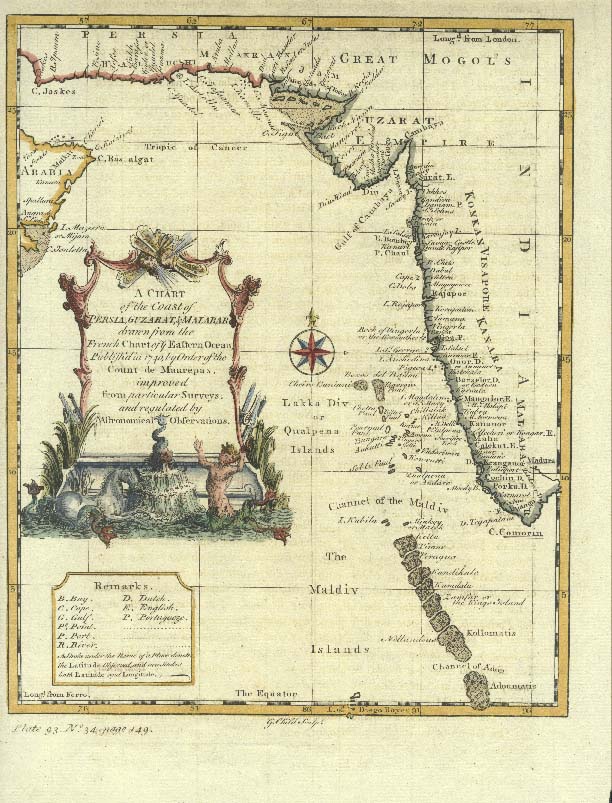
Malemo Cana - Vasco Da Gama’s pilot

Posted by Maddy Labels:

Readers get to the Vasco Da Gama story by sheer curiosity; desire to read about adventure, interest in Malabar or Portuguese history or a need to study in the academic course. Vasco or Gama as he is called is indeed an interesting person and there is so much of text out there praising him, ridiculing him and lauding him for his sheer tenacity. Well, the explorer did set out in search of the spice route and found it for his King. ‘He set out with 170 men in July 1497 on three ships (plus a 4th supply ship that was lost early). By Feb 1498, he had reached Malindi, and here was where his fortunes were to change.

For here he met and contracted the services of a person who was to direct the ships to the coast of Malabar. For the first time, the Portuguese had to cross a large expanse of water. Today we have navigational aids and propulsion that makes it easy, but in the days of winds, sailing and the non availability of precise charts, it was a hit and miss. They needed some person who knew how to navigate the monsoon winds. They found such a person, and sources argue over the identity of the pilot, identifying him variously a Christian, a Muslim, and a Gujarati Hindu. Some stories, text books and novels describe the pilot as the famous Arab navigator Ibn Majid, but historians and contemporaneous accounts disagree. The Portuguese historians of the time also fail to connect the person to Ibn Majid or mention the August name. So who could this pilot have been, the person who changed the course of history, both for the west and the east? People who have read about the age of history will agree that the impact of this Portuguese landing indeed changed the course of trade and history.
Let us first get to know Ibn majid. Quoting Wikipedia, Shihab Al-din Ahmad Ibn Majid al Najdi was an Arab navigator and cartographer born in 1421 in Julphar, which is now known as Ras Al Khaimah. He was raised with a family famous for seafaring; at the age of 17 he was able to navigate ships. He was so famous that he was known as the first Arab seaman. The exact date is not known, but bin Majid probably died in 1500. He was the author of nearly forty works of poetry and prose. His most important work was Kitab al-Fawa’id fi Usul ‘Ilm al-Bahr wa ’l-Qawa’id (Book of Useful Information on the Principles and Rules of Navigation), written in 1490. It is a navigation encyclopedia, describing the history and basic principles of navigation, lunar mansions, thumb lines, the difference between coastal and open-sea sailing, the locations of ports from East Africa to Indonesia, star positions, accounts of the monsoon and other seasonal winds, typhoons and other topics for professional navigators. He drew from his own experience and that of his father, also a famous navigator, and the lore of generations of Indian Ocean sailors. Bin Majid wrote several books on marine science and the movements of ships, which helped people of the Persian Gulf to reach the coasts of India, East Africa and other destinations. He grew very famous and was fondly called Shihan Al Dein (Sea's Lion) for his fearlessness, strength and experience as a sailor who excelled in the art of navigation.

His maps certainly helped the Portuguese find a way to India, and many Arabs find fault with Ibn Majid for personally helping Gama across to Malabar and destroying their lucrative trade with Malabar. For as you know most of the ships that plied these waters were Arab, the traders in Malabar were of Arab or Arab extraction and the goods were destined to Arab ports where hefty customs duties were levied. They found their way over even more expensive camel caravans to Alexandria where they were again loaded into ships bound for Europe. This trade from time immemorial was honorably wrought, till the Gama destroyed it all. The pilot is blamed by many Arabs for having helped the Gama destroy this trade.

Calicut heritage forum covered the contents of the book Pepper & Christ, where the fictional account introduces you to young Taufiq, a disciple of Ibn Majid who guides the Gama to Calicut. Was Keki Daruwalla right in his train of thought?

The time lines were right and much interest could be brought about in the subject by bringing the two people together, one in relentless quest of scientific discoveries and the other a rapacious trader. How did this happen? To figure it all out, we have to read the masterly book on the Gama by Sanjay Subrahmanyam, the heavily bearded Professor and Navin and Pratima Doshi Chair of Indian History at UCLA, a person who not only is ‘the expert on these matters’ but also one who loves to demonstrate such diverse aspects like South Indian cooking. A very interesting man (no! I have not had the honor of meeting him, but have read about him and his books) Subrahmanyam has written books in Tamil, Hindi, Portuguese and Italian, English and French, to name a few. In all, he knows ten languages and reads in two more.

Sanjay explains in very interesting fashion how Ibn Majid was brought into the picture, by a writer of Gujarati extract in Mecca.

Barros and Castaneda termed the pilot a Malemo Cana or Malemo Canaca a moor, Barros clarified it as Moor from Guzerate whereas Castaneda called him a Gujarati. The person who connected this to Ibn majid was French orientalist Gabriel Ferrand writing on Ibn majid. He borrowed text from the book written by Qutb Al-din Muhammed Al Nahrawali. Al makki. Nahrawali, a Gujaratai living in Mecca, wrote a book to celebrate Ottoman achievements over the Yemeni Arabs. He mentioned the name Ahmad Ibn Majid as the name of the pilot, wrote that he was given much wine to drink by the Portuguese and the pilot in a state of drunkenness explained the methods of sailing the oceans to the Admiral. Interestingly, the text does not state that Ibn Majid accompanied the Gama, but only states that he explained the way. I will not recount the text, but all he said was ‘do not follow the coast, make for the open sea without fearing it and well, follow the winds’. Now that is not expert advice, in my mind but plain common sense in rough and uncharted waters. Anyway Ferrand connected this Ahmad Ibn Majid to the expert Ibn Majid and set the tongues wagging. However it is still not clear why and how Nahrawali mentioned the name and where and how he obtained it. Was it another Ibn Majid of Gujarati extract?

The clinching reasoning behind Ahmad Ibn Majid’s involvement was his supposed regret over helping Gama as evidenced in a poem written by him. These arjuzas were discovered by Russian orientalist Kratchkovsky and translated. The devil is in the detail and the detail provided in the rather clumsy translations (and substantial additions by the translators in the process) made it an even bigger mess. Ibrahim Khoury a Syrian historian pointed out later the corruption of the translated text and the fact that Ibn Majid was already too old to navigate by the 1490’s and that this poem by Ibn Majid where he expressed regret over helping the Portuguese, was actually composed in the 1470’s, much before 1498 when all this happened.

Anyway the fable and legend continued to grow. The most interesting part is that according to Gama’s letters, the pilot accompanied him back to Lisbon for interrogation. So as you can see, Ibn majid, dons the guise of a Gujarati, gets drunk and guides the Gama and after wretchedly showing him the way to Calicut returns to Lisbon with him and settled down there, for there are no records of him returning.

So who was the pilot? Was he one of the Gujrai Nakhuda’s in Malindi? There was a sizable Indian population there according to Portuguese records. The sailors were not all Arabs, as I wrote in my previous blog. Was it just another chap who succumbed to threats or avarice and well, finally went back to settle down in Lisbon as a Fidalgo? Perhaps, but then we get to know that he really knew his business and to be called a Mualim in an Arab world required you to be one. To get to the details you have to read what Barros wrote

Let us see what Barros had to say – Quoting the footnote in ‘3 voyages of Gama’ based on Correas Lendas, translated by the Hakluyt society.

Barros says that some gentiles from Cambay, whom they call Banians, came to see the ships, and that seeing a picture of Our Lady in Da Gama's cabin, and that the Portuguese reverenced it, they made adoration to it with much more ceremony; and next day they returned to it. The Banians and Portuguese were mutually pleased, and the Portuguese imagined that these people were samples of some Christian community in India from the times of St. Thomas.


About the l5th July. Barros says that among the people who came to visit the ships was a Moor of Guzarat, named Malemo (malemo – Muallim or instructor in Arabic and Cana – kanaka – Astrologer in Sanskrit) Cana, who, both from the satisfaction which he felt at the intercourse with the Portuguese, and to please the King of Melinde who was looking for a pilot for them, accepted to go with them. Vasco da Gama, after talking to him, was very well satisfied with his knowledge, especially after he had shown him a map of all the coast of India, with the bearings laid down after the manner of the Moors, which was with meridians and parallels very small (or close together), without other bearings of the compass ; because, as the squares of those meridians and parallels were very small, the coast was laid down by those two bearings of north and south, and east and west, with great certainty, without that multiplication of bearings of the points of the compass usual in our maps, which serves as the root of the others. When Vasco da Gama showed him the great wooden astrolabe which he had brought and others of metal with which he took the sun's altitude, the Moor was not surprised, and said that some pilots of the lied Sea used brass instruments of a triangular shape, and quadrants with which they took the sun's altitude, and chiefly that of a star which they most made use of for their navigation. But that he and the Cambay mariners and those of all India made their navigation by certain stars both in the north and in the south, and also by other notable stars which traversed the middle of the heavens from east to west, and they did not take their distance with instruments like those, but with another which he used; which he brought at once to show, which was of three tables (or plates). Since we have treated of its shape and use in our geography in the chapter of instruments of navigation, it is sufficient to say here that in that operation they use an instrument which we now use, and which mariners call balhestilla the cross staff (or Jacob's staff), and in that chapter an account of it and its inventors will be given.

Osorio, in speaking of Gama's arrival at Mozambique, describes the compasses used by the Arab mariners at great length; he also says they used quadrants for observing the sun's distance from the equinoctial line; and says: "Finally, they were instructed in so many of the arts of navigation, that they did not yield much to the Portuguese mariners in the science and practice of maritime matters."

Where did the Melinda Sheikh find the pilot or pilots? It appears that they belonged to the Gujarati ships docked at Melinda. How come they left their ships and accompanied the Gama? For monetary compensation of course, considering the fact that the pilot demanded his reward as soon as he sighted Calicut. Could this have been Ahmad Ibn majid? Doubtful, for he had already retired and was living in peace, I suppose.

Would Ibn Majid be an ordinary pilot for a Gujarati ship? Doubtful again and considering that those Indian ships would have also been waiting to sail back to Cambay with the monsoon winds, it is doubtful that he left his own ship in the lurch had he been a honorable pilot. A Melinda King would not be able to overrule that, I presume.

The St Gabriel sailed out on April 26th 1498, as we know reached Kappad around 20th May 1498. The pilot demanded his reward which was apparently provided immediately as soon as the hills behind the city of Calicut were sighted. The Gama and his sailors made history and small fortunes though Vasco vanished for the next few years, however not before heralding the Century of discovery and the start of the ruin of Malabar. Vasco returned twice and eventually fell sick and died during the third of his voyages in the lands he discovered for the West, in pain of an unknown disease.

The Kamal or the Rapalagai (Malayalam) - The Gujarati pilot used a kamal to guide the San Gabriel to Calicut. In using the kamal, the knots are counted by keeping the string between one’s teeth; hence the name kau (=teeth) for the pole star. Vasco da Gama’s men actually thought that the pilot (Malemo Cana) was telling the distance by his teeth! Vasco da Gama later carried back a copy of the instrument “to have it graduated in inches”, suggesting that he did not understand the difference between a linear scale and a harmonic scale. In fact, Europeans seem never to have quite understood the principle of harmonic interpolation used in the kamal.

Notes:
1. The sheikh of Melinda actually provided two pilots to the Gama, though mentions are made often to one and him being Ibn majid in history books. Who was the second? Food for thought.

2. GR Tibbetts feels that Barros may have borrowed from Varthema as he wrote his book in 1540. Varthema mentions a chart seen during his 1508 voyage, marked with latitudes & longitudes. Whereas Correa and Castenada do not mention nay such thing.


References
The career & legend of Vasco D agama – Sanjay Subrahmanyam
E.J. Brill's first encyclopaedia of Islam, 1913-1936, Volume 1 - M. Th. Houtsma, page 362
Indo-Portuguese Encounters - Lotika Varadarajan
The Navigator Ahmad bin Majid – Paul Lunde - Saudi Aramco World
Arabs and the sea – Saudi Aramco World
Ancient sailing and navigation – Nabateae.net


Pic of Arab with kamal- Nabateae

The Rayar invasion through Palghat -1510

Posted by Maddy Labels:

Krishna Ayyar remarked "At Albuquerque's request Krishnadevaraya invaded the Zamorin's dominion in Palghat" in his book ‘A History of Kerala’ and referred to this again a number of times. Further this has been echoed by other writers such as S.S Shashi in the Indica encyclopedia and CK Kareem in his Gazetteer on Palghat. Some others had cast a doubt on this statement but did not provide any supporting evidence. Now this must have been an interesting development at that time for Ayyar goes on to provide quite a few details of the attack. Ayyar also states emphatically - Though the Palghat Gap is twenty four miles wide, on account of its rugged terrain and impenetrable forests, infested by wild animals and snakes, there had been only one invasion through it, that of Krishnadeva Raya in 1510. I was curious myself, for the older people of Palghat never mentioned such a thing in their ramblings and mutterings, though people like Tippu and Zamorin were frequently mentioned. So what was this all about?

Readers will recall that Albuquerque lost a humiliating battle to the Zamorin and had been tearing at his hair and his ‘waist long graying beard’ in search of answers. He did find answers eventually, and they can be connected to two matters of interest, namely the Arab horse trade and the kingdom of Vijayanagar with Krishna Deva Raya.

To set perspective, one must try to understand the relations between the Zamorin’s Malabar and the Vijayanagar kingdoms and also figure out what horses have to do with this story. Of the first, there is but little ‘formal’ information other than the brief record by Abdur Razzaq and offhand remarks by a number of historians that the relationship was cordial, but not a close knit one with embassies and visitors. Razzaq mentioned that Calicut was a tributary of Vijayanagar and that Zamorin accepted the Suzerianty of the Vijayanagar king, but as you may know he was disillusioned with Calicut and the Zamorin, so Abdur razzaq had a reason to say as will be clear in my previous article.

I do not however believe that the Zamorin considered the Vijayanagar king his suzerain. There are no records to confirm this or corroborating information. Mehrdad Shokoohy in his book on the Muslim architecture of S India, writes (based on his study of the Arabic work) Pg 71 that Razzak considers the ruler of Calicut, while independent from the king of Vijayanagar, showed him (Vijayanagar king) respect and maintained peaceful relations, wary of interference with the trade of Calicut, or even annexation.

Duarte Barbosa says that on account of the high mountains which separated Malabar from the main territory, the Vijayanagar kings could not conquer Malabar and thus Calicut was independent of Vijayanagar.

Duarte concurred, stating – beyond these mountains on the further side, the land is flat and level, while from the hither side, so difficult is the ascent that it is like mounting to the sky, and so rough is it that men can only pass through it by certain places and passes; wherefore the kings of Malabar are so independent, for had these mountains not stood in his way, the king of Narsyngua would ere now have subdued them, “inasmuch as the land of Malabar streteches from the mountains to the sea and for this reason they have no access to it.”

Longworth Mansell Dames in his footnote to Barbosa’s comments, affirms, stating that the success of Malabar in trade did give them a coveted position in the region and that Calicut was certainly independent when Albuquerque attacked it in 1510, but that he tried to induce the Raya to attack Calicut ‘for his kingdom touches that of Calicut and the two kings are not friendly’ (Commentaries II-73). However Dames also confirms that there is no record of any Raya war against Calicut and that the Raya’s fought only Muslim monarchies.

So in effect, we know that a possibly strained or diplomatic, but hands off relationship existed between Calicut and Vijayanagar with the Kolathiri princes sandwiched in between. As the Portuguese struggled to get a foothold in Malabar, they controlled a reasonable base in Cochin, but the incessant wars with the people of Malabar were becoming too much though they fetched some success on the seas and many failures on land. But let us get back to Portuguese ambitions.

Albuquerque had three items in focus, the lucrative horse trade, the very lucrative spice trade and finally victory over the heathen Muslim or Moor, whom he wanted to destroy with religious zeal. Colonization and statesmanship came later, I suppose, to his mind. He had already taken Ormuz in 1507 and that was where the horse trade was centered then. Cannanore was one destination for the horses, and here the Ali raja and the Kolathiri were supportive of the Portuguese as they disliked the Zamorin. Next he decided to go northwards for support. Goa was another aim, but Goa was to be wrested away (from Adil Khan of Bijapur) and here again, his enemy Adil Khan was Krishna Deva Raya’s enemy. So Albuquerque saw that he could possibly stir up some mud near the Vijayanagar king due to these common enemies, namely the Moors or Muslims.

Albuquerque finally decided to seek support from the Vijaynagar king. He went on to write a letter in the king’s name and dispatch it through Father Luiz, to the Krishna Deva Raya. Now was King Manuel of Portugal more interested in trade or fighting the moors of Malabar? Did he really support Albuquerque in becoming a statesman in Malabar using his name? A question for another day, for therein lies a subplot.

But before we follow Frei Luiz to Vijayanagar, we have to understand the equation involving horses. Continuous wars between the Bahmani sultanate of Bijapur and Hindu kingdom of Vijaynagar demanded frequent supplies of horses, which were imported through sea routes from Persia and Arabia. This trade was subjected to frequent raids by thriving bands of pirates based in the coastal cities of Western India.

Let me quote Harihariah Oruganti

Import of horses played a prominent part in the foreign trade. The effective demand for war-horses arose to meet the requirements of cavalry which formed an important wing of the army. The strength of the cavalry may be gauged from the observations of Fernao Nuniz, a Portuguese traveller "The King (Krishnadevaraya) every year buys thirteen thousand horses of Ormus, of which he chooses the best for his own stables and gives the rest to his captains...


He took them dead or alive at three for a thousand Pardaos, and of those that died at sea they (horse-merchants) brought him the tail only, and he paid for it just as if it had been alive". The animals were shipped from Arabia, Syria, Turkey and neighboring countries through the ports of Dufar, Bahrain and Ormus and were disembarked at Bathecala (Bhatkal – Mangalore), Cannanore and Goa. From the port-towns the animals were transported overland to Vijayanagara city where the sale and delivery was affected.

So as you see, these horses landed at the northern ports and were mainly needed by the Bijapur and Vijayanagar kings. As a Muslim ruler, Adil khan had better control over the incoming shipments. Now if Albuquerque were to defeat Adil khan and provide all the horses to Vijayanagar, he would have a partner in crime.

Note here that horses were never popular in the dense mountainous terrain of Malabar which was more suited to foot mounted hit & run style Nair guerilla warfare – after all horses need space to wheel and turn and gallop and brake and so on…it was ok on the plains, but not near the hills and forests which the people of Malabar never cleared then, or thankfully for that matter, now. Also the warfare based on ‘kalarippayattu’ was for foot based warriors, not mounted warriors who tarried and thrust and sliced and chopped. Horses in Malabar were for ceremonious occasions though some were used by the chiefs in later days during combat.

The Portuguese, decided to control the Arab's trade, with the Ormuz takeover. For his strategic position dominating the entrance to the Persian Gulf, Ormuz was one of the two strategic strongholds on the trade routes between the Arab world and Asia (the other being Aden near the strait of Babel Mandab). Ormuz was regarded by Albuquerque as the third key of the Portuguese Empire in Asia (the others two were Goa and Malacca).

Now an astute reader might wonder why so many thousands of horses were imported for decades. Were there so many battles and were so many horses killed? How come horse armor was never employed? The answer is quite funny, for the horses simply died due to wrong diet (like our friend Suleiman the Elephant in Europe – remember my story?)  They were fed all kinds of silly stuff they were not used to, such as boiled wheat, barley, rice, beans, flour, sugar, molasses, salt & ghee. In other words, rice dhal and ghee. Sometimes when grass was available (not real fodder grass, but wild grass) they got rice with boiled mutton and milk, much to the horror of Middle Eastern & western visitors. Oats was never cultivated or fed to Horses…Sadly these ‘bahari’ horses also suffered from the high humidity.

As a base on this side of the waters, Albuquerque chose Goa, in the territory of the Sultan of Bijapur, Yusuf Adil Shah. It had a good harbor and was also a center of shipbuilding. The sultan imported horses from Arabia for, like all the inland sultanates, he maintained his power against rivals with cavalry. Control of the horse trade could be used as a weapon. To fight Adil Shah, Albuquerque needed support and this came from a clever man Thimayya or Timoja, again a man of another story for another day.

And so Frei Luiz approached the Raya with a written request reading as follows (Commentaries II 74-77)

The King of Portugal commands me to render honor willing service to all the gentile kings of this land and of the whole of Malabar, and that they are to be well treated by me, neither am I to take their ships nor their merchandise; but I am to destroy the Moors (Muhammadans), with whom I wage incessant war, as I know he also does; wherefore I am prepared and ready to help him with the fleets and armies of the King, my Lord, whensoever and as often as he shall desire me to do so; and I likewise, for my part, expect that he will help on with his army, towns, harbors, and munitions, and with everything that I may require from his kingdom; and the ships which navigate to his ports may pass safely throughout all the Indian sea, and receive honor and good treatment at the hands of the fleets and fortresses of the King of Portugal,'


Albuquerque goes on to say-


'And so I intend to drive out of Calicut the Moors, who are the people that furnish the Zamorin with all the revenue that he requires for the expenses of war, and after this is over I shall give my attention forthwith to the affairs of Goa, wherein I can help in the war against the King of the Deccan.'


Albuquerque then adds that Ormuz now belongs to the King of Portugal, and that—


' the horses of Ormuz shall not be consigned except to Baticala [Bhatkal] or to any other port he (the Raja of Vijayanagar) pleases to point out where he can have them, and shall not go to the King of the Deccan, who is a Moor and his enemy.

It was while waiting for a reply that Albuquerque was forced to make an ill advised attack on Calicut forced by a young Coutinho in Jan 1510 about which I had written earlier.

Between June & Nov 1510, a number of attacks were launched by the Portuguese at Goa with Timoja’s support and towards the end of the year, after final success, he started the butchery of the Muslims there. The Zamorin apparently sued for peace, but Albuquerque wanted a fort in Calicut. While the rest of the story goes on in similar vein, how did the Raya’s get involved with this mess in Malabar? Did they reply the letter? Did they attack Calicut via Palghat as KV Krishna Ayyar stated? Portuguese and Arab records are clear that no answer was returned to Albuquerque and that the Raya cast a blind eye at it.

It was after smarting from the failure at Calicut and hopefully the incessant throbbing pain on his shoulder after the injury from Calicut that Albuquerque waited for the reply to the letter sent via the Friar Luiz to Vijayanagar with this new ‘Shakuni’ ploy. Ayyar says that the Rayar acceded to the request and that the resultant raid by the Raya was the only time Kerala was ever invaded through the Palghat gap, but he forgets Makhdoom Ali’s troops from Hyder’s entourage much later. He is possibly right there; for Hyder’s and Tipu’s troops came via Coimbatore to Palghat, not through Anamalai hills and the gap.

The war with the Rayas troops and the Zamorin’s 10,000 took place at Tharuvur, Tarur or Tharoor, a village near Alathur (The Tharoor dynasty was called Nedumpurayur which was later changed into Tarur or Taravur) but it was in those times the location of the Tharavur swaroopam, which was somewhat aligned to the Perumbadappu swaroopam or the Cochin royal family by marriage.

Now I will recount Ayyar’s own words

Krishnadeva invaded kerala in response to Albuquerque’s request. He sent a force through the Palghat gap. Marching through the territory of Sekhariverma, who were not well disposed towards the Zamorin, the invading forces erected a fort at Tarur (Taravur). Though Tarur did not belong to the Zamorin, it was on his frontier and he could not allow an enemy of Krishnadeva Raya’s resources and reputation to establish himself so close to his empire. He sent the famous 10,000, whom he might have even led in person, against Taravaur. Expelling the invaders and destroying their fort, the 10,000 seem to have even pursued them through the Palghat gap into Kongunad.

So we see an alliance of the Raya, Cochin and Tarur with the Portuguese against the Zamorin. Was this right or a flight of fantasy?

Ayyar refers the Tharoor battle to Keralolpatti Malayalam– pages 50-56; however, I could find no mentions of a 1510 battle there and I did not have access to Kareem’s edited Palghat Gazetteer of 1976.

But was Ayyar right in his accounts? Well let us refer to some Keralolpatti versions and the Malabar Manual by Logan. Interestingly the very pages quoted by Ayyar refer to the very famous attack by Krishnadeva rayar (of Anakundi) through the Anamalai territory around the 7th or 8th century AD at a time when the unity of the 64 villages was shattered. The Perumal was not successful in taking the fort the first time. This was the battle where the Udaya varaman escorted by the young Manavikramas who created the Zamorin dynasty earned their colors. The Raya’s army did come down and build a fort at Taravur in Palghat. It was the 36th year of Cheraman perumal’s reign. This was when Manichan and Vikraman were deputed by the Cheraman perumal, who took the fort from the Rayar after a 3 day fight. The youths were assisted by 10,000 hand marked people from Polanad who then became the 10,000 Nair’s of the Zamorin ( It is a long and interesting story – If somebody is interested, I will quote the English translation by T Madhava Menon some day).

So as one can infer, the events of a long gone era crept into later years of the Ayyar history book, possibly by error. Once could also assume that an identical attack took place in 1510 and the Zamorin retaliated in identical fashion, if only this was cross referenced in other written works, but alas, I could not find any.

Ah! If only I could talk to KV Krishna Ayyar, he was around in our village in Pallavur, leading a retired life during my younger days, but alas, I was not interested in history then or these matters. The slightly eccentric master historian Ayyar walking around with the dhoti tied around his neck near the agraharam would have gladly answered me and hand corrected the limited circulation book had he been wrong (and as he already has in some other pages of the copy I have, which he gifted my uncle)..

Aftermath – The Vijayanagar king delayed his reply for two reasons, one he did not want to give away access to Bhatkal to Albuquerque and secondly he did not trust Albuquerque who actually opened negotiations with Adil Shah at the same time. Now why did Albuquerqe do that? Because Frei Luiz warned him not to trust Timoja who wanted to get his back on Adil Shah and had offered Goa to the Raya in the past. As time was going by, Frei Luiz do Salvador got killed under mysterious circumstances, possibly an assassination by a Turkish assassin employed by Adil Shah. It was a very muddled situation and the relationship between the 4 people is very complex, one played against the other. It was also Albuquerques plan to ‘dismantle the port of Bhatkal’ so that the horse trade was moved to Goa & kept under control. Remember also that this was before the firearms trade got into the picture. He believed that Bhatkal had no other reason to exist. Now does that signify how and why many Malabar ports faded away in history or why the port of Goa and some others had significance due to the military aspect and the prospect of alliance with one or the other controlling kings?

As the story went, Albuquerque at Goa indeed signed a treaty by the end of 1510 with the Vijayanagar Raya and the Zamorin, but he retaliated by procrastinating at length on the Raya’s requests just as the Raya had done some time before.

But then, as Ayyar inferred that these things were just not right, the way the Portuguese went about doing things– by saying aptly ‘in a climate of war, trade cannot blossom it can only whither’.


Author’s note March 2011-03-11

Finally I got a hold of Kareem’s records of Palghat and the details of the Rayar attack.
Upon Portuguese request, Krishna Deva Raya the renowned ruler of this dynasty sent his army under his general’s Ramapayya and Devapayya. They were helped by the Tarur Swarupam who were allied to Cochin. But the Zamorin could easily expel the Vijayanagar soldiers after a three day fight and destroy the palace of the Palghat rulers. Krishna Iyyer had previously added - The Kuthiravattam Nayar (deputizing the Zamorin) defeated the Badagas and pursued them beyond the Anamalai hills.

Kareem quotes this from the Ernakulam Archives, Series 1 # 166/VIII dated 12-2-968 (1794AD)

Tail notes

1. Some historians feel that the Tharavur battle actually involved a Pandyon king, not the Anakundi Raya
2. I was originally planning to cover this aspect in another article, but it would be incorrect not to mention it for it touches on the core of this topic. Now most of you would have read the comments about the unreliability of content in the Keralolpatti and one of the oft cited anomalies is the Krishna Deva Raya attack set so early into the past, at a time when there was no Krishna Deva Raya or Vijayanagara kingdom. Raya ruled between 1509-1529.So Ayyar may have been left with two venues, either to cite Keralolpatti, but not to mention the anomaly for reasons best known to him or to mention the Rayar attack as it may have actually happened in 1510 but cross reference it to Keralolpatti. Gundert opines that the Rayar mentioned in the Keralolpatti in the 8th century was an Ikkeri Nayak..


References
A History of Kerala – KV Krishna Ayyar
Travel and Ethnology in the Renaissance: Joan-Pau Rubiés
The Political Economy of Commerce: Sanjay Subrahmanyam
Asia in the making of Europe: The century of discovery - Donald Frederick Lach
The Hindus: an alternative history - Wendy Doniger
Malabar Manual –Logan
Keralolpatti - Gundert
The commentaries of the great Afonso Dalboquerque Walter de Gray Birch
Albuquerque - Henry Morse Stephens
The Book of Duarte Barbosa- DAMES, Mansel Longworth

Pics
Thanks to Wikipedia

The Vencaticota Ola - Part 2

Posted by Maddy Labels:

For part 1 – click this link

The History of the Feringees coming into Malabar

In the year of the Taliha 904, or the sixth of Karkadom 672, three of the Feringee's ships came to Pandarany kollam. It being in the monsoon, they anchored there and came on shore. They went to Korikote, where they learnt all the news of Malabar. At this time they did not trade, but returned again to their own country, Portugal-it is supposed the motive of their coming was for pepper. Two years afterwards they returned from Portugal with six ships, and came to Korikote. They landed; and while they were trading in a merchant-like manner, the Feringees said to the Tamuri's Karyakars, ' If you will put a stop to the trade of the Arabs and Moplahs, we will give more money to the Sircar than they do. During this time the Moplahs and Feringees quarreled, and came to blows. The Raja ordered some of his people to go and put a stop to it and the Feringees quarreled with them too, and seventy of their people were killed in the affray. All the rest went on board their ships, and fired their large guns at those assembled on the shore; they in return fired at them.

It continued for a short time, and the whole of the ship then sailed for Cochin, where they landed, saw the Raja of the country, built a fort there: this was the first Feringee fort that was built in Malabar. There was at the time a Pally there, which the Feringees pulled down and destroyed. These people remained at Cochin, and carried on the business of merchants in a proper manner. They then went to Cannanore, lived among the people there in a peaceable manner, and built a fort; they carried on diverse kinds of merchandize, bought pepper; some of them went to Portugal. The cause of their coming from and returning to such a distance, was supposed to be for pepper.

A year after this, four ships came from Portugal; they landed at Cochin and Cannanore, where they bought pepper and ginger; again they went home. At the expiration of two years, twenty-eight ships came from Portugal; they again returned with pepper, ginger, and diverse other goods. At this period the Tamuri Raja went against the Cochin Raja, and captured the others Kowlgum (Kovialkom).

During the war, three of the Cochin Rajas were killed; and the Tamuri having conquered the Cochin country, went to Korikote. A year after this period, ten ships came, seven of them fresh ships, and three of them belonging to the former twenty-eight, which, after setting off, put back again. The seven fresh ships took in their lading of goods at Cochin, and went away; the other three remained there. On hearing this, the Tamuri Raja set off to Cochin with 100,000 Nairs, and several Moplahs, for the purpose of seizing these ships; but a very great firing was kept up, and at that time they could not get into Cochin.

After this the Ponaniwaikel Moplahs fitted out three vessels, embarked on them, and sailed to where the three ships were; a battle took place between them, and many of the Moplahs having been killed, they retreated. The next day the Ponaniwaikel people and the Baligat people together fitted out four vessels; the people of Kapata and those of Kollam fitted out three, together seven vessels, on which the Moplahs embarked, and had a severe engagement with the Feringees, in which they suffered no defeat; but as the rains were near, the Tamuri withdrew his people to Calicut.

On Thursday the 22nd of the month Metha, in the year of the Taliha 915, or 683 Malabar style, the Feringees came to Korikote, entered the town, burnt the Miskala Pally, got into the Tamuri's Kowlgum, and there took up their abode. At this time the Tamuri Raja was absent on a war against a distant country; the whole of the Nairs about Korikote assembled together, attacked the Feringees, and drove them from the Kowlgum, in which action the latter lost 500 men killed, the rest of them embarked on their vessels and went away.

Once before the above date, the Feringees disembarked from their ships at Ponani; and of the vessels laid up there they burnt about fifty, and killed seventy Moplahs. After this the Feringees sailed for Teke Kollam, had an interview with the Raja, addressed him respectfully, and built a fort there; nor did they procure anywhere so much pepper as at Cochin and Teke Kollam, which was the reason of their erecting the fort. After this the Feringees went to Goa, and captured it, at which period Goa belonged to Adil Shah Sultan.

The Feringees then made it the principal place of their residence for the transaction of all affairs in Malabar. Adil Shah Sultan attacked the Feringees, and retook Goa; but they returned in great force, and a second time carried it. They then built several forts in that country, collected their forces, and the power of the Feringees from that time increased daily, at which period they and the Tamuri Raja had some friendly conferences together, and made peace.

The cause of this was, that from the time of the former quarrel, the trade of the Moplahs decreased ; and the person who was then Tamuri had been some time dead, and the Elia Raja ( 2nd in command) had succeeded, who considered that it might be good policy to be at peace with the Feringees, that it would cause both his city and the trade of the Moplahs to flourish in the same way that the traffic of Cochin and Cannanore did; that on these conditions, if their differences were made up, it would be beneficial to Korikote.

In this treaty an article was inserted by the' Tamuri, that the Moplahs in his dominion should every year load four vessels with ginger and pepper, and sail for Mecca, without any hindrance given by the feringees, to which the latter assented. And when the Feringees began the building of the fort, the Moplahs commenced their voyage for Arabia with the four ships; they rallied under the flag and passport of the Feringees-this was in the year of the Taliha 921, or 689 Malabar style.

The above vessels disposed of their cargoes, and returned again to Korikote, at which time the Feringees had finished the fort; after which they would not only prevent the ginger and pepper being carried to Mecca, but prevented every other power from trading in these or any other articles, except themselves. And they declared, that if they saw a root of ginger or a grain of pepper embarked on any other person's vessel, they would seize and detain such vessel with all its cargo. They then began to consider how to seize and carry off the Tamuri Raja, but their deceit did not succeed. This was the manner of planning it - after they had finished the fort, and rendered it strong; they built a house near it for the residence of the Raja. Some of the Feringees waited on the Tamuri, and told him, that the king of Portugal had sent him a present, and that he must come there to receive it. He accordingly went, and while residing there, one of the Feringees came, and informed him of the deception intended. Immediately on hearing this, the Raja said; ' I am going to the Tank, and will return again immediately by which means he affected his escape.

The Feringee who had given this information to the Raja, was sent by his comrades to Cannanore. The Feringees now began to kill the Nairs, and to force the Moplahs from their abodes; on which all the latter withdrew from the coast, and assembled together to the eastward, among the Moplahs living in Cochin. Of the Moopanmar, Muhamatha Marcar, Kuahaly Marcar, and Aly Marcar, these three men set off from Cochin, together with their followers.

They came to Korikote, had an interview with the Raja; on which the Feringees considered them as intending to act inimically against them. They (feringees) collected warlike stores, set off from Cochin, came to Ponaniwaikel; they landed there, destroyed the houses, burnt some of the Pally; they cut down the cocoa-nut trees growing by the sea side, and killed some of the people. They stayed there one day after this, and the next night they sailed for Pandrany kollam, where they seized all who had come to trade, and forty of their vessels; some of the people there were also killed. In this manner did they devastate the country, and rendered it impossible for the inhabitants to reside in their abodes; on which the Tamuri prepared to go to war with them; but as he was himself absent at the time from Korikote, he sent his royal writing to his Karyakar Eliatha to get ready.

On seeing the royal writing, he immediately began to collect warlike stores; and the Moplahs from several countries assembled, and came to Korikote, by which time the Tamuri Raja also arrived. Immediately the war began. Many days having expired, and the provisions in the fort being expended, and not having it in their power to get a supply, they embarked all their property on their ships, destroyed the fort, and, unknown to those on the outside, they got to their ships and went away. This was on the 16th day of the month Mahasanam in the year of the Taliha 933, or 701 Malabar style.

In this war two thousand Nairs and Moplahs died. In consequence of this, the Tamuri and the Feringees were much exasperated against each other; and in a short time, the Moplahs having repaired their vessels, they began to embark ginger, pepper, and other articles of trade, for Guzerat and other countries. They now sailed without either flag or passport. Some of their vessels the Feringees seized, some they drove ashore by means of firing at them, and others arrived at their destined ports, and traded without molestation. After the monsoon of the above year, the Moplahs of Dhurmapatam and their friends made peace with the Feringees, sailed under their flag and passport. The Tamuri, his subjects, and the Feringees, had now been long at variance, when in the year of the Taliha 935, or 703 Malabar style, the Feringees went in a ship to Tanore, and having landed there, had an interview with the Raja.

The Tamuri, on hearing this, sent his royal commands to the Tanore Raja, to send him all the men and property belonging to the ship, with which, however, he did not comply, but cultivated great friendship with the Feringees. They consulted together to overpower the Tamuri, plunder the Moplahs, destroy Ponaniwaikel, and build a fort on the left side of the river at that place; for which purpose stones, chunam, and other requisite articles, were embarked in vessels, and when arrived close to Ponaniwaikel, a violent storm arose, and all of them, except a small dhow, were wrecked on the shore. Some of the crews were drowned, and those who got on shore were made prisoners. The cannon that were in these ships the Tamuri got. Their scheme of building a fort at Ponan was now rendered abortive.

After this, it is said, that the Feringees built a fort at Chaliut. A captain came to Ponaniwaikel, in order to make peace with the Tamuri; he was a person who was acquainted with all that had passed at Korikote and Ponaniwaikel. The Tanore Raja exerted himself greatly to bring about a peace between the Tamuri and the Feringees: the present Tamuri was the same who reigned when the fort at Korikote was taken from the Feringees. The Tanore Raja came to Korikote, settled all disputes between the Tamuri and the Feringees; the latter were then permitted to build a fort at Chaliut. The spot assigned for building the fort was on the public highway, which being known, it was considered as giving trouble to the lading of goods on vessels for Arabia; still leave was given to build it at Chaliut.

The Feringees began to collect materials for constructing their fort, and brought them into the river; this was in the year of the Taliha 938, or the 5th of Wrischigom 707 Malabar style. The Feringees then finished the fort at Chaliut; it was a very large one, and remarkably handsome. During the building of the fort, a Feringee having taken a stone from the Pally built by Mallikadeen (Malik Dinar), the whole of the Moplahs of the place went to the captain of the fort, and having made their complaint, the captain himself and his people took stone and chunam, went to the Pally, and had it repaired; this pleased the Moplahs very much. The next day several of the Feringees went to the Pally, pulled down all the stones off it, and carried them away.

The whole of the Moplahs went a second time, and laid their complaint before the captain. He told them, that their Raja had given both the Pally and the ground to him, therefore he had pulled it down. On this the Moplahs retired overwhelmed with grief; and at a little distance from thence they built another. After this the Feringees carried away the stones from the Moplah burying-ground for their fort. The Elia Raja having been installed Tamuri, a war began with the Chaliut Raja to destroy his country; but the latter having laid his grief submissively before the former, he withdrew his army, and then turned his forces against the Raja of Tanore. While he was meditating an attack, the Tanore Raja surrendered Karakatirutty and New Ponani to him, on which they made peace, and the Tamuri retired.

In the year of the Taliha 963, or 726 Malabar style, the Feringees burnt and destroyed Tricodi, Pandrany kollam, and Ponaniwaikel. In the year of the Taliha 963, or 732 Malabar style, the Feringees and the Raja made peace; they again quarrelled in 970 T. or 736 M. S. The Feringees built forts at Mangalore and Pekanur (baknur). In 970 T. or 739 M. S. a Moplah, called Kuty Poker Marcar, captured a ship belonging to the Feringees. In 974 T. or 743 M. S. the Tamuri set off to wage war with Cochin, and having tarried two months on the road, he lost 2,000 men by the water being poisoned, which obliged him to retire to Paloly; and having placed the Tanore Raja in the place he resided, the Tamuri went secretly away.

The Feringees came to seize him, and did carry off the Tanore Raja, so that had the latter not been placed there, they would have seized the Tamuri. In 979 T. or 747 M. S. the Tamuri took the fort at Chaliut from the Feriugees. In 992 T. or 760 M. S. the Tamuri agreeing to their building a fort at Ponaniwaikel, the Feringees and he made peace. In 998 T. or 766 M. S. the Feringees seized a vessel of the Raja's at sea, in consequence of which they again quarreled.

This is the History of the Feringees and the Raja.

Maddy’s comments

Work in progress - to be updated often

- The usage of the hejira calendar dates in a Grantham is strange, If this were an incorporation by the English translator, then again the explanation is not complete for he would have used the Gregorian calendar. Or did it originate from the Tuhfat?


- The use of the term feringhee I believe was by the translator. It must have been Parangi in the malayalam text.


- The last portions look meager and speeded up. As an ola or court record, the account may not have been elaborate like a book. So did the court scribe himself abridge the text from a larger document? If so does it mean somebody wrote a lengthy version of events? As we do know, such a writing style did not exist in Malayalam in the medieval times, whereas it perhaps did in Arabic. In Malayalam, it was mostly poetic rendition.


- I believe that the original work was yet another which was used by Zainuddin 2 as well as this scribe from the Zamorin’s court. Considering the extensive reference to the Nairs and the absence of the Islamic religion components in the text itself, I feel that the writer of the original longer text probably had it and the scribe from the court of the Zamorin edited it.


- The translation was made in the year 1800 for it says as much in the footnote - "A descendant of this Mappila by name Kunhaly Marcar is now (1800) living in the Cotah. The fact of taking the vessel is still preserved in the family and they pride themselves much on it". – However, it does not sound quite right for the words mention descendants of the Kunhali, and we do know that he had none save the relative in Goa whom I wrote about earlier.


- I do not recall reading about the Muslim Palli stones and Chunam being stolen before. That is new.


- I recall reading from other sources about the Zamorin’s forces poisoning the wells around Cochin and Chetwa. This one says the reverse.


- There is plenty more to analyze, which will be done in due course. But a tail note – was this perhaps written up in the courts of the Tanore Rajah?


- The English writer who introduces (see link at the end) and attempts a side by side comparison of the Rowlandson version of Zainuddins work and the Vencaticota Ola concludes thus


References

The Asiatic journal and monthly register – Vol 13, Page 266 - Original document link
Asiatic Journal 1817 – Page 27 - Original document link

Introducing - The Vencaticota Ola

Posted by Maddy Labels:

A manuscript describing Malabar history and the Portuguese arrival

For some years, I have been lamenting on the absence of history material archives especially Granthavari copies and translations in the public medium related to Malabar. Then there are the Brahmin and Chetty archives (who were among the few who had the skill and permission to indulge in writing) lying somewhere. In the Zamorin’s court, Menons (or more correctly Menokki in the Zamorin’s Malabar) were the court scribes creating the records. It is my belief that a large number of these records were (thankfully in hind sight)  carted away in the early 19th century to Madras or other places by the EIC and other administrators. Some are listed in document collections. But they are sealed away and out of sight. If they are now made available, it would be useful and could be correctly translated and archived. An example can be seen in this article..

Somewhere around 1816-1817, a Pana Ola or palm leaf manuscript surfaced which had on it the history of the Portuguese arrival and departure from Malabar briefly recorded. The Pana ola (or Brab tree) or Palmyrus leaf text was translated by some officer in the EIC and posted in the Asiatic journal and monthly miscellany. I doubt if anybody else has seen it in recent times, for I have never ever seen any reference to it thus far. It was subsequently republished in 1834 together with a comparison to the Rowlandson’s translation of the Tuhfat al Mujahideen (by contemporary religious scholar Sheikh Zainuddin – See my blog on the subject).

For those who do not quite understand this type of manuscript and writing technique, suffices to say that these are handwritten Malayalam records on dried palm leaves as pictured, using an iron nail stylus, held between the writing fingers and is the hereditary task of scribes or court clerks – otherwise from the Nair caste, subclass Menon. After the writing, the dried leaves are in most cases etched with oil & carbon black to provide contrast. For details of the technique, refer this article.

The original Ola bundle in this case was supposedly obtained by the British from a Vencaticota Raja belonging to the Tamuri (Zamorin) family. I spent some time trying to figure out what Vencaticota meant and concluded correctly that it had to be the Venkatta kota (Venkotta) at today’s Kottakkal where the Kizhakke Kovilakom is located. That certifies the lineage to the Zamorin family and the source. So we can trust the statement from 1817 that it was acquired from the Zamorin family. In the course of the next two or three blogs, I will detail the brief text, possibly add some further comments of interest and provide my own inferences with respect to the similarity with Zainuddin’s text.

Considering that this document has not seen light in recent times, it would surely be of some interest to history enthusiasts, buffs and Malabar specialists. I can only begin by offering a small token of thanks to today’s modern search engines like Google and the good sense of the long lost Englishman who consigned this to paper and archived it for posterity. Regrettably, our own precious original history & manuscript collections are slowly rotting away and disintegrating in Kerala, if not gone already, for lack of care & finance.

And above all I must thank Nabeel Moidu who by asking questions made me recheck some aspects of the authorship of the Tuhfat and this led to the discovery of the said text referred below. As is evident, this was possibly written around the 1585-1590 time frame, and is a second record of the times by an Indian source.

It will of course be surprising if the original Ola was ever traced in England, for then the translation from Malayalam could be crosschecked. It will then doubtless prove to be an older history text compared to what we know today as Vellayude charithram dealing with a later period, covering the nefarious visit by Haider Ali to Malabar, to exact tribute from the Zamorin.

It would also be very interesting if one day we found out who translated it from that old Malayalam ola to English, perhaps souls who aided and abetted the EIC, like our nemesis Swaminatha Pattar. Note here in perspective that the Tuhfat was translated from Arabic to English & much later from Arabic to Malayalam.

Without further ado, I will recount the translated text of the Ola.

Quote

Part 1 -The Background

When the Emperor Perumal was about to depart for Mecca, he gave the whole country of Malabar in shares to the different Rajas; at which period the Tamuri Zamorin was at some distance, which was the reason of his not having a country given to him. The Tamuri Raja after this came back; Perumal gave his seal and sword to him, telling the Tamuri he must conquer countries, and retain them by that sword. Accordingly in a short time the Tamuri Raja employed himself diligently to do as Perumal ordered him and he got the country of Korikote.

At this time the people of the tribe of Islam came to see the Raja, took up their residence at Korikote, and from diverse countries, merchants and trades-people came; and by exercising their respective callings, Korikote began to grow a large place. Throughout the whole of Malabar, the city of Korikote was the first in rank, After this the tribe of Islam came from several places, and assembled together by which the Tamuri became the most powerful, and the principal among the Rajas of Malabar, of whom some were possessed of strength and some were not.

In this period none of the Rajas passed each other's boundaries, which was agreeable to the orders of Perumal at his departure. Their kingdoms extended some one kathum (a katham is a measure of distance of four to five miles) and some more. Some of them had 100 men, some 200, some 300, some 1,000, some 5,000, some 10,000, some 100,000, and some had still more. In some countries there were two Rajas, in some three, and in others even more. In the countries that had two Rajas, if one was more powerful than the other, he would not quarrel with and trespass in the other's boundaries.

If any did quarrel, he would get no one to assist him. Amongst these Rajas, the one who had most men governed the country from Tekke (South) Kollam to Kaniakumary (Cape Comorin) at this time and his name was Tripathi (Tiruvitankur Raja). The next Raja reigned over Madi Walaputnam, around Cannanore, Edekaat, and Dhurmapuram; he was called the Kolatirri Raja.

But amongst these Rajas, in point of dignity, power, and consideration in foreign countries, the Tamuri was pre-eminent and amidst all the remaining Rajas in Malabar in honours and dignities, the Tamuri stood first. The reason of this was the gift of the seal and sword by the Emperor Perumal, who himself reposed confidence in the tribe of Islam; after whose departure they came and settled in the country, put trust in the Tamuri, and on account of this friendship, strangers came from other countries with shipping people, whom the Raja received honourably and sent them away in a friendly manner.

When the Raja went to any place, either for war or any other affair of consequence, the sword was carried before him, as formerly before (by the) Perumal. If any circumstance occasioned a war between the Tamuri and any other of the Malabar Rajas, and they gave him either money or country, and sued for peace, then he retired quietly and left them; but if any of the Rajas neither gave money nor country, he then would not cause his army to commit devastation, but remained for a length of time upon the borders of that country, till he was satisfied, such was the ancient custom, nor could he act in any other manner. But if quarrels and wars arose among the other Rajas of Malabar, they slaughtered each other, and ruined each other's country.

Maddy’s comments

The general wording gives one a feel that the original text has been written by an outsider, not an inside court scribe or Menokki, who would have normally mentioned other aspects such as the greatness of the Zamorin house etc, and less about the arrival of Islam and its significance. So was it a Malayalam translation of another work or did much of the text originate from another? Was it perhaps a record for posterity & filing?


The word Tamuri has been used in the text. It was not Samoothirpad or Karanavapad or Thamburan, but Tamuri. A court scribe would have used the appropriate term, viz Tamburan or at best Samoothrirpad. The word Tamuri was mainly used by Arabs. So does this signify the Tuhfat as a possible source? What does the Tuhfat say? Was Tamuri the translation of Thamburan by the Englishman? If that was the case, did the word Tamuri originate from Samuri or Thamburan?


The use of the word Korikote is another interesting aspect. This is strange for the Portuguese and the Dutch used terms like Calicut, Calecut etc. in later documents. I think Korikote was used in the earliest records, so was the original text much older than 1580? Obviously Kozhikode or Koilkot as a word existed then. Koil Kotta is my guess.


The Travancore Raja title Tripathi is not quite clear to me, however, the explanation given by the English translator seemed gibberish, so has been discarded by me (For those interested this was what was stated - The official name of the Travancore Raja's Sircar is Tirinpasaaron, taken, probably, from Tirinpathy). The title could be Tiruvitamkoor raja but I think Tripathi has been used in some situations too.


The most interesting paragraphs in this part are the mentions about the code of conduct of wars and resolution of major disputes.


The action taken in a dispute, especially his stay at the border (refer the Chetwa & Trichur interludes) is very strange indeed and one wonders if it was just a battle of wits. You posed with power, just as they do with war exercises & parades these days, showing your might till the other party acquiesced. However we do know that very expensive wars were fought to settle disputes. So the purpose of this statement is unclear.


The lack of emphasis propagation of Islam, building of mosques and the words of the prophet clearly indicate editing to a certain extent even if this was indeed borrowed from the Tuhfat, but was it?


The other possibility is if the entire work was done together. A Menokki and Zainuddin 2 working in concert, creating two different pieces of work for the same purpose. But here again we fail to conclude the purpose. The Nairs acted in unison when called upon by the Zamorin or their regional head. The need to unite was more needed within the minority group covering the diverse Moplah & expatriate Arab population. Thus Zainuddin wrote in Arabic, also to get the sponsorship of the Bednore prince Ali Adil Shah.


Considering the sovereignty of the Zamorin, my belief is that a Menokki started the draft and Zainuddin altered it or vice versa, for the Tuhfat had a purpose and before it was issued, it had to be whetted by the person in power. But then again, the sponsor of the Tuhfat was Ali Adil Shah king of Bednore, not the Zamorin. Why was that so, Why not the Zamorin? Was the relationship already strained due to the Kunjali episode? We will get back to the discussion in the Part 2 which is very interesting indeed and, until then, this will be food for thought & comment.


Vencata cotay or Venkatta kota is the seat of the Kizhake kovilagom in Kotakkal – Malappuram. It was once the Srinada taluq. Hamilton Buchanan for example was a visitor there in the early 19th century and he writes about meeting the prince there and at length about his visit to the area and the palace.

                                    (To Be Continued...........................)

Pics - from the net, thankls to the uploaders, They are not not the manuscript described above

Introducing the Muziris Papyrus

Posted by Maddy Labels:

I have deliberately been staying away from the topic of Muziris. There is such a lot out there for public consumption and there are many experts working on this subject. So with many contributors on a regular basis covering the history, geography & anthropology of that ancient port, I decided to instead work my way through other confusing chapters of Malabar history. Nevertheless, when a friend Nikhil asked me an interesting question, I dredged a bit into my treasure chest of Indian Ocean trade which has a large collection of books including the Goitein collection and the India book, to get to the appropriate answer.


The question was - Why did the people of the Chera kingdom import Olive oil from Rome? The gist of the answer I gave him was - that the presence of Amphorae actually signified the import of three liquids from broad studies of the ports in the West & East coastal ports, namely Olive oil, Wine and Garum. The consumption of fragrant Italian wine is something we see mentioned in ancient scripts like the ones from the Sangam era – e.g. Manimekhalai& Silapadhikaram. It was imported for local but possibly upper class consumption. It is also concluded that olive oil was never staple in South Indian diet and is an acquired taste which was never acquired into S Indian cooking to date. Garum is a smelly fish sauce predominantly found in ancient Roman cooking. Thus olive oil & Garum signify consumption by foreigners resident in Muziris and Kaveri Poompattanam. This as you can figure out implies the presence of Yavana colonies in these two locations.

So now having answered the question in a somewhat satisfactory fashion, I thought I would share a bit more of a complex discovery at Muziris and introduce you to a fascinating document called the Muziris Papyrus. Even though fairly recent (1985) in terms of discovery, it added a strong base to ancient international and trade laws in particular and has been studied at length by economists, lawyers as well as historians. The outcomes from the former is pretty dense, to say the least. But first let us start with a very quick summary on Muziris and the various discoveries over the last decade.

Muchiri pattanam, a location close to today’s Kodungallur, was not really a sea port as some believed. It was a city on the banks of the Periyar somewhat inland and accessed through the maze of canals. Roman Ships anchored out in the sea and transported their goods in small boats guided by local pilots through the canals to Pattanam. From centuries in the past until the 14th, the city was well known to the Arab and especially the Roman sailors who conducted trade with Malabar. Sometimes the ships went to Barygaza or Baruch, sometimes to Nelycinda (will be covered in a separate blog) other times, they landed up in Muziris. They came in with Western luxury goods and gold and took away spices and Eastern goods. Sometimes the ships went around the Cape Comorin and docked at Kaveri Poompattinam close to Pondicherry. The Romans had expatriate settlements or colonies in both places as I mentioned before and much information about them can be found in Sangam Era writings like the Silappadhikaram and Manimekhalai. The Peutinger table shows Muziris on the Roman map and even alludes to an Agustus temple (later studies assume it was an Agasthya temple) in Muziris. Writers like Ptolemy, Pliny and so on had written much about the trade, so also the Tamil poets. So let us conclude that robust trade took place, until the floods of the Periyar wherein the riverbed got silted in the 13th Century. Since that event and due to other issues at the Roman and Arab areas, the trade petered off and veered off to other places like the Cochin and Calicut. But by then the Arab traders had a stronghold on the route and they staved off any competition until the next aggressive bunch – the Portuguese came in – followed by the Dutch and finally the English who eventually settled down and colonized the lands they came to trade with. But we will not talk about all the events that took place in the process, we will instead focus on the Muziris papyrus, something that you do not see often mentioned in mainstream media. And so we go to the rather active Roman Colony or river port called Pattanam well before the advent of Christ. But then you have to say ‘hello’ to Rajappan.

Rajappan. I do not know him, nor does anybody else I know. I do know however that he consented to have his land in the Paravur area dug up. And when that happened, around his house Krishna Nivas, they unearthed confirmation and sufficient archeological information finally enabling the announcement by Dr Shajan of the rediscovery of Muziris at Pattanam. There are still plenty of places to dig, but Kerala as you may know is densely populated, so the idea of relocating people for the purpose of archeology needs real hard sell and lots of monetary infusions. And so, thus far only about two hectares have been dug up.

More details can be found on this attached article and this.

When the trade with Muziris started is not known, however a document discovered recently, the Muziris Papyrus in 1985, takes us back to the 2nd century, by which time it seems to have been well established. During the Ptolemaic Roman period (third century B.C. to sixth century A.D), Berenike for example served as a key transit port between ancient Egypt and Rome on one side and the Red Sea-Indian Ocean regions on the other. Exotic goods from Rome and Egypt flowed into Berenike along the same desert road before being loaded into large ships bound for the Indian Ocean as I have explained in the past. According to most accounts, one of the major centers in India that ships from Berenike travelled to, along with the monsoon winds, was the emporium of Muziris, on the Malabar Coast. The presence of much teak in the finds at the red sea coasts also suggested that many of the ships were built in India, one of the indications of a major Indian role in the trade. But Dr. Casson, a specialist in ancient maritime history, says it was also possible that the teak timber was shipped to Berenike and turned into vessels there. Written records refer to ships in the India trade being among the largest of the time. That means, Dr. Casson says, that they could have been as long as 180 feet and capable of carrying upto 1,000 tons of cargo. Such ships had stout hulls and caught the wind with a huge square sail on a stubby mainmast.


The Roman ships with their square sail was not quite appropriate for sea travel with the winds, but it is more likely that the ships used were of Arabic Indian design as concluded by scholars. Even though the Muziris area was infested by pirates according to Pliny, and the need for transshipment to smaller boats, it figures to have recived more prominence than other like Nelcynda. One major spice the Romans sought via Muziris was Gangetic nard, spikenard or Jatamansi, after the popular Pepper. What the people in Malabar & Tamil regions needed was ( after the wine) the gold, which they never used as currency (the coins were mostly partly split making them non legal tender in S India) but possibly melted the coins and made ornaments.

What then brings us back to the Muziris papyrus ( also known as the Vienna Papyrus as it is kept in Vienna) ? It is the mention of a loan agreement made in Muziris. Now did Muziris therefore have a Roman settlement? Evidence points to that in two ways, one by a statement in the Periplus “enough grain for those concerned with shipping, because merchants do not have use for it’. The merchants are thus rice eaters, the Indians. Those concerned with shipping are the Yavana trader’s resident at Muziris. To this, one must also connect up the evidence of wine, olive oil and garum jars found at Arikumedu which date to the 3rd Century AD.

Of inestimable value for a study of the organization of trade are the Muziris papyrus and the archives of Nicanor. The Nicanor archives provide detailed information on the taxes levied on a variety of items transported along the desert roads from Myos Hormos and Berenice to Egypt. The papyrus confirms the distinction between those engaged in travel to the orient and local merchants.

The creditor lived in Alexandria in the 2nd century, the papyrus was sold by a collector in Egypt in 1980, and the loan agreement was drawn in Muziris and the papyrus is now housed in a Museum in Vienna. Two merchants documented their contract in the said document, listing the items, the costs and the people who owe and are owed money. Customs duties are listed, so also all the links in the chain such as the camel driver and how much he should be paid. I t mentions many people, signifying that this was not a financiers copy but by the trader himself. Interestingly the creditor had the first right of purchase which may possibly have been the first intention. The text also estimate steh value of the goods after a 25% tax has been deducted, but this amount itself is staggering, one shipload worth some 7 million Drachmas or sestertia (A solider was paid 100 drachmas maximum a month or around 800 per annum). The tax due at Alexandria was paid as goods, so the state itself did not get the money immediately. Possibly the trader had only to pass on a credit of the 25% tetarte (tax) and not the goods itself as moving the sates portion of the goods across the Coptos desert was not the traders responsibility. Considering the immense value it was carefully tracked from point to point. The Nard, the cloth and the ivory were the most valuable items in the holds. Camels and donkey owners handling these valuable items minted money from this trade billing the Roman government and were possibly escorted by military compared to the usual caravans. Towns along the Coptos desert charged tolls, and it is seen that the toll was dependent on the financial strength of the payer, thus variable.

No considering that Strabo talked of an average 120 ships going to Muziris every year, and multiplying the figure of 7million drachmas with the ships, you can imagine how much money flowed into Muziris and Malabar. This was how much goods of luxury were worth in those times. The question of if individuals had these kinds of fortunes or if a group worked together is not clear. However it is clear that the cost of failure meant death, so big were the amounts. Imagine a ship wreck or piracy, not thoughts meant for the faint hearted as eminent writer Sidebottom mentions in his book.

The first and second pages of this contract letter are lost so we are unable to know the name of the merchants who were engaged in business and the exact transactions at Muziris. In 1985 H. Harrauer and P. Sijpesteijn published the contents of this papyrus

It reads as follows (for complete paper check this link)

... of your other agents and managers. And I will weigh and give to your cameleer another twenty talents for loading up for the road inland to Koptos, and I will convey [sc. the goods] inland through the desert under guard and under security to the public warehouse for receiving revenues at Koptos, and I will place [them] under your ownership and seal, or of your agents or whoever of them is present, until loading [them] aboard at the river, and I will load [them] aboard at the required time on the river on a boat that is sound, and I will convey [them] downstream to the warehouse that receives the duty of one-fourth at Alexandria and I will similarly place [them] under your ownership and seal or of your agents, assuming all expenditures for the future from now to the payment of one-fourth-the charges for the conveyance through the desert and the charges of the boatmen and for my part of the other expenses.

With regard to there being- if, on the occurrence of the date for repayment specified in the loan agreements at Muziris, I do not then rightfully pay off the aforementioned loan in my name-there then being to you or your agents or managers the choice and full power, at your discretion, to carry out an execution without due notification or summons, you will possess and own the aforementioned security and pay the duty of one-fourth, and the remaining three-fourths you will transfer to where you wish and sell, re-hypothecate, cede to another party, as you may wish, and you will take measures for the items pledged as security in whatever way you wish, sell them for your own account at the then prevailing market price, and deduct and include in the reckoning whatever expenses occur on account of the aforementioned loan, with complete faith for such expenditures being extended to you and your agents or managers and there being no legal action against us [in this regard] in any way. With respect to [your] investment, any shortfall or overage [se. as a result of the disposal of the security] is for my account, the debtor and mortgager...

According to the Historian Thur, the contract between ego and tu was drawn up in Alexandria in two separate documents; one that spelled out the maritime loan and another that spelled out the security involved what the papyrus contains is a portion of the latter, the document that dealt with the security.

As Casson concludes - One of the great contributions of the papyrus is the concrete evidence it furnishes of the huge amounts of money that the trade with India required. The six parcels of the shipment recorded on the verso had a value of just short of 1155 talents almost as much as it cost to build the aqueduct at Alexandria The parcel of ivory and the parcel of fabric together weighed 92 talents and were worth 528,775 drachmas. A Roman merchantman of just ordinary size had a capacity of 340 tons; it was capable of carrying over 11,000 talents of such merchandise. And the weather conditions on the route to India were such as to require the use of vessels of at least this size. Loaded with cargoes of the likes of that recorded in this papyrus, they were veritable treasure ships.

With the listed part of that ships goods (only a part load) pegged at 131 talents, one could buy 2500 acres of finest farmland in Egypt and if there were 150 such ships every year, what would have that trade been worth? Immense, to say the least. The historian Pliny, who died in 79 A.D., has left us a contemporary account of these early voyages. "It will not be amiss," he says in his Natural History, "to set forth the whole of the route from Egypt, which has been stated to us of late, upon information on which reliance may be placed and is here published for the first time. The subject is one well worthy of our notice, seeing that in no year does India drain our empire of less than five hundred and fifty millions of sesterces [many many million dollars], giving back her own wares in exchange, which are sold among us at fully one hundred times their cost price.

Strangely the Malayali’s acquired taste of fancy Italian wine seems to have been eroded from the genetic code, to be replaced by the stuff from Scotland.

Note: this is only a brief introduction. I have deliberately not got into the depths of the analysis of the complex subject of trade for fear that this would then turn out into a long & boring paper.

References
New Light on Maritime Loans: P. Vindob G 40822 – L casson
Ships and the development of maritime technology on the Indian Ocean- Ruth Barnes, David Parkin
Periplus Maris Erythraei
The Natural history of Pliny
Rome's eastern trade: international commerce and imperial policy, 31 BC-AD 305 -Gary Keith Young
The monetary systems of the Greeks and Romans -William Vernon Harris
The Red Land: The Illustrated Archaeology of Egypt's Eastern Desert - Steven E. Sidebotham, Martin Hense, Hendrikje M. Nouwens
At empire's edge: exploring Rome's Egyptian frontier - By Robert B. Jackson


Pic courtesy - Trade map pic – Archeology news

The Ravi Varma’s of the Padinjare Kovialkom

Posted by Maddy Labels: ,

In hindsight, I feel it was not the valor of Tippu or Haider or their soldiers or their French training and discipline or for that matter, European armaments that really defeated the Nair’s of Malabar. Some times I think it was purely the fear of losing caste and fear of hunger and lowly death that drove families out of the Malabar area to Travancore. Such was the grip of the Brahminical caste system on the masses of Kerala at that stage. Samanthan Nair Kings wanted to avoid the stigma of being branded Sudra and instead wanted be known as a Khatriya kings from the Suryavansha and lower down, the other Nair’s wanted to hold on to their dignity and class status as long as possible.

I will get to the details and reasoning of the above aspect some time later, but this article is mostly on the semblance of resistance offered by two resolute individuals in the face of possible ignominy and utter despair after the elderly rulers and their families fled Calicut. Working with enemies who became friends and friends who became enemies as the tide of these wars crept higher and higher, they played a desperate game to hold on to the powers and possessions of the Zamorin of Calicut, as the old man and the ladies of the family boarded boats and went into exile in Travancore. We will now look at a crucial period of Malabar history – 1732-1805, not really at the Padayottam or the Sultan’s reign, but specifically the role that these two gallant gentlemen played in the affairs of the land and the battles of the time.

The individuals that are in focus are the Padinjare Kovilakom Zamorin princes. Perhaps the first of the freedom fighters of this era, these two Varma’s proved to be an enigma. Variously allied with and against the British at different times, and even with one or against the Mysore Sultans at times, they finally ended up fighting against both. The Ravi Varma and his uncle lived to be termed as the rebels or brigands of Calicut during these dark days of Hyder & Tipu in Malabar followed by the British take over of the Zamorin’s lands & power. While the old Zamorin and his family were exiled in Travancore, the uncle and nephew were the leaders of a lightly armed ragtag guerilla army of Nairs, fighting a useless battle on foot against the heavily armed, French trained army of the Sultan’s riding on horseback. Ravi Varma (normally synonymous with the nephew) is mentioned as a difficult customer by the British, and a close ally of the more illustrious Pazhassi Raja, but why do we not have much written material about him? I tried to delve as deep as I could, but information is still scarce. Here is a scant reconstruction of the time, of the two men, who did much more by way of sustained resistance, compared to the last and more talked about Pazhassi Raja. Yes, you may recall from the movie the boast by Pazhassi that only he remained while the nobles fled to Travancore, but he forgot to mention the uncle and nephew who held on till their respective deaths. The anger of the populace at the absconding Zamorin and the absence of the family nobles meant that the Varma’s fame virtually died with their deaths.

They were probably the first of the leaders who fought against not just the Mysore sultans and other oppressors, but also the English. They alone saw through the plans of the foreigners. Their method was guerrilla warfare on foot and for this purpose, were accompanied by a small & loyal band of Nairs right through their life spans.

The Ravi Varma’s of Padinjare Kovilakom, one of the seats of the Zamorins of Calicut can be first traced to the days of Hyder Ali when Kishen (Krishnan) raja was an Eralpad, 2nd in command or deputy of the Zamorin. It was the period when Malabar’s famed prosperity declined rapidly as the power rapidly leaked away from the Zamroin’s hands first to the Mysore Sultans and later to the British.

As the power of the Zamorin’s grew rapidly through the medieval centuries, the Palghat Achans curried for favor with Cochin. South of the Nila River, the Nambitis adopted the same strategy whenever they felt oppressed by Cochin and held on the alliance with the Zamorin. This cat-and-mouse game continued until the invasions from Mysore in the mid-eighteenth century pushed Palghat and Malabar into one of the infamous stories of the British conquest of south India and the war against the Muslim rulers of Mysore—Hyder Ali and his son, Tipu Sultan.
 
Hyder first walked into Palakkad and Malabar in 1766 and then again marched into Malabar via Thamarassery in 1767. He quickly understood the Nair psyche and pride and tackled it cleverly. First he deprived Nair’s of caste privileges, equating them to Paravas and outlawed them, also prohibiting them from carrying arms, but offered privileges back to anybody who converted to Islam. The Zamorin’s retaliation starts around 1768 as Hyder’s rule is headquartered in Manjeri. The British offer some support and command positions to the rebels from 1767, against the Sultans. The French recognize the American declaration of Independence in 1769 and the Anglo French wars start. The Zamorin families are soon in exile at Travancore after the reigning Zamorin, unable to meet Hyder’s demand, immolates himself in the Kottpuram palace, setting the ammunition room on fire, thus bringing a curtain down on the Zamorin’s rule of Malabar.

Haider is later aligned with the French. In 1780 Haider signs a treaty with the Kottyam Rajas. Kottayam gains importance while tax evaders (tax to the Mysore Sultans) find safe haven there. The British have to support the Kottayam rebels (the very same ones they went against later) as the Tellichery fort lies within the Kottayam kingdom.

New troops arrive from Bombay, and the British aided by the rebels defeat Hyder & later Sirdar Khan commits suicide. Further rebellions start in Malabar. It is 1782 now, Hyder dies and Tipu continues his forays into Malabar to quell the riots. In 1784 the British establish a peace treaty with the Sultans and the Malabar kings lose out in the agreement. They are mortified, especially the Calicut Zamorin’s families and the warring princes.

By 1788 Tipu is reestablishing his capital at Feroke, based at the Mammally area in today’s Cheruvannor. He now orders forced conversions. The Nair’s rise up in arms again to support the many Brahmins who were caught in a noose. Tipu crushes the rebellion and the exodus to Travancore starts. Then in 1789 the Pazhassi raja rises in prominence in Kottayam.

Meanwhile, Tipu cements his position by creating a family alliance between his son and the Arakkal Beevi’s daughter. The Beevi however quietly supports the EIC. Tipu increases taxes and alienates all of the public including the Moplah’s. He then sets his sights on Travancore. 1792-99 is the period covering the Anglo – Mysore wars. Tipu loses and British get Malabar. That in essence is the time line that we will look at.

The Nair rebellions were very interesting in the sense that they were a combination of passive and active resistance. The passive rebellion was by flight, by refusal of tax payment (very important to note as they had control over tax collections and the Sultans did not yet have a dependable set up of their own) and by providing false valuation. It was a big come down from the honest levels they once maintained, in the name of rebellion. The active rebellions were skirmishes, fought by minimally organized militia, some of whom were led by one or both of the Ravi Varma’s.

So now we take up the story of the Varma’s. Hyder marches to Malabar via Chirakkal. The Zamorin has just ended his life 1766 by self immolation and the 600 year reign of the Zamorins of Calicut had formally come to an end. However the uncle and nephew from the Padinjare kovilakom branch have sworn to take revenge on Hyder.

The Eralpad Kishen Varma who takes over moves to Ponnani and then Tanur – and orders the retaliation. The Moplah’s join Hyder’s troops. Hyder soon returns to Mysore. The period of 1768-74 is characterized by a period of some peace – The new Zamorin returns to Calicut & is back to his old ways of picking up a quarrel with the Cochin king and quibbling over unnecessary things instead of fortifying the area for the future or building an army. By 1774 the Zamorin signs a treaty with the French, but Hyder’s troops are on the march again into Malabar, this time led by Srinivasa Rao. The French walk away offering no support to the Zamorin. This Zamorin also flees by boat to Travancore. The Eralpad and his rag tag army of Nairs led by his nephew Ravi Varma on foot is no match for the Mysore troops and quickly disperse in different directions planning to meet up again in Calicut. In 1779 discussions take place between Hyder & Malabar chiefs with the Chirakkal Raja mediating. Ravi Varma is allowed personal collection of taxes for his support as a personal tribute and the Zamorin family is offered reinstatement if they agree to certain terms. The discussions break down as Ravi Varma is suspicious of some movements and returns to Nedunganad (KV Krishna Iyer).

He soon returns to Calicut, his traditional area of influence and authority, for better co-ordination. Tipu sent a large Mysore army under the command of M. Lally and Mir Asrali Khan to chase and drive out the Zamorin prince from Calicut. However, during the above operations, Ravi Varma princes assisted not less than 30,000 Brahmins to flee the country and take refuge in Travancore" (p. 508). Later in 1782 Ravi Varma helps the British occupy Calicut after a war with Hyder, now fighting under British command.

It is soon 1783 and the British have made definite and alternate plans, playing towards their main game step by step. Fullterton goes to Palghat to capture the fort with the Zamorin’s troops supporting. The Eralpad agrees to support the British in exchange of reinstatement of the Zamorin at Calicut , soon the fort is taken and handed over to the Zamorin. The British however hand it back to Tipu. The Zamorin has to abandon Palakkad and the fort as a consequence. As part of the Anglo Mysore discussions, the British give up their claim on Malabar in 1784.

Ravi Varam is back & fighting. 1785 is the period of the Manjeri Gurukkal revolt which I had written about some time ago, Ravi Varma is now seen joining Tipu’s troops in crushing it. Ravi Varma is thus allied with Tipu Sultan in 1784 where he gets a Jaghire of land (Land Control in Indian History: A Case Study of Malabar, 1766-1835 - By Loren Howard Michael). It was a clever ploy. Though Tipu conferred on him a jaghire (vast area of tax-free land) mainly to appease him, the prince Ravi varma, after promptly taking charge of the jaghire, continued his revolt against the Mysore power, more vigorously and with wider support.

Kishen Raja the Eralpad returns to Malabar, some books confuse him with Ravi Varma and mention that he proclaimed himself Zamorin. In 1788 the Varma princes again discuss a reinstatement of the Zamorin at Calicut. Tipu refuses to accede. The Earlapad Kishen Raja is invited by Tipu in 1788 for discussions. Kishen sends Swaminatha Pattar, who is told that Kishen will be provided a compensation for cooperation. Tipu tells Swaminatha Pattar that the Nediyirippu swaroopam will be reinstated if they support Tipu in his war to take over Travancore, by spearheading the attack. Tipu himself would not attack Travancore since it was under a British treaty of protection. Kishen apparently agrees but does not cooperate (some books mention he refused outright to cooperate). Tipu believed that Kishen raja has broken his word and lashes out in fury against the Malabar populace again with religious persecution, forced conversions, and general mayhem.

Calicut was again attacked by Tipu in November 1788. Tipu's officers also lay hands on the Karanavappad of Manjeri. The Nairs of Calicut and South Malabar headed by Ravi Varma and other princes of the Padinjare Kovilakam turns in despair against their oppressors. Tipu sends 6,000 troops under M. Lally to raise the siege, but Ravi Varma could not be driven out of the field though he has to leave Calicut and took to the forests. The fires of rebellion have again been fanned by the Varmas. The Chirakkal Raja also come to the support of the Varmas, but Tipu retaliates by threatening to circumcise and convert him, when the Chriakkal ruler apparently commits suicide.

1790 Tipu takes the last misstep and invades Travancore by himself. The British, whose successes have so far been mainly owing to the ground support received in the wars from the Varmas, now play the end game to perfection when Lord Cornwallis invites the Varma princes for discussions, agreeing to restore the Zamorin all his lands and commercial powers should the rebels render long term cooperation to them. Accordingly Ravi Varma meets Gen Meadows at Trichy and conducts negotiations. A Cowlnama is drawn up between Kishen Varma and the British which says

Cowl Nama from his Excellency, Major General Meadows, Governor and Commander-in-Chief , on the part of the Honourable Company to Kishen, Zamorin Raja of Calicut.

"Whereas the English forces have by the blessing of Providence possessed themselves of the fort and district of Palghaut and certain adjacent countries of the Malayalam, and design further to extend their possessions in that quarter, and whereas Kishen, Zamorin Raja of Calicut has on the present and former occasions evinced firm attachment to the British interests and proved himself useful in supplying their armies, it has therefore been resolved that the said Zamorin shall be invested, and he is hereby invested with the sole management of all the countries heretofore included in the province of Calicut which are or may be conquered by the British troops.
The said Zamorin is therefore directed to exert his authority and influence in embodying the Nairmars of that country and in directing their operations against the common enemy either separately or in conjunction with the British forces as he may be instructed by the Officer commanding in that quarter.
He is to exert himself in establishing magazines in such places as he may be required to collect them, aid in supplying, as far as may be practicable, every thing necessary for the prosecution of the war, for which regular receipts will be given, and the amount duly accounted for, at its conclusion.
This instrument to which strict obedience is enjoined by all, whom it may concern, is to be considered as a Cowl Nama and authority for administering the revenues during the present war, and at its successful conclusion by the favour of the Almighty, the Murassie or right of inheritance of the said Zamorin, and of every Raja, Zemindar and Polygar shall be strictly examined and justly determined to the rightful inheritor agreeably to established custom,and then also the Peiscush to be paid to the Honourable Company shall be equitably adjusted. Given under my hand and seal at Coimbatore, the twenty seventh day of September in the year of our Lord, one thousand seven hundred and ninety.
(Signed) W. MEADOWS, Governor and Commander in Chief. 27th Sept 1790

With the help of the Varama’s and their Nairs, the Mysore armies are routed by the British in Malabar. In 1791, the Cochin king after having been at first under the Portuguese and later the Dutch, agree to the suzerainty of the British and to pay an annual tribute. With Mysore under simultaneous attack by the British, Tipu sues for peace in 1792 and cedes Malabar to the British in compensation. The Varma princes were in the meantime busy restoring order in Malabar and fighting and taming the Muslim leaders who were persecuting them under Tipu’s reign. It was to prove a mistake.

What followed was a mixture of misused opportunity and undue faith in the legality of the 1790 cowl nama. A meeting called by Cornwallis was not attended by the Malabar princes. The old Zamorin, more interested in celebrating his ‘ariyittuvazcha’ or coronation in Chavakkad possibly missed the significance of the British call for a meeting in Cannanore to discuss the rights. The British were miffed that the Zamorin crowned himself without discussing the matter with them and were disappointed with the Zamorin still not sending a delegation. Assuming that the Zamorin was playing a delay tactic, they leased a number of his lands to the Kurumbranad raja. If one were to look at the palace intrigues of the time, they would perhaps see the hand of a very clever man who played the cards – He was Swaminatha Pattar. As things turned out, the Zamorin finally deputed his Munalpad (not the Eralpad Kishen raja!!) and Swaminatha Pattar for the meeting with the British.

The hard negotiations lasted two months. The British decided against reinstating the Zamorin and other Malabar princes with all their powers using the argument that they would continue wars with the Moplahs who had been against them in the Hyder - Tipu reign and that the British will have to spend time, money and maintain an army to keep peace. Swaminatha Pattar swayed the Zamorin and other princes by explaining their cause as lost (and by also mentioning that Dewan Keshava Pillai was planning to add Malabar to Travancore). Finally an unsatisfactory agreement was arrived at, the details of which I will get into some other day, but in essence providing a title to the Zamorin and other chiefs but no authority though burdening them with all the liabilities and responsibilities. Swaminatha Pattar was thence named a British agent to collect taxes (the responsibility that the Zamorin originally had) and later titled a Dewan. The Padinjare Kovilakom princes, especially the Ravi Varma’s were aghast when all this happened. They insisted on restoring the kingdom to the Zamorin, though the Zamorin himself had given up the right based on the Pattar’s persuasion.

The Padinjare kovilakom branch of the Zamorins was provided with the Nedunganad area, to be lorded by the Eralpad Kishan Varma. The Varmas moved to Kalladikode which had by then also become a haven for Pazhassi raja’s fleeing rebels. Here they were aided by the Ravi Varmas who were dealing with the area but they soon had a lengthy quarrel with the Zamorin’s family (according to Logan) from the Kizhakke kovilakom of that time. The Varmas fortify their home in the Kalladikode Attapadi area, aided by the tribal’s and the Chetty’s who had supported them in the previous wars. It soon became a meeting point where many dissatisfied Malabar nobles and leaders met often, discussing strategies. The Kottayam Raja Pazhassi was by then also in league with them. The British were wary and wanted to nip any further rebellion in the bud.

Ravi Varma first got a warning letter from Stevens accusing him of conspiracy against the EIC, for taking over the Zamorin’s position, forceful collection of revenues and taxes due instead to the EIC and weakening the position of the reigning Zamorin. However he also said that more than everything the main EIC grouse was the threat of body injury to Swaminatha Pattar. Accordingly they were ordered to pay 100,000 due to the Zamorin immediately.

It is 1793 now. Seeing more treachery played by Swaminatha Pattar, the two Varma’s get enraged. They decided on executing revenge and a move away to the fortified palace in Kalladikode and away from Calicut. But first they summoned the Pattar to the Mankavu Kovilakom where he was stabbed (For more details of the event read my blog on the scorned Dewan).

The Varma’s decide to cork the hole in the leaky boat by planning an assassination of Shamnath for his treachery after luring him to the ancestral Zamorin house or the Mankavu Padinjare kovilakom. One can imagine the extreme state of agitation in their minds, for a Nair to harm a Brahmin in those days was unthinkable. The Kovilakom itself is a huge courtyard with the Bhagavathy temple in the middle and the men’s quarters on the left and the Women’s lodge on the right. Between the temple and the women’s quarters is the Thampuran’s dwelling. Behind the temple is located the Ayappan Kavu and the Kalari where martial arts are practiced.


Swaminatha Pattar was lured to the temple and stabbed by the young Ravivarma Unni Nambi and his uncle Ravivarma. Shamnath does not die though and the Ravi Varma’s flee to the Wayanad hills. The Rani or Amma Thamburatti is deeply troubled by the terrible act committed on a Brahmin and orders that a special puja be conducted. Accordingly a Brahmarakshassu is installed between the Ayyappan temple and the Kalari at the Kovialkom. I have since then seen a mention that it was not one of the Ravi Varma’s but an 5-amkur (5th in the succession line prince) Manavikraman who actually stabbed the Pattar.

The upstarts take to the hills. They are joined there by Unni Moota Mooppan, some Coimbatore poligars, Kunhi Achan from Palakkd etc. The East India Company offers a reward of Rs 5000/- for their capture. Capt Burchall pursues them through the Anamalai’s in Waynad, but they escape to Travancore.

The elder Ravi Varma is soon arrested by Capt Burchall but dies a day or two later in custody. His nephew Ravi Varma is also taken into custody by the British but released on receipt of a surety by the Kizhakke Kovilakom Thampuran - Nalam thampuran (and after payment of some Rs100,000 arrears due to the EIC).

At this point the history books go a little hazy and time lines are blurred as we are not sure who dies in captivity and who retired. Somewhere in 1793, the elder Ravi Varma dies from complications arising from an old bullet injury according to one book. It has been 27 years of unsuccessful fighting; he died without seeing his ambition of restoring power to the Zamorin clan. He was cremated at Kalladikode. Accolades came from far and near, including Pazhassi raja and many other Malabar chiefs. The younger Verma was also captured soon after by the British and interned in the Cherplassery jail where he was found dead of poisoning the next day. However this part of the story is not corroborated anywhere, Logan mentions as follows

The Kalladikode kovilakom is razed to the ground. The 5am kur manavikraman who stabbed Swaminatha Pattar is interned in Coimbatore, also dies in jail. The year is 1797, and the Ravi Varams are finally erased from the scene. The prominence of the next freedom fighter, the Pazhassi raja commences.

In 1797 the rest of the Zamorin princes agree to give no trouble to the British and settle down in Calicut. In 1806 four senior member of the Zamorin family are offered a malikhana or pension, and the Puthiya kovilakom is constructed.

With that the last of the rebels or freedom fighters, whichever way one may term it, had passed on, leaving the reins of Malabar fully in the hands of a company which came to trade honorably. The terms of the 1790 cowl nama were soon forgotten and the hey days of Malabar were sadly consigned to history, only to be mentioned in passing as a place where Vasco De Gama landed or sometimes with respect to pepper, the black gold that grew there.

Notes: I have come to the conclusion that some history books have made wrong connections due to the existence of the ‘padinjare kovolakom’ in two families, the Calicut Zamorin family and the Kottayam family (where Pazhassi raja gained importance). Many of the earlier rebellions attributes to the Padinjare kovoilakom princes actually refer to the Western faction of the Zamorin family and were spearhead by the two Ravi Varmas. Sadly no picture or detailed life story of either prince remains even after checking with present day representatives of the Padinjare kovilakom. The above is an attempt to trace it into some kind of a cohesive narrative, but no personal portfolios of the two princes can be obtained, their personal life, family life, descendants (if any) or details of their normal life and times.

Another confusion lies in the identity of the Ravi Varma, the nephew Ravi Varma Nampi and the Eralpad Kishen raja (Varma). Some books mention that the Kishen raja and the uncle Ravi varam were one and the same.

An astute reader would note the absence of flesh and blood to the two characters. They are not described anywhere as small or big, tall, short, stocky or muscular, but simply as two souls working in unison against enemies. They are not painted or embellished, no songs are made about them, no letters recorded, no paintings made. One could assume that the absence of scribes and poets in the war torn area may have been the reason.

Many blame the Zamorin’s for flight, but remember the power structure in the late medieval. The suzerain has little direct control and the fighting hundreds or thousand Nairs reported to individual clan leaders who had by then bolted to Travancore with possibly their fighters leaving only a rag tag army and the symbolic Zamorin’s nephews to try & spearhead a rebellion and reclaim an empire from the shambles.

So these two will always remain as enigmas, fighters with faces unknown, and fighters with no personal life, who spent their entire youth and middle age fighting the Mysore Sultans & the British, mainly the former. The populace in the eagerness to name only the British as the oppressors and conquerors forgot the two lone fighters who fought for Malabar against both. Nevertheless, the Pazhassi raja that joined later got into the limelight mainly because his fight was against the declared invader the British and much better chronicled.

The reader today is not possibly interested in the atrocities committed in the name of religion, hatred and contempt by the Mysore Raja’s who have by now been declared in the annals of history as the ones who bravely fought the British. But that is how history is, unkind to some, grateful to others, forgiving to some and glorifying the remaining. The Ravi Varma’s alas rest in the group of forgotten people.

One possible source I have not been able to get access to is the Joint commissioners report 1792-3. In addition to the above, if anybody has more information to provide, please let me know.

References
Zamorins of Calicut – KV Krishna Iyer
Malabar Manual – W Logan
Manjeri revolt
Scorned Dewan
Palakkad fort