The Zamorin and a Padre (1587-1620)

Posted by Maddy Labels: , , ,

And Umara Charare, the convert

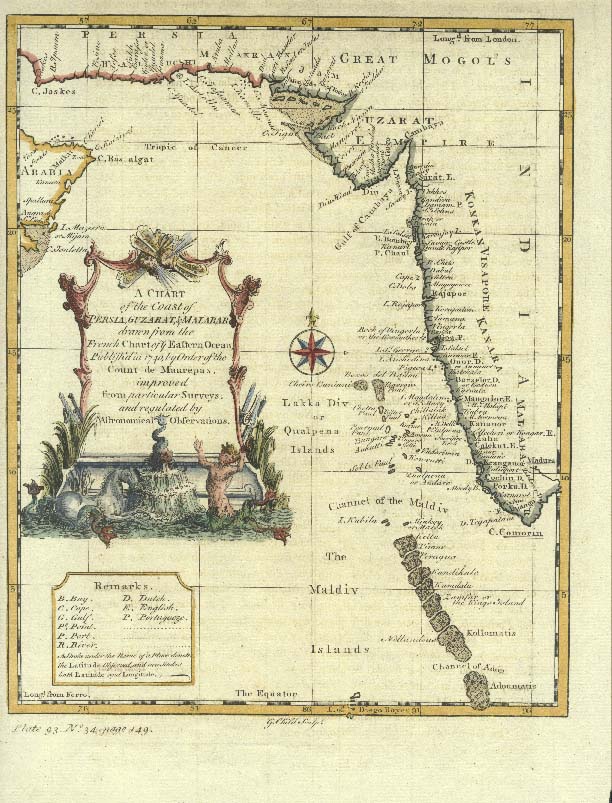
While we studied the stories of Kunhali IV, the conversion of the King of Tanur and so on, we came across the fact that the reigning Zamorin during those years had allowed building of churches in Calicut and other parts of Malabar, that he had a good relation with some of the Padres and even that he was somewhat influenced by them, especially so in the case of the capture of Kunhali IV. It is also mentioned that the Portuguese tried hard to ensure that this Zamorin did not get any ideas of alignment with the new entrants in the Malabar trade, the Dutch. Were their work purely missionary of was it a combination of commerce, politics and administration? A study of a couple of works throws much light on these questions and so let’s head to the Calicut during the last decades of the 16th century. As we go on, we will come across some very interesting ministers of Christ, a Zamorin who became more inclined towards the Portuguese, perhaps seeking peace on earth, his nephew who went on to convert to Christianity and as we already saw, a Raja of Tanur who converted. So let’s hasten to that Malabar which had just witnessed much turmoil what with the likes of Furtado and the naval warlord Kunhali IV.

Travancore lines – a Reality Check

Posted by Maddy Labels: , , ,

The Nedumkotta fortifications - A discussion

The Travancore lines were according to some historians, first planned by Marthanda Varma duly assisted by his general De Lannoy and built by the Travancore troops in order to protect Travancore and Cochin from the Zamorin’s attacks. Others mention that it was built by the succeeding Dharmaraja for the same purpose, with De Lannoy’s supervision and that they were further strengthened by Travancore to prevent any potential incursions by Hyder and later, by Tipu Sultan. It became a bone of contention between the Mysore Sultans and Travancore as well as the European powers, the Dutch and the English. I had also written about the battle which took place later, but the question in front of us is, who actually built these walls or lines? Was it built from scratch by De Lannoy, as reported by Travancore historians such as Nagam Aiya, Velu Pillai, Ulloor and many others? Or was history fudged a wee bit?

The Moplah Rebellion 1921 – A British Soldier's viewpoint

Posted by Maddy Labels: , ,

Donald Sinderby in Malabar

There are so many books with deal with the revolt in Malabar, or what the British Raj termed a rebellion (i.e. waging war against the crown) with a purpose to clamp down the area under martial law.  Some of these were written by Malayali congressmen and survivors, some others by the British administrators who were in the thick of things. There are very few firsthand accounts from the British side perhaps because such reporting was not encouraged. There is one, a work of historical fiction which gained a certain amount of popularity but vanished from the shelves after a while. Having obtained a dog eared 1927 copy of that book, I decide to peruse it carefully without tearing those ancient pages, with an intention of finding out what a common soldier thought about the whole thing. What you will read on is not a review but a summary of Sinderby’s opinion of Malabar, the Nairs, the administrators and the revolting Moplah, not about the love story which he wrote. In a way this book is unique since it is one of its kind, though the contents are not summarily of great value.

The Fathul Mubiyn, Qadi Mohammad and the Zamorin

Posted by Maddy Labels: , , ,


A study of the Fathul Mubyin, a war poem – Calicut 1550-1590

In a clamor to analyze and study the Tuhfat Al Mujahideen by Sheikh Zainuddin, most historians forgot a very interesting companion text which was perhaps a contemporary to the Tuhfat or even a forerunner. It is an urjuza short titled Fatḥul-mubyin and scripted by a Qadi Muḥammad al-Kālikūtī. To get to the details, we have to go to the Malabar of the 16th century, a place where many communities resided and traded amicably, until the Portuguese sailed in and demanded a monopoly. The resulting resistance, intrigues, skirmishes, wars and confusion left the entire region in a state of turmoil, what with neighboring Cochin and Kolathunad working with or even siding with the Portuguese. The bordering principalities of Tanur and Vettom sat on the fringes swaying either way depending on the situation. Those mainly affected were the trading communities comprising the Pardesi Muslims and some local Moplahs. The Pardesi community was a complex mix of Yemenis, Hanafi Arabs, Egyptians, Turks and so on. The biggest were the Yemenis who centered on Ponnani & Mambram and some Yemenis and Hanafis who settled in Calicut. Their leaders generally led the Muslim populace.

An American Consulate in Kerala?

Posted by Maddy Labels: , ,

Abbot L Dow 1880, and the story of Alleppey

Difficult to believe, right? But that was indeed the case. An early US representation in India did exist for a while at Alleppey, and this started first with the appointment of a commercial agent stationed there and his office was later upgraded to a consulate. The consular officer was one Mr Abbot L. Dow.

Hans Raj - The British Approver

Posted by Maddy Labels: , , , , ,

And his role in the Amritsar Massacre

I spent a considerable amount of time reading various published accounts of the infamous Jallianwala Bagh massacre. A summary of the events that transpired and an accounting of some of the persons who attained notoriety from it was posted the other day. But there was one thread that I did not unravel in that article, for I thought it deserved a more studious effort. That related to the murky role played by a person of some consequence and mentioned in the various records of the event. Many Indians refused to agree that it was a minor role and some even went on to characterize his role as a part of a large conspiracy. Who was that person and was there a conspiracy? Let’s check out the involvement of the infamous local lad Hans Raj, in the Amritsar massacre of 13th April 1919.

The Chalappuram Gang and the Ameen Lodge

Posted by Maddy Labels: , , , , , ,

Those turbulent years, Calicut (1920-34)

Calicut under British governance was a different place than you see it today. My own memories of childhood in Calicut take me to the days I spent with my aunt at Ambalakkat house, Chalappuram. I still remember the walk down the road from Ambalakkat towards Tali, turning right and going past the Chalappuram post office, past the gates of the Achutan Girls school and drifting to the Ganapati School, during my younger days in Calicut. And I recall the temple behind N Ambalakkat, the house of Karunakara Menon my grand uncle, Keshava Menon, Norman Achutan nair, the Anakara Vadakath people, and the homes of so many others who are going to be mentioned in this article, though they belonged to a bygone era. As I wrote in a previous article, it was a time when there were horse driven jutkas, cycle rickshaws and hand pulled rickshaws on the road. On those serene mornings, an odd Ex-servicemen bus roared by, scattering the people on the road hither and thither, and people were sometimes witness to a man (people held their noses as the wheelbarrow like cart with the galvanized iron pots passed by) held in much disgust, the ‘thotti’ who would trundle by, head hung low, pushing his night soil cart. Horns were hardly heard, the rickshaw drivers yelled ‘kooyi’ or rang a bell to get a right of way. The 30’s was still different, there was no electricity and the one person who gave a personal account and provided a vivid description of life in Calicut in the 1930’s is ARS Iyer.

Ullal - An account

Posted by Maddy Labels: , , ,

And the Abakka Rani

To the north of Kasaragod, where the historical borders of Malabar ends, is Manjeshwar and a little north of it, but south of Mangalore, bordering the Netravati River and facing the Arabian Sea is the small municipality called Ullal (Ullala or Olala). At one point in Malabar’s history, it had a connection to the Zamorin’s of Calicut and with the Portuguese. It is the story of Ullala which we will fish out today, but with some detail and background, for most books just pass it off as a couple of sentences mentioning a minor queen named Abakka Devi or Tirumala Rani. There was more than that, as you can imagine.

Conolly and the Calicut Canal

Posted by Maddy Labels: , , ,

The Canoli Canal of Calicut

The story of this Canal is quite engaging. Most people believe that the Elattur - Kallai canal as it was formally known was the brainchild of the man who lent his name to the project, the result of which was eventually called the Canoli Canal or more correctly the Conolly Canal. Well, the idea germinated well before that actually and what most people also do not know is that while Conolly lived to construct the canal, he also lost his life due to an argument over a simple monetary issue arising from this canal construction.

The Khilafat Movement, Turkey and Ataturk

Posted by Maddy Labels: , ,

Having lived in Turkey for a few years and having admired Mustafa Kemal Ataturk‘s rebuilding of that war torn nation into a modern Turkey, I was always curious as to what Mustafa Kemal had to say about India. After all, he had come eye to eye with many an Indian soldier working in the British Army at Gallipoli and slew many (a lot of them still rest in Turkish graves) and later hobnobbed with many an Indian Khilafat representative. This article will lightly focus on the Kemalist approach to the Indian Khilafat movement. As it all ended, it appeared that Mustafa Kemal had lost interest in the concept of the Caliphate and walked away from the whole thing, leaving the Indian side who had invested time, resources and huge amounts of money in Turkey’s support, bewildered and shattered.

The Conolly’s in British India

Posted by Maddy Labels: , , ,

And their tragic lives

Many have asked me questions about the Conolly family and over the years I had been trying to gather as much of detail as I could find. While I came across a reasonable amount of information on the father and his four sons, it was not really possible to go on any further in time, other than get a confirmation from a line of that family, presently resident in India, Australia and England, that they are indeed connected to the illustrious Conolly's of the 19th century.

The ICS Collectors of Malabar

Posted by Maddy Labels: , ,

British Governance - Calicut

There is a furor at Calicut these days resulting from the transfer of a benevolent collector popularly known as ‘collector bro’ and it appears that this resulted from the differences in opinion between bro and a member of parliament. I am sure much debate and argument will continue over this, but then again, it has always been like this. These positions of administrative bureaucracy though very important for any district are unfortunately at the mercy of the politicians. One only needs to look at the career of Malabar’s premier administrator William Logan. He was moved in and moved out of the Malabar Collector’s position no less than 7 times between 1869 and 1887 till he finally threw in the towel.