Cheraman Perumal and the Myths

Posted by Maddy Labels: ,

Revisiting the topic….

Some years ago I wrote briefly about this interesting bloke who appears often in Kerala History. Most of the discussions from readers focus around his retirement actions where he distributes his kingdom and goes off on a pilgrimage. I touched upon the topic a few times after that and more recently JK at Varnam penned an interesting article about the event

We see that in general the popular versions cover the travails of a Chera king who leaves the West Coast of Malabar, bound for another location which is purported to be variously Mecca in Saudi Arabia, Kailas in North India and the abode of St Thomas in Mylapore (there are many other versions too, but too obscure).  We see the possibilities of three or even four conversions in these stories, one to Islam, the second to Buddhism, third Jainism and finally to Christianity. The timelines vary widely, from the 9th to the 12th century. But each of these myths found takers and were promptly spread by both the Portuguese and the Dutch as well as Muslim scholars creating much confusion as to which was most probable.

Armed with a fascinating and thorough study done well before Indian independence by the doyen of Malabar history, Mr KV Krishna Ayyar, I decided to revisit the topic. Ayyar starts by confirming that it is an unsolved puzzle and after a thorough analysis, concludes with the Bhuvibhaga or Chera empire partition. It is a very difficult 25 page treatise, especially for those uninitiated to what is known as the Periyapuranam. It also requires you to have a working knowledge of the Keralolpatti, at least the version authored presumably by Tunjath Sankaran Ezhutachan in the 16th century. So without much ado let us get to the points raised by KVK and more specifically get introduced to the Tamil epic PeriyaPuranam (a.k.a Tiruttontarpuranam - the life stories of the sixty-three Shaiva Nayanars) penned by Sekkizhar in the early 12th century.

Set during the period of the Chola king Kulothunga II, the story goes that Sekkizhar a poet chief minister of his decided to wean the king away from his fascination of the 10th century Jain erotic epic Civaka Chintamani. Now you can imagine that it is a difficult task, but then again Sekkizhar wrote about the 63 Saivite saints, sitting in the thousand pillared hall of the Chidambaram temple. Interestingly, all of the saints mentioned in this epic are actual persons. Therefore, this is a recorded history of the 63 Saiva saints called as Nayanmars (devotees of Lord Siva), who incidentally belonged to different castes, different occupations and lived in different times.

As you may guess, one of these saints was none other than our Cheraman Perumal. KVK first of all establishes that the Malayalam sources like Keralolpatti are all proto-history works which are somewhat haphazard and purely inconsistent attempts at making a record of their history. As he himself explains, with a little patience, one can remove the legendary encrustations to reach the nucleus by reading through both works in detail. The entire work of Ayyar’s painstaking detection and deduction is best left where it has originally been published, so I will get to the crux of the matter, only briefly touching on the meticulous work starting with the establishment of the fact that the Tamil Cheraman is exactly the same person and the Malayalam Cheraman after carefully analyzing the dates seen in the documents. KVK establishes Cheraman’s date of birth as 742 AD, then his parentage, later his peculiar accession to the throne, his progeny, internal and external events to Tiruvanjikulam (Kodungallur), periods of strife, his division or partition of Malabar and finally pilgrimage and ascension to the heavens in 826 AD, following which the Kollam era was sanctioned.

In summary therefore, Cheraman was born in 742 AD at the Chera capital Tiruvanjikulam or Cranganore. He was the son of the sister of King Sengorporiayan. Interestingly his father was a Chola prince, who had strayed to the Chera court, and in those days the powerbases at Tamilakam were actually with the Pallavas and the Pandyas. Cheraman grew up in his uncle’s palace, but was mostly found in the Mahadeva temple of Tiruvanjikulam, interested mainly in the service of Siva. As times go by, he married a lady from the Nediviruppu kovilakom and had a son through her. His sister incidentally married the Perumbadappu Namboothiri. Cheraman’s son was Manavikiraman (the first Zamorin of Calicut) the Nedivirippu Thamburan, while his nephew became the Perumbadappu Thamburan (later known as the Cochin king). The fact that the Cochin and Kolattiri kings were higher born Kshatriyas while the Zamorin was a Nair born of the Sambandham with the Eradi lady has been the biggest bone of contention since in all the acrimonious issues between the three of them, for hundreds of years.

One thing bothered me though in this analysis. KVK is clear that there was just one son named Manaivicraman, not two boys as all other myths mention. He also details that the Cheraman sword is given to this one boy, (not two boys Manavan and Vikraman) following the battle at Palghat. He also states that this is the Manavikraman who becomes the first Zamorin. I wondered for a moment at how Palghat comes up in all critical points of passage in Malabar history! Later it comes to the fore again, when the Mysore Sultans attacked.

Life seems to have been going well, till Rajasimha Pandya decided to invade Kerala in 765AD. The powerful Pandya was not something the Chera ruler could contend with, so he decided to abdicate and retire to the forests, as the tale goes. The ministers of the palace were greatly perturbed, and agitated. By conjecture, the only male who could be persuaded to take over was young Cheraman as was the custom of Malanad (being the nephew and not the son) or for some other good reason such as a recommendation by the invader Rajasimha, who might have perceived that the ascetic ruler would be a good proxy, a man without heroic and kingly ambitions or inclinations.

Nevertheless Cheraman Perumal was an able king who rebuilt the 16 ports and temples, and built a fort Cheramankotta as well at the Northern border town of Valarpattanam near Talipparamba. Around this time, the great Sankaracharya was born in 788AD, adding luster to the King’s reign. However there was further strife at the Eastern borders and we see Pandyan attacks near Palghat, the establishment of the fort at Taravur (Tarur) and the takeover of Vizinjam. As the war continues, Manavikraman his son (in other stories we hear of two youngsters Manavan and Vikraman) rushes to his support and defeats the Pandyan king Varaguna in 782AD.


From here on, KVK observes Cheraman’s disinterest in worldly pursuits and in 810AD, he leaves on a pilgrimage after dividing up the land among his feudatories. He goes on to Chidambaram and then to Tiruvalur where he becomes a friend and disciple of Sundaramurti. They move on to tour various temples and places in Tamilakam, and after all this Cheraman and Sundara turn back to Malabar in 820AD. After a sojourn in Cranganore for another 6 years, both of them depart from this world (or leave for Kailas) in 826AD. The day is called Cheraman day which is an annual event since then, celebrated with pomp and splendor.

So as you see, KVK links up filtered events from Kerala proto-historians to the little bits of history he could dredge out from Periyapuranam in order to create a coherent account on the life of Cheraman Perumal. Of course he debunks the events leading to Perumal becoming a Muslim or a Christian.
But we can’t close the topic just like that, for there would be many unanswered questions hovering around the conversions, the division of land and so on. What could be the possible directions? Let’s check.

Quoting the words from the Census - The world knows nothing of its greatest men, and so it is with Cheraman Perumal, for while he is the most familiar and famous of the Viceroys of Kerala, while his name is in everybody's mouth from the most cultured Brahman down to the most ignorant Paraiyan, there are no reliable materials affording any definite information about his life and times. Cheraman Perumal's rule, from the important events it contained and from the little direct knowledge we have on the subject, has naturally attracted the attention of many diligent scholars, and many are the traditions that have gathered round his name. The Jains, Buddhists, Christians and Mahommedans all claim him as a convert to their religion. There is the tradition of a Perumal having become a Buddhist, or as others would have it, a Jain. It must be observed in this connection that Buddha Matam or Buddhism has often been confounded with any religion other than Hinduism, for in the days of the conflict between Hinduism and Buddhism, to a Hindu all non-Hindus were Bouddhas or followers of Budha, which term acquiring a general significance was indifferently applied in later times to the followers of Mahomed, Christ, etc. To a Hindu in Kerala, any one professing any religion other than Hinduism has been a Bouddha, a term which is even applied to a low caste Hindu. One of the Perumals is said to have renounced his faith, and become a Jain, and not a Mahommedan. His name is supposed to have been Pallibana Perumal.

First we go to the Tuhfat Al Mujahideen. Sheik Zainuddin admits that even during his period, the Hindus had stated that the king ascended to the sky. They also believe that he will come down one day and that is the reason why they keep a pitcher of water and a pair of sandals with lit lamps and decorations at a place near Kodungallur on certain nights. So there is a good amount of backing to the Periyapuranam story. Nevertheless, Zainuddin does not provide any factual support to the story of this perumal going to Makkah. Also there is confusion about the dates with Zainuddin stating this happened in the 9th century while others state it was during the reign of the Prophet Mohammed. Zainuddin is clear anyway that this person could not have been the Cheraman Perumal. Ibn Batuta writing in 1342 mentions the king of Balipatanam as the convert, dating it to the 13th century and Abdul Razak visiting Calicut in 1442 does not mention these stories at all (for him it would have held great propaganda value!). Ferishta, the Mohammedan historian, is positive that the Malabar king who embraced the Moslem faith and went on a pilgrimage to Mecca, at the end of the 9th century, is a Zamorin of Calicut.

Cheraman becoming a St Thomas Christian is alluded by Decouto and Faria Souza, and here again there is confusion about the dates, and there is also mention of the Cheraman being one of the three wise magi’s visiting the infant Jesus. The problem is that the dates fluctuate between the birth of Christ and the 4th or 6th century and so it seems difficult to lend the stories too much credence.

So in all the conversions of Cheraman Perumal to Christianity and Islam seem to be backed with little by way of fact or conjuncture. Buddhism on the other hand was in the decline already by 850AD, and Jainism in Malabar predated it by many centuries, so it is very probable that the Periyapuranam account borders the truth that the Perumal eventually passes away while on his pilgrimage. But there is another twist in the analysis of legends, for it is stated in the Census of India as follows relating to the Jain link.


As far as the handing over of the kingdom is concerned, KVK clarifies that this was how it always was and these local feudatories were under the suzerainty of the Perumal at Cranganore. When the king left on his trip, all he did was release them from that symbolic connection. He could have asked his son Manavikraman to take over but that was not permitted in those days as he was not a Kshatriya.

But when he left, he authorized the Zamorin to annex what he could wisely, with his sword. As the Zamorin had no areas in profitable regions or ports he could only annex them by might.

PC Alexander in his ‘Dutch in Malabar’ concurs by stating that the Perumal died a Saivite and never converted. And he indicates that the mural in the Brahadeeswara temple in Tanjore depicts the Perumal proceeding to Kailas with his friend. MGS Narayanan agrees with KVK’s theories and connects the first Cheraman Perumal to the Periyapuranam and names him the Rama Rajashekara – Rajadhiraja Parameswara Bhattaraka of Makotai. Sadasivan says that the king of Maldives was the person who converted to Islam.

I am sure the myth will remain for more decades, but the above is a summary of the studies of KVK Ayyar, which I believe makes a lot of sense.

References
Bharata Kaumudi Pt 1, 1945 - Cheraman Perumal – A New study – KV Krishna Ayyar
Perumals of Kerala – MGS Narayanan
Census of India, 1901, Parts 1-2


Debtor’s circle

Posted by Maddy Labels: , ,

Settlement of unpaid debts – an old tradition in Malabar

Today you have enforcers who are wandering round, looking for debtors on the run. There are collection agents who come and seize cars which are not being paid for with agreed regularity, and we see musclemen on the prowl these days, as depicted in the movies, to provide some firm persuasion. You also see ad’s like the one below in newspapers for debt collection executives, promising a handsome salary.

Needed – executive to help collect over-dues and discuss with customers on best possible payment plans, should possess strong and firm verbal communication and negotiation Skills, a good amount of Intelligence, be persistent and Firm, and persuasive in reasoning. Unsaid requirement – be of muscular build and capable of depicting an aggressive demeanor

But things were a little different some 500 -900 years ago and this peculiar custom in Malabar was first brought to light by Al Idrisi in 1154AD. He explained – If one man owes another some money and the creditor locates him, he draws a circle around him. The creditor also enters the ring and the debtor cannot go outside the ring till the creditor is satisfied or forgives him.

From this arose an old Malayalam idiom ‘vattathil akkuka’ (being put into a circle) which is somewhat colloquial for harassment. Whether ‘vattam chutti’ (going in circles) also falls in the same category is not clear, but I hope you get the idea.


Varthema wrote of a custom he found in the Malabar ports by which the administration of civil justice was considerably simplified. The king had 100 scribes, and in case of debts evidenced by deeds in the handwriting of these scribes, the law provided a summary remedy. "If the debtor promising many times, fails to pay, the creditor not willing to wait any longer nor give him any indulgence, takes a green branch (of a palm) in his hand, goes softly behind the debtor, and with the said branch draws a circle on the ground surrounding him, and if he encloses the debtor within the circle, says to him these words three times ' Brahmananane rajavinane purath pokalle, i.e., I command you in the name of the Brahmins and in the name of the king, not to leave the circle (until you have paid the debt). If the debtor left the circle without paying the debt, he was liable to the penalty of death."

Archibald Williams adds a twist in his memoir - In order to secure payment from a persistent debtor, the creditor tries to draw a circle round him on the ground, saying three times, “ By the head of the Brahmins and of the King, you shall pay me what you owe before you quit the circle.” The debtor thus encircled must either pay or die of starvation; for nobody may give him food; and death is the penalty for crossing the line without payment.

The green branch of a palm, says Ibn Batuta, was also used by the officers of the king to help the collection of the royal dues from the merchants. If the merchants did not pay the royal dues, an officer of the king came with the green branch of a palm and suspended it in front of the shop. No person could buy or sell from the merchant until the branch was removed.

The rule was applicable both to nobility as well as to the common man and Marco Polo visiting Ma’abar emphatically claims he was an eye witness where the king was harassed so. Marco Polo states (Cordier -Yule)-  They have the following rule about debts. If a debtor shall have been several times asked by his creditor for payment, and shall have put him off from day to day with promises, then if the creditor can once meet the debtor and succeed in drawing a circle round him, the latter must not pass out of this circle until he shall have satisfied the claim, or given security for its discharge. If he in any other case presume to pass the circle he is punished with death as a transgressor against right and justice. And the said Messer Marco, when in this kingdom on his return home, did himself witness a case of this. It was the King, who owed a foreign merchant a certain sum of money, and though the claim had often been presented, he always put it off with promises. Now, one day when the King was riding through the city, the merchant found his opportunity, and drew a circle round both King and horse. The King, on seeing this, halted, and would ride no further; nor did he stir from the spot until the merchant was satisfied. And when the bystanders saw this they marveled greatly, saying that the King was a most just King indeed, having thus submitted to justice

Yule adds as a foot note - This custom is described in much the same way by the Arabo-Persian Zakariah Kazwini, by Ludovico Varthema, and by Alexander Hamilton. Kazwini ascribes it to Ceylon. "If a debtor does not pay, the King sends to him a person who draws a line round him, wheresoever he chance to be; and beyond that circle he dares not to move until he shall have paid what he owes, or come to an agreement with his creditor. For if he should pass the circle the King fines him three times the amount of his debt; one-third of this tine goes to the creditor and two-thirds to the King." Pere Bouchet describes the strict regard paid to the arrest, but does not notice the symbolic circle. (Gildem. 197; Varthema, 147; Ham. I. 318; Lett. Edif. XIV. 370.)

Rev. Dr. Caldwell adds a footnote "The custom undoubtedly prevailed in this part of India at a former time. It is said that it still survives amongst the poorer classes in out-of-the-way parts of the country, but it is kept up by schoolboys in a serio-comic spirit as vigorously as ever. Marco does not mention a very essential part of the ceremony. The person who draws a circle round another imprecates upon him the name of a particular divinity, whose curse is to fall upon him if he breaks through the circle without satisfying the claim."

Forbes wiring his oriental memoirs provides details of a version that has become stringent as times went by - For debts, and non-payment of fines, inflicted as a punishment, they are confined by the caricar (Kariakar), or-chief of the district; who draws a circle round the prisoner, from which he dare not move; then, gently laying a sharp stone on the crown of his head, demands payment of the sum required: on a refusal, he places a large flat stone over the other, and ties it firmly on; additional weights are gradually accumulated, with a repetition of the demand, until the sharp stone-penetrating the head, either insures payment, or causes a painful death.

Vissicher provides details of differing methods from Dutch Cochin - For laying the property of another in arrest, the warrant of a magistrate is not required ; any private individual may do it ; so that a man of low caste has it in his power to harass and annoy a Brahmin or a Caimal, through his lands and properties. The Rajahs possess the same power over each other. However, although license is not required for the performance of this embargo, the Rajah’s authority is necessary to settle the affair; both parties must appear before him, and after duly weighing the merits of the case, and receiving a sum of money, he gives judgment. When Rajahs thus arrest each other’s property, it is a fruitful ground for wars and dissensions: mediators are sometimes called in to arrange the matter.

The token of this embargo or arrest, is the leaf of a cashew nut or other tree which is tied on the article thus arrested, or if it be land, it is stuck up on a stick, the party exercising this privilege announcing, “this is the Rama, or arrest of the Rajah.” After this no one may gather the fruits off the lands or remove the token; such act would be considered crimes of lese majesty. The East India Company exercises the same right, and on such occasions they plant their flag on the spot: but this is only done by order of the Commandant or the proper authorities. In the lands subject to the Company, the Commandant may remove any rama, placed by a native. The residents in the small outlying stations, are obliged to suffer the ramas of the Malabars, and are allowed to exercise the same privilege on their side.

The Resident of Porcad told me an entertaining anecdote on this subject. He had once caused a rafter to be brought to the station for the repair of the factory; when it was close to the building, a Nair came and fastened a rama, to it, upon which the coolies who were carrying it, ran away, as it was illegal for them to touch it any longer. The Resident being informed of what had occurred immediately planted the Company’s rama on the spot, so that the parties who were so ready with their arrest, were themselves arrested; and compelled to stand without stirring a foot in the heat of the sun, until such time as the first rama was removed by order of the Rajah, then the Resident released them.

In a similar manner, when the Rajah owes money to a Brahmin who can adduce satisfactory proof of the debt, the creditor can demand the money of the Rajah, three distinct times, and if the Rajah still delays payment, the Brahmin brings a rama from a pagoda, when the Rajah may neither eat, sleep or bathe till the dispute is settled and the rama removed. Such cases however do not often happen, for the people know that monarchs have long arms.

I am however not sure what this ‘rama’ is – perhaps some kind of flag…

Hamilton writing in 1723 continues in the previous vein…They have a good way of arresting people for Debt, viz. There is a proper person with small stick from the Judge, who is generally a Brahman and when that person finds the debtor, he draws a circle round him with that stick, and charges him, in the King and Judge's Name, not to stir out of it till the creditor is satisfied either by Payment or Surety; and it is no less than death for the debtor to break Prison by going out of the circle.
Now that we have talked about the Debtor’s circle, let us take a look at another system that is still practiced by protesters in India, called the Dharna. What was that? We hear about the Dharna method as early as 1615 from Roger Hawkes. In fact he says he had to use the method himself to get his debt with the Zamorin settled.

The 20th December, a Malabar captain brought in a prize he had taken from the Portuguese, and would have traded with us; but we could not get in any of our money, due long before. We also heard that day of four English ships being at Surat. The governor and people continued their wonted perfidiousness; the former being more careful in taking and the latter in giving bribes, than in paying our debts. We used a strange contrivance of policy to get in some of these; for, when we went to their houses, demanding payment, and could get none, we threatened not to leave their house till they paid us. We had heard it reported, that, according to their customs, they could neither eat nor wash while we were in their houses; and by this device we sometimes got fifty fanos from one, and an hundred from another. They would on no account permit us to sleep in their houses, except one person, with whom we remained three days and nights, with three or four nayres.

So as we can generalize, it is the medieval and modern practice of sitting in dharna, once used against debtors, by literally 'holding up' a defaulting debtor with a threat to commit suicide at his door by starvation. This ‘door sitting’ practice has its origins from the laws of Manu and we also note a looser form of dharna, called takaza, which permits the creditor to institute by proxy, a regular siege of the debtor's house.

Westlky details it - The creditor would sit dharna at the debtor's door or gate, until some arrangement or instalment was extorted by his importunity. Lord Teignmouth gives us an interesting description of the process of sitting dharna, and the principle involved. The Brahmin creditor proceeds to the door of his debtor and there squats himself, holding in his hand some poison, a dagger, or other instrument of suicide, which he threatens to use if his debtor should attempt to molest him or pass by him; and as the inviolability of a Brahmin is a fixed principle with the Hindoos, and to deprive him of life, either by direct violence or by causing his death in any way, is a crime which admits of no expiation, it will readily be seen that the debtor is practically under arrest in his own house. "In this situation," concludes Lord Teignmouth, "the Brahmin fasts, and by the rigor of etiquette the unfortunate object of his arrest ought to fast also, and thus they both remain till the institutor of the dharna obtains satisfaction. In this, as he seldom makes the attempt without the resolution to persevere, he rarely fails; for if the party thus arrested were to suffer the Brahmin sitting in dharna to perish by hunger, the sin would forever lie upon his head." It became a popular tool for Gandhi during the independence movement and is sadly used to date in India for various protests.

To lend much higher gravity, a Brahmin was employed as proxy to execute the dharna at the debtor’s house.

Fink summarizes - A faint trace of the origin of the practice will be found in the fact that the creditor who resorted to dharna, often found it necessary to hire a Brahmin to starve himself vicariously… At this juncture, it is more than probable that the creditor arrested the arm of the debtor by hiring a Brahmin whose person was always held sacred, and who could not be resisted with violence. The Brahmin thus retained, adopted his own peculiar method of fasting at the door, and even put the debtor under immediate fear by providing himself with some instrument of suicide…To permit a man to starve or fast at your door without relieving his wants, was always looked upon as an act which, in the next world, placed the beggar in enjoyment of heaven, and reversed the condition of the rich man to that of deplorable misery. It was a dread of this supernatural retribution which, in India, made fasting at the door such a powerful instrument in extorting charitable donations to the Brahminical priesthood. And it will be observed that sitting dharna was always undertaken where the debtor was a man of wealth or of superior caste to the creditor.

Was this kind of circle drawing noticed elsewhere in the world? William Ian Miller explains - The Talmud tells of a certain Honi HaMe'aggel (Honi the Circle Drawer) 1st century CE who was asked to pray for rain to relieve the community from drought. In an incident that could have been lifted from an Irish saint's life or from Hindu debt-collection rituals, he drew a circle around himself.

The Chinese practiced a much more sensible variety of dharna than the Hindoos. Instead of starving themselves to death, and broiling in the sun or shivering in the rain, creditors simply quartered themselves and their families upon their debtors, and the latter were generally glad to get rid of their unwelcome guests by scraping together and paying off the amount due. A debtor who was unable to meet his obligations could be compelled to wear a yoke round his neck in public, the hope of the creditors being that the man's friends or relatives would pay off his debt in order to save him from a prolongation of this terrible disgrace.

Sitting dharna was said to be practiced in Persia as well in those days. A man intending to enforce payment of a demand by fasting, begins by sowing some barley at his debtor's door, and sitting down in the middle. The idea that the creditor means to convey to his debtor by this is, that he will stay where he is without food, either until he is paid, or until the barley-seed grows up and gives him bread to eat. Something similar to this dharna was known in ancient Ireland. One of the Brehon laws enacted that a notice of five days was to be served on a debtor of inferior grade, and then distress was to be taken from him. But if the defendant was a chieftain, a flaith, a bard, or a bishop, the plaintiff was obliged to "fast upon him" in addition. The Troscead, or fasting upon one, consisted in going to the debtor's house and waiting at his door a certain time without food. The law ran: "He who refuses to cede what should be accorded to fasting, the judgment on him is that he pay double the thing for which he was fasted upon." If, however, the debtor offered a pledge or security for his debt, and the creditor stubbornly refused to accept it, he, the creditor, forfeited his entire claim.

But well, these kind of things are no longer workable methods to collect debt, life has changed, crooks care not a hoot, though Dharna is still a popular method of protest in India. Humorous scenes of the starving politician sipping lemonade under cover can be seen in movies. So also can be seen movies where the Chinese method of moving into the debtors home are practiced in Kerala, exemplified by Mohanlal’s and Priyadarshan’s great movie of yesteryears – Sanmanassulavarkku Samadhanam.

References
Essays from Travancore – Ulloor S Parameswara Iyer
The Travels of Marco Polo: The Complete Yule-Cordier Edition: By Marco Polo
Oriental Memoirs – James Forbes
OLD LAWS CONCERNING DEBT. By Georgk H. Westlky.
The Romance of Early Exploration - Archibald Williams
A New Account of the East Indies – Alexander Hamilton
THE HINDU CUSTOM OF 'SITTING DHARNA.' By H. R. Fink. (THE CALCUTTA REVIEW)
Letters from Malabar - Jacob Canter Visscher, Heber Drur


Gandhiji’s visit to Calicut - 1920

Posted by Maddy Labels: ,

We talked about the salt fields and the salt march at Calicut in a previous post and the research naturally led to Gandhiji and his visits to Kerala and particularly Calicut. He came twice to the Malabar headquarters in those days, at first in 1920 in connection with the Khilafat movement. Let’s take a look at those days.
First a few words about the Khilafat movement. Following the defeat of Turkey in WWI, the british decided to abolish the office of the Kahlifa or the highest religious institution for Muslims in 1918, and break up the Ottoman empire by 1920. The Caliphate as you may know, is an Islamic system of governance in which Islamic law is used for state rule. The Muslims of SE Asia joined hands in the protest against this, and India was foremost in the campaign. With Gandhiji’s exhortation, the Hindus slowly joined hands with the Muslims in this regard and presented a combined face against the British. The non-cooperation campaign was initially quite successful as protests, strikes and various acts of civil disobedience spread across India. Hindus and Muslims joined up to offer peaceful resistance. To spread the word, Gandhiji and Shaukat Ali decided to travel around India.
Gandhi and Shaukat Ali traveling from Trichy, arrived at Calicut on the 18th August 1920. They arrived around 2.30 p.m. and alighted at the Kozhikode railway station and were garlanded by Khan Bahadur Mootha Koya Thangal. Their host was Shyamji Sunderdas (Crocin sole selling agent) at the Gujarati Street in Calicut, and this was where Gandhi stayed during this and later visits. The meeting for the public was organized at the Vellayil beach and lawyer VV Rama Ayer (father of VR Krisha Iyer) presented the welcome address on behalf of the taluk board. Popular accounts point out that some 20,000 people turned up at the Kozhikode beach that evening at 630PM to hear Gandhiji talk. K. Madhavan Nair translated and at the end of the speech, KP Raman Unni Menon handed over a check of Rs.2,500/- as a contribution to the Khilafat fund. Later, his Gujarati host entertained the members of his party and others with a sumptuous dinner.
Peeking into “the Source material for a history of the freedom movement in India” Volume 3, Part 1,pages 318-319, we find the following report


Generally speaking there is little sympathy with the non-co-operation movement at Calicut, and were it not for a few fanatical Mappilla youths headed by P. Moideen Kutty and brief-less vakils led by K. Madhavan Nayar, Gopala Menon and P. Achutan, no notice would be taken of it.
In the afternoon there was a private conference at Gandhi's residence. Nearly all the vakils and a few Mahommadans attended. Gandhi advised the vakils to suspend their practice and withdraw the children from Government aided schools; but apparently he failed to convince his audience, most of whom thought his scheme unworkable. At the evening meeting Rs. 2,500 was presented to Shaukat Ali; but he was disappointed and expected more. The Seths (Bombay Merchants) were responsible for the reception; the local leading Mahommadans took very little interest in the visit. The money was chiefly collected on Gandhi's behalf, more as a personal matter than anything else. The result of the visit generally may be regarded as a failure.
PGHS - Photo provided by Premnath Murkoth
Extract from speeches delivered by Gandhi and Shaukat Ali at Calicut on the 18th August.
Subject — Non-co-operation. Audience- ten to fifteen thousand.
Mr. Gandhi said, "I am here to declare for the tenth time before this great audience that in the Khilafat matter the British Government have wounded the Moslem sentiment as they have never done before, and I say without fear of contradiction that if the Mussalmans of India had not exercised exemplary self-restraint and if they had not accepted the gospel of non-co-operation preached to them, and if they had not accepted the spirit of that gospel, there would have been blood-shed in India by this time
A more complete text of the speech can be found in Appendix 2 of Moplah Rebellion 1921 by C Gopalan Nair. He explains that following this visit, Khilafat committees were formed in Malabar and the swaraj idea began to take root. We also see the following text in the speech.
If the Mussalmans of India offer non-cooperation to Government in order to secure justice on the Khilafat, it is the duty of every Hindu to co-operate with their Moslem brethren. I consider the eternal friendship between Hindus and Mussalmans as infinitely more important than the British connection. I therefore venture to suggest that if they like to live with unity with Mussalmans, it is now that they have got the best opportunity and that such an opportunity would not come for a century.
Continuing with the source material documents we now see something different.
Gandhi and Shaukat Ali passed through North Malabar District enroute to Mangalore on the 19th August and returned on the 20th August. Train stopped at most stations. On the 19th there was great enthusiasm at Tellicherry and Cannanore and to a lesser degree at Badagara and Tallparamba Road. A large crowd had assembled at the first two places; some people were evidently full of zeal, but the majority were curious sight-seers. Of course there were garlands, flowers, etc., flung about, and at both places the usual speeches by Gandhi at Tellichery and Shaukat Ali at Cannanore were received with cheers. The crowds were good humored and rather enjoyed the squash at the railway stations. The people were curious to see what the leaders were like, and treated them as a huge joke—at least this was the conclusion drawn from their faces, demeanor and conversation. The interpreter did what he could to exaggerate every sentence uttered. Every caste and tribe in Malabar was represented at the stations on the journey to Mangalore.
On the return hardly anybody came to see Gandhi at the many stations stopped at. A more unsatisfactory tour so far as North Malabar District is concerned from their point of view could hardly be described. The Khilafat agitators have failed miserably to carry the public with them along the road to non-co-operation, and Gandhi has broken or will break the spirit of these very agitators by his unswerving devotion to the full spirit of the idea. He cannot carry these people along the straight way he had laid down for their guidance. He may be a semi lunatic, but these people are not.
At Cannanore they got Rs. 500 and Shaukat Ali said it was not enough. A rumor went round in Tellichery that the Government has forbidden the Mahommadens of Baghadad to perform "Mowlood" i.e. to sing poems regarding the Prophet's life. This worries the Mappilah, and that is about all.
As Gopalan Nair explains the aftermath - In the beginning it was not a very serious affair, the Moplah felt it an honor to be called upon to take part in meetings presided over by the Saintly Mahatma, by the Great Moulana, by barristers, High Court Vakils and other prominent men; he did not well understand the lengthy speeches delivered at meetings; but he felt himself elevated: he, grew in importance, as a Khilafat member; his Musaliar was the secretary; his Thangal graced the position of chairman of the Khilifat Committee; he rose higher and higher until he found himself a prominent member of the Hindu-Moslem Brotherhood; working for the attainment of Swaraj, for the salvation of the Khilafat; and of his own country, in which, under the British regime, the Indians were treated as 'coolis' and 'slaves’………

The movement collapsed by late 1922 when Turkey gained a more favorable diplomatic position and moved toward secularism, led by Mustafa Kemal Ataturk. By 1924 Turkey simply abolished the roles of Sultan and Caliph. In India, the alliance between the Congress and the Khialaft leaders petered out as each felt the other had cross purposes, and due to the lack of support from the core groups viz Muslim league and the Hindu mahasabha. Critics of the Khilafat started to see its alliance with the Congress as a marriage of convenience and various proponents of the Khilafat saw it as the spark that led to the non-cooperation movement in India and as a major milestone in improving Hindu-Muslim relations, while advocates of Pakistan and Muslim separatism saw it as a major step towards establishing the separate Muslim state.

So we can see that while initially the Khilafat movement in Malabar was taken up enthusiastically, it petered off and culminated in the 1921 revolts. I had covered those aspects in some detail in previous posts.

In total Gandhiji visited Kerala 5 times, and always considered the state a true experimental ground. In fact the atrocities of the 1921 revolt so depressed him that he decided to visit Calicut again, but he was stopped by the British at Waltair station and eventually he went to Madurai. The white worn by the people of Malabar and their simplicity was in his mind. That was when (Sept 1921) he decided to discard his clothes and wear only the loin cloth which became his trademark.See the following article

This Malabar visit in 1920 and another in 1925 to Travancore did make a huge impact on Gandhiji, for he was as always a keen observer of the common man and his ways. Gandhiji later wrote about this latter visit thus…..

And as I travelled, I seemed to go from one end of a beautifully laid out garden to the other. Travancore is not a country containing a few towns and many villages. It looks like one vast city containing a population of over 400,000 males and females almost equally divided and distributed in small farms studded with pleasant looking cottages. There was, therefore, here none of the ugliness of so many Indian villages in which human beings and cattle live together in an overcrowded state in spite of the open air and open space surrounding them. How the Malabaris are able to live thus in isolated cottages and to feel, as they evidently do, safe from the robber and the beast I do not know. Those of whom I inquired about the cause could not say anything beyond corroborating my inference that both men and women must be brave.

Following a meeting with the Sethu Lakshmi Bayi of Travancore, he wrote

Instead of my being ushered into the presence of an over-decorated woman, sporting costly diamond pendants and necklaces, I found myself in the presence of a modest young woman who relied not upon jewels or gaudy dress for beauty but on her own naturally well-formed features and exactness of manners. Her room was as plainly furnished as she was plainly dressed. Her severe simplicity became the object of my envy. She seemed to me an object lesson for many a prince and many a millionaire whose loud ornamentation, ugly looking diamonds, rings and studs and still more loud and almost vulgar furniture offend the taste and present a terrible and sad contrast between them and the masses from whom they derive their wealth. I had the honour too of waiting on the young Maharaja and the junior Maharani.

I found the same simplicity pervading the palace. His Highness was dressed in a spotlessly white dhoti worn in the form of a lungi, and vest reaching just below the waist. I do not think he had even a finger-ring for an ornament. The junior Maharani was as simply dressed as the senior Maharani the Regent. It was with difficulty that I could see on her person a thin delicate mangala mala. Both the ladies had on their persons spotlessly white cotton hand-woven saris and half-sleeved jackets of similar stuff without any lace or embroidery.

I must own that I have fallen in love with the women of Malabar. Barring Assam I have not seen the women of India so simply yet elegantly dressed as the women of Malabar. But let the Assamese sisters know that the women of Malabar are, if possible, simpler still. They do not require even borders to their saris. The length needed is under four yards, a sharp contrast to the Tamil sisters on the east coast who need nearly ten yards heavily coloured saris. The Malabari women reminded me of Sita as she must have been dressed when she hallowed with her beautiful bare feet the fields and forests of India along the route she traversed. To me their white dress has meant the emblem of purity within. I was told that in spite of the utmost freedom they enjoyed, the women of Malabar were exceptionally chaste. The eyes of the most educated and advanced girls I met betokened the same modesty and gentleness with which God has perhaps endowed the women of India in an exceptional degree. Neither their freedom nor their education seemed to have robbed them of this inimitable grace of theirs. The men of Malabar in general are also just as simple in their taste as the women. But, sad to say, their so-called high education has affected the men for the worse and many have added to the simple articles of their original dress and in so doing have purchased discomfort in the bargain. For, in the melting climate of this country the fewest white garments are the proper thing. In making unnatural unbecoming additions they violate the laws of both art and health.
His second visit to Kerala was in 1925 to lend support to the Vaikkom satyagraha and he passed through Calicut in 1927. His next visit to Calicut was in 1934 and his final visit in 1937. When you read accounts of this visit, you will find the calculated congress planning in the official records and the more passionate aspects from the public in their own accounts. The 'Beach Road' was renamed Gandhi Road from Evan's Road after Mahatma Gandhi's visit in January 1934

References
Source Material for a History of the Freedom Movement in India: Mahatma Gandhi. pt. 1. 1915-1922
Moplah Rebellion 1921 by C Gopalan Nair


Wishing you all a happy new year 

The story of Dom João de Tanur

Posted by Maddy Labels: , , ,

When the Tanur king converted to Christianity

The scene - After Vasco da Gama’s unsuccessful attempts in obtaining a foothold in Malabar to increase the pepper shipments to Lisbon and after Cabral’s show of force failed to shake the Zamorin, the Portuguese settled down around 1500 with their newfound ally the Cochin raja. The furious Zamorin had decided then to teach the Cochin king a good lesson. Intrigues and battles followed, with one or the other ascending the ladder of supremacy. But the Raid on Cranganore (October, 1504) and the defection of the Tanur king to the Portuguese were serious setbacks for the Zamorin. These events pushed the front-line of battles north and effectively placed the Vembanad lagoon out of reach. Any hopes the Zamorin had of quickly resuming his attempts to capture Cochin via the backwaters were effectively dashed.

Chaliyam’s (the nearby locales of Parappanad, Beypore, Tirur, Tanur are all known in history from ancient times and form part of this locale) history is certainly checkered after that, and the events in that region were to determine the futures of many a king, namely the Zamorin, the Portuguese, the Chinese, the Arabs and Moplahs. One can think a bit and easily figure out why the place was important. One was the access to the river Bharatapuzha, trade connected to it and secondly the geography of the vicinity. As you will note the serene Puzha flows over the Nila valley and empties the waters from the mountains into the Arabian Sea at Ponnani, so it was an important sea port that connected though a major river to inland centers where material for trade arrived. This locale in early Malabar history was called Vettathnaad, Vattathunad, Vattathukovil, Prakasha Rajya or land of light. Today the family that ruled these areas is extinct, and their story is not very easy to piece together, but we do know that at one time, one of the chieftains for the sake of survival even changed religion to side with the Portuguese. Rivalry with the neighboring Zamorin of Calicut determined the future of that place.

Readers should note that there were two chieftains, one being the Tanur king or Vettath raja, the other being the vassal of the Zamorin called the (N) Parappanad raja. Vettatnad (Vettam) or Tanur Swarupam comprised of parts of Ponnani and Tirur Taluks. It included within itself such places as Tanur, Trikkantiyur, Chaliyam, Triprangode etc. Chalium on the other hand was controlled by the Parappanad raja called UrinamaThe Tanur kingdom was in those days very learned, and produced many famous people, mathematicians and artists. Tanur was thus a swaroopam. Somewhere during the 1350 period the wars between the upcoming Zamorin and the Vettah raja intensified and the dynasty were defeated by the Zamorin. The Ponnani port was very important for Arab trade and thus the strategic importance meant that the Zamorin had to have a long term relationship with the raja. Following this the Tirunavaya wars took place and in the uneasy truce that followed the Vettam raja was given a significant position in the ceremonious Mamankham where he stood to the left of the Zamorin and the Shahbandar koya of Calicut to his right.

The local kings of Vetathunaad, Beypore and Chaliyam did not quite like the policy adopted by the Zamorin (recall that they were connected family wise to the Cochin king already, not to the Zamorin) to conquer Cochin. The Vettath raja was the first to decide that he should align himself to the Portuguese and obtain an insurance against a Zamorin overture.

Initial forays in 1504 by the Portuguese to firmly ally with Tanur and find other allies in the region were not conclusive but the Tanur Raja helped some shipwrecked Portuguese in 1528 by giving them shelter & support. Da Cunha who succeeded Lopez finally sued for peace with the Zamorin towards 1529, after a tumultuous period where fortunes seesawed. Da Cunha seizing the opportunity sought support from him to build a fort in Tanur. However the building materials shipped for that purpose were lost in a shipwreck.  Tanur continued to be in the Portuguese eyes for they not only had rice, coconuts and tradesmen, but also a number of ships. But the Portuguese had established a fort in Calicut instead and this lasted during 1513-1525 before being destroyed.

At Calicut a new Zamorin had come to the sthanam in 1531. Da Cunha, hell bent on securing that strong foothold in Malabar, enticed the Chaliyam Raja - Unni Rama by offering 2000 pardaus and 50% of the customs revenue, and requested permission to build a fort, which he agreed to after persuasion by his neighbor the Raja of Tanur. Using stones from the tombs and the old mosque (quoting Zainuddin Mukkadam) at Chaliyam or Pappu kovil, the Franks finally started building their base much to the annoyance of the local Muslims. With the help of the Chaliyam raja, a fort and a chapel ‘Santa maria de Castello’ were built at Chalium in 1532, together with a house for the commander, barracks for the soldiers, and store-houses for trade. The thoroughly incensed Moplahs and Arab moors appealed to the new suzerain at Calicut (Note that Tanur, Chaliyam and beypore were always under the Zamroin’s suzerainty). As you will realize, the fort at Chalium was strategic for it controlled the entrance to the sea and the waterways providing much control over trade in the region.

When the Zamorin remonstrated, the Chaliyam raja immediately agreed to stop support for the Portuguese, but the Tanur (Vettath) Raja decided to formally side the Portuguese and even take a step further by converting to Christianity to get the full support of the Franks (the Cochin king had meanwhile, refused to convert) and protect himself in future endeavors. The dates go a little awry here, for Krishna Ayyar mentions that these events took place in 1531, however Jesuit documents reconfirm 1545 as the date when the conversion of the king was planned to be carried out in secret.

It was sometime in 1545 that Francis Xavier came to Malabar. He left Lisbon in 1541 and by fall 1542, he had reached the fishery coast to tend to the Paravas (Read my articles listed under references for further details of his work and the persona of Joao da Cruz). While Xavier did succeed in getting many conversions done, his work was considered to be very unsystematic. This was the time when a new iron handed rector named Antonio Gomes entered the scene and soon locked horns with Xavier, but Xavier was on his way to Japan already after being disappointed by the Indians (barbarians, inconstant, and liars according to him) compared to the Japanese whom he found likeable. Xavier who was in theory Gomes’s superior, also found the Portuguese bureaucracy stifling. Gomes using his stronger connections in Lisbon, decided to start a number of Jesuit colleges and Chale or Claliyam was one of the locations he chose. Gaspar Barzaeus was to take care of this college. Xavier complained that António Gomes had no qualifications “to be in charge of the brothers in India and of the college”. But while the Jesuit college proposal for Chale never took off, Gomes did end up in Tanur.

Quoting Zupanov - From April until September 1549, he resided in part in Tanur, close to the Portuguese fortress in Chale, and in part traveled down the Malabar Coast. Officially, he had been sent by Bishop Juan de Albuquerque to instruct the king, who had been secretly converted to Christianity the previous year and who, in Gomes’s words, was “a man of good prudence and knowledge and, in what he shows he does not aspire to anything more than his salvation. In fact, more than or in addition to his spiritual salvation, the king of Tanur banked on Portuguese temporal, that is, military, support.

So we see that the king converted in 1548. Stepping back in time and looking into Jesuit records, we see that the Tanur King expressed his desire to convert in 1545, but as the whole idea of making a grand spectacle of baptism very risky, and since other matters were more pressing, delayed the event and then again, Xavier was away in Malacca. Another reason was that the King actually wanted the conversion to be done privately “in order to preserve the external signs of his caste and religion, such as the (sacred Brahman) thread and other pagan rites” (Note here that unlike the Zamorin who was a regular Nair, the rest of the Tamburans including the Tanur king were considered to be Samanthan Kshatriyas who could wear a poonool). This was not acceptable to Goa in 1545, but the resistance decreased in the next two years (It also appears that Diogo de Borba who was sent to Chaly on a fact finding mission felt that the Tanur king was just trying to use this ruse to get concessions from the Zamorin). But following Gomes’s intervention and involvement, the king allowed himself to be secretly converted following a concerted effort by João Soares, the vicar in Chale, and the Franciscan Frey Vicente de Lagos, who gave the neophyte a metal crucifix to hang onto his thread, “hidden on his chest.”

Now you see Gomes, entering the scene, having had a bigger win at converting a noble man compared to the lower classes Xavier had converted. Gomes spent five months at Tanur educating the new Christian Dom Joao, into Christian ways. He also converted the wife of the king, christening her as Donna Maria later in 1549.

In Goa, Albuquerque grandly stated: “It is the same in our case of Dom João de Tanur, who on the outside is dressed like others and in his heart wears the Catholic faith (en seu coração traz vestida a fé catoliqua), for the goal of converting many grandees and Nayars in his kingdom. . . . And when the time comes . . . he will break the Brahman thread, and will tear his old clothes and will be dressed in Christian clothes, which are Portuguese, just as the knight St. Sebastian did.

Perhaps the Tanur King felt a little insecure now, for he expressed his desire to travel to Goa. His relatives and the people of Malabar dissuaded him, so also the authorities at Goa. They wanted their pepper economics to be stable and to keep the game in play. The Zamorin also refused permission, and even offered additional territory near Ponnani to prevent him from going, but he left anyway. He is accosted, and imprisoned in a temple in Cannanore, but he escaped and reached Goa.

As the story goes, the Tanur King was warmly received in Goa in Oct 1549

It was yet another reason for Goa to celebrate it like a carnival. According to Juan de Albuquerque, Dom João received all the honors due a king, marked by three types of sounds: musical instruments such as trombetas, atabales (kettledrums), and charamellas (shawms); artillery discharges; and church bells. In this way, he was symbolically, or rather acoustically, co-opted into (or captured by) the Portuguese social, military, and religious orbit. At least for a short period of his stay in Goa, the king went “native”; he became a Portuguese because that was still the undisputed goal of conversion to Christianity. Thus, before entering the town, Dom João was “dressed in a Portuguese manner in honorable and rich clothes, with a very rich sword fastened [around the waist], with a rich dagger, one golden chain, black velvet slippers, a black velvet hat with a printed design (com uma estampa).”Fittingly caparisoned, he was paraded through the equally bedecked streets animated by dances, mimes, and gypsies performing along the Rua Direita and led in a solemn procession from the palace to the cathedral for the Mass. The next day he visited the monasteries and, at the invitation of António Gomes, spent the night in the College of St. Paul. He was then confirmed by the bishop and, on October 27, Dom João embarked the fusta, loaded with honors and gifts, and returned home to Tanur. Also his mother and son were converted and baptized.

The Goan Governor paid a return visit to Tanur, following which more conversions occurred and a new church was built. This was all to affect the people of Malabar for in 1598 one of the Zamrin’s nephews converted. We will get to that story soon.

Now why did the Tanur king feel so insecure to adopt this huge risk? As he admitted to the bishop of Goa, his position vis-à-vis the neighboring kings might be weakened by his conversion, and his younger brother who had fled Tanur was only waiting for a chance to snatch his kingly title. Moreover, he was a substitute king for his older, feebleminded (não capaz de siso) brother.

But all this wonderful stuff came to naught in the politics of the pepper trade. The Casa da India in Lisbon wanted Malabar pepper and this came from the Zamorin’s lands or from Cochin. If somebody was reason enough to reduce this regular outflow of pepper, Christian or not, the reason had to be snuffed out.

More wars and tussles took place, the Cochin king and the Zamorin had bones of contention with the Portuguese. The Tanur king tried to mediate unsuccessfully, and the fourth pepper war took place in 1550 over the territory of Bardela (Vaduthala?). The Goan establishment had also started to sense some disenchantment with the Tanur king who they now believed to be insincere. A rebellion of sorts took place against Gomes and Henriques who was appointed as confessor to the king, refused to listen to this pagan. Perhaps realizing the impractical nature of the situation and the complex relationship with the Portuguese, the Tanur raja soon returned to Hindu beliefs and deserted the Portuguese and instead allied with the Zamorin in the pepper war.

Pepper cargo to Lisbon was delayed until 1551 and soon enough Governor Jorge Cabral left for home and Gomes lost his political support in Goa. According to Gaspar Correa, whose Lendas da Índia ends with the Pepper War of 1551, it became obvious to everybody that the conversion of the King of Tanur was a fraud. His only reason for conversion was to renegotiate with the Zamorin certain territorial possessions along the river Ponnani.

We also hear a small story of the Tanur kings treachery and support for the Portuguese, in his papers about the two Dutchmen who were first invited by this king from Achen and Maladives and who were later handed over through the Cochin king and hanged by the Portuguese.

But the region would soon become the scene for more bloodshed, and for details of what happened, and how the Chalium fort was demolished in 1571 and eventually how the marakkars lost out, see the story of Kunhali marakkar narrated earlier. It appears also that when the fort of Chalyam fell, the residents were taken to the king of tanur. It could of course be said that this alignment was commercially better for the merchants of Tanur and the king himself, for they stopped paying the dues to the Zamorin.

The Tanur principality was to play a continuing role in regional politics. This became a base for Jesuit fathers trying to make forays into the Malabar towns. This was also where Father Fenizio started his work about which we will be discussing soon. We see that the descendants of the king also supported the Portuguese and they built more churches there in the early 17th century. But troubles continued when one of them was destroyed and then a plague hit Tanur and the Jesuits left for Calicut.

They not only supplied princes for adoption to the Cochin kingdom, but also Travancore. In 1658 when the Cochin crown fell vacant, five princes from the Tanur and Aroor royal families were taken into the palace by the regent. What followed was a war where the Portuguese, the Dutch and the Zamorin were involved with a lot of intrigues. Later the Tanur royal family lost a lot when the Mysore sultans attacked. Eventually, the EIC took over and finally with no natural or adoptive heirs to succeed the last king of Tanur, the kingdom was declared forfeit to the EIC and the temple was transferred to the Zamorin in 1842. For details on the relations with Travancore and ravi Varma, see the article Raja in Ravi Varma..

Tanur was instrumental for some important events though, for the Vettath sampardayam in Ramanattam (which later became Kathakali) originated from Vettah nadu and is attributed to a later raja of Tanur (1630-1640). During British times, Tanur Sardine oil was popular.

References
Journal of Kerala Studies, Volume 10 – The king of Tanur on the Malabar coast and the Indo Portuguese trade in the 16th century – KS Mathew
One civility but multiple religions – Ines Zupanov
Missionary topics – Ines Zupanov
Jesuits in Malabar – D Ferroli
The raja in Ravi Varma

The St Katevan legend and the million dollar bone fragment

Posted by Maddy Labels: , ,

Mario, the great cartoonist and Goan resident got me started on this, with his chapter (in his book ‘Legends of Goa’) ‘An unsolved mystery’ which ended in a question about some ancient relics. Time passed since I read it and in the meanwhile, matters of the relics had come to a head, with the question being answered once and for all, earlier this year. The story which started and ‘kind of’ ended far away in Georgia in the mid 1620’s, moved later to Persia and finally trickled down to Goa in India. Fittingly a closure was applied by an Indian scientist, but with a ghoulish price tag – a million dollars (as stated in news articles, but not substantiated!). Two things triggered the story in my mind recently, one was the chance meeting of an American of Iranian descent from Shiraz at a Persian restaurant (while eating some succulent Kobide kebabs) and the other being a completion of my study of migration  and how genetic analysis helped in determining some conclusions about it. Time is I suppose right to get back to this marvelous story. It is important to get some background on the order of Augustine and the church itself, for we are going to Goa at the end of the story, once again…

From Augnet - Augustine incidentally was a saint who lived in Italy and Africa between 383-430AD. In his spiritual tradition all good things come back to the one thing: love, the very center of Christian existence. The heart, which artists have often portrayed Augustine holding, is a key to this spiritual tradition. For Augustine the heart is a metaphor for all that is deepest, truest and personal in every individual person. Around 1535, two friars Villa Franca and Montoya with Dom Joao’s support preached the virtues of this particular order and brought about the golden age of the Portuguese Augustinians 1569-1630. The Order of Saint Augustine began to send men from Portugal to Goa in 1572 and this became the center for members of the Order until its decline around 1834.  The Augustinians initiated the construction of the Convent and Church of St. Augustine on the Holy Hill soon after. This new Augustinian monastery, became the richest monastery in Goa, and next to it was the massive Church - the largest church in Goa. This tall church was a great sight and the Italian architect ensured that it was solid by firing cannon balls at it.  The Augustinians are soon busy with conversions and rescue of child slaves being shipped to Persia and Arabia.

The Church of St. Augustine, was a very spacious building, with its facade looking to the west. A
long and beautiful staircase led up to it. It had two towers which were very high, and contained bells of enormous size. It had a nave, with a vault which was the best constructed in Goa, and was therefore admired by strangers. Captain Franklin says that the building of the choir belonged to the Gothic style. The edifice had eleven altars, all richly adorned, but the main altar is said to have been a masterpiece of workmanship. This beautiful church was erected almost at the same time as the convent; and there is a curious tradition about it. An Italian architect, who was entrusted with the construction of its vault, twice built it, but his labors were on both occasions rendered fruitless by its fall. Being reduced to despair, he rebuilt it a third time, and to try its stability placed himself and his only son directly under it and ordered a heavy cannon to be fired near the building, choosing rather to lose his life in the event of the vault falling through than to undergo a fresh disappointment. Fortunately the vault resisted the shock; he was satisfied as to the durability of the work, and received a suitable remuneration for his pains.

An important event occurred towards the end of the 16th century in Persia for Hamza Mirza, the heir to the throne fell critically ill and recovered after his Christian wife from Georgia brought him back to normalcy with Christian prayers. His promise was that he and his nation would convert and this message reached Goa through an Armenian who was living in Persia. Recall also that Cappadocia in Turkey was home for many Christian monks and Georgia had adopted it as a stage region early on. Priests reporting to Rome could be seen until early 16th century after which internal strife resulted in the local post at Georgian Tibilisi becoming vacant. The events which followed come from the religiously colored eyewitness account of an Augustinian missionary present at Shiraz and published as recently as 1982.

Shah Abbas, the Shehenshah of Iran came to the throne during a troubled time when the neighbors the Ottomans and Uzbeks were busy taking over parts of the country after a weak rule by his father. In 1588, Murshid Qli Khan a Qizilbash leader, overthrew Shah Mohammed in a coup and placed the 16-year-old Abbas on the throne, but the wily kid took over control quickly. To get rid of the Qizilbash prevalent powerbase, he used Georgians, Armenians and other Ghulams who were brought in and placed in court employment, after due conversion to Islam. As you can imagine, these Georgians and other new groups were already heavily vying with the Qizilbash for power and were often involved in complex court intrigues.

In Georgia meanwhile, Queen Ketevan gets married to Prince David of Kakheti. David’s father, King Alexander II had two other sons, George and Constantine. Constantine was converted to Islam and was raised in the court of the Shah Abbas I.  However, the young king David who has risen to the throne, dies suddenly, survived by Ketevan, and two children, Teimuraz, and Elene. At this point Constantine is asked by Shah Abbas to get rid of Alexander. He goes on to kill his father and brother and decides to take Queen Ketevan as his wife. The people finally revolt and kill Constantine. Teimuraz grows up, he and Shah Abbas become friends, Teimuraz’s wife Ana dies of throat cancer, and eventually he and the Persian Monarch are no longer friends, but Teimuraz takes over the throne.  In 1614 Shah Abbas informs Georgian King Teimuraz that his son would be taken hostage, and Teimuraz is forced to send his sons and mother Ketevan to Persia.

Now those who have studied the history of that region will remember that the Shah was aligned to the British and had expelled the Portuguese from Bahrain and Kisijhne. By 1622 the Portuguese had relinquished Homruz to the British who gave it back to the Persians. When the Portuguese requested the Shah’s help to restart their relations afresh, the Shah asked for Portuguese for forces to fight the Turks, but the Portuguese then under Spanish yoke could not provide it.


We now head to Fars, one of Iran’s 30 provinces; its capital city is Shiraz. As the story goes, the queen is finally on her way back to Georgia, and while at Shiraz, demanded the release of her compatriots imprisoned by the Shah. Various other reasons are attributed to the subsequent imprisonment of the queen (such as spying, support for Russians etc) and the castration and conversion of her grandsons, but eventually we see queen Ketevan in prison in Shiraz, and there she remained behind bars for a long period of 11 years. After five years of exile, the princes Alexander and Levan are separated from Ketevan and castrated. Alexander who could not endure the suffering died, while Levan went mad.

After some time Shah Abbas decided to convert Ketevan to Islam, and he also announced his intention to marry her. In case she agreed, she was to be honored as a queen, and case she refused, she was to be subjected to public torture.

What happened is narrated by the eyewitness, an Augustinian friar Ambrosio dos Anjos who had in 1623 been given permission to start a small hospice and church in Shiraz. Interestingly accounts mention that there were many Indians also living in Shiraz, even Brahmins!

What was Anjos doing in Shiraz? It seems a good number of Christians had moved to Shiraz after Hormuz was captured by the Shah in 1622. To take care of these Christians, the prior of Isfahan’s Augustinian convent, Sebastiao de Jesus, sent two clergymen to Shiraz, Ambrósio dos Anjos and Manuel da Madre de Deus. The contended Anjos states – “In Esfahan, Basrah and this one in Shiraz, the divine offices are celebrated with as much tranquility as in Goa”.

Ketevan clung on to her faith and exhorted everybody else to do so, refusing to convert or marry the Shah, infuriating the governor of Shiraz and also the Shah headquartered in Isfahan. Whether it due to Teimuraz’s affinity or involvement with Russians vying for territory or some other petty reason is not clear but the Shah had enough of Ketavan and her meddling in his affairs. Matters came to a head when the Russians sent an emissary on behalf of her son Teimuraz asking for her release.

The Persians tried hard to convince Ketevan that she could name her price to convert, but she would not. Finally the two torturers who were waiting in the courtyard were summoned. The rest of the graphic description is difficult to stomach these days, but I presume it was common stuff in Persia and up north.Bringing in two braziers filled with burning coals, they tied her hands, placed a heated copper bowl on her head and slowly tore off flesh from her with red hot tongs working their way down from her face. She is then horribly mutilated, killed and finally her dead body is bound up in a sack and buried in a deep pit nearby without any headstones.

Anjos, three Portuguese captives and Pedros dos Santos recovered the body some months later in Jan 1625. Anjos faithfully recorded the queen’s devotion with a plan to get her beatified. They brought the relics to the church and placed the bones in a small urn. Of the body itself, only the right hand and left foot remained, with flesh as white and beautiful as if the person was alive! They decided that it was not safe to keep this treasure in Shiraz (as the Carmelites wanted it for themselves) and moved it to the Augustinian convent at Isfahan in the care of Manuel da Madre de Deus.

In 1626, the Augustinians faced the latest wrath of the volatile Shah and had to flee. Anjos fled to Goa, but Deus could travel to Goa only ten months later. The right hand and a bone from the dead queen’s arm were carried to Goa with an intention to hand them over to Pietro Della Valle in Rome.

Remember Pietro Della Valle? He was a traveler who ended up marrying a Persian woman and lived for a while serving at Abbas’s court. He then went on to tour India, and was at Calicut as well. But why was he the consignee? Because he understood the region, the politics and because he was a gentleman of the bedchamber, appointed by Pope Urban VIII. As it occurred, the friars in Goa decided to retain the relics in Goa and sent only the lower mandible of the Queen to Della Valle who was happy with it. It is presumed that this is interred in the crypt in St Peter’s basilica.

Church politics was of course at play here and the Augustinians wanted to expand and establish a church in Georgia. To ensure that this went smoothly Anjos would be deputed to Georgia with the precious bones of the martyred queen. Eventually Anjos, Pedro and party reached Teimuraz in May 1628 and handed over Ketevans foot to Teimuraz. Teimuraz gladly gave the consent to the Augustinians to build a church in Gori. After the holy mission was accomplished, Pedro returned to Goa. Now the remaining task was only the canonization of the martyred queen, but that got stalled for a while as a question about her Catholicism and obedience to the pope was not quickly clarified. Even though records (Silva Regos works) stated – Guativanda Deadapoli has been instructed in the Christian faith by Friar Ambrosio dod Anjos and swearing obedience to the Roman Church encouraged by other religions, she renounced her marriage with the king of Persia (was she married briefly to Shah Abbas?) and for this reason she was tortured and finally put to death by her executioners on Sept 22 1624. Queen Ketevan was finally canonized by Patriarch Zachary of Georgia (1613–1630)

Sometime in the 18th century, the tiled scenes depicting the martyrdom of the queen were exhibited
in Lisbon, where you can still see them. At Gori things went well until 1634 when an attack of plague killed most of the mission except for our friend Anjos, who survived. Pedro had earlier gone back to Goa in 1633 did not return to Gori but stopped in Isfahan and later in 1639 had to sell off the convent after seeing the condition it was in. Anjos traveled again to Goa, returned to Rome but died in a shipwreck while going home to Lisbon.

Now we come to the relics themselves. The fragments provided to Teimuraz by Anjos were lost when his horse fell into a river. Those buried in Ispahan were never found. Those which landed up in a Russian monastery were returned to the Georgians. But the bits that were still left in Goa were still there until the archeologists hit a black box. The Goans friars, had preserved the bones in a black stone box which was displayed near the window in the church of Nossa Senhora da Graca.

The church of St Augustine in the meantime was on its decline. The end of Portuguese government funding to religious orders in 1832 meant that these things had to be closed or consolidated. As it happened, the buildings fell into neglect, and gradually became dilapidated, their ruin being precipitated by the fall of the sumptuous vault of the church, on the 8th September 1842, which buried under its debris the colossal image of St. Augustine, founder of the order, and that of Nossa Senhora da Grafa, patroness of the church. The Council of the Public Treasury ordered the sale of the materials in the following year. This church was closed along with the convent; the valuable articles belonging to both were sold or lost, and the principal bell, which weighed 4,800 lbs., was removed to the fortress of Agoada.

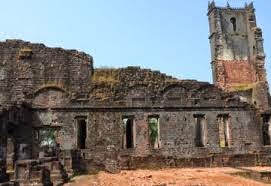
When it was completed in the 16th century, the grand Nossa Senhora da Graca Church was recognized as one of the three great Augustinian churches in the Iberian world, the other two being the Basilica of the Escorial in Spain, St. Vincente de Fora in Lisbon. But the church did not stand the test of time though it withstood the cannon barrage by the Italian architect who built it. Only a lone tower and parts of the faced remained.

Goatourism states -The tower is one of the four towers of St. Augustine Church that once stood at the
site. Initially built of laterite and colossal in size, almost forty-six meters high, it had four stories. The Tower was meant to serve as a belfry and the Church had eight richly adorned chapels and four altars and a convent with numerous cells attached to it. This remnant, the renowned St. Augustine's tower is all that remains of what was once one of the largest buildings in Goa -- The Augustinian Monastery

And as all that happened, the bones of Queen Ketavan rested near it…undisturbed…until now…

The importance of Queen Ketevan for the Georgian people led to hunt for this relic during the last decade, notably in Goa. Since 1989, various delegations coming from Georgia worked with M Taher of the Archaeological Survey of India to try to locate Ketevan's grave within the ruins of the Augustinian convent. In 2000-2001 Dr Kenchoshville of Georgia obtained permission from the Indian government and spent weeks excavating somewhere near the second window, but reached nowhere. In May 2004, the Chapter Chapel and window mentioned in the sources were finally discovered. Although the stone urn itself was missing, it’s coping stone and a number of bone fragments were found close to the window mentioned in the Portuguese sources.

Dr. Niraj Rai of the CSIR-Centre for Cellular and Molecular Biology, Hyderabad, India carried out DNA analysis on these human bone remains excavated from the St. Augustine convent by sequencing and genotyping of the Mitochondrial DNA. The investigations of the remains revealed an unusual mtDNA haplogroup U1b, which is absent in India, but present in Georgia and surrounding regions. Since the genetic analysis corroborates archaeological and literary evidence, it is likely that the excavated bone belongs to Queen Ketevan of Georgia.

However as the scientific paper on the DNA analysis states - it is important to keep in mind that Ketevan's palm and arm bone fragments were kept in the same urn as the complete remains of two European missionaries, Friar Jerónimo da Cruz and Friar Guilherme de Santo Agostinho. Therefore, it would be crucial to determine the sex and the kind of bone of the fragments tested in order to have conclusive results.

The Huffungton post article concludes with a geneticist’s views -The study is well done and honest, Jean-Jacques Cassiman, a geneticist at the University of Leuven in Belgium who was not involved in the study, wrote in an email.”It is a bone presumed to be of the queen and will remain so until its DNA can be compared to that of preferably living relatives and if not available dead relatives," Cassiman said, referring to nuclear DNA that is in all the body's cells. But until that point, the conclusion is based on statistics. Those statistics strengthen the idea that the bone belongs to St. Ketevan, but aren't strong enough to positively identify the remnant, Cassiman said. The Georgia news article puts a million dollar price tag, but it does not corroborate it.

I do not know if the relics finally found their way back to Georgia.

References
The mission of the Portuguese Augustinians to Persia and beyond (1602-1747) – John M Flannery
The martyrdom of Queen Ketevan in seventeenth century Iran: an episode in relations between the Georgian Church and Rome – John Flannery
A Historical and Archaeological Sketch of the City of Goa: By José Nicolau da Fonseca
Edge of Empires: A History of Georgia - Donald Rayfield

Tailnote
1.       It seems the movie Gunnam – the suspense thriller was shot near this church! Strange isn’t it, also to note that a singer of Goan origin (from the Mangeshi village) Lata Mangeshkar is singing the spooky song - Gunam hai koyi remember ti?? You can even see the ruins of this very church in the movie


2.       Gori incidentally is also popular for being Stalin’s birth place!