


Some days ago I had written about the Damon slave and the Portuguese and VOC slave trade in the 17th century Malabar. Later, when I stumbled upon this story, it literally took my breath away. While much of it is legend, study of a number of texts enabled me to extract the gist from them, though the passage of many hundreds of years have tainted the story quite a bit.
Now will you forget all that gory stuff (relating to the slave trade) for a moment and imagine a  story line that goes thus? A Rajasthani girl and her brother are walking on a beach, the girl is abducted and sold to Portuguese slave traders in Cochin. The girl is purchased and taken to Philippines from Malabar. The Spanish bring her to Puebla, Mexico. Well – that is the story of Catarina de San Juan (1606-1688), whose real name was Meera and who almost became a saint.
Meera (La China Poblana) kept her name and her unique and ‘provocative’ Rajasthani dress sense (some even say Saree that got adapted to a skirt-blouse-shawl combination later in her life) all through her life. Her pious nature and her dressing sparked a craze for her dress – which is now popularly known as the China Poblana (Chinese from Puebla) dress of Mexico. Look at the similarity in the pictures of the Rajasthani dress and the Poblana dress and you can see how fascinating a route this story takes.
 There are at least three versions to this story. The first that I will recount is based on a biography (Yes there are more than three varying and voluminous autobiographies and countless articles and she is still so popular, revered in Mexico to saintly proportions!) written by Jose Del Castillo Grajeda and outlined by Gauvin Alexander Bailey in his study ‘A Mughal princes in Baroque New Spain’. The other and more popular biography is based on the lengthy (considered surprisingly big and a very expensive sponsorship by the Church) book written by Padre Alonso Ramos in 1689.
According to these accounts, Meera belonged to a Mughal royal family in Agra (contradicts Meera’s own words recounted later in this article), and her family had converted to Christianity early in life from Islam, but when persecuted, moved to Surat around 1615 from where she was abducted in 1616 when she was walking along a seaside with her brother. The Portuguese who snatch her, fight with each other in order to molest her, but she manages a miraculous escape with some stab injuries, is thence rebuffed by her Mughal fiancé and after more difficult travails end up in Cochin (or the whole disgraced family had by then moved to Cochin by then which is more likely).
There, Meera takes refuge in a Jesuit mission, where she is baptized by Xavier with the name Catarina de San Juan, but she gets kidnapped again and is taken to the slave market at Philippines. There she spends five miserable years as ‘hot female property’ till she is purchased by the rich Puebla Captain Miguel de Sosa. During this period, she is even courted by a Japanese prince intent on marrying her, but she is whisked away by her jealous owners.
She lands up in Acapulco in 1621 on board the ship “Nao de Manila” or ‘Nao de China’ (dressed as a boy during the 9 month voyage to escape the sex starved sailors). Miguel Soso, some say, purchases her for 10 times what she was being quoted (the original indenter was the Viceroy Marquess of Gélves who wanted a ‘chinita’ – one that was as exotic as the papayas in his garden, but then it appears he lost his job after some riots and could not buy her!) and takes her home to Puebla some 300 miles away.
Sosa and his wife Margarita Da Chavez take a liking to her and treat the  ‘nina’ Meera more as a daughter. Meera, a curiosity in town, wore funny clothes and always covered her head with her ‘shawl/dupatta’. This made the people of Puebla feel that she was a demure & saintly one! And thus they started to revere and worship her.
Meera gets manumitted after the death of Sosa, is betrothed in 1626 to a man called Domingo Suarez (A Chinese or Asian slave himself), on a precondition that they will not have sex (One cannot but agree with her total distaste for sex after the Manila horrors). Meera does in time learn to speak poorly & highly accented Spanish. The story takes an interesting route now, Suarez tries to force himself on her but she places a cross on her bed and Suarez becomes impotent as he reaches the bed! The relationship thus remained celibate for 14 years. Meera in compensation works as a seamstress (making & selling localized versions of China Poblana dresses skirt, blouse and shawl as it is known and seen today) and provides the returns to Domingo. He sets up his own business and has a mistress (with whom he begets a child) but goes bankrupt & eventually dies (Women in Iberian Expansion Overseas, 1415-1815 By Charles Ralph Boxer).
It was after Sosa died that the divine apparitions first started in Meera’s life (though some write that it started even earlier in India). After Suarez’s death Meera is left out virtually on the streets. Priest Pedro Suarez rescues her, inducing her to live a humble ecclesiastic lifestyle as an anchorite(religious hermit) confined to a small room, but her fame starts to grow with news of her visions and she is visited by all the gentry and the populace for spiritual discussions, advice, prophecies etc. All through her life she has visions of Jesus and Mary, painting or describing those incredible scenes of an evangelical nature. She is said to have performed many miracles, like turning a hurricane away once from the lands of Mexico. Originally when she wanted to join the convent of Immaculate Conception, she was not granted admission as she was not virgin (apparently after her horrors in the Manila slave camps which at one time housed over a hundred thousand slaves) but she later worked there though never becoming a nun as Spanish law forbade a non white from becoming one. Meera’s fame grew and hundreds of thousands of people came to see her regularly till her death on Jan 5th 1688 aged 82 years.
During her later years when troubled by illness, she started to teleport (paranormal bilocations)  on spiritual journeys around the world (including China and India) and the heavens. “At the hour of her death she was nearly paralytic because she suffered from respiratory complications and many other physical problems. The diseases were as much due to her age as because of her unfortunate and difficult existence”.
Now why was she called the beauty from China? In this sense it appears that this generic term ‘Chino’ also means servant, concubine or country girl according to Bailey. So it was a corrupted usage in the real sense. How about the contention that Meera was a Mughal? Very unlikely that she was a Muslim as Meera was not a name that came from Mirr, Maria or Miram (‘bitterness’ in Arabic/Hebrew as believed by Bailey) as no parent, in my opinion, would name an offspring so. It most definitely was Meera as in a Hindu family (means light, merriness, prosperity or saintly woman. Almerah means princes, aristocratic lady or food in Arabic and Meera also means ‘Mine’ in Urdu. Meera as a person and name is very popular in Rajasthan or Rajputana?). In any case Meera herself stated that she is a Kshatriya or a Brahmin by birth.
"For her part, Meera remembers that her father was the lord of a certain principality, and, besides, a physician and seer, who knew how to quieten the tempests. In these remembrances of hers, distant and blurred, Meera categorizes her parents as much as belonging to the ruling caste or Kshatirya or to that of the priests or Brahmins."
 Some say she came from Indraprastha, some others mention Bangladesh or Cochin (Cochin is unlikely due to the colorful dress that Meera wore. In the 17th century women in Kerala did not wear such patterns or bright colors). It is also said that Meera’s skin was almost white; she had dark hair, ample forehead, lively eyes, sultry nose, twin braids of hair and a classy walking style. She looked virginal & saintly according to the written notes. However the pictures that I could find do not quite present a beautiful countenance.
The dress style now known as China Poblana, a white blouse and colorful embroidered red and green shirt, has evolved to include the national symbols of Mexico - an eagle clutching a snake, and prickly pair cactus. A woman who wears the dress usually braids her hair on two sides, tied with red, white and green ribbons.
Not only did Meera introduce Indian colors and dressing in Puebla but it is said (By Ramos) that she also introduced the ‘Mole’ an Indian curry where the spices & chillies are roasted with chocolate, ground together and cooked to be served as a brown paste with chicken! (I do not quite believe this though; Fish Mole was introduced to the Malabari’s by the Portuguese themselves and is more a bland stew with coconut milk). Today you can still find the famous China Poblana Chicken Mole in Puebla.
 I understood that much of the Mughal element in this story comes from biographer Ramos’s embellishment after his reading Kircher’s ‘China Illustrata’. He wove what he picked up from Kircher’s book into Meera’s story, a1000 page edition titled ‘Prodigios’. Rev Ramos apparently recommends sainthood for Meera due to her huge popularity sand saintly life and hoped to gain considerable popularity for himself in publishing this work. He collected the information from Meera over the course of their 15 year relationship as confessor and Padre. However, during the Spanish inquisition the book was banned, considered blasphemous, indecent and unbelievable and Meera was thus not considered Saint material.
In Puebla de los Ángeles she was thus venerated as a saint until 1691, when the Holy Inquisition prohibited open devotion to her. Today, the Templo de la Compañía, in Puebla, is known as La Tumba de la China Poblana because in its sacristy lie the remains of Catarina de San Juan.
Herein lays a tantalizing possibility - Was Meera’s name, life story and story of origin itself a clever creation by Ramos and was Meera the original Meera bai (1498-1547)of Rajasthan whose story & fame were used here for good lasting effect? The stories are rather similar, but other than Kircher’s contemporary book that talked of China, Delhi and Mughals, the story of Mirabai may not have reached Ramos at all.
Most historians however agree that the slave girl came from India. It is also to be borne in mind that there were many Rajput girls in the Akbar harem, so she just might have been in theory a Mughal princess. So why choose a royal lady with origin in India as the character for Catherine? If you recall from my blogs on Joao Da Cruz and De Nobili, you will note that the Portuguese wanted stories of major success in India, i.e. stories of conversion of the upper classes to Christianity and their resulting enlightenment as a need to further Christianity in those times.
But then, for Ramos, Meera was “the prodigious flower who tread the earth in the orient until she arrived at the pinnacle of perfection in this Occident, bestowing upon us a map imbued with virtue providing a sure path with which to guide our way”.
No! I am not finished – Roshni Rustomji recounts a meeting with a (imaginary or real, that I am not sure) living descendant of the child Suarez had with his mistress. Sofia Cruz the descendant runs a Mexican Chocolate shop in USA in Roshni’s short story – Black tea and Raw chocolate
So friends, this was the story of the Indian girl who lived her saintly, lonely and sad life in Mexico. Next time you plan a travel to Mexico, do not forget to put Puebla on your travel route, and when you reach there, let them know where you are from. If it is India, I am sure you will have a good conversation going, in no time.
In any case, this legend of Meera has withstood the test of time. Let it be so.
References
A Mughal princes in Baroque New Spain - Gauvin Alexander Bailey
Imagination Beyond Nation Latin American Popular Culture -By Eva Paulino Bueno, Terry Caesar
Outside Stories, 1987-1991 By Eliot Weinberger
Athanasius Kircher By Paula Findlen
Women in the Inquisition By Mary E. Giles
Times of India article
A poem on Catarina
A lovely short film on La China Poblana (in Spanish)

Puebla - The city of Puebla was founded on April 16, 1531 as "La Puebla de los Ángeles". With more than 20 universities, Puebla is second only to Mexico City in the number of universities within its borders. It was the first city in central Mexico founded by the Spanish conquerors that was not built upon the ruins of a conquered Amerindian settlement. Its strategic location, half-way between the port of Veracruz and Mexico City, made it the second most important city during the colonial period. Puebla's monument to La China Poblana, an enormous statue atop a tiled fountain, is located in the northern end of the city at the junction of Boulevard Heroes del 5 de Mayo and Avenida Defensores de La Republica.
It was my recent attempt at reading ‘Women of the Raj’ by Margaret McMillan that triggered memories of a period in the 80’s when I came into close contact with some very interesting progeny the English left behind, the ‘Indian’ Anglo Indians or Eurasians.
Margaret McMillan sums up quite well the Memsaheb’s and the Crown’s feelings about the Eurasians in her book (and in my mind also explaining the unsaid code of loyalty that the Eurasians eventually assumed) – If the new British arrivals accepted the code of the Anglo Indians (the name was what the British in India preferred for themselves until the Eurasians appropriated it) they would at least belong somewhere. The first article of the code was loyalty to the community. The Eurasians muddled things by trying to scramble up into the ruling race, claiming first that they were Anglo Indians and, when that term finally came to stand for those of mixed race by the time of the first world war, that they were Europeans, annoying the original Anglo Indians. They in turn were pressed by the native Christians who saw no reason why they should not share more than just the imperial religion.
While the introduction and conclusion sections of this book are exemplary, the rest is a good account for posterity, but a little bit of a difficult reading for me. It might be because I shared no empathy with the lofty memsahib, struggling to find her place among her many suitors serving the crown, the teeming coolies and ‘niggers’ of India, at that particular time in history in an inhospitable terrain and an uncivilized place. Many came grumbling and left with abusive words, only to retire much later in dowdy England, muttering with fond nostalgia ‘Ah! India, what a place that was, that was where we once lived a jolly good life’.
 Let us first find a definition for the term Anglo Indian – According to Blair Williams (Book Anglo Indians – the author is an Anglo Indian himself) they were created in the 17th and 18th centuries, products of a male progenitor of European descent and a female from India. Always, they resisted from integrating themselves into the Indian populace, while the British in India themselves rejected them and eventually some 200,000 of them migrated to the UK in 1947 (the second and the third waves moved to Australia and Canada in the 60’s and 70’s). During the independence movement they supported the British. And thus for 200 years they lived life as a distinct ethnic group, hated by the British and the Indians. They were educated separately, in Anglo-Indian schools. The English while in power provided them preferential jobs at the railways, P&T, Customs and police departments. Unfortunately historians and sociologists have always treated them as marginal to both cultures. Today just over a 100,000 remain out of which the southern states have the bulk with Tamil Nadu accounting for the highest count.
Frank Anthony (1942) summed it then "We are Anglo-Indians by Community. Of that fact we have every reason to be proud. Let us cling and cling, tenaciously, to all that we hold dear, our language, our way of life and our distinctive culture."
The above statement will succinctly sum up the cauldron of emotions the poor Anglo Indian family would have been subjected to, hated by the English, ridiculed by the Indians and even fellow Christians (It was much the same case with the Luso Indians that the Portuguese left behind, and the black Jews of Cochin and Malabar, but they were few in comparison). The mistress to the English man may have married again, but the offspring bore the brunt of the scathing comments that they would have been subjected to. Their one intention in the earlier days was to find passage to England during which time they lived a turbulent period, but the ones that remain today have effectively assimilated into the population. A forlorn photo of the times gone by may hang by the proverbial thread, perhaps on the wall of the living room with a mother wearing a pretty English frock, holding a parasol maybe but wearing a bonnet and standing next to a pale suited-booted-bowler clad man from England or a dapper adventure seeker lost in India.
Most of us would have come across them in Bollywood movies notably ‘Julie’, which first came out in Malayalam as a lovely movie ‘Chattakari’, introducing the effervescent Lakshmi to the Indian masses or the more recent realistic movie ‘Akale’. Many of you may also remember the ‘Coppakoot’ people from Cannanore, the ones with very fair skin and sometimes blue eyes. Fortunately there were very few blond offspring. Memories of a drunken stepfather may remain, a father taunted by the populace for his wife’s fidelity, for that was always questioned of such female offspring.
Some time back I had written about two Anglo Indian’s Cliff and Engelbert. I am yet to post my article on Orwell, but this blog accounts my memories of two very interesting AI families that I came across. They were a proud lot, as Dr Moore summarizes - Anglo-Indians were among India's most international, emancipated and democratic people, a Westernized minority amongst the vast Indian population.
The memories of my few months stay at the Railway quarters with my uncle and aunt remain vivid, prominently featuring the Anglo Indian family across the street. The early days of my working life at Madras, as it was called then, jaunting aimlessly along aptly named streets like Pantheon road, Santhome, Mount road, Edward Elliots road, Vepry, St Thomas Mount, Gen Patters road, locations like Perambur, Mint, Egmore, Central, Pursuwalkam flash through my mind fleetingly. Today many of these names would have changed, and I remember the Fountain Plaza, the one and only ‘cool’ place in Madras, where eye candy and young people were always in plenty, for this was where we hung about. And I also remembered my friend (for a few months) who used to work nearby.
 I remember the family at the railway quarters most of all – with the three pretty girls. The first who was married and who used to come often on a bike with her husband to see mama, then the very beautiful air hostess who would bring home her boy-friends and finally the youngest, the high school going girl who was eyed by all the boys and young men in the colony. There would be many youngsters wandering around that street towards evenings trying to get an eyeful of the sisters and we of course had a vantage point behind the wooden grille that the colony quarters just across their house, had. The hot afternoons outside presented a contrast to the cool innards of the high roof ‘quarters’, with a fan of 19th century vintage droning noisily above. The girls liked attention but hardly flirted with the local ‘brownie’ boys. Even as neighbors, they hardly mingled with us except for a hi-bi. Immaculately dressed in the latest western fashion (at least we thought so) and with bobbed hair, they were a pleasure to the eye. They mingled only with other Anglo Indian boys and so all we could do was ogle. Sometimes one of the three would make it even more painful by bringing out a Spanish guitar and strumming a few chords with a lilting voice to accompany. The father was an engine driver and would be seen only on some days, not very sober as well. He in contrast would be wearing shorts (Hanuman undies as people called it then – now they are boxers) and a half sleeved ‘banian’ and got along well with my uncle, an engine driver himself. The was seldom seen; she did not want the sun to spoil her dainty skin, but the offspring had acquired all the good qualities of both races resulting in those envious looks. As we eyed them on a daily basis, my aunt would come and chide her son and me in a good natured fashion. You think we listened? Sadly, some months later I found lodging of my own and moved, never to see these girls again and soon after that, my uncle and aunt also moved out of the Railway quarters and into their own house after his retirement.
It was a tragedy really, for they were a stereotyped lot, even though many of them were hard working & god fearing, they spoke in English ( today it is ‘cool’ to do so) and they dressed and felt like the English (today it is ‘cool’ to have a western outlook in India). Every Anglo Indian lady in the early part of the century was considered promiscuous (Nirad Chaudhuri was one who featured them in such a light) and every man a drunkard. Unfortunately they were more Anglo than Indian and that rankled in the minds of a lot of proud people who had ‘by the way’ just obtained independence.
It was in one of those sweaty summers that Cathy (not her real name) strode in to the environs of Pantheon road. My brother wrote to say that his friend Jack’s girl friend was moving to Madras from Kovai and asked me to make sure that she was getting along fine. I was not sure what to expect but when I saw her, I was jolted out of my tracks. Exquisite is the word I must use, she was ‘that’ good looking. She proved to be a very nice conversationalist and seemed to be at home in the hostel she had found to stay. The office where she worked was also OK though the Setu boss seemed to harbor not very innocent thoughts. My brother assured me that Cathy would have no problems on that account; they had perfected adept ways of keeping such people at bay. She missed Jack, and wistfully talked of the difficulties they had faced all those years, with the hope that things would change. I must have met her couple of times after that, and one fine day I heard that the two were getting married. For Jack had finally got his approvals to migrate to Britain and was taking Cathy with him. They left soon after and I heard that true to form, Jack had joined the British rail as an Engine driver himself . Well, as you can see; life takes a full turn to get you back to where you started, at times. I am sure they are doing well in England these days, and not facing any increased scrutiny on account of the mixed parentage. They were the lucky ones, they looked more British than Indian and would easily merge into the Britain of today. I doubt if Jack remembers Kovai or Cathy remembers Pantheon Rd, but I wish them peace and a life without conflicts.
I have also the feeling that when Blair Williams the writer met many of the Anglo Indians in UK to carry out his exhaustive study culminating in the AI book, he would have come across Jack and Cathy and presented his questionnaire – with one of his questions being ‘Did you miss India’? The answer would have been a resounding No! Like many agreed, the only thing they would have missed from India was – the shortage of domestic help in UK – and Cathy would have then sounded like a memsahib pictured in Margaret’s book.
I have not yet had the opportunity to read two oft mentioned books -the first of books is ‘Bhowani junction’ and the second ‘To the coral strand’ by John Masters where he presents the British Soldier Rodney Savage, the Anglo Indian girl Victoria and her husband Patrick. The first book was a successful movie, but I have them now.
And thus, I will always remember the Anglo Indians, especially the girls, their railway mutter, the pop music (they always scoffed at Usha didi’s and Uma pocha’s home grown pop, it had to be the Beatles or Rolling stones or some such thing though they took kindly to Cliff and Englebert) the rum that flowed at their parties (if one got invited), the dances, the balls, their talk about the ‘blighty’, their fixation to the possibility of the sun darkening their skins, the western attire and bobbed hair, their distaste for us ‘country’s’- country bumpkins, their lovely cakes and their lilting singing voices and the peculiar English accent. They were among the pav-wali’s of Bandra (though I must clarify that many of the Sandra’s from Bandra were also of Portuguese and Dutch descent), the Anglo’s of Madras and the Chattakari’s of Kerala, who were and are always a piece in the Indian cultural fabric.
Even though they were precariously perched between the color conscious English man and the Hindu caste system, and sometime termed half castes, they survived to tell many a tale today. They are the Anglo Indians. Many of the remaining AI’s integrated into the Indian Diaspora and became important people, sportspeople, artistes, writers, thinkers, officers, armed forces personnel and professionals. Today you hardly see any differences or the segregation that once existed.
The Anglo-Indian heritage center website opens it doors with a beautiful message that tells us how they feel - "If England is the land of our fathers; India is the land of our mothers. If to us England is a hallowed memory, India is a living verity. If England is the land of our pilgrimage, India is the land of our homes. If England is dear as a land of inspiring traditions, India is loved for all that she means to us in our daily life." Herbert Alick Stark (1926)
Recommended reads
Anglo Indian – Blair Willaims, his website
Children of Colonialism - By Lionel Caplan
Anglo Indian contribution to Indian railways
Margaret Deefholts essay
A brief history of the Anglo Indians by Dr. Gloria J. Moore
HarryMclure’s site
Paromita Vohra’s wonderful short movie Where’s Sandra?
I have always wondered if the Portuguese themselves had a hand at cementing the dowry system and color consciousness into the Malabari cultural fabric!! And then I remembered the fine movie ‘Vasthavam’ starring Prithviraj where the dowry for the suitor is a Government (clerical) job at the Secretariat in Trivandrum. All this sounded suspiciously similar to some customs the Portuguese followed…Here is the story.
 The acute shortage of women amongst the ranks kept the Portuguese of the 16th century a dissatisfied lot, but they were not allowed to marry locally at first. Goa was even worse, they had some 2000 unmarried ‘Soldado’ soldier Europeans, mainly Portuguese, during 1580-1600. The Portuguese tried to bring women in from Lisbon, but were not successful with the virgin recruitment (Orfaes del Rei - orphans of the king) and the ladies sent in 1636 were of ‘questionable reputation’. Now the intention was to find them decent husbands, at the same time preventing Portuguese liaisons with Indian women. Such women were sometimes provided dowries by the Lisbon authorities in the form of government jobs for the husbands; after they returned (one example is the governor of Cranganore). The funny thing was that it became too popular in 1627 and so the order for such appointments was limited to a 3 year job stint!! (The Portuguese in India By Frederick Charles Danvers)
The Orphas had to be white & Roman Catholic and children of people who had died fighting the ‘Muslim’, between the ages 15-30 and good looking (Women in Iberian Expansion Overseas, 1415-1815 By Charles Ralph Boxer). They were typically from the orphanages in Lisbon and Oporto (even Coimbra). Jewish girls were not admitted. Since 1686, mixed blood girls were admitted, though a decree banning it had originally been issued. While the quantities appear large, the numbers of girls dispatched from Lisbon did not cross a 100 and were at 30 on the lower count. When the mixture started to become more of a non virgin nature, the Archbishop Menses of Goa intervened and established a ‘retirement house’ in Goa where those dubious types, who agreed to repent were boarded.
Nevertheless, the Orphas had a tough time. Many did not survive child birth in the tropics and  many of the lot were too ugly though virtuous and were unable to find husbands (Boxer). Some could not find husbands as suitors complained that the dowry (government position) was too low. Denis Kincaid in his book British Social life even states that some of the Virgin ships were pirated by Muslim pirates of the Arabian sea and the girls chained and sent off to slave markets in Surat! Some were picked up by local Dutch or English officials; some went into Mughal Harems or local King’s Harems. The famous beauty of Surat, Donna Lucia was one such orphan bride.
It was much later that single virgin Dutch girls were dispatched to Cochin by the VOC since European women continued to be at a premium. Such ships bringing in Dutch virgins were called maiden ships. Eligible virgins were recruited from orphanages in Netherlands. They were then made available to higher ranked officials though the lower ranked were forced to marry locally. In Ceylon, servants were enticed to marry their Dutch masters, but such relations were not enduring (The Arabian Seas - By R. J. Barendse). VOC called them company daughters.
Anyway there were too few white women of virtue and beauty so; both the Portuguese and the Dutch resorted to the local populace. However the English who came last were decidedly lucky. They bought the ‘Women of the Raj’ or shall I say the dreadful weather of England ensured that the women went out to warmer climes? It is a long story best explained in the book ‘Women of the Raj’ by Margaret McMillan. They were also distinctly lucky to create the community called Anglo Indians or Eurasians by their might as rulers.
Tarling (Cambridge history of SE Asia) says that Albuquerque finally encouraged his staff in 1510 to find and marry ‘beautiful Aryan type’ women (The fairer kind is what he meant – this has been confirmed by Thomas Brady) who could be converted and thus form a corps loyal to the Portuguese. Siexo states that these fair women were usually from the defeated Moslem households since Brahmins and Kshatriyas refused to allow this to happen in their households. While this was frowned on by Lisbon, the Portuguese commoner went ahead with the idea. Thus they became ‘Casados’ or married men and their children Mesticos (Reinols were the purebred ones). These Portuguese or their offspring who remained behind became the interpreters and help for the Dutch who came in later.
The Dutch decided after seeing the Portuguese experiments and the failure with respect to virgin recruitments that their men could marry locally, but after getting an agreement that the women and offspring accepted Christianity.
Some funny things came out of these unions – The clergy found that some of these casados had picked up strange habits like holding their tumblers and pouring liquid into their mouths without the rim touching the lip. This was a far distance from the first voyages when Vasco de Gama publicly whipped three Portuguese women who were stowaways in the 1524 voyage to India, whereas Cabral brought his wife with him.
I also assume that this insistence of keeping the fair damsel in high stead by Albuquerque resulted in strengthening the complex in South India with respect to color. The gainers from this vanity, of course, were the entrepreneurs who make creams that make your skin a few shades lighter, to this day…
Why did the Portuguese fail in Malabar? And why did they become so hated a community? It was mainly their refusal to integrate, their disdain for local culture and practice, their apparently cruel ways, their insistence on people converting and their pathological refusal to learn any local tongue. They even planned to eliminate the local languages and substitute it with Portuguese, such was their gall!! The saving grace was when the papacy in Rome made it very clear that any priest had to know the local language, rightfully so (A History of Christianity in India - By Stephen Neill). Can you believe that in Portuguese Cochin and Goa, women had to wear veils at one time, were zealously guarded by men folk or even black eunuchs?
This has been a topic of choice for many writers of mystery and intrigue, most recently Steve Berry and Clive Cussler (Treasure). The Steve Berry novel Alexandria Link that I read gives a brief history of the library, sufficient to raise interest in the mind of people who are fond of history, people like me.The search for further information was not conclusive, but nevertheless provided much insight. Some people still feel that the keepers have secreted the vast hoard of books somewhere…
 Most celebrated from ancient times, it was started by famous people like Ptolemy and Philadelphus. It had a number of distinguished keepers over the ages and suffered repeated losses & disasters. At one time it had over 700,000 works. Destruction of the library has been attributed to the mistaken zeal of the Christians in the time of Theodosius the great and later to the fury of Saracens under Omar in 642AD.
The times were not great – Romans burnt the books of the Jews, Christians and philosophers, The Jews burnt the books of Christians and the pagans, and the Christians vice versa. Gibbons in his ‘rise and fall…..”describes the pathetic situation at the Library of Alexandria after destruction by the Christians, – The valuable library of Alexandria was pillaged or  destroyed and near twenty years after wards, the appearance of empty shelves excited the regret and indignation of every spectator whose mind was not darkened by religious prejudice. The compositions of ancient geniuses so many of which have irretrievably perished might surely have been exempted from the wreck of idolatry, for the amusement and instruction of succeeding ages and either the zeal or the avarice of the archbishop may have been satiated with the richest spoils which were the rewards of his victory.
The library was set up during the reign of the three Ptolemy’s of Alexandria. Ptolemy Soter (306-285BC) laid the foundation. The endowment was continued by Ptolemy Philadelphus who had the celebrated Callimachuis as his librarian. Callimachus collected great works such as those or Aristotle and had many others translated.
However, the library in addition to having a number of original versions made the first translations and copies. Some say originals were kept and copies given back to authors, but it is difficult to attest.
The first translations were made by Mantho the priest. He translated the first sacred books of Jerusalem into Greek to create what are known as the version of the seventy. 
Ann Charlotte Botta concluded that the work of destruction of the empire was started by Theodosius in the 4th century and Saracens completed the destruction in the 7th century. Justinian closed the schools of Athens and the only remaining works were in Constantinople.
Thomas Done states – There was this immense library in Alexandria started by the Ptolemies. Standing at the waters edge, the library was situated in the Alexandrian museum at Bruchion . The apartments which were allotted to it were beautifully sculptured and crowded with the choicest statues and pictures, the building made with marble. Initially it built up a collection of 400000 volumes. Due to space constraints a second library was established and placed in the temple of Serapis. This daughter library had 300000 volumes. The objectives were three 1. for the perpetuation of knowledge (buy at the kings expense any number of books) , 2. for the increase of knowledge, 3. diffusion of knowledge.
 People flocked to this library and it is said that at one time 14000 students were in attendance. During the siege of Alexandria by Caeser (some say accidentally when his ships were burnt and later again when it was sacked by Aurelian) it was burnt down. Supposedly, to make amends, the library of Euemens (from Pergamom - Izmir Turkey) was presented to Cleopatra by Anthony. This third library was the one burnt down in 329AD by Theophilus (385-412AD) the bishop of Alexandria. On the foundation was built a church.
The tragedy did not stop – even after the destruction, a brave lady Hypatia, daughter of Theon used to conduct lectures on whatever she knew. Alexandria continued to flock to her. One day, Saint Cyrils (!!) monks numbering a great many, stripped her & dragged her through the streets to a church where ‘Peter the reader’ struck her dead with his club. The corpse was cut to pieces, the flesh was scraped off the bones with shells and the remnants cast into afire.
Starbo, Euclid, Archemedis and so many others studied and taught there…The Old Testament was translated here by Ebenezer & his 70 elders. However the library was reestablished in some fashion and survived till the arrival of Caliph Omar.
The subsequent sacking & burning by Omar the Khalif of Sacria is even more shocking who having proclaimed that the Koran has already all the answers and that no other book need survive. This was in 642 AD. The books were used as fuel instead of wood for a period of 6 months (Ancient history-Chares Rollin)
Historically there has been much debate as to who destroyed the libraries, the Christians (Orosious visit 20 years after the first destruction confirms the destruction by Theophilus – he was the first to record the empty shelves) or Muslims. The matter was investigated in the Gibbon book and subsequently by so many and the above narrative could be considered true though in public domain one many find other stories favoring one or the other faction mentioned above.
Some historians state that many of the books were moved to Constantinople after the library destruction by Theophilus. There they rested for another 1000 years till this Seraglio library was also burnt down in 1204 during the 4th crusade! Some books were saved and remained in  the Ottoman library in Istanbul, but are not mentioned anymore.
Or did the books disappear or move on to another place?
That was as some say, the end of free thought, for a very very long period since then…
Manual of Classical Literature - By Johann Joachim Eschenburg, Nathan Welby Fiske (pg 339)
Curiosities of Literature By Isaac Disraeli Pg 17
Hand-book of Universal Literature By Anne Charlotte Botta
Penny Cyclopaedia of the Society for the Diffusion of Useful Knowledge - By Society for the Diffusion of Useful Knowledge (Great Britain)
Bible myths – Thomas Done
19th century – Knowles Page 568
Story of books – Burford Rawlings
Inscription - By Tiberius Claudius Balbilus of Rome (d. 56 AD) which confirms that the Library of Alexandria must have existed in some form in the first century AD.
Update - Mar 2009
I completed reading another source recently - 'The vanished Library' by Luciano Canfora. According to him, the library was not a library at all. The books were lined on the walls of the palace museum and was not really open to the public until much later. The library was never set fire to during the Ceasar visit, but it was another godown where 40,000 books kept for shipment to Rome that caught fire. He also says that after the early days the library just fell into disuse and the books that remained were burnt by Emir Amoru, Caliph Omar's deputy in Alexandria. Curiously the only books that the library could never possess were the great Aristotle teachings and the books from India, Persia etc. Canfora also clarifies that the biggest rivalry was between the library at Pergamon and Alexandria and that the books from Pergamom were never given to Alexandria...
The mystery continues....
http://www.youtube.com/watch?v=OLlVnKOb4Mk
History channel documentary
http://www.youtube.com/watch?v=SuwQyvx70Mw
http://www.youtube.com/watch?v=dSBz7je7o0c
http://www.youtube.com/watch?v=LZYb9Xvx2k0
http://www.youtube.com/watch?v=hBGkF8iG7PI
http://www.youtube.com/watch?v=YTqmrWi1wxI
I have always passed it, since the road that takes me from Palakkad town to Pallavur snakes by the Kotta Maidanam (the ground by the fort) and beside one of the ramparts of the majestic fort. Some times it is dry and black, sometimes it is covered with moss, but it has always stood there, hardly damaged by the years, the weather or the many thousands who folk by every year to see it. The complex is square in shape, situated on 15 acres of land, with walls of immense thickness and strong bastions at all four corners and in the middle. The sober majesty of those laterite walls of the fort quietly hides many tales of valor and courage.
 As you pass by you see games played in the grounds, sometimes it is a cricket match, sometimes soccer…but the surrounds of the fort are always full of children and people, there is a children’s park with swings and the such called Vatika, I think there is a driving school and an auditorium, but I can assure you not many of people lounging there would know the horrors and history associated with the fort or the grounds and of the many thousands who were massacred over that very soil.
There is a certain mystery to it all, while most historians state that the majestic fort was built by French designers & engineers for Haider Ali in the 18th century, at least one gazetteer mentions that it has been there from ancient times. I do not believe that claim however.
The story starts with the Palakkad Rajah-Kombi Achan. His relationship with the powerful Zamorin of Calicut (Palghat is 120km away from Calicut) soured when the latter laid claims to the fertile paddy growing regions and forests that previously belonged to him, by drawing the Naduvattam wedge. This was in 1757, a time when Haider Ali was gaining importance in Deccan. This one action went on to culminate in the arrival of Haider and his troops across the Kerala borders and the 4 decades of Mysore Malabar wars.
The Palghat Rajah (one of the two brothers) quickly requested support from Haider who was at Dindigul. Haider initially was not for it, but when the Raja offered space to build a fort and pay a tribute fee, he quickly agreed. Haider sent his brother in law Mukaddam Ali with 2000 horses and 5000 troops to fight the Zamorin. The Zamorin seeing the armed opposition did not fight & submitted to Haider, but Haider suspecting treachery demanded a ransom of 12 lakhs. The promise was not kept and this amount was not paid for many years thereby infuriating Haider. Meanwhile the Rajas of Palakkad became a tributary to Mysore and agreed to pay a sum of 5000 fanams (Rs1 =12 fanams) to Mysore annually as protection money.
Haider himself moved south into the Kanara region only in 1766. He sent his forces to capture Calicut as the Zamorin did not pay the earlier arrears and a further demand of a Rs One Crore ransom. The Zamorin, in despair and after sending his family to Ponnani, set fire to his Mananchira Kovilakam and killed himself. Hyder then moved on to Palghat & Coimbatore, having received submissions from kings at both places.
 When the Nairs rebelled, Hyder it is stated, imposed his troops on them, massacred many and deported over 15,000 Nairs to Kanara. The Gazetteers state that only 200 survived. After this event, an amnesty was proclaimed and the Palghat Fort construction with French engineering started in 1757-1764. Haider was supposed to have built the fort to serve as a common point and to facilitate communication between Coimbatore and Palakkad, two vantage points in his new territory. The grounds as such were used to ‘park’ the elephants used by the army.
In 1768, Capt Wood first took over Palghat ( those days it was called Palghautcherry) & the fort from Haider Ali, but Haider soon fought back to retake it in Nov 1768. In the war with the English in 1767-8 the fort was damaged and Hyder Ali reconstructed it, this time on a solid foundation.
Haider’s command after his death in Dec 1782 had passed on to Tippu, his son. Then started the decisive battles with Col Fullerton in 1783 where the fort was heavily damaged but was eventually taken by the British. The Zamorin reestablished sovereignty over Palghat till Tippu came back to Coimbatore and fought again to regain it in 1788. The fort was retaken later by Col Stuart in 1790, after which it remained in British hands where they used it as a as a garrison and base for further battles against Tippu.
According to the official report of Col. Fullerton of the British forces stationed in Mangalore, many atrocities were committed by the Mysore raiders in 1783 during the siege of Palghat Fort which was being defended by the Zamorin and his soldiers. "It is asserted that the Zamorin rather than witness such enormities and to avoid further killing of innocents, chose to abandon the Palghat Fort" (p. 500). An original order sent to various army contingents by the sultan was found among the records from Palghat Fort, after its capture by the English Company in 1790. It has been reproduced as a footnote on page 454of the Malabar Manual: "It is directed (all military detachments) that every being in the district should be honored with Islam…………that they should be traced to their hiding places, and that all means of truth and falsehood, fraud or force, should be employed to effect their universal conversion.”
In 1797 the English repaired the damaged fort once again. The war between Tippu and East India Company ended with the treaty of 1792 and all the possessions of Tippu in Malabar were ceded to the British. During all these periods, the fort was popularly referred to as Tippu’s fort. It was at this fort that Chemban Poker, the Mopilla leader escaped from the clutches of the 20 year old Thomas Baber (See Nick Balmer’s blog on this event).
After the British took over the fort, it was made into a Tahsildar’s Kutchery, and the fort also housed other British government offices. It was then turned into a jail in 1877 when the Cannanore and other jails started getting overcrowded (Source – I Tyrrell- From England to the Antipodes & India - page 225) and many from the total of 400 inmates died from dysentery & other diseases. Mismanagement by the British meant that even milk for the prisoners was diverted for private use. The work that the inmates had to do was collecting pebbles from the Yakkara River for road repairs. Accounts of the non stop rain for 23 days is amusing – the author wonders where the water came from ( It was also a time when Tyrrell picked up some gold dust near Coimbatore by filtering the soil, garnets from the river bed and so on!!)!! In 1881 it ceased to be a jail.
In the 20th century, the fort became a Taluk office once again. Now declared as a monument, the Fort is under the custody of Archaeological Survey of India. It houses a small museum and an open air auditorium called Rappadi. The old draw bridge has since been replaced by a permanent one. The children’s park is called Vatika. A Hanuman temple is located inside the fort.
All these bloody battles for the fort were fought on the grounds (Kottah maidanam) which today serenely host yet another game that the English taught us, cricket or a district fair and exhibition. And of the Palghat Raja, PCN Raja from the Zamorin family states - The Palghat Raja, Ettipangi Achan who had surrendered, was imprisoned by Tippu on suspicion and later taken to Sreerangapatanam. Nothing was heard of him subsequently.
Here is an Arial view of the fort as seen from the skies. This lovely webindia123.com video will take you for a complete virtual tour of this magnificent fort.
Kumaran Nambiar alias Hyat Sahib
Posted by Labels: Malabar - English period 1800-1900, Malabar Mysore SultansSome months ago I had written about the Jao Da Cruz who reached great heights among the Portuguese Fidalgo’s, who then later came back to torment the Zamorin and become an advisor to St Xavier. This time it is about the Nawab of Bednore (Now in Shimoga – Karnataka), alias Sheikh Muhammad Ayaz Khan alias Ayya Khan alias Malik Ayaz alias Hyat Sahib alais Dowlat Khan. It is yet another gem from the deep annals of history.
This story starts in 1766 when Haider Ali decides to march into the rich kingdoms of Malabar. During this campaign, he took back a large number of Nair captives to Mysore. Many die and a few survive. One amongst them was a bright ‘good looking’ lad of 10-12, named Kumaran Nambiar, hailing from Chirakkal in Canannore, who immediately caught the fancy of Hyder’s eyes. Hyder takes him under his wings and is captivated by the boy’s intellect and genius. He is circumcised, converted to Islam and given a name Muhammad Ayaz Khan.
Soon they forge an enviable relationship and Hyder keeps mentioning the superiority of Ayaz Khan over his real son Tippu. Tippu’s resentment over the convert develops into cold hatred against Malabar. Father Hyder soon appoints (originally offers the more important position as governor of Chittledroog which Ayaz does not accept stating he was illiterate) Ayaz as the governor, Jemedar or Nawab of Bednore (Hydernagar), a wealthy kingdom Hyder had recently captured. Bednore lies about 40 miles inland from the Mangalore coastline, one not dissimilar to Chirakkal where the boy originated from. He made it his home.
Hyders advice to Ayaz runs thus – Keep a Corla (rope whip) in your right hand, and that will do you better service than pen and ink. Place reliance on your excellent understanding, act for yourself alone, fear nothing of the calamities of the scribblers, trust in me as I trust in you. Reading and writing, how I have risen in the empire without knowledge of either? His love for Ayaz is also stated in the case where 20 year old Tippu forcefully circumcises a British soldier in Public. Hyder upon hearing of this abuses Tippu publicly and sends Tippu into solitary confinement and states – It is unfortunate that you will succeed me, if only it was Ayaz instead of you!! (Historical sketches of S India – Mark Wilks Page 522). Logan also confirms (Malabar manual) that Hyder stated many times that Ayaz was always his right hand in the times of danger.
Donald Campbell (son of Col Campbell) is the first to recount a fascinating meeting with the now regal Jamedar Ayaz, circa 1783 in the book ‘A narrative of the extraordinary adventure’. The first aspect one notices is Ayaz’s absolute reverence for Hyder, in the manner in which a lecture is provided to Campbell about Hyder’s power & exploits. As he was being entertained by Ayaz, an offer is made for Campbell to lead Ayaz’s army of 5000 men which is rebuffed. Campbell then comes across the previous Dewan of Chirakkal (must have been the Dewan of an uncle of Hyat) who is being tortured to divulge the location of the previous raja’s wealth. After a few months of imprisonment, Campbell is released and hears that Hyder has died suddenly and that Tippu had issued a death order on Ayaz Khan. Ayaz decides to hand over the fort of Bednor and all other neighboring towns to the British and escape to Bombay, which he does. Capt Mathews and Ayaz settle terms for the takeover. It is under the British that Ayaz as a name gets corrupted to Hyat. The British take away all of Ayaz’s wealth, a huge amount (some 12M Sterling) as rumored and Ayaz is blamed by Tippu though Tippu finds some or most of it after defeating Gen Mathews force under Maj Campbell (read the story here..) . Mathews dies in 1783.
Tippu later claims gleefully that the ‘ungrateful Malabari slave’ Ayaz has run away with considerable booty at this first opportunity and that his father Hyder should never have trusted him. His revenge thence on Malabar was apparently severe; he forcefully converted the whole Bednore populace (Hindus & Christians according to English sources) and sent all the young men to his army in Seringapatanam.
Sadly while Tippu was busy trying to wreak revenge on Ayaz & Malabar, Col Fullerton had increased British readiness and moved to capture the Palakkad fort (A jolly good story for another day) from Tipu’s soldiers, working together with the Zamorin. For once a Malayali (Ayaz) helped Malabar though not meaning to by diverting Tippu’s attention.
Sometime in 1792, Hyat reappears on the historic scene (Logan - Malabar Manual) with a claim for land in Chirakkal that he claims to have got from his Hindu ancestors. The claim is considered fraudulent & thrown out by the British.
After Hyat retired to relative peace in Bombay he sat hoping that Bednore would be restored to him, which of course never happened. Tippu later tried to ‘bargain’ to repurchase Ayaz and take revenge as part of his negotiations with the British, but the EIC did not do so though they were advised that it would be a good riddance (since Ayaz had legitimate claims over his plundered & unreturned wealth which was becoming a major embarrassment to the EIC). Ayaz ended up getting Rs 4’000/- per month ‘as a pension’ till he died (which unfortunately happened soon after). All his claims were studiously ignored (Counter flows to colonialism MH Fisher pages 192-210) by the Crown.
Ayaz Khan, died in 1799 (in his early 50’s) leaving his widows & sons destitute. His funeral expenses worked up to Rs 40,000/-. Fyaz Ali khan, his minor son was denied the father’s pension and he then chased the bureaucracy for due justice in Bombay courts and London. The British did not even give him permission to travel to UK to fight the case. A representative Muhial Din did considerable studies on the case in UK but soon found himself indebted and facing imprisonment in UK. The EIC offered to clear his debts by paying GBP 3,500 & a return ticket if he dropped support to Fyaz. As the London stonewalling was going on, the EIC finally saw sense and restored the pension to Rs 4000 p.m plus the funeral expenses to Fyaz. The lawyer returned to Bombay but as fate destined, the ship that carried all the case papers sank in the ‘Bay of Bengal’. Finally in exasperation, the settlement was accepted as final by Fyaz and his lawyer.
Thus ended the legacy of the Nambiar from Chirakkal – the one who had a few million pounds of wealth in his hands and a small country, to end up destitute in Bombay.
References
Collection of most celebrated voyages – Forster
Collection of treaties & engagements – Aitchison
History of Mysore – Mark Wilks
Counterflows to colonialism – MH Fisher
Malabar Manual – Logan
Campbell’s story
Read this characterization of a Slave from Malabar (Walks & Sketches – Robert Semple) – He is in all respects the best of the household slaves. Without the inactivity or the dullness of the Mozambique slave, or the penetrative genius of the Malay, he forms an excellent medium between the two. More intelligent, more industrious and more active than the former, more docile and more affectionate than the latter, he unites steadiness with vivacity, and capability of instructing to wining manners.
This story outlines the life of many slaves who were taken by the Dutch & Portuguese slave  traders to Cape Town, Africa, Mauritius and many other places between the late 1600’s and early 1800’s. Cochin was a shipment point for different types of slaves by the VOC. Those who went to the far eastern countries and the West Indies integrated with the local populace to some extent, but whatever happened to the many that went to Africa? Some of them have presented us in history with tales of persistence, valor and extreme hardship. Read on.
Between 1626 and 1662, the Dutch exported with reasonable regularity 150–400 slaves annually from the Arakan-Bengal coast. Slave raids into the Bengal estuaries were conducted by Magh pirates using armed vessels (galias), joining hands with unscrupulous Portuguese traders (chatins) and operating from Chittagong outside the jurisdiction and patronage of the Estado da India. Until the Dutch seizure of the Portuguese settlements on the Malabar coast (1658–63), large numbers of slaves were also captured and sent from India's west coast to Batavia, Ceylon, and elsewhere. After 1663, however, the stream of forced labor from Cochin dried up to a trickle of about 50–100 and 80–120 slaves per year to Batavia and Ceylon, respectively
Modus Operandi (Reference Van Rensburg papers) –
 Starting around 1652, the VOC started active slave trading, sourcing the slaves from Indonesia, Bengal and Malabar. Innocent children were kidnapped by the Mohammedans and sold at Cochin to the Dutch, then they were send to Batavia or the Cape, reference Adoor KK Ramachandran Nair in his book Slavery in Kerala, p 16. The VOC sent custom built ships (Fly boats or Fluyt boats) and brought back these slaves to Cape Town under miserable conditions where many died during the voyage due to sickness.
Upon arrival the slaves were sold to ‘burghers’ from Netherlands working in Cape Town. Then started the ordeal without an end where they were sold and resold. Punishment was severe for escaping, typically mutilation, whipping, death and long term incarceration wearing heavy chains. Yet many escaped to remote parts of Africa to live short periods of freedom in dense jungles, only to be caught again.
The women slaves and their daughters had no choice; they mostly became lovers of the  burghers. Later, burghers as Rensburg explains, preferred marriages to women from these mixed unions, in other words these women were then classified as 'van de Kaap' (note this term did not only refer to people of black or mix ancestry). Curiously at the Cape the legal line of descent for both slaves and free citizens were matrilineal, following the Malabar practice, which is by virtue of who their mother was. If the father was free, but the mother a slave, then the child was a slave. If the mother was free, but the father was a slave, then the child was free. These Malabar slaves were also called Maroon slaves for their tawny color.
The story of Damon - Let us look at the incredible story of the slave from Malabar who is otherwise titled the ‘Damon slave’ in history (extracted from the book).
In the early 1800s, while exploring the areas of Van Plettenburg and the dense forests to the East, three high ranking officials (Col Collins, Dr Dowdray and Andries Stockenstrom stumbled on the dwelling of an escaped Malabar slave who had lived in the forests for six years before he was recaptured. This extraordinary man as the travelers described him was brought to them heavy with chains, so that they might acquire some information respecting the country. He was named Damon from Malabar for he was found near the Damon fountain. As the name suggests, he originated from Malabar.
Here is a more detailed story extracted from Col John Sutherland’s notes & other books that I perused for this purpose.
Damon the slave had a friend with him when he first came to the Zitzakamma woods (now Southern George - Storms River). However he died soon after and Damon lived in a small but hidden cave (or hut) in the woods. Later on, after over five years of solitude and after developing more confidence, he started to build a better and bigger one with his own hands. Damon had concluded that he would spend his lonely days in it in relative peace. It was while he was midway into construction (I am sure that was what kept him sane – the building work) of his humble abode that he got caught by the Kaffers (African natives or Hottentots – they were termed Kaffers by early Portuguese voyagers).
Damon was in ingenious man; for he used the skins of all the animals he caught (using pits and snares) to make fashionable ‘western style’ clothes. The bones were all carefully heaped in a spot. He had cleared at least two acres which he had planted with vegetables, tobacco and fruit trees using the dung of the numerous elephants and buffalo in the area, as manure. Our friend even made baked earthenware for cooking his food. The stream that supplied him with water lies about 16km west of the Storms River (or Doll or Kaeman River near the Outinuqua mountains) and is now called the Damon’s fountain. This man had committed no crime prior to his flight; his only desire was to be a free man, wishing trouble for no one. Collins originally decided to keep him, but fearing that Damon would inform others of the location or help them, sent him off to Cape Town
Further study revealed that the man was probably from Cochin or Malabar and knew about farming & agriculture. He must have been toiling in some wealthy landowner’s lands in Malabar before he was caught and shipped to Africa. The Kaffers caught him and turned him over to Col Collins only for the purpose of a reward. At their direction he was sent to the cape ‘there to be charged or otherwise disposed of.
He was considered very interesting and energetic by Collins, 40 years, dark and muscular, very animated, and he informed Collins that he had a fearful life, pursued often by buffaloes, which charged & destroyed his hut many times. When he ran away from enslavement, he had only a handful of seeds and the vegetable garden that Collins saw was a result of his planting and nurturing them (imagine his thought process before his flight!).
At least he was not; I believe ‘hung in chains in the open on gibbets to be eaten by birds’ as many other slaves were sentenced. Henry Rikes (Brenton memoirs) states that he was (probably on Collin’s recommendation) released from his owner Petrus Terblans in 1809 by the Colonial government who directed that this land be purchased for him and thus he became a resident of George (a place 240km away from Cape Town). Col Sutherland later heard that Damon was building a house there & that he had offspring. So that was a good end to the arduous life & travel of this 45 year old slave.
I was waylaid a bit when I found that another Damon from Malabar was banished to Robben Island 12km away from Cape Town to work in chains for 15 years more without wages (1793 Cape records). Nelson Mandela incidentally, was also interred in Robben Island for 27 years. Today Robben Island, thanks to Nelson Mandela is a tourist attraction, but many would never have heard the story of this Damon from Malabar.
A thought - Compare this slave’s life to the life led by Tom Hanks in the film Castaway and try to imagine the hardships Damon endured.
Summary of numbers -ES Reddy in his collection of Indo African papers states that some 1300 plus Indian slaves (a full 37% of the total slaves from Africa India, Indonesia and Ceylon) were brought in between 1658 and 1760 and out of this Indian total, 500 came from the Bengal area and 400 plus from Malabar!! The slaves were invariably given Christian Dutch names but their places of origin were indicated in the records of sales and other documents. Worden however concludes that between 1697 and 1750, a higher number 48% (673) of the sample of 1,401 slaves came from the Indian subcontinent (mostly Bengal and Malabar),
Read through Cape town records - There are so many slaves from Malabar mentioned in that turbulent period; slaves like Cupido, Catherine, Helena, Peter, Jan, Joaun, and most of them met violent death by hanging for trying to escape. These people lost their identity, their very names, their religion and their culture. The women got integrated into the Dutch community and some genealogy is available as in the case of Catherine.
Reddy adds - Most slaves however, dispersed and lost their identity in the course of time. The Indians became part of the "Malay" community - so called as Malayo-Portuguese was the lingua franca in the Asian ports at that time - and their descendants later came to be identified as "Cape Malays" (Cape Muslims) as the Muslim community expanded.
After looking at the numbers of slaves from India and the spread, I wondered, well, this was yet another occasion when Bengali’s and Malayali’s are grouped together. Normally they are grouped when it comes to food habits, intellect, political leanings and the such. Yes, there were contacts between the Bengali’s and Malyali’s from historical times when trade linked them, rice from Bengal and Orissa passed Calicut in the trading Chinese ships. Yes they are also well known (i.e. Malayali’s and Bengal’s) for their consciousness of individual rights wherever they are. Did it perhaps originate from the slave days? Or was it that they were brought together by the British who starting from Malabar moved on from Telicherry and Calicut to Calcutta which was their next commercial and political capital? Who knows!!! Food for thought.
Trivia - The Khoi-Khoi, for instance, developed the ramkie, a guitar with three or four strings, based on that of Malabar slaves, and used it to blend Khoi and Western folk songs. I guess it is the Paana veena that we know.
ReferencesThe Garden Route and Little Karoo - By Leon Nell Pg 100
John Sutherland Memoirs
Henry Rikes – Brenton memoirs
ES Reddy – Collection of Indo African Papers
Cape of Torments – Robert Ross
Walks & Sketches – Robert Semple
Van Rensburg site
Iziko site - http://www.iziko.org.za/sh/resources/slavery/slavery.html
Pictures from ‘google images’ – thanks to the uploaders.
 Wikipedia summarizes - The Moplah Riots (also known as the "Moplah Rebellion", "Maappila Lahala"or ‘Malabar Kalapam’ in Malayalam) was a British-Muslim and Hindu-Muslim conflict in Kerala that occurred in 1921. During the early months of 1921, multiple events including the Khilafat movement and the
Most books I referred to mention that the dead were ‘convicted’ and sentenced (under summary martial law rules though) political prisoners being transported for internment to the Podanur Jail. ‘New Outlook’ By Alfred Emanuel Smith mentions in page 698 that the wagon was freshly painted and hence even the small ventilation holes were blocked!! (In fact the British faced a previous disaster where a number of English soldiers were killed while transportation in a similar way in a Karachi troop train!!). The book MP Narayana Menon by MPS Menon provides partial information of the 61 dead as follows - 32 were coolies, 19 agricultural laborers, 4 mukri’s, 2 tea shop keepers, 2 mosque attendants & 2 preachers. This was the # 77 Calicut - Madras Passenger train. If I read right, the Hindu Correspondent filed the first report from Coimbatore. It was early in the morning of Nov 22nd that the tragedy came to light. That particular report stated that the prisoners were actually bound for Bellary.
Madhavan Nair’s book Malabar Kalapam provides the following information – The jails were over crowded and it was virtually impossible to house the convicted in Tirur. The personnel tasked with the transportation to Podanur were Col Humphreys, Mr Hitchcock (Police Supdt) & Mr Evans. The train was to be escorted by police, but no policemen were available. In the past open wagons were used, but Mr. Hitchcock in his hearing explains that he thought this not a good idea. He was of the opinion that they would be seen by the public who may rise to their rescue. The first wagons used were those meant for transporting cattle. Then came the goods wagon which was more secure from Hitchcock’s point of view. Such methods were regularly used in transporting all kinds of prisoners from Calicut to Cannnore (Stated by K Kelappan - Fortunately when he and others were transported, the door was kept open and a policeman kept as guard). In total 2600 prisoners were transported on 32 trips in such a fashion. On this fateful day the doors were sealed, the sergeant & constable moved on to relax in another compartment. The doors remained closed until the train reached Coimbatore. During a subsequent inquisition, the sergeant stated that at Cheruvannur, he had heard prisoners screaming for water. But as there was no time, none were given. A number of witnesses stated to having heard screams at Olavakkot & other stations. The prisoners went crazy & berserk in their quest for air and water. Brahmadattan Namudiri in his book adds that every two prisoners were handcuffed together in this wagon. They scratched, bit and clawed each other in their death throes, and the wounds were evident on the dead bodies.
The Coimbatore medical officer confirmed death by suffocation even though authorities wanted to pass it off as due to other causes. The news reached the press and public only because Coimbatore was not under martial law. Hitchcock was found not guilty in the later commission investigation. The wagon manufacturer, the traffic inspector and the poor sergeant were stated as the guilty parties. The compensation to the family of each of the dead was Rs 300/-.
"I wish some Indians would win high military distinction in this war. It would help to build a bridge between the English and the Indians."
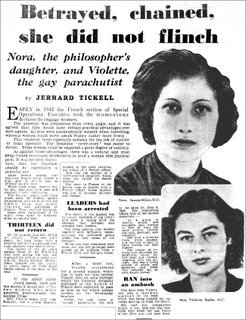
 Whenever I passed the Baker Street tube station in London, it was the thought of Sherlock Holmes that sprang to my mind. Until I read about the WWII - SOE operations centre at Baker Street and the life of an extraordinary spy who uttered the words above.
The SOE, but for a couple of officers, believed otherwise.Driven by ideals of freedom and calling herself Nora Baker, she volunteered for SOE, which specialised in dropping agents behind enemy lines. Trained at the secret Baker Street headquarters, she proved a poor recruit, being too clumsy, too emotional and too scared of handling weapons… Her finishing report, which the official historian of F Section found in her personal file long after the war, read: She has an unstable and temperamental personality and it is very doubtful whether she is really suited to the work in the field."
Nobody knows if it was just idealism or if it was a broken engagement that drove Norah to volunteer. But she did, spending a rigorous year in training and was then dropped behind enemy lines in France, Code name Madeline, Cover name Jean Marie. France was known territory, a place she had grown up in, and here she worked in constant danger, moving constantly avoiding detection, as the only woman radio operator spying & reporting on the German movements.
At the critical moment before the D-Day landing in Normandy she remained the last radio operator on the Continent, ensuring the last link between the Allied Headquarters and the French Underground. The life and death of millions and the fate of generations after the war was to depend upon one spirited by the vocation of a hero who accepted the risk of the supreme sacrifice: torture.
Incredibly enough, the girl eluded the dreaded Gestapo for many months, cycling, with transmitter in tow, from one 'safe house' to another. It was even reported that she solicited the help of an enemy officer to string up her antenna - telling him, of course, that it was a clothes line!"'
She was instrumental in keeping a steady flow of information to the allies. But it was not to be, the Gestapo was catching up and eventually her friend’s wife betrayed her for a few francs. She was jailed, beaten, chained and interrogated. Stoic & brave by day, sobbing at night, probably fearing the betrayal and compromise of her intelligence operation (which it did), she resisted interrogation for many months though trying unsuccessfully to escape a couple of times. She was not destined to live, however, Hitler had decreed that escaping agents should be shot after interrogation.
She never talked, and her courage so impressed at least one of the Gestapo, Josef Kieffer, head of Gestapo HQ in Paris, that at his trial he is said to have broken down in tears when questioned about her death. "The Germans had learnt nothing from her - not even her real name."
On the fateful day, The SS undressed the girl and she was terribly beaten by Ruppert all over her body. She did not cry, neither said anything. When Ruppert got tired and the girl was a bloody mess he told her then he would shoot her. She had to kneel and the only word she said, before Ruppert shot her from behind through the head, was `liberté'." She was 30 years old. Dachau 1944.
A French military band still plays outside her home in the suburbs of Paris every July 14. The country she worshipped, India, hardly knows her.
 Noor unissa Inayat Khan – the great great great granddaughter of Tippu Sultan. Her father Hazrat Inayat, a man with a mission, to spread Sufism around the world, left India for America, met & married Ora-Ray Baker (Begum Sharada Ameena Baker). Tsar Nicholas II through Rasputin invited them to Russia and it was here that Noor was born in 1914. The Bolshevik revolution was brewing in Kremlin and it forced the family to move, destined for France where they settled and where Noor grew up, excelling in languages. Tragedy struck, Pir Inayat returned to India and died from illness. Noor was slowly settling down to
 become a writer (her published works – 20 Jataka tales is still available on Amazon), but when the Germans reached France, the remaining family fled to Britain where Noor became Nora and decided to join the war cause, along with her brother. But she was clear that she would work for the Allies during WWII to defeat Fascism and that she would go back to India after the war to join the freedom struggle against the British!!
At a memorial service in Paris, General de Gaulle’s niece summed up her achievement: “Nothing, neither her nationality, nor the traditions of her family, none of these obliged her to take her position in the war. However, she chose it. It is our fight that she chose, that she pursued with an admirable, an invincible courage.”
Noor’s comment about military distinction proved prophetic: at the "VE" and "VJ" days to mark the anniversary of the end of World War II, an astonishing fact came to light at the roll call, that it was Indians who outnumbered even the British as the largest recipients of Victoria and George Cross medals, the highest British awards for bravery.
SS Trooper Wilhelm Ruppert was tried for war crimes and executed by the Americans on May 29, 1946.
Update August 2007 - Shyam Benegal is planning on directing an upcoming movie on Noor Inayat Khan - The princess spy, based on Basu's book.
 Further reading
Noor Inayat Khan - WikipdeiaMadeline – Jean fuller
Spy Princess The Life of Noor Inayat Khan - Shrabani Basu
The Tiger claw – Shauna Singh BaldwinNoor Appreciation siteThe women who lived for danger – Marcus Binney