A French Calicut?

Posted by Maddy Labels:

One of the little known and less written about stories of Calicut is set during the period just after the immolation of the Zamorin and the conclusion of the Zamorin era in 1766 during the onset of Hyder’s invasion of Malabar. I will be covering the Zamorin’s death and the story around it soon, but this one comes after the said event and snapped the last thread of hope the family of Zamorins had of holding on to their prestige & territories.

We talked in other articles about the Portuguese, the Dutch and at times the English. This one involves the French Infantry colonel and Governor of Mahe, later theologian Le Comte Du Prat and of the astounding situation where for the first time; a French flag was flown on the flag mast at the Zamorin’s palace in Calicut. Now imagine what would have happened if that situation had taken root, just imagine, we would be eating crepes and croissants, foie gras, duck confit and all that and talking French and I would not have had to trouble my friend Murali to try and get to the gist of what Duprat had to say in his own antiquated French words in his memoir. Just imagine, we would have been swimming in perfume and doffing our noses daintily at the English. But as you all know that did not happen.Let us now get serious and find out what happened.

French in Malabar
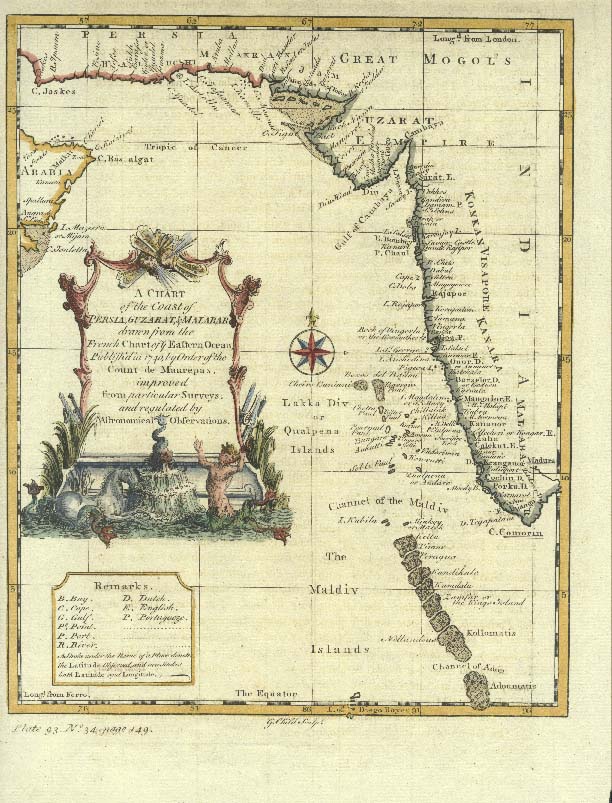
We now go to a period around 1774 to Mahe. Now historians would prefer to start with the 1642 when the French East India Company was formed, but actually the French got started around 1668 at Surat to set up a factory under the French flag. Then it was Madras. The French finally came to Malabar, some years after establishing themselves in Pondicherry, and founded a factory at Mahe in 1721, but settled down there by 1725.

Situation in Calicut
By 1764 the complacent Calicut was attacked by Hyder’s troops. Hyder had started out from Mysore via Palghat with his army demanding a tribute and restitution amounting to Rs 12 crores or something like that but the Zamorin had no money to pay that kind of retribution. He tried delay tactics, but when the armies were at his door and he was threatened with bodily injury and starvation tactics were hinted at, he had no option but to give up and committed suicide by immolation in his palace. The Zamorin’s families moved on to Tanur or Kottakkal and Hyder’s people ransacked Calicut with able support from the Moplah populace.

Finally in 1768, the new Zamorin returned to Calicut after agreeing to pay the required annual tribute to Hyder. Peace prevailed for 6 years between 1768 and 1774. The Zamorin in the meantime started the usual quarrels with the Cochin rajah on petty issues, this time over the appointment of a priest at the Trippayar temple. As Krishna Iyer succinctly puts it ‘as though his head and existence of his kingdom depended on it’. Hyder on the other hand was busy with his fights elsewhere, the Marathas and the English. Once that was all done and dusted, and he had come to agreements with the foes, he took notice of the transigence at Calicut and deputed his General Srinivasa Rao through Wynad with an army to occupy Calicut once again and quell any revolt.

Knowing that Hyder the Nawab of Mysore was pally pally with the French, the Zamorin approached the French for help, through the newly appointed Governor of nearby Mahe - Colonel Duprat.

Le Comte Pierre-Antoine Duprat
The French were smarting under the English takeover of Mahe in 1761 and it was in 1764 that they wrested it back. The English had pillaged and destroyed the settlement by then, working in league with the king of Kadathanad. Law de Lauriston the French commander at Pondicherry considered maintaining the small town of Mahe uneconomical, due to the heavy expenses in keeping a garrison and a constant vigil. The Zamorin no longer had absolute power over the region and there were skirmishes all the time, some directed against the garrison. Kottayam, Kurangod, Kolathunad, Chirakkal, Kadathanad and so on continued with their internal issues. Mahe was in their middle. The 3 or 4 forts that the French had, were destroyed by the British in 1761.The question in 1765 was whether to quit Mahe or not. The garrison contained 160 French and 150 sepoys or topasses, which according to Law was a greater ‘citizens to soldier ratio’ than even Pondicherry. But the feeling of trouble hung low like the monsoon clouds, ready to break at any moment. The French were also considering relocation to Colachel in Travancore, upon the Travancore Raja’s invitation. During this period the station head at Mahe was Picot De La Motte. He left briefly in 1773, on a leave of absence and his place was taken up by Duprat.

Duprat was a firm believer in French might and would fight hard to maintain its prestige. Historians say it was an unduly false notion, but as we all know plenty of people with such notions have been there in history and still remain in various countries in and out of power. Many a war as been fought by them due to these notions and visions, all through the the history of time.

Duprat decided to extend the French holdings and influence in Malabar, entirely on his own initiative, with all of his resources (310 soldiers as we saw previously). Very forthrightly he said in his memoirs ‘I have never looked at things except in a great way, I believe a man can do what man has done and many have done great things’. Interesting person, right? What he was to do would put the French directly against the might of the Mysore Sultans and earn their distrust for a very long time indeed. So let us see where Dupart led the French to.

As we saw before, Sreenivasa Rao was on his way to subdue Calicut once again, upon Hyder’s orders, and late in Dec 1773 the Zamorin had established contact with Duprat. The ambitious Duprat decided that this was an opportunity to make the once mighty Zamorin his vassal and annex his forces and influence. Duprat without waiting for formal clearance from Pondicherry agreed to provide military support to the Zamorin against the forces of Hyder bearing down on them through the Wyanad passes. Dupart sailed to Calicut with 100 or so soldiers and 3 cannons, in the frigate Belle Poule.

Duprat in his own words states that he left out for India in 1772 and after stays in the East coast and later Pondicherry, reached Mahe in Nov 1773. His first observation of the people of Malabar is interesting. “I studied it much the character of the Indian They are sweet & shy people easily deceived, though somewhat inconsistent, and are suspicious assets, very ignorant in the art of war”. Interesting fellow, I suppose.

In January 1774, the French flag was apparently hoisted on the Zamorin’s palace and the citadel (what and where was that?) and on the 12th a treaty was signed with the Zamorin where Calicut was placed under the protection of the French and in return the Zamorin granted the French a complete monopoly over trade and the right to build forts wherever they pleased. Well, that was interesting and is indeed a fact. Some day I will provide you the text of that treaty after some translation efforts.

In the meantime, Duprat sent off letters informing Hyder that Calicut was under the French flag and that it would be wise if he called back Rao and his forces. The tone was rude and arrogant. Again, in strident tones he added text to inform Hyder of the might of the French empire backing his actions (which of course was not the case). In fact Duprat’s letter even mentioned that he had come in a French battleship and was expecting two more ships and 4,000 men as reinforcement. He even offered a formal alliance to Hyder with the French nation in return. Hyder of course called the bluff.

Srinivasa Rao reached Calicut with his forces and found the French in control there. It appears that he was a very wise man and so paused for a while at the gates. The vast army of Hyder would have decimated the 100 (or 140) soldiers and 3 cannon of Duprat. Duprat finally encountered lady wisdom after seeing the forces. What happened was this, the Zamorin left Calicut in a hurry and Duprat slunk away to Mahe with his flag and soldiers.

The adventure was rash and the withdrawal was humiliating, and on top of that Hyder was enraged. But Duprat was Duprat. He wrote to Hyder from Mahe saying that he had not retreated in fear and haughtily claimed that it was due to his refined wisdom and that Hyder actually owed the French a lot for all the help they had obtained from the French. Hyder did not forget this for a long time and his distrust of the French was to become even more marked after this episode. It built up later into outright animosity. On one hand, Law was in regular touch with Hyder and on the other hand there was a lower level commander Duprat threatening him. For 5 years Hyder was to maintain a cold relation with Pondicherry due to this act.

Duprat was severely reprimanded in writing in Feb 1774 , but then he would not keep quiet. He was smarting from the ignominy and defeat at Calicut and decided now to flex his arms at the king of Kadathanad. He decided to enforce a monopoly on pepper and refused to allow them to sell it to the English as they had done for years. The revenue which was to be provided indirectly to Hyder was to be diverted to the French. Hyder protested but Duprat in reply instead threatened Srinivasa Rao in Calicut that the French forces would be directed against them with full might, soon. Law finally decided to put an end to this and recalled Duprat to Pondicherry and sent De Rependigny to take charge at Mahe.

Dupart indignantly resigned from the French forces and joined the army of the Nizam in Hyderabad. But fate is what it is, quite quirky as many have noted. Later, Duprat while working for the Nizam, trespassed Mysore territory and was arrested by Hyder’s men. It took much intervention from Law in Pondicherry to get Duprat released. Duprat also quickly completed a short memoir on the events at Mahe, explaining is stand.

Duprat finally returned to France after all his adventures and became a theologian in Paris around 1791 to retire amongst the saints and to writing stuff dealing with theology and the Lord. As for Mahe, Repentigny was also a problem and so Picot De La Motte returned to his old position around 1775 or 76 and kept the matters suitable low key, as they were once before, while Mahe returned to being a sleepy little town with a French twist.

Just imagine, if all had gone in the directions that Monsieur Duprat had wished, Calicut would have been a French Colony and instead of eating chicken biriyani at Sagar we would have been ordering Bouillabaisse or Coq au vin or some such strange stuff like frogs legs sautƩed in wine in some French restaurant. Well, thankfully that did not happen, but chefs of French ancestry like Anthony Bourdain travel to Kerala these days, spend days on houseboats drinking Kallu and talk at length (and sometimes cuss in private) on TV about the exquisite cuisine of the Malayali, through their food channels.

References
The French in India – SP Sen
Zamorins of Calicut – KV Krishna iyer
Voyage Du Comte Duprat Dans L’inde - Duprat

The Murder of Collector Connolly

Posted by Maddy Labels:

Oru perumazhakkalam – 155 years ago

I had introduced Collector Connolly to readers when I wrote about the canal and the teak gardens some months ago. Lt Henry Valentine Connolly (Connelly or Conolly or even Canoli in texts & records) was the Malabar Collector and district magistrate between 1841 and1855. Connolly was tragically murdered in 1855 by Moplah fanatics at the start of the Moslem revolt in Malabar. What led him to his death? Why was he so chosen for this? Who were the killers? The event was to prove momentous to the British, for it was the first and only case where a senior administrator was murdered while in office in Malabar. That he was an able and far seeing administrator is clear, with the development of the one and only man made teak plantation in Nilambur and the canals and roads he constructed in various parts of Malabar. In spite of the broad and firm measures taken by him in suppressing revolts, a retrospective study indicated him to be a very balanced and neutral collector for which he deserves to be commemorated to memory of the people in Malabar. Now to do that, let me take you some 155 years back, to the tail end of a monsoon season, to West hill Calicut, to the Collector’s Bungalow.

Writer and traveler Richard Burton had just left after a stay as a guest of the collector Connolly. His reminiscences of that visit are public and available and CHF had written about it some months ago. Calicut I understood, at that point of time had probably 20 Europeans living in the West hill area. Burton pitied the Malabar expatriate’s life in September, during the monsoon; as he remarked “what a dreary life they must be leading, with no other sounds in their ears but the roaring wind, the pelting of the rain and the creaking of the palm trees.” The richer families and nobles were having their traditional rain treatments of Ayurvedic oils and massages, the women busy making the ‘monsoon special’ porridge and reading the Bhagavatham at dusk while the Moplah women were busy preparing their goat leg and chicken broth soup for their spouse’s well being. It was a tranquil part of Malabar, a sleepy little hamlet as some others were to later describe this once busy trading entrepot. But was it? Beneath the tranquility of the tropical paradise lay a seething cauldron of discontent, religious fervor and the brimming of a revolt rising to pressure cooker proportions. It had exploded a couple of time already. The EIC bureaucracy was struggling to come to terms with the reasons and actions. The after effects of the EIC retaliation was soon to be felt on the figurehead of law and order in the area, the District collector HV Connolly.


HV Connolly - Image provided by Anusha Arun
Henry Valentine was one of the four brothers who served the British Indian establishment. He had entered the India service in 1824 and was posted to Calicut in 1840-41. It was going to be a turbulent and testing time for the 35 year old Englishman from the Midlands of UK, but then he was not the first from his family. He was from the Connolly family that carried a curse so to speak, four distinguished brothers of this name served in India, Captain Edward Connelly, Captain Arthur Connelly, Captain John Connelly, and Lt Henry Valentine Connelly, all of whom were cut off prematurely. Two of them were killed in action and two of them murdered. Captain Edward of the 7th Bengal Cavalry was killed by a sniper during battle in Afghanistan, October 1841. Captain Arthur Connelly was kept captive till his death or murder at Bokhara in 1842. Captain John Connelly was killed (or died in captivity) at Kabul in 1842. These three distinguished brothers perished in Afghanistan within a year of each other. The last brother Henry Valentine Connelly, of the Madras Civil Service, was posted to Calicut after these tragedies. What was his fate going to be? Was he also ill fated?

He had been in India since the age of 18, after education at Rugby and joining the EIC in 1824, His bio reads thus - Writer by 1826: Assistant to the Principal Collector and Magistrate of Bellary. 1828: Head Assistant to the Principal Collector of Tanjore; Deputy Secretary in the Military Department. 1831: Canarese Translator to Government. 1834: Cashier to the Government Bank. 1835: Assistant to the Sub-Treasurer. 1836: Acting Additional Government Commissioner for Carnatic Claims. 1837: Cashier to the Government Bank and Assistant to Sub-Treasurer, and Canarese Translator. 1838: Proceeded on furlough. 1840: Returned to India. 1841: Collector and Magistrate, Malabar.

After 14 difficult years at Calicut, where he struggled with a revolt of a different kind with no straightforward rule book and formulating the POA, creating solutions on the fly and keeping a reasonable amount of control on the district affairs, but at the same time working to improve the lives of the people living there as well as the coffers of his masters, Connolly was sadly assassinated towards evening of the 11th September 1855, at Calicut.

CKR alluded to the death in his recent blog and mulled over the reasons. As I had studied this for a while, I thought it would be a good idea to pen a little bit of the affairs of the time and the death itself. In doing so, I have not taken the British view or the Moplah view. But it was not too difficult to come to a just conclusion. If I am wrong or have drifted, I invite discussions which will enliven the subject. However I must also admit that the many books I studied were definitely polarized in favor of one or the other side, depending on the author. Some blamed the caste system, some blamed the landowners, some blamed the lack of education of the Moplah, many blamed the Mambram Pookoya Thangal, others blamed the new lower (labor) class ‘inland Moplah’ converts, many blamed the British for their heavy handedness and the Moplah act, some said it was just personal revenge owing to a contractual matter between the accomplice of one of the murderers and Connolly during the canal construction, but well, it was in reality a combination of all this. First we need a little understanding of the relative situation of that period.

Malabar 1805-1855 - The Moplah restlessness

The Pazhassi Rajah was killed in Nov 1805 and with it (barring another revolt in 1809) the Hindu populace of Malabar warily settled down to a long period of British rule. The proud Nair resistance had been subdued, their leaders slain and kings & suzerains gone, many decided that this was so fated by the course of destiny and started learning new trades such as overseeing the tilling and maintenance of ancestral property. While the coastal Moplah continued his trade, the inland Moplah (many of them recent converts) did not really have lands of their own and were working for the landowners. Then there were Tharavadi Moplahs like the Manjeri Athan Kurikkal who were to figure in these revolts. The lands that some Moplahs had usurped during the Hyder – Tipu interlude had been taken back by the landlords who returned from Travancore and the issues and problems started over ownership and revenues. The British apparently sided with the landlords and with it the Moplah’s directed their anger against the landlords and the British. Then again some say they were further instigated by the Arab religious leaders in their midst about equality and so on. This by itself is a long case best discussed separately on another day, for it requires even more thought and consideration.

Suffices to say that the Moplahs were a discontented lot embarking on expressions of revolt, which though heroic if viewed through a narrow lens, were largely unproductive and polarized opinion against them even more as time went by. All it ended up was creating a caricature of the Moplah as a brutish hopeless, illiterate fanatic driven by religious fatwa’s in the minds of the ruling EIC. Between 1836-53, a number of outbreaks took place (some 22 or so). The British retaliated in typical fashion, with a show of arms, confinement, deportation, collective fines and confiscation of property and weapons. The community was getting hopelessly alienated by this time and some illiterate youngsters as I read, were led to believe that their jihad will reach an explosive and victorious end with support by way of many ships arriving from Arabia loaded with arms, food etc for 40,000 people (Sadasivan- Social history of India) to annihilate the non believers. Many a youngster or recently ‘capped’ person then ended up as a Halar – a Shahid after the hal-ilakkam and conducted attacks on temples and landowners. Reasons attributed were the retribution exacted on the Moplahs by the Hindus after Tipu was slain, forced contributions towards temple constructions (this was a special case where the Manjeri rajah insisted on it because his temple was destroyed by the Moplahs). Another reason stated was that the Hindus used courts and the British to get back lands that originally belonged to the Hindus but were decreed for mosque construction etc by Tipu Sultan. Then there were issues related to the newly converted Cherumars who insisted that they be addressed respectfully and refused to work on Fridays and started to ‘dress up’. Some explained that it was all a case about land ownership. The Hindus would not sell them land and the Moplahs were not too keen on identity as indentured labor after being traders for long. Then again as the numbers of Muslims increased, the numbers of mosques or the need thereof increased and according to custom a mosque can only be built on freehold land, otherwise it had to be classified ramshackle or temporary. The attempts to procure land to build mosques of course met with little success thus becoming a major irritant to the community.

The Thangal Syeds on their part tried to force the British to find solutions to a number of these issues by increasing mass awareness with the issue of fatwas and booklets, but the results were on many occasions indiscriminatory riots. Another special situation was a fact that Moplahs were not considered for government employment, especially in the Police. The British wisely or unwisely backed out stating that these were either unfounded or private matters beyond the reach of the British government.

This was the situation HV Connolly was in. He was among the small British presence in West Hill and struggling to administer justice while at the same time conducting lengthy correspondence with his superiors in Madras for approval was needed every step along the way. Connolly on his part was considered a very fair person, analyzing most cases thoroughly, though he administered justice firmly as stipulated by the law. He was to prove balanced, as an example he had concluded that the possession of arms were proportionate by both Hindus and Muslims though the general rumor was that Muslims had amassed large caches of weapons.

An example of his fairness is cited in the Joint commissioner’s report - In Malabar, torture for revenue purpose/ is entirely unknown; and although traces of its use for police purposes still linger in the district, the ill-fated collector, Mr. Connolly, had been most active and energetic in repressing the practice and punishing the offenders. A peon, who, in 1843 (long before this agitation had been thought of), had ill-treated a prisoner so as to lead him to attempt suicide, was sentenced by Mr. Connolly to two years imprisonment and hard labor.

He also believed originally that Moplahs should be included in governance and increased Muslim adhikaris from 2 to 22 in Ernad. However the situation was rapidly careening from bad to worse. The alienation between the communities was reaching breaking point and the revolt in the name of land and tenure was rapidly taking a strong religious tone. Connolly saw and concluded an outside hand in this, the hand of the Arab cleric Mambram Pookoya thangal – Syed Fazal. With this observation, Connolly got into the thick of the revolts in 1851 and spent 4 years wallowing in the muddy waters seeing no quick fire solutions. He was forced to admit that he would need army/police help using battalions from Bangalore and Madras if things continued in this fashion or even mounted troops. As for himself, personally, he knew that he was in deep waters for he said

I wish for the utmost publicity. If any want of or mistake in management on my part has led in the slightest degree to these fearful evils (far more fearful in my times than they have ever been before) I am most desirous that a remedy be applied, whatever be the effect as regards my personal interests…..No measures taken as yet have reached the root of the evil which there is too much reason to fear is growing in place of decaying.

An Allens mail report - A correspondent, writing from Malabar, says, “Regarding the cause of these atrocities, two opinions prevail here, and we are informed that the collector and his sub are at issue upon the subject. The collector has hitherto been of opinion that fanaticism was the cause and martyrdom the object in view. Of late, we are told, he allows that this fanaticism is taken advantage of by evil-disposed men, and that the attention of the fanatics is directed to influential landlords, who may have offended their tenants either by expulsion or oppression. The sub-collector holds that this fanaticism is purposely created by the influential Moplahs and their head priest, and that parties are set aside for the purpose of gradually carrying into execution the extermination of the Hindoo proprietors by murder, or causing them to emigrate through fear. This opinion he grounds upon the fact that these atrocities are increasing in exact proportion with the success attending them. The collector advocates a more liberal policy towards the Moplahs, by admitting them into public employ, and giving them an interest in the peace of the district, by holding them, as public servants, responsible for the parish or umshan over which a party may preside. The sub-collector advocates a system of repression, and the establishment of a local corps to keep the Moplahs down, and protect the Hindoo landlords in the exercise of their just rights, holding the Moplahs as a race in general unfit to be entrusted with power, or to be admitted into equal privileges with the Nair population. —Madras Athenaeum, Feb. 13. (The collector was HV Conolly and the sub collector was Mr Charles Collet)

Agrarian aspects

One could always discuss the caste system, the agrarian system, the feudalism, the enslavement of the lower class and so on. One could also say that the workers who were reasonably contented with their selves were instigated upon with a new identity and a glorious and free future ahead if they converted. Whatever may have been the case, some Cherumars and some Tiyas were in a state of uncertainty. Some converted but continued to work in the lands of the wealthy owners, but with a new moplah identity and new clothes (covered chests). This was a break from the age old traditions; some landowners like Krishna Panikkar did not quite like it and with it started retaliation and further turbulence. The British focused on the instigators to put an end to the disturbance, the Moplah’s worked to increase their ground strength which was obtaining more recruits & converts.

If only the instigators had studied Connolly’s original work in this area - In 1839 orders were issued "to watch the subject of the improvement of the Cherumar with that interest which it evidently merits, and leave no available means untried for effecting that object." Ultimately the Government of India passed Act V of 1843, abolishing Slavery in Malabar. Its provisions were widely published throughout the district by Mr. Connolly, the Collector, and he explained to the Cherumars that it was their interest as well as their duty to remain with their masters if treated kindly. He proclaimed that “the Government will not order a slave who is in the employ of an individual, to forsake him and go to the service of another claimant, nor will the Government interfere with the slave's inclination as to where he wishes to work." And, "again, any person claiming a slave as Jenmi, Kanom, or Panayom, the right of such claim or claims will not be investigated into at any of the public offices or Courts." Another aspect was a statement by Connolly that Cherumar slaves would be employed on Government works at the same rate of wages as free men (Cherumars of Malabar Vol 110-111 – CR)

But it was Syed Fazal Thangal’s writing of an article on equality for lower Cheruman classes and how they should be addressed etc that signaled broader rebellions against the British and the Hindu landlords and attracted the ire of the British who were finding slow solutions in the meantime as stated above. Pressure was slowly brought on the Thangal to move out of the troubled area. But rumors flew thick & fast that the British were going to attack and forcibly capture the man. A show of force was made by the Moplahs with the amassing of some 7000 men near in his house. Connolly did not want to precipitate the issue.

On 21st Feb 1852, he wrote

I thought it well to send a confidential person to intimate to the Tangul, that the reports which he had heard regarding his forcible seizure were exaggerated or false, and that no definite orders had come on his case, which was under the consideration of Government.

2. The person made use of was one Atra Coya, a connection of the Tangul by marriage, an extremely intelligent and respectable (half) Arab merchant, and a person, who from his position, commands that private access to the Tangul which the cupidity and evil designs of the immediate attendants of that personage render very difficult to most visitors.

3. Atra Coya returned with a message from the Tangul to the effect, that the crowd had assembled at Tiruwangady on the 13th instant, without his orders, on hearing that he was in danger; that he, the Tangul, was not conscious of having done anything to deserve the displeasure of the Government; that he repudiated the deeds of the fanatics; and that it was his misfortune that a general blessing intended to convey spiritual benefits to those alone who acted in accordance with the Mahomedan faith, should be misinterpreted by a few parties who acted in contradiction to its precepts.

The arguments were, indeed, just similar to those brought to notice in my letter of the 12th October 1849, paragraph 35, as having been advanced by the Tangul on a former occasion.

But the Tangul went on to make the very important addition, that as his blessing was sometimes misunderstood and his presence in the country unfortunately had led to deeds of horror, he was willing, if the Government chose it, to end further embarrassment by leaving Malabar and taking up his permanent abode among his people in Arabia. He had more than once, he said, thought of doing this before, but had been restrained by the remonstrances of his immediate connections and adherents, who insisted on the spiritual loss which Malabar would sustain from his departure.

4. How far this message and proposition came from the Tangul's own mind, or how far it was prompted by the shrewd connection who brought it—(from his intercourse with the world and knowledge of our power he was evidently alive to the inevitable consequences of a collision between the Tangul and the Government, as regards the former),—I could not say, but the opening presented seemed to me so providential a one, that I at once resolved on doing all I could to further it on my own responsibility, trusting to the Government to pardon what I had done, in case it seemed to them objectionable.

5.- The consequence of my resolve and of another visit to the Tangul by the same agent has been, as I am just informed by him, that the Tangul has determined on starting for Arabia with the whole of his family, some 60 or 70 people, in an Arab ship which will sail within twenty days.

On 19th March 1852, the Hadhrami family of clerics that had arrived from Yemen centuries ago sailed out of their temporary abode. I will not get into the description of the Tangal his antecedents or his life after he left, but they moved first to some Gulf states and finally to Istanbul. The Thangal then relocated to Yemen and eventually back to Istanbul, where he died.


Three years were to pass by. In the meantime a number of events transpired, including attempts by the Thangal to try & return to Malabar, for he himself stated that he had left on his own accord and so would not accept any edict barring his stepping back on Malabar soil. His relatives tried to test the waters, but did not succeed and settled in Mahe under French protection.

Was the eventual act due the deportation of the religious head of a wild and barbarous people as Collett had documented? Was it because Connolly disarmed the Moplahs? For in Dec 1854, Connolly had led a vigorous march to collect war knives from Moplahs. By January the collection of knives had reached a figure of 7561. Connolly unmindful of personal danger never armed himself, not carrying a weapon or revolver in his person. It was not a matter of pride of the backing of a huge EIC establishment, but I believe a feeling of righteousness on his part.

In the middle of all this Connolly got a warning from Aden asking him to be careful. As we know today, Connolly paid no heed to it. The result of all this was apparently what ended up with the event of 11th Sept 1855, a full 3 years later. Let us read the report of the event

It appears that on the evening of Tuesday, the 11th Sept., the ill-starred gentleman (Connolly) was sitting with his wife at their house, West Hill, in Calicut, when, about half-past eight o'clock, a noise on the gravel attracted the attention of Mrs. Connolly. She looked up and saw a man emerge from the darkness outside, and spring with a single bound on her husband, who occupied a couch just opposite her own. The place was a small verandah adjoining the house, and Mrs. Connolly fled inside, screaming for assistance. A peon and mussalchee (torch bearer) came forward at the summons, but both were grappled with by the assassins, who stabbed the mussalchee in the arm, and cut off four of the peon's fingers. There were three fellows engaged in the murder, and in an incredibly short time they had completed their work, and had disappeared. More assistance was procured, and Mr. Connolly was carried to his room, where he lived for an hour, but had only consciousness to commit his soul to God, and speak a single word to his poor wife. Dr. Barker was sent for, but living three miles from Calicut he only arrived to see the lifeless clay. On examination, it was found that Mr. Connolly was nearly cut to pieces, no less than twenty-seven wounds having been inflicted upon him : seven of these were on the head, three of which penetrated to the brain—one of them through the ear and mastoid process of the temporal bone must have caused death. Both hands were cut to pieces, and nearly severed from the arms; the lower jaw was cut through. There were two stabs by a bayonet on one arm, and seven or eight wounds on the back, very deep, apparently stabs with a dagger or knife. The right knee-joint was opened, and the lower part of the bone of the thigh fairly cut through. How the tortured Victim survived for a moment, is almost past comprehension. Mr. Connolly had been for upwards of fourteen years presiding over the wild districts of Malabar and the able way in which his administration was conducted received on more than one occasion the thanks of Government—Telegraph and Courier.

The Mappilas who murdered Connolly were escaped convicts from Calicut Jail (from the town Jail, not the courthouse) called Valasseri Emalu, Puliyakunat Tenu, Chemban Moidin Kutti and Vellattadayatta Parambil Moidin. They had escaped from a prison working party on the 4th of August 1855, spent the following month on the run in various houses in the foothills of the Ghats. At Mambram, they prayed at the shrine of the Thangal. Then they hid in a house three-quarters of a mile away, for several days, before taking vows at a Nercha ceremony where they sang a song called Moidin Mala Pattu. Their war knives were passed through incense smoke.

A huge manhunt commenced, and eventually on the 17th Sept near a village called Eddamannapara the attackers were tracked down to a building where the Police Corps and a part of No. 5 Company of H.M. 74th Highlanders under Captain Davies attacked the house they were holed up in. A mortar and cannon were used to force the men out of the building, whereupon they were cut down, but only after they had killed a Scottish soldier and wounded another in the throat.

Why did the three decide to murder Conolly?

A clue comes up from the investigation of the involvement of one Malakel Mammu (who was imprisoned in the aftermath and is termed 1st prisoner) of Calicut in whose house the murderers stayed. Apparently Mammu had some monetary issues involving Connolly.

He (Mammu) had also had a good deal of intercourse with Mr. Conolly since the canal was begun. On account of his being in default for some work he undertook on the canal, Mr. Conolly was forced to bring a suit against him and obtained a judgment for the money (Rupees 156). As he had little property, Mr. Connolly out of compassion recovered the sum (except interest which he forgave him) by keeping back the rent for the temporary Jail. Nevertheless the 1 st prisoner in a petition in October 1854 demanded this rent, which as he strictly owed money to Government, Mr. Conolly refused, telling him he should think himself lucky to be let off what he owed. The necessity for bringing a suit against him and his subsequent unjust demand of rent render it probable that he had a personal bad feeling towards Mr. Conolly.

Initial reports also linked the murder to the Thagal – Collet reported - In the course of this enquiry it was clearly ascertained that the object of the attack upon Mr. Conolly was to inflict vengeance on him for the part he had taken in the banishment of the Tungal to which he had already adverted. "The murderers," said Mr. Collett, the Joint Magistrate, "in more than one place declared this to be their motive. "It is now clear, he observed," That, from an early date, they shaped their proceedings with a view to this end. It is from the knowledge that they were plotting to retaliate upon the person of the Chief Officer of Government for this offensive measure, that their caste people generally conspired together to aid them, and preserved their secret inviolate, though it was literally known to scores, including women and children."

Most reports thus mentioned that the murderers were avenging the deportation of the Thagal (One Pathumah who was interrogated was asked why Connolly was singled out, replied - Is it not the case that our Thagal is not to be seen in the country?? Conrad), but it was never established. Magistrate Walter Elliot in his report of 1856 stated

Several speculations are advanced to account for the cause of Mr. Conolly's murder. But the attempt to connect its origin with the deported Tangul is not to my mind successful. No doubt his name was used by the murderers as a means of obtaining more general sympathy and support, and the vindication of his cause entered largely into the motives of all concerned. But I am inclined to think that the irksomeness of the continued imprisonment to which the assassins were subjected, and the certainty of further prolonged incarceration if recaptured as they must have been, made them desperate, and induced them to fling away their lives in a manner far more daring, and more likely to invest their memories with the reputation of distinguished martyrs than had previously been heard of.

The anonymous letter angle - Collett had originally reported - Mr. Connolly had received an anonymous letter warning him, but unfortunately thought it needless to take precautions, and had not even mentioned it to Mrs. Connolly. It later transpired that Capt Haines in Aden had written to Connolly in Nov 1854 that his life was in danger. An intense search was launched to get to the details of the tip, however the result seems to have been somewhat of a whitewash and ends up in intriguing fashion with Haines himself in some Indian prison, and Mrs Haines writing on his behalf that it was just an innocent observation in private and so on. It would have made a lot of sense at that time to prove that all this was instigated or premeditated from Arabia by the irate cleric or his relatives, for that was what the EIC and Collett would have preferred to establish. Or was it quashed for political expediency? Perhaps so, in the name of peace, but we can only speculate. Perhaps it was the truth.

One recent writer Bob Williams remarked - Sometimes it seemed that the English came to India just to die. And died they did in their droves, often quite young, and invariably in a very English kind of way. Connolly’s memorial sports the following epitaph - Henry Valentine Connolly Esq. 49 of Madras Civil Service Collector and Magistrate of Malabar who “after nearly 12 years devoted to the improvement of the province committed to his charge, fell at the hands of a band of fanatics.”

To most Malayalees, Hindu, Muslim or Christian, Connolly was a collector, who lived in Calicut and administered the masses with a firm hand, under the British flag. He was to them a British ruler to the core, even equated to the likes of Gen Dyer, not interested in the development of the land he was administering, all he was interested was in collecting the taxes for her majesty. How wrong we are is proven if you study Connolly’s life, for he was a man with a vision and he lived 30 years of his life in India and died in India.

Younger brother Arthur Conolly participated in many reconnaissance missions into Central Asia and coined the term ‘The Great Game’ to describe the struggle between the British Empire and the Russian Empire for domination over Central Asia. Often travelling in disguise, he used the name "Khan Ali" in a word-play on his true name. In November 1841 he was captured on a rescue mission to free fellow British officer Lieutenant Colonel Charles Stoddart held in Bukhara. The two were executed by the Emir of Bukhara, Nasrullah Khan in June 1842 on charges of spying for the British Empire.

Edward Connolly, the first discoverer of Seistan, was shot from an unknown fort in Kohistan. SÄ«stān is a border region in eastern Iran and southwestern Afghanistan , the vanished paradise, the ‘sakake’ of the Greeks.

John Connolly - British political officer who remained in Bala Hissar during negotiations in 1841-42; was taken prisoner by Afghans; died of fever in 1842.

They were born a year apart, they died in India. While three of them died in Afghanistan, the fourth died in Kabul. None died a natural death. They were so fated

Charles Collett who was threatened with death during the trails moved on to Madras and wrote a reader in Malayalam (written in 1856). Whether he is the same person who later wrote a number of law books is not clear.

After all this one other attempt was made on the life of a sitting collector. In this case, CA Innes interfered (upon a complaint by the boy’s father) in the case of a 11 year old tiya boy who was (forcefully?)converted.

Connolly was survived by wife Anne who returned to England. The family had two sons, one of whom I read was named Edward and who became a lawyer. More details of the family are not available. Some Rs 31,000 collected by way of fines from the Moplah locales was paid to the widow as compensation.

Connolly was buried in Calicut, in the old burial-ground close to the pier. After his death a monument was erected in St George’s Cathedral Madras and a scholarship and endowment named after him was created at the Madras University.

A great epitaph is provided to him by Jeremiah Ryan in his book ‘Gold mining in India "Than whom no purer minded or more philanthropic man ever graced the bright roll of the best of any service the world has ever produced, that of the old East India Company".

The teak gardens in Nilambur and the Canal in Calicut stand as silent testament to the labors of Collector Connolly. The water flows silently through the Canal, as the few trees left sway in the mountain breeze and brave the wood robbers. They remain as witnesses of a rough and tough time long gone, long forgotten. The Malabar they were borne into is no more, the people and the prosperous but later troubled lands, now a part of a busy city which remembers neither the Gama nor the Zamorin, neither the Conolly nor the Logan.

The monsoons continue with regularity.

References
Mappila Muslims of Kerala – Roland E Miller
Malabar Manual Logan
Mappila Padanangal – M Ganghadharan
Kerala Muslims – KT Hussien
Malabar Kalapam – K Madhavan Nair
The Moplah rebellion and its genesis – Conrad Wood
Hindu Muslim relations in North Malabar 1498-1947 Theodore Gabriel
Mappila Padanangal – M Gangadharan
Kerala Muslim Charithram – PA Syed Mohammed
The Hadhrami Diaspora – Stephen Dale (Ulrike Frietag collection)
Correspondence on Moplah outrages in Malabar – vol 1, vol 2
The Tangled Web: A Life of Sir Richard Burton - Jon R. Godsall

Aftermath

The "West Hill bungalow" continued to be a collector’s bungalow. West hill itself was purchased by the Government and converted into barracks for the European detachment comprising an Officers' quarters, the Racquet Court, the married men's quarters and other buildings. The collector’s bungalow in which Mr. Conolly was murdered in 1855 became part of the European barracks on West Hill. A flagstaff on East Hill opposite the barracks marks the bungalow of the Collector, which was guarded nightly. In its heydays, this bungalow had one of the most extensive wine cellars in India. A report in 1906 stated - It takes the form of a central single-storied block containing a large drawing room (40'X25') and a dining room with wide verandahs (17') round drawing room, and entirely distinct blocks (1) for occupants and (2) for guests.

I used to think all this time that the East hill Krishna Menon Museum was the collector’s bungalow, it was apparently not. If somebody could clarify this I would be happy.

One person who was somewhat troubled by the religious places bill and the burial grounds issue was Judge Hobart in Madras. His deliberations on this issue are of immense value to the historian and show the seriousness accorded by a person of responsibility in disposing such a heavy issue. It provides for fascinating reading and shows a balanced thought process. I wish sometimes that the judiciary today worked with this kind of seriousness and were less guided by matters of self gain and political pressure.

In 1881 a commissioner was appointed to enquire into all these Agrarian grievances and that was none other than William Logan, whom some of us know pretty well from the Malabar manual.

20 years later another famous man came to Calicut, and it was another perumazhakalam, another monsoon when the rain came down in huge torrents. This famous writer and artist lived for some days at the Malabar Club (today’s Beach hotel premises). He looked at the sea, he sipped gin tonics, he read the Punch, he observed the populace streaming by, he wandered around Mananchira and rode bullock carts and he sketched and he wrote about them and the crows – ‘Ye crows of Malabar, What a cussed bore you are’ was a famous utterance. More of those interesting days and sketches of Calicut will follow in the next article.

-----------------------

No disrespect is meant to any religion involved, with any part of the text of this article, all events are sourced from historical accounts as referenced. If any personal inference or reference is erroneous, I invite the reader’s views for corrections.

Malemo Cana - Vasco Da Gama’s pilot

Posted by Maddy Labels:

Readers get to the Vasco Da Gama story by sheer curiosity; desire to read about adventure, interest in Malabar or Portuguese history or a need to study in the academic course. Vasco or Gama as he is called is indeed an interesting person and there is so much of text out there praising him, ridiculing him and lauding him for his sheer tenacity. Well, the explorer did set out in search of the spice route and found it for his King. ‘He set out with 170 men in July 1497 on three ships (plus a 4th supply ship that was lost early). By Feb 1498, he had reached Malindi, and here was where his fortunes were to change.

For here he met and contracted the services of a person who was to direct the ships to the coast of Malabar. For the first time, the Portuguese had to cross a large expanse of water. Today we have navigational aids and propulsion that makes it easy, but in the days of winds, sailing and the non availability of precise charts, it was a hit and miss. They needed some person who knew how to navigate the monsoon winds. They found such a person, and sources argue over the identity of the pilot, identifying him variously a Christian, a Muslim, and a Gujarati Hindu. Some stories, text books and novels describe the pilot as the famous Arab navigator Ibn Majid, but historians and contemporaneous accounts disagree. The Portuguese historians of the time also fail to connect the person to Ibn Majid or mention the August name. So who could this pilot have been, the person who changed the course of history, both for the west and the east? People who have read about the age of history will agree that the impact of this Portuguese landing indeed changed the course of trade and history.
Let us first get to know Ibn majid. Quoting Wikipedia, Shihab Al-din Ahmad Ibn Majid al Najdi was an Arab navigator and cartographer born in 1421 in Julphar, which is now known as Ras Al Khaimah. He was raised with a family famous for seafaring; at the age of 17 he was able to navigate ships. He was so famous that he was known as the first Arab seaman. The exact date is not known, but bin Majid probably died in 1500. He was the author of nearly forty works of poetry and prose. His most important work was Kitab al-Fawa’id fi Usul ‘Ilm al-Bahr wa ’l-Qawa’id (Book of Useful Information on the Principles and Rules of Navigation), written in 1490. It is a navigation encyclopedia, describing the history and basic principles of navigation, lunar mansions, thumb lines, the difference between coastal and open-sea sailing, the locations of ports from East Africa to Indonesia, star positions, accounts of the monsoon and other seasonal winds, typhoons and other topics for professional navigators. He drew from his own experience and that of his father, also a famous navigator, and the lore of generations of Indian Ocean sailors. Bin Majid wrote several books on marine science and the movements of ships, which helped people of the Persian Gulf to reach the coasts of India, East Africa and other destinations. He grew very famous and was fondly called Shihan Al Dein (Sea's Lion) for his fearlessness, strength and experience as a sailor who excelled in the art of navigation.

His maps certainly helped the Portuguese find a way to India, and many Arabs find fault with Ibn Majid for personally helping Gama across to Malabar and destroying their lucrative trade with Malabar. For as you know most of the ships that plied these waters were Arab, the traders in Malabar were of Arab or Arab extraction and the goods were destined to Arab ports where hefty customs duties were levied. They found their way over even more expensive camel caravans to Alexandria where they were again loaded into ships bound for Europe. This trade from time immemorial was honorably wrought, till the Gama destroyed it all. The pilot is blamed by many Arabs for having helped the Gama destroy this trade.

Calicut heritage forum covered the contents of the book Pepper & Christ, where the fictional account introduces you to young Taufiq, a disciple of Ibn Majid who guides the Gama to Calicut. Was Keki Daruwalla right in his train of thought?

The time lines were right and much interest could be brought about in the subject by bringing the two people together, one in relentless quest of scientific discoveries and the other a rapacious trader. How did this happen? To figure it all out, we have to read the masterly book on the Gama by Sanjay Subrahmanyam, the heavily bearded Professor and Navin and Pratima Doshi Chair of Indian History at UCLA, a person who not only is ‘the expert on these matters’ but also one who loves to demonstrate such diverse aspects like South Indian cooking. A very interesting man (no! I have not had the honor of meeting him, but have read about him and his books) Subrahmanyam has written books in Tamil, Hindi, Portuguese and Italian, English and French, to name a few. In all, he knows ten languages and reads in two more.

Sanjay explains in very interesting fashion how Ibn Majid was brought into the picture, by a writer of Gujarati extract in Mecca.

Barros and Castaneda termed the pilot a Malemo Cana or Malemo Canaca a moor, Barros clarified it as Moor from Guzerate whereas Castaneda called him a Gujarati. The person who connected this to Ibn majid was French orientalist Gabriel Ferrand writing on Ibn majid. He borrowed text from the book written by Qutb Al-din Muhammed Al Nahrawali. Al makki. Nahrawali, a Gujaratai living in Mecca, wrote a book to celebrate Ottoman achievements over the Yemeni Arabs. He mentioned the name Ahmad Ibn Majid as the name of the pilot, wrote that he was given much wine to drink by the Portuguese and the pilot in a state of drunkenness explained the methods of sailing the oceans to the Admiral. Interestingly, the text does not state that Ibn Majid accompanied the Gama, but only states that he explained the way. I will not recount the text, but all he said was ‘do not follow the coast, make for the open sea without fearing it and well, follow the winds’. Now that is not expert advice, in my mind but plain common sense in rough and uncharted waters. Anyway Ferrand connected this Ahmad Ibn Majid to the expert Ibn Majid and set the tongues wagging. However it is still not clear why and how Nahrawali mentioned the name and where and how he obtained it. Was it another Ibn Majid of Gujarati extract?

The clinching reasoning behind Ahmad Ibn Majid’s involvement was his supposed regret over helping Gama as evidenced in a poem written by him. These arjuzas were discovered by Russian orientalist Kratchkovsky and translated. The devil is in the detail and the detail provided in the rather clumsy translations (and substantial additions by the translators in the process) made it an even bigger mess. Ibrahim Khoury a Syrian historian pointed out later the corruption of the translated text and the fact that Ibn Majid was already too old to navigate by the 1490’s and that this poem by Ibn Majid where he expressed regret over helping the Portuguese, was actually composed in the 1470’s, much before 1498 when all this happened.

Anyway the fable and legend continued to grow. The most interesting part is that according to Gama’s letters, the pilot accompanied him back to Lisbon for interrogation. So as you can see, Ibn majid, dons the guise of a Gujarati, gets drunk and guides the Gama and after wretchedly showing him the way to Calicut returns to Lisbon with him and settled down there, for there are no records of him returning.

So who was the pilot? Was he one of the Gujrai Nakhuda’s in Malindi? There was a sizable Indian population there according to Portuguese records. The sailors were not all Arabs, as I wrote in my previous blog. Was it just another chap who succumbed to threats or avarice and well, finally went back to settle down in Lisbon as a Fidalgo? Perhaps, but then we get to know that he really knew his business and to be called a Mualim in an Arab world required you to be one. To get to the details you have to read what Barros wrote

Let us see what Barros had to say – Quoting the footnote in ‘3 voyages of Gama’ based on Correas Lendas, translated by the Hakluyt society.

Barros says that some gentiles from Cambay, whom they call Banians, came to see the ships, and that seeing a picture of Our Lady in Da Gama's cabin, and that the Portuguese reverenced it, they made adoration to it with much more ceremony; and next day they returned to it. The Banians and Portuguese were mutually pleased, and the Portuguese imagined that these people were samples of some Christian community in India from the times of St. Thomas.


About the l5th July. Barros says that among the people who came to visit the ships was a Moor of Guzarat, named Malemo (malemo – Muallim or instructor in Arabic and Cana – kanaka – Astrologer in Sanskrit) Cana, who, both from the satisfaction which he felt at the intercourse with the Portuguese, and to please the King of Melinde who was looking for a pilot for them, accepted to go with them. Vasco da Gama, after talking to him, was very well satisfied with his knowledge, especially after he had shown him a map of all the coast of India, with the bearings laid down after the manner of the Moors, which was with meridians and parallels very small (or close together), without other bearings of the compass ; because, as the squares of those meridians and parallels were very small, the coast was laid down by those two bearings of north and south, and east and west, with great certainty, without that multiplication of bearings of the points of the compass usual in our maps, which serves as the root of the others. When Vasco da Gama showed him the great wooden astrolabe which he had brought and others of metal with which he took the sun's altitude, the Moor was not surprised, and said that some pilots of the lied Sea used brass instruments of a triangular shape, and quadrants with which they took the sun's altitude, and chiefly that of a star which they most made use of for their navigation. But that he and the Cambay mariners and those of all India made their navigation by certain stars both in the north and in the south, and also by other notable stars which traversed the middle of the heavens from east to west, and they did not take their distance with instruments like those, but with another which he used; which he brought at once to show, which was of three tables (or plates). Since we have treated of its shape and use in our geography in the chapter of instruments of navigation, it is sufficient to say here that in that operation they use an instrument which we now use, and which mariners call balhestilla the cross staff (or Jacob's staff), and in that chapter an account of it and its inventors will be given.

Osorio, in speaking of Gama's arrival at Mozambique, describes the compasses used by the Arab mariners at great length; he also says they used quadrants for observing the sun's distance from the equinoctial line; and says: "Finally, they were instructed in so many of the arts of navigation, that they did not yield much to the Portuguese mariners in the science and practice of maritime matters."

Where did the Melinda Sheikh find the pilot or pilots? It appears that they belonged to the Gujarati ships docked at Melinda. How come they left their ships and accompanied the Gama? For monetary compensation of course, considering the fact that the pilot demanded his reward as soon as he sighted Calicut. Could this have been Ahmad Ibn majid? Doubtful, for he had already retired and was living in peace, I suppose.

Would Ibn Majid be an ordinary pilot for a Gujarati ship? Doubtful again and considering that those Indian ships would have also been waiting to sail back to Cambay with the monsoon winds, it is doubtful that he left his own ship in the lurch had he been a honorable pilot. A Melinda King would not be able to overrule that, I presume.

The St Gabriel sailed out on April 26th 1498, as we know reached Kappad around 20th May 1498. The pilot demanded his reward which was apparently provided immediately as soon as the hills behind the city of Calicut were sighted. The Gama and his sailors made history and small fortunes though Vasco vanished for the next few years, however not before heralding the Century of discovery and the start of the ruin of Malabar. Vasco returned twice and eventually fell sick and died during the third of his voyages in the lands he discovered for the West, in pain of an unknown disease.

The Kamal or the Rapalagai (Malayalam) - The Gujarati pilot used a kamal to guide the San Gabriel to Calicut. In using the kamal, the knots are counted by keeping the string between one’s teeth; hence the name kau (=teeth) for the pole star. Vasco da Gama’s men actually thought that the pilot (Malemo Cana) was telling the distance by his teeth! Vasco da Gama later carried back a copy of the instrument “to have it graduated in inches”, suggesting that he did not understand the difference between a linear scale and a harmonic scale. In fact, Europeans seem never to have quite understood the principle of harmonic interpolation used in the kamal.

Notes:
1. The sheikh of Melinda actually provided two pilots to the Gama, though mentions are made often to one and him being Ibn majid in history books. Who was the second? Food for thought.

2. GR Tibbetts feels that Barros may have borrowed from Varthema as he wrote his book in 1540. Varthema mentions a chart seen during his 1508 voyage, marked with latitudes & longitudes. Whereas Correa and Castenada do not mention nay such thing.


References
The career & legend of Vasco D agama – Sanjay Subrahmanyam
E.J. Brill's first encyclopaedia of Islam, 1913-1936, Volume 1 - M. Th. Houtsma, page 362
Indo-Portuguese Encounters - Lotika Varadarajan
The Navigator Ahmad bin Majid – Paul Lunde - Saudi Aramco World
Arabs and the sea – Saudi Aramco World
Ancient sailing and navigation – Nabateae.net


Pic of Arab with kamal- Nabateae

The Rayar invasion through Palghat -1510

Posted by Maddy Labels:

Krishna Ayyar remarked "At Albuquerque's request Krishnadevaraya invaded the Zamorin's dominion in Palghat" in his book ‘A History of Kerala’ and referred to this again a number of times. Further this has been echoed by other writers such as S.S Shashi in the Indica encyclopedia and CK Kareem in his Gazetteer on Palghat. Some others had cast a doubt on this statement but did not provide any supporting evidence. Now this must have been an interesting development at that time for Ayyar goes on to provide quite a few details of the attack. Ayyar also states emphatically - Though the Palghat Gap is twenty four miles wide, on account of its rugged terrain and impenetrable forests, infested by wild animals and snakes, there had been only one invasion through it, that of Krishnadeva Raya in 1510. I was curious myself, for the older people of Palghat never mentioned such a thing in their ramblings and mutterings, though people like Tippu and Zamorin were frequently mentioned. So what was this all about?

Readers will recall that Albuquerque lost a humiliating battle to the Zamorin and had been tearing at his hair and his ‘waist long graying beard’ in search of answers. He did find answers eventually, and they can be connected to two matters of interest, namely the Arab horse trade and the kingdom of Vijayanagar with Krishna Deva Raya.

To set perspective, one must try to understand the relations between the Zamorin’s Malabar and the Vijayanagar kingdoms and also figure out what horses have to do with this story. Of the first, there is but little ‘formal’ information other than the brief record by Abdur Razzaq and offhand remarks by a number of historians that the relationship was cordial, but not a close knit one with embassies and visitors. Razzaq mentioned that Calicut was a tributary of Vijayanagar and that Zamorin accepted the Suzerianty of the Vijayanagar king, but as you may know he was disillusioned with Calicut and the Zamorin, so Abdur razzaq had a reason to say as will be clear in my previous article.

I do not however believe that the Zamorin considered the Vijayanagar king his suzerain. There are no records to confirm this or corroborating information. Mehrdad Shokoohy in his book on the Muslim architecture of S India, writes (based on his study of the Arabic work) Pg 71 that Razzak considers the ruler of Calicut, while independent from the king of Vijayanagar, showed him (Vijayanagar king) respect and maintained peaceful relations, wary of interference with the trade of Calicut, or even annexation.

Duarte Barbosa says that on account of the high mountains which separated Malabar from the main territory, the Vijayanagar kings could not conquer Malabar and thus Calicut was independent of Vijayanagar.

Duarte concurred, stating – beyond these mountains on the further side, the land is flat and level, while from the hither side, so difficult is the ascent that it is like mounting to the sky, and so rough is it that men can only pass through it by certain places and passes; wherefore the kings of Malabar are so independent, for had these mountains not stood in his way, the king of Narsyngua would ere now have subdued them, “inasmuch as the land of Malabar streteches from the mountains to the sea and for this reason they have no access to it.”

Longworth Mansell Dames in his footnote to Barbosa’s comments, affirms, stating that the success of Malabar in trade did give them a coveted position in the region and that Calicut was certainly independent when Albuquerque attacked it in 1510, but that he tried to induce the Raya to attack Calicut ‘for his kingdom touches that of Calicut and the two kings are not friendly’ (Commentaries II-73). However Dames also confirms that there is no record of any Raya war against Calicut and that the Raya’s fought only Muslim monarchies.

So in effect, we know that a possibly strained or diplomatic, but hands off relationship existed between Calicut and Vijayanagar with the Kolathiri princes sandwiched in between. As the Portuguese struggled to get a foothold in Malabar, they controlled a reasonable base in Cochin, but the incessant wars with the people of Malabar were becoming too much though they fetched some success on the seas and many failures on land. But let us get back to Portuguese ambitions.

Albuquerque had three items in focus, the lucrative horse trade, the very lucrative spice trade and finally victory over the heathen Muslim or Moor, whom he wanted to destroy with religious zeal. Colonization and statesmanship came later, I suppose, to his mind. He had already taken Ormuz in 1507 and that was where the horse trade was centered then. Cannanore was one destination for the horses, and here the Ali raja and the Kolathiri were supportive of the Portuguese as they disliked the Zamorin. Next he decided to go northwards for support. Goa was another aim, but Goa was to be wrested away (from Adil Khan of Bijapur) and here again, his enemy Adil Khan was Krishna Deva Raya’s enemy. So Albuquerque saw that he could possibly stir up some mud near the Vijayanagar king due to these common enemies, namely the Moors or Muslims.

Albuquerque finally decided to seek support from the Vijaynagar king. He went on to write a letter in the king’s name and dispatch it through Father Luiz, to the Krishna Deva Raya. Now was King Manuel of Portugal more interested in trade or fighting the moors of Malabar? Did he really support Albuquerque in becoming a statesman in Malabar using his name? A question for another day, for therein lies a subplot.

But before we follow Frei Luiz to Vijayanagar, we have to understand the equation involving horses. Continuous wars between the Bahmani sultanate of Bijapur and Hindu kingdom of Vijaynagar demanded frequent supplies of horses, which were imported through sea routes from Persia and Arabia. This trade was subjected to frequent raids by thriving bands of pirates based in the coastal cities of Western India.

Let me quote Harihariah Oruganti

Import of horses played a prominent part in the foreign trade. The effective demand for war-horses arose to meet the requirements of cavalry which formed an important wing of the army. The strength of the cavalry may be gauged from the observations of Fernao Nuniz, a Portuguese traveller "The King (Krishnadevaraya) every year buys thirteen thousand horses of Ormus, of which he chooses the best for his own stables and gives the rest to his captains...


He took them dead or alive at three for a thousand Pardaos, and of those that died at sea they (horse-merchants) brought him the tail only, and he paid for it just as if it had been alive". The animals were shipped from Arabia, Syria, Turkey and neighboring countries through the ports of Dufar, Bahrain and Ormus and were disembarked at Bathecala (Bhatkal – Mangalore), Cannanore and Goa. From the port-towns the animals were transported overland to Vijayanagara city where the sale and delivery was affected.

So as you see, these horses landed at the northern ports and were mainly needed by the Bijapur and Vijayanagar kings. As a Muslim ruler, Adil khan had better control over the incoming shipments. Now if Albuquerque were to defeat Adil khan and provide all the horses to Vijayanagar, he would have a partner in crime.

Note here that horses were never popular in the dense mountainous terrain of Malabar which was more suited to foot mounted hit & run style Nair guerilla warfare – after all horses need space to wheel and turn and gallop and brake and so on…it was ok on the plains, but not near the hills and forests which the people of Malabar never cleared then, or thankfully for that matter, now. Also the warfare based on ‘kalarippayattu’ was for foot based warriors, not mounted warriors who tarried and thrust and sliced and chopped. Horses in Malabar were for ceremonious occasions though some were used by the chiefs in later days during combat.

The Portuguese, decided to control the Arab's trade, with the Ormuz takeover. For his strategic position dominating the entrance to the Persian Gulf, Ormuz was one of the two strategic strongholds on the trade routes between the Arab world and Asia (the other being Aden near the strait of Babel Mandab). Ormuz was regarded by Albuquerque as the third key of the Portuguese Empire in Asia (the others two were Goa and Malacca).

Now an astute reader might wonder why so many thousands of horses were imported for decades. Were there so many battles and were so many horses killed? How come horse armor was never employed? The answer is quite funny, for the horses simply died due to wrong diet (like our friend Suleiman the Elephant in Europe – remember my story?)  They were fed all kinds of silly stuff they were not used to, such as boiled wheat, barley, rice, beans, flour, sugar, molasses, salt & ghee. In other words, rice dhal and ghee. Sometimes when grass was available (not real fodder grass, but wild grass) they got rice with boiled mutton and milk, much to the horror of Middle Eastern & western visitors. Oats was never cultivated or fed to Horses…Sadly these ‘bahari’ horses also suffered from the high humidity.

As a base on this side of the waters, Albuquerque chose Goa, in the territory of the Sultan of Bijapur, Yusuf Adil Shah. It had a good harbor and was also a center of shipbuilding. The sultan imported horses from Arabia for, like all the inland sultanates, he maintained his power against rivals with cavalry. Control of the horse trade could be used as a weapon. To fight Adil Shah, Albuquerque needed support and this came from a clever man Thimayya or Timoja, again a man of another story for another day.

And so Frei Luiz approached the Raya with a written request reading as follows (Commentaries II 74-77)

The King of Portugal commands me to render honor willing service to all the gentile kings of this land and of the whole of Malabar, and that they are to be well treated by me, neither am I to take their ships nor their merchandise; but I am to destroy the Moors (Muhammadans), with whom I wage incessant war, as I know he also does; wherefore I am prepared and ready to help him with the fleets and armies of the King, my Lord, whensoever and as often as he shall desire me to do so; and I likewise, for my part, expect that he will help on with his army, towns, harbors, and munitions, and with everything that I may require from his kingdom; and the ships which navigate to his ports may pass safely throughout all the Indian sea, and receive honor and good treatment at the hands of the fleets and fortresses of the King of Portugal,'


Albuquerque goes on to say-


'And so I intend to drive out of Calicut the Moors, who are the people that furnish the Zamorin with all the revenue that he requires for the expenses of war, and after this is over I shall give my attention forthwith to the affairs of Goa, wherein I can help in the war against the King of the Deccan.'


Albuquerque then adds that Ormuz now belongs to the King of Portugal, and that—


' the horses of Ormuz shall not be consigned except to Baticala [Bhatkal] or to any other port he (the Raja of Vijayanagar) pleases to point out where he can have them, and shall not go to the King of the Deccan, who is a Moor and his enemy.

It was while waiting for a reply that Albuquerque was forced to make an ill advised attack on Calicut forced by a young Coutinho in Jan 1510 about which I had written earlier.

Between June & Nov 1510, a number of attacks were launched by the Portuguese at Goa with Timoja’s support and towards the end of the year, after final success, he started the butchery of the Muslims there. The Zamorin apparently sued for peace, but Albuquerque wanted a fort in Calicut. While the rest of the story goes on in similar vein, how did the Raya’s get involved with this mess in Malabar? Did they reply the letter? Did they attack Calicut via Palghat as KV Krishna Ayyar stated? Portuguese and Arab records are clear that no answer was returned to Albuquerque and that the Raya cast a blind eye at it.

It was after smarting from the failure at Calicut and hopefully the incessant throbbing pain on his shoulder after the injury from Calicut that Albuquerque waited for the reply to the letter sent via the Friar Luiz to Vijayanagar with this new ‘Shakuni’ ploy. Ayyar says that the Rayar acceded to the request and that the resultant raid by the Raya was the only time Kerala was ever invaded through the Palghat gap, but he forgets Makhdoom Ali’s troops from Hyder’s entourage much later. He is possibly right there; for Hyder’s and Tipu’s troops came via Coimbatore to Palghat, not through Anamalai hills and the gap.

The war with the Rayas troops and the Zamorin’s 10,000 took place at Tharuvur, Tarur or Tharoor, a village near Alathur (The Tharoor dynasty was called Nedumpurayur which was later changed into Tarur or Taravur) but it was in those times the location of the Tharavur swaroopam, which was somewhat aligned to the Perumbadappu swaroopam or the Cochin royal family by marriage.

Now I will recount Ayyar’s own words

Krishnadeva invaded kerala in response to Albuquerque’s request. He sent a force through the Palghat gap. Marching through the territory of Sekhariverma, who were not well disposed towards the Zamorin, the invading forces erected a fort at Tarur (Taravur). Though Tarur did not belong to the Zamorin, it was on his frontier and he could not allow an enemy of Krishnadeva Raya’s resources and reputation to establish himself so close to his empire. He sent the famous 10,000, whom he might have even led in person, against Taravaur. Expelling the invaders and destroying their fort, the 10,000 seem to have even pursued them through the Palghat gap into Kongunad.

So we see an alliance of the Raya, Cochin and Tarur with the Portuguese against the Zamorin. Was this right or a flight of fantasy?

Ayyar refers the Tharoor battle to Keralolpatti Malayalam– pages 50-56; however, I could find no mentions of a 1510 battle there and I did not have access to Kareem’s edited Palghat Gazetteer of 1976.

But was Ayyar right in his accounts? Well let us refer to some Keralolpatti versions and the Malabar Manual by Logan. Interestingly the very pages quoted by Ayyar refer to the very famous attack by Krishnadeva rayar (of Anakundi) through the Anamalai territory around the 7th or 8th century AD at a time when the unity of the 64 villages was shattered. The Perumal was not successful in taking the fort the first time. This was the battle where the Udaya varaman escorted by the young Manavikramas who created the Zamorin dynasty earned their colors. The Raya’s army did come down and build a fort at Taravur in Palghat. It was the 36th year of Cheraman perumal’s reign. This was when Manichan and Vikraman were deputed by the Cheraman perumal, who took the fort from the Rayar after a 3 day fight. The youths were assisted by 10,000 hand marked people from Polanad who then became the 10,000 Nair’s of the Zamorin ( It is a long and interesting story – If somebody is interested, I will quote the English translation by T Madhava Menon some day).

So as one can infer, the events of a long gone era crept into later years of the Ayyar history book, possibly by error. Once could also assume that an identical attack took place in 1510 and the Zamorin retaliated in identical fashion, if only this was cross referenced in other written works, but alas, I could not find any.

Ah! If only I could talk to KV Krishna Ayyar, he was around in our village in Pallavur, leading a retired life during my younger days, but alas, I was not interested in history then or these matters. The slightly eccentric master historian Ayyar walking around with the dhoti tied around his neck near the agraharam would have gladly answered me and hand corrected the limited circulation book had he been wrong (and as he already has in some other pages of the copy I have, which he gifted my uncle)..

Aftermath – The Vijayanagar king delayed his reply for two reasons, one he did not want to give away access to Bhatkal to Albuquerque and secondly he did not trust Albuquerque who actually opened negotiations with Adil Shah at the same time. Now why did Albuquerqe do that? Because Frei Luiz warned him not to trust Timoja who wanted to get his back on Adil Shah and had offered Goa to the Raya in the past. As time was going by, Frei Luiz do Salvador got killed under mysterious circumstances, possibly an assassination by a Turkish assassin employed by Adil Shah. It was a very muddled situation and the relationship between the 4 people is very complex, one played against the other. It was also Albuquerques plan to ‘dismantle the port of Bhatkal’ so that the horse trade was moved to Goa & kept under control. Remember also that this was before the firearms trade got into the picture. He believed that Bhatkal had no other reason to exist. Now does that signify how and why many Malabar ports faded away in history or why the port of Goa and some others had significance due to the military aspect and the prospect of alliance with one or the other controlling kings?

As the story went, Albuquerque at Goa indeed signed a treaty by the end of 1510 with the Vijayanagar Raya and the Zamorin, but he retaliated by procrastinating at length on the Raya’s requests just as the Raya had done some time before.

But then, as Ayyar inferred that these things were just not right, the way the Portuguese went about doing things– by saying aptly ‘in a climate of war, trade cannot blossom it can only whither’.


Author’s note March 2011-03-11

Finally I got a hold of Kareem’s records of Palghat and the details of the Rayar attack.
Upon Portuguese request, Krishna Deva Raya the renowned ruler of this dynasty sent his army under his general’s Ramapayya and Devapayya. They were helped by the Tarur Swarupam who were allied to Cochin. But the Zamorin could easily expel the Vijayanagar soldiers after a three day fight and destroy the palace of the Palghat rulers. Krishna Iyyer had previously added - The Kuthiravattam Nayar (deputizing the Zamorin) defeated the Badagas and pursued them beyond the Anamalai hills.

Kareem quotes this from the Ernakulam Archives, Series 1 # 166/VIII dated 12-2-968 (1794AD)

Tail notes

1. Some historians feel that the Tharavur battle actually involved a Pandyon king, not the Anakundi Raya
2. I was originally planning to cover this aspect in another article, but it would be incorrect not to mention it for it touches on the core of this topic. Now most of you would have read the comments about the unreliability of content in the Keralolpatti and one of the oft cited anomalies is the Krishna Deva Raya attack set so early into the past, at a time when there was no Krishna Deva Raya or Vijayanagara kingdom. Raya ruled between 1509-1529.So Ayyar may have been left with two venues, either to cite Keralolpatti, but not to mention the anomaly for reasons best known to him or to mention the Rayar attack as it may have actually happened in 1510 but cross reference it to Keralolpatti. Gundert opines that the Rayar mentioned in the Keralolpatti in the 8th century was an Ikkeri Nayak..


References
A History of Kerala – KV Krishna Ayyar
Travel and Ethnology in the Renaissance: Joan-Pau RubiƩs
The Political Economy of Commerce: Sanjay Subrahmanyam
Asia in the making of Europe: The century of discovery - Donald Frederick Lach
The Hindus: an alternative history - Wendy Doniger
Malabar Manual –Logan
Keralolpatti - Gundert
The commentaries of the great Afonso Dalboquerque Walter de Gray Birch
Albuquerque - Henry Morse Stephens
The Book of Duarte Barbosa- DAMES, Mansel Longworth

Pics
Thanks to Wikipedia