The Alexandria Library

Posted by Maddy Labels:

This has been a topic of choice for many writers of mystery and intrigue, most recently Steve Berry and Clive Cussler (Treasure). The Steve Berry novel Alexandria Link that I read gives a brief history of the library, sufficient to raise interest in the mind of people who are fond of history, people like me.The search for further information was not conclusive, but nevertheless provided much insight. Some people still feel that the keepers have secreted the vast hoard of books somewhere…

Most celebrated from ancient times, it was started by famous people like Ptolemy and Philadelphus. It had a number of distinguished keepers over the ages and suffered repeated losses & disasters. At one time it had over 700,000 works. Destruction of the library has been attributed to the mistaken zeal of the Christians in the time of Theodosius the great and later to the fury of Saracens under Omar in 642AD.

The times were not great – Romans burnt the books of the Jews, Christians and philosophers, The Jews burnt the books of Christians and the pagans, and the Christians vice versa. Gibbons in his ‘rise and fall…..”describes the pathetic situation at the Library of Alexandria after destruction by the Christians, – The valuable library of Alexandria was pillaged or destroyed and near twenty years after wards, the appearance of empty shelves excited the regret and indignation of every spectator whose mind was not darkened by religious prejudice. The compositions of ancient geniuses so many of which have irretrievably perished might surely have been exempted from the wreck of idolatry, for the amusement and instruction of succeeding ages and either the zeal or the avarice of the archbishop may have been satiated with the richest spoils which were the rewards of his victory.

The library was set up during the reign of the three Ptolemy’s of Alexandria. Ptolemy Soter (306-285BC) laid the foundation. The endowment was continued by Ptolemy Philadelphus who had the celebrated Callimachuis as his librarian. Callimachus collected great works such as those or Aristotle and had many others translated.

However, the library in addition to having a number of original versions made the first translations and copies. Some say originals were kept and copies given back to authors, but it is difficult to attest.

The first translations were made by Mantho the priest. He translated the first sacred books of Jerusalem into Greek to create what are known as the version of the seventy.

Ann Charlotte Botta concluded that the work of destruction of the empire was started by Theodosius in the 4th century and Saracens completed the destruction in the 7th century. Justinian closed the schools of Athens and the only remaining works were in Constantinople.

Thomas Done states – There was this immense library in Alexandria started by the Ptolemies. Standing at the waters edge, the library was situated in the Alexandrian museum at Bruchion . The apartments which were allotted to it were beautifully sculptured and crowded with the choicest statues and pictures, the building made with marble. Initially it built up a collection of 400000 volumes. Due to space constraints a second library was established and placed in the temple of Serapis. This daughter library had 300000 volumes. The objectives were three 1. for the perpetuation of knowledge (buy at the kings expense any number of books) , 2. for the increase of knowledge, 3. diffusion of knowledge.

People flocked to this library and it is said that at one time 14000 students were in attendance. During the siege of Alexandria by Caeser (some say accidentally when his ships were burnt and later again when it was sacked by Aurelian) it was burnt down. Supposedly, to make amends, the library of Euemens (from Pergamom - Izmir Turkey) was presented to Cleopatra by Anthony. This third library was the one burnt down in 329AD by Theophilus (385-412AD) the bishop of Alexandria. On the foundation was built a church.

The tragedy did not stop – even after the destruction, a brave lady Hypatia, daughter of Theon used to conduct lectures on whatever she knew. Alexandria continued to flock to her. One day, Saint Cyrils (!!) monks numbering a great many, stripped her & dragged her through the streets to a church where ‘Peter the reader’ struck her dead with his club. The corpse was cut to pieces, the flesh was scraped off the bones with shells and the remnants cast into afire.

Starbo, Euclid, Archemedis and so many others studied and taught there…The Old Testament was translated here by Ebenezer & his 70 elders. However the library was reestablished in some fashion and survived till the arrival of Caliph Omar.

The subsequent sacking & burning by Omar the Khalif of Sacria is even more shocking who having proclaimed that the Koran has already all the answers and that no other book need survive. This was in 642 AD. The books were used as fuel instead of wood for a period of 6 months (Ancient history-Chares Rollin)

Historically there has been much debate as to who destroyed the libraries, the Christians (Orosious visit 20 years after the first destruction confirms the destruction by Theophilus – he was the first to record the empty shelves) or Muslims. The matter was investigated in the Gibbon book and subsequently by so many and the above narrative could be considered true though in public domain one many find other stories favoring one or the other faction mentioned above.

Some historians state that many of the books were moved to Constantinople after the library destruction by Theophilus. There they rested for another 1000 years till this Seraglio library was also burnt down in 1204 during the 4th crusade! Some books were saved and remained in the Ottoman library in Istanbul, but are not mentioned anymore.
Or did the books disappear or move on to another place?

That was as some say, the end of free thought, for a very very long period since then…

The new library of Alexandria is also an awesome monument, inspired by the old library. Today it is a visitors stop as well.

References
Manual of Classical Literature - By Johann Joachim Eschenburg, Nathan Welby Fiske (pg 339)
Curiosities of Literature By Isaac Disraeli Pg 17
Hand-book of Universal Literature By Anne Charlotte Botta
Penny Cyclopaedia of the Society for the Diffusion of Useful Knowledge - By Society for the Diffusion of Useful Knowledge (Great Britain)
Bible myths – Thomas Done
19th century – Knowles Page 568
Story of books – Burford Rawlings

Inscription - By Tiberius Claudius Balbilus of Rome (d. 56 AD) which confirms that the Library of Alexandria must have existed in some form in the first century AD.


Update - Mar 2009

I completed reading another source recently - 'The vanished Library' by Luciano Canfora. According to him, the library was not a library at all. The books were lined on the walls of the palace museum and was not really open to the public until much later. The library was never set fire to during the Ceasar visit, but it was another godown where 40,000 books kept for shipment to Rome that caught fire. He also says that after the early days the library just fell into disuse and the books that remained were burnt by Emir Amoru, Caliph Omar's deputy in Alexandria. Curiously the only books that the library could never possess were the great Aristotle teachings and the books from India, Persia etc. Canfora also clarifies that the biggest rivalry was between the library at Pergamon and Alexandria and that the books from Pergamom were never given to Alexandria...

The mystery continues....
------

Pics - Brittanica Dedrofy & others ackd with thanks

The Palakkad fort

Posted by Maddy Labels: ,

I have always passed it, since the road that takes me from Palakkad town to Pallavur snakes by the Kotta Maidanam (the ground by the fort) and beside one of the ramparts of the majestic fort. Some times it is dry and black, sometimes it is covered with moss, but it has always stood there, hardly damaged by the years, the weather or the many thousands who folk by every year to see it. The complex is square in shape, situated on 15 acres of land, with walls of immense thickness and strong bastions at all four corners and in the middle. The sober majesty of those laterite walls of the fort quietly hides many tales of valor and courage.

As you pass by you see games played in the grounds, sometimes it is a cricket match, sometimes soccer…but the surrounds of the fort are always full of children and people, there is a children’s park with swings and the such called Vatika, I think there is a driving school and an auditorium, but I can assure you not many of people lounging there would know the horrors and history associated with the fort or the grounds and of the many thousands who were massacred over that very soil.

There is a certain mystery to it all, while most historians state that the majestic fort was built by French designers & engineers for Haider Ali in the 18th century, at least one gazetteer mentions that it has been there from ancient times. I do not believe that claim however.

The story starts with the Palakkad Rajah-Kombi Achan. His relationship with the powerful Zamorin of Calicut (Palghat is 120km away from Calicut) soured when the latter laid claims to the fertile paddy growing regions and forests that previously belonged to him, by drawing the Naduvattam wedge. This was in 1757, a time when Haider Ali was gaining importance in Deccan. This one action went on to culminate in the arrival of Haider and his troops across the Kerala borders and the 4 decades of Mysore Malabar wars.

The Palghat Rajah (one of the two brothers) quickly requested support from Haider who was at Dindigul. Haider initially was not for it, but when the Raja offered space to build a fort and pay a tribute fee, he quickly agreed. Haider sent his brother in law Mukaddam Ali with 2000 horses and 5000 troops to fight the Zamorin. The Zamorin seeing the armed opposition did not fight & submitted to Haider, but Haider suspecting treachery demanded a ransom of 12 lakhs. The promise was not kept and this amount was not paid for many years thereby infuriating Haider. Meanwhile the Rajas of Palakkad became a tributary to Mysore and agreed to pay a sum of 5000 fanams (Rs1 =12 fanams) to Mysore annually as protection money.

Haider himself moved south into the Kanara region only in 1766. He sent his forces to capture Calicut as the Zamorin did not pay the earlier arrears and a further demand of a Rs One Crore ransom. The Zamorin, in despair and after sending his family to Ponnani, set fire to his Mananchira Kovilakam and killed himself. Hyder then moved on to Palghat & Coimbatore, having received submissions from kings at both places.

When the Nairs rebelled, Hyder it is stated, imposed his troops on them, massacred many and deported over 15,000 Nairs to Kanara. The Gazetteers state that only 200 survived. After this event, an amnesty was proclaimed and the Palghat Fort construction with French engineering started in 1757-1764. Haider was supposed to have built the fort to serve as a common point and to facilitate communication between Coimbatore and Palakkad, two vantage points in his new territory. The grounds as such were used to ‘park’ the elephants used by the army.

In 1768, Capt Wood first took over Palghat ( those days it was called Palghautcherry) & the fort from Haider Ali, but Haider soon fought back to retake it in Nov 1768. In the war with the English in 1767-8 the fort was damaged and Hyder Ali reconstructed it, this time on a solid foundation.

Haider’s command after his death in Dec 1782 had passed on to Tippu, his son. Then started the decisive battles with Col Fullerton in 1783 where the fort was heavily damaged but was eventually taken by the British. The Zamorin reestablished sovereignty over Palghat till Tippu came back to Coimbatore and fought again to regain it in 1788. The fort was retaken later by Col Stuart in 1790, after which it remained in British hands where they used it as a as a garrison and base for further battles against Tippu.

According to the official report of Col. Fullerton of the British forces stationed in Mangalore, many atrocities were committed by the Mysore raiders in 1783 during the siege of Palghat Fort which was being defended by the Zamorin and his soldiers. "It is asserted that the Zamorin rather than witness such enormities and to avoid further killing of innocents, chose to abandon the Palghat Fort" (p. 500). An original order sent to various army contingents by the sultan was found among the records from Palghat Fort, after its capture by the English Company in 1790. It has been reproduced as a footnote on page 454of the Malabar Manual: "It is directed (all military detachments) that every being in the district should be honored with Islam…………that they should be traced to their hiding places, and that all means of truth and falsehood, fraud or force, should be employed to effect their universal conversion.”

In 1797 the English repaired the damaged fort once again. The war between Tippu and East India Company ended with the treaty of 1792 and all the possessions of Tippu in Malabar were ceded to the British. During all these periods, the fort was popularly referred to as Tippu’s fort. It was at this fort that Chemban Poker, the Mopilla leader escaped from the clutches of the 20 year old Thomas Baber (See Nick Balmer’s blog on this event).

After the British took over the fort, it was made into a Tahsildar’s Kutchery, and the fort also housed other British government offices. It was then turned into a jail in 1877 when the Cannanore and other jails started getting overcrowded (Source – I Tyrrell- From England to the Antipodes & India - page 225) and many from the total of 400 inmates died from dysentery & other diseases. Mismanagement by the British meant that even milk for the prisoners was diverted for private use. The work that the inmates had to do was collecting pebbles from the Yakkara River for road repairs. Accounts of the non stop rain for 23 days is amusing – the author wonders where the water came from ( It was also a time when Tyrrell picked up some gold dust near Coimbatore by filtering the soil, garnets from the river bed and so on!!)!! In 1881 it ceased to be a jail.

In the 20th century, the fort became a Taluk office once again. Now declared as a monument, the Fort is under the custody of Archaeological Survey of India. It houses a small museum and an open air auditorium called Rappadi. The old draw bridge has since been replaced by a permanent one. The children’s park is called Vatika. A Hanuman temple is located inside the fort.

All these bloody battles for the fort were fought on the grounds (Kottah maidanam) which today serenely host yet another game that the English taught us, cricket or a district fair and exhibition. And of the Palghat Raja, PCN Raja from the Zamorin family states - The Palghat Raja, Ettipangi Achan who had surrendered, was imprisoned by Tippu on suspicion and later taken to Sreerangapatanam. Nothing was heard of him subsequently.

Here is an Arial view of the fort as seen from the skies. This lovely webindia123.com video will take you for a complete virtual tour of this magnificent fort.


Photo 1- Wikipedia
Photo 2 - Dilip's album at Picassaweb

Kumaran Nambiar alias Hyat Sahib

Posted by Maddy Labels: ,

Some months ago I had written about the Jao Da Cruz who reached great heights among the Portuguese Fidalgo’s, who then later came back to torment the Zamorin and become an advisor to St Xavier. This time it is about the Nawab of Bednore (Now in Shimoga – Karnataka), alias Sheikh Muhammad Ayaz Khan alias Ayya Khan alias Malik Ayaz alias Hyat Sahib alais Dowlat Khan. It is yet another gem from the deep annals of history.

This story starts in 1766 when Haider Ali decides to march into the rich kingdoms of Malabar. During this campaign, he took back a large number of Nair captives to Mysore. Many die and a few survive. One amongst them was a bright ‘good looking’ lad of 10-12, named Kumaran Nambiar, hailing from Chirakkal in Canannore, who immediately caught the fancy of Hyder’s eyes. Hyder takes him under his wings and is captivated by the boy’s intellect and genius. He is circumcised, converted to Islam and given a name Muhammad Ayaz Khan.

Soon they forge an enviable relationship and Hyder keeps mentioning the superiority of Ayaz Khan over his real son Tippu. Tippu’s resentment over the convert develops into cold hatred against Malabar. Father Hyder soon appoints (originally offers the more important position as governor of Chittledroog which Ayaz does not accept stating he was illiterate) Ayaz as the governor, Jemedar or Nawab of Bednore (Hydernagar), a wealthy kingdom Hyder had recently captured. Bednore lies about 40 miles inland from the Mangalore coastline, one not dissimilar to Chirakkal where the boy originated from. He made it his home.

Hyders advice to Ayaz runs thus – Keep a Corla (rope whip) in your right hand, and that will do you better service than pen and ink. Place reliance on your excellent understanding, act for yourself alone, fear nothing of the calamities of the scribblers, trust in me as I trust in you. Reading and writing, how I have risen in the empire without knowledge of either? His love for Ayaz is also stated in the case where 20 year old Tippu forcefully circumcises a British soldier in Public. Hyder upon hearing of this abuses Tippu publicly and sends Tippu into solitary confinement and states – It is unfortunate that you will succeed me, if only it was Ayaz instead of you!! (Historical sketches of S India – Mark Wilks Page 522). Logan also confirms (Malabar manual) that Hyder stated many times that Ayaz was always his right hand in the times of danger.

Donald Campbell (son of Col Campbell) is the first to recount a fascinating meeting with the now regal Jamedar Ayaz, circa 1783 in the book ‘A narrative of the extraordinary adventure’. The first aspect one notices is Ayaz’s absolute reverence for Hyder, in the manner in which a lecture is provided to Campbell about Hyder’s power & exploits. As he was being entertained by Ayaz, an offer is made for Campbell to lead Ayaz’s army of 5000 men which is rebuffed. Campbell then comes across the previous Dewan of Chirakkal (must have been the Dewan of an uncle of Hyat) who is being tortured to divulge the location of the previous raja’s wealth. After a few months of imprisonment, Campbell is released and hears that Hyder has died suddenly and that Tippu had issued a death order on Ayaz Khan. Ayaz decides to hand over the fort of Bednor and all other neighboring towns to the British and escape to Bombay, which he does. Capt Mathews and Ayaz settle terms for the takeover. It is under the British that Ayaz as a name gets corrupted to Hyat. The British take away all of Ayaz’s wealth, a huge amount (some 12M Sterling) as rumored and Ayaz is blamed by Tippu though Tippu finds some or most of it after defeating Gen Mathews force under Maj Campbell (read the story here..) . Mathews dies in 1783.

Tippu later claims gleefully that the ‘ungrateful Malabari slave’ Ayaz has run away with considerable booty at this first opportunity and that his father Hyder should never have trusted him. His revenge thence on Malabar was apparently severe; he forcefully converted the whole Bednore populace (Hindus & Christians according to English sources) and sent all the young men to his army in Seringapatanam.

Sadly while Tippu was busy trying to wreak revenge on Ayaz & Malabar, Col Fullerton had increased British readiness and moved to capture the Palakkad fort (A jolly good story for another day) from Tipu’s soldiers, working together with the Zamorin. For once a Malayali (Ayaz) helped Malabar though not meaning to by diverting Tippu’s attention.

Sometime in 1792, Hyat reappears on the historic scene (Logan - Malabar Manual) with a claim for land in Chirakkal that he claims to have got from his Hindu ancestors. The claim is considered fraudulent & thrown out by the British.

After Hyat retired to relative peace in Bombay he sat hoping that Bednore would be restored to him, which of course never happened. Tippu later tried to ‘bargain’ to repurchase Ayaz and take revenge as part of his negotiations with the British, but the EIC did not do so though they were advised that it would be a good riddance (since Ayaz had legitimate claims over his plundered & unreturned wealth which was becoming a major embarrassment to the EIC). Ayaz ended up getting Rs 4’000/- per month ‘as a pension’ till he died (which unfortunately happened soon after). All his claims were studiously ignored (Counter flows to colonialism MH Fisher pages 192-210) by the Crown.

Ayaz Khan, died in 1799 (in his early 50’s) leaving his widows & sons destitute. His funeral expenses worked up to Rs 40,000/-. Fyaz Ali khan, his minor son was denied the father’s pension and he then chased the bureaucracy for due justice in Bombay courts and London. The British did not even give him permission to travel to UK to fight the case. A representative Muhial Din did considerable studies on the case in UK but soon found himself indebted and facing imprisonment in UK. The EIC offered to clear his debts by paying GBP 3,500 & a return ticket if he dropped support to Fyaz. As the London stonewalling was going on, the EIC finally saw sense and restored the pension to Rs 4000 p.m plus the funeral expenses to Fyaz. The lawyer returned to Bombay but as fate destined, the ship that carried all the case papers sank in the ‘Bay of Bengal’. Finally in exasperation, the settlement was accepted as final by Fyaz and his lawyer.

Thus ended the legacy of the Nambiar from Chirakkal – the one who had a few million pounds of wealth in his hands and a small country, to end up destitute in Bombay.

References

Memoirs of Hyder & Tipoo Ramachandra Rao
Collection of most celebrated voyages – Forster
Collection of treaties & engagements – Aitchison
History of Mysore – Mark Wilks
Counterflows to colonialism – MH Fisher
Malabar Manual – Logan
Campbell’s story

Damon – The Malabar Slave

Posted by Maddy Labels:

Read this characterization of a Slave from Malabar (Walks & Sketches – Robert Semple) – He is in all respects the best of the household slaves. Without the inactivity or the dullness of the Mozambique slave, or the penetrative genius of the Malay, he forms an excellent medium between the two. More intelligent, more industrious and more active than the former, more docile and more affectionate than the latter, he unites steadiness with vivacity, and capability of instructing to wining manners.
This story outlines the life of many slaves who were taken by the Dutch & Portuguese slave traders to Cape Town, Africa, Mauritius and many other places between the late 1600’s and early 1800’s. Cochin was a shipment point for different types of slaves by the VOC. Those who went to the far eastern countries and the West Indies integrated with the local populace to some extent, but whatever happened to the many that went to Africa? Some of them have presented us in history with tales of persistence, valor and extreme hardship. Read on.

Between 1626 and 1662, the Dutch exported with reasonable regularity 150–400 slaves annually from the Arakan-Bengal coast. Slave raids into the Bengal estuaries were conducted by Magh pirates using armed vessels (galias), joining hands with unscrupulous Portuguese traders (chatins) and operating from Chittagong outside the jurisdiction and patronage of the Estado da India. Until the Dutch seizure of the Portuguese settlements on the Malabar coast (1658–63), large numbers of slaves were also captured and sent from India's west coast to Batavia, Ceylon, and elsewhere. After 1663, however, the stream of forced labor from Cochin dried up to a trickle of about 50–100 and 80–120 slaves per year to Batavia and Ceylon, respectively
Modus Operandi (Reference Van Rensburg papers) –

Starting around 1652, the VOC started active slave trading, sourcing the slaves from Indonesia, Bengal and Malabar. Innocent children were kidnapped by the Mohammedans and sold at Cochin to the Dutch, then they were send to Batavia or the Cape, reference Adoor KK Ramachandran Nair in his book Slavery in Kerala, p 16. The VOC sent custom built ships (Fly boats or Fluyt boats) and brought back these slaves to Cape Town under miserable conditions where many died during the voyage due to sickness.

Upon arrival the slaves were sold to ‘burghers’ from Netherlands working in Cape Town. Then started the ordeal without an end where they were sold and resold. Punishment was severe for escaping, typically mutilation, whipping, death and long term incarceration wearing heavy chains. Yet many escaped to remote parts of Africa to live short periods of freedom in dense jungles, only to be caught again.

The women slaves and their daughters had no choice; they mostly became lovers of the burghers. Later, burghers as Rensburg explains, preferred marriages to women from these mixed unions, in other words these women were then classified as 'van de Kaap' (note this term did not only refer to people of black or mix ancestry). Curiously at the Cape the legal line of descent for both slaves and free citizens were matrilineal, following the Malabar practice, which is by virtue of who their mother was. If the father was free, but the mother a slave, then the child was a slave. If the mother was free, but the father was a slave, then the child was free. These Malabar slaves were also called Maroon slaves for their tawny color.

The story of Damon - Let us look at the incredible story of the slave from Malabar who is otherwise titled the ‘Damon slave’ in history (extracted from the book).

In the early 1800s, while exploring the areas of Van Plettenburg and the dense forests to the East, three high ranking officials (Col Collins, Dr Dowdray and Andries Stockenstrom stumbled on the dwelling of an escaped Malabar slave who had lived in the forests for six years before he was recaptured. This extraordinary man as the travelers described him was brought to them heavy with chains, so that they might acquire some information respecting the country. He was named Damon from Malabar for he was found near the Damon fountain. As the name suggests, he originated from Malabar.

Here is a more detailed story extracted from Col John Sutherland’s notes & other books that I perused for this purpose.

Damon the slave had a friend with him when he first came to the Zitzakamma woods (now Southern George - Storms River). However he died soon after and Damon lived in a small but hidden cave (or hut) in the woods. Later on, after over five years of solitude and after developing more confidence, he started to build a better and bigger one with his own hands. Damon had concluded that he would spend his lonely days in it in relative peace. It was while he was midway into construction (I am sure that was what kept him sane – the building work) of his humble abode that he got caught by the Kaffers (African natives or Hottentots – they were termed Kaffers by early Portuguese voyagers).

Damon was in ingenious man; for he used the skins of all the animals he caught (using pits and snares) to make fashionable ‘western style’ clothes. The bones were all carefully heaped in a spot. He had cleared at least two acres which he had planted with vegetables, tobacco and fruit trees using the dung of the numerous elephants and buffalo in the area, as manure. Our friend even made baked earthenware for cooking his food. The stream that supplied him with water lies about 16km west of the Storms River (or Doll or Kaeman River near the Outinuqua mountains) and is now called the Damon’s fountain. This man had committed no crime prior to his flight; his only desire was to be a free man, wishing trouble for no one. Collins originally decided to keep him, but fearing that Damon would inform others of the location or help them, sent him off to Cape Town

Further study revealed that the man was probably from Cochin or Malabar and knew about farming & agriculture. He must have been toiling in some wealthy landowner’s lands in Malabar before he was caught and shipped to Africa. The Kaffers caught him and turned him over to Col Collins only for the purpose of a reward. At their direction he was sent to the cape ‘there to be charged or otherwise disposed of.

He was considered very interesting and energetic by Collins, 40 years, dark and muscular, very animated, and he informed Collins that he had a fearful life, pursued often by buffaloes, which charged & destroyed his hut many times. When he ran away from enslavement, he had only a handful of seeds and the vegetable garden that Collins saw was a result of his planting and nurturing them (imagine his thought process before his flight!).

At least he was not; I believe ‘hung in chains in the open on gibbets to be eaten by birds’ as many other slaves were sentenced. Henry Rikes (Brenton memoirs) states that he was (probably on Collin’s recommendation) released from his owner Petrus Terblans in 1809 by the Colonial government who directed that this land be purchased for him and thus he became a resident of George (a place 240km away from Cape Town). Col Sutherland later heard that Damon was building a house there & that he had offspring. So that was a good end to the arduous life & travel of this 45 year old slave.

I was waylaid a bit when I found that another Damon from Malabar was banished to Robben Island 12km away from Cape Town to work in chains for 15 years more without wages (1793 Cape records). Nelson Mandela incidentally, was also interred in Robben Island for 27 years. Today Robben Island, thanks to Nelson Mandela is a tourist attraction, but many would never have heard the story of this Damon from Malabar.

A thought - Compare this slave’s life to the life led by Tom Hanks in the film Castaway and try to imagine the hardships Damon endured.

Summary of numbers -ES Reddy in his collection of Indo African papers states that some 1300 plus Indian slaves (a full 37% of the total slaves from Africa India, Indonesia and Ceylon) were brought in between 1658 and 1760 and out of this Indian total, 500 came from the Bengal area and 400 plus from Malabar!! The slaves were invariably given Christian Dutch names but their places of origin were indicated in the records of sales and other documents. Worden however concludes that between 1697 and 1750, a higher number 48% (673) of the sample of 1,401 slaves came from the Indian subcontinent (mostly Bengal and Malabar),

Read through Cape town records - There are so many slaves from Malabar mentioned in that turbulent period; slaves like Cupido, Catherine, Helena, Peter, Jan, Joaun, and most of them met violent death by hanging for trying to escape. These people lost their identity, their very names, their religion and their culture. The women got integrated into the Dutch community and some genealogy is available as in the case of Catherine.

Reddy adds - Most slaves however, dispersed and lost their identity in the course of time. The Indians became part of the "Malay" community - so called as Malayo-Portuguese was the lingua franca in the Asian ports at that time - and their descendants later came to be identified as "Cape Malays" (Cape Muslims) as the Muslim community expanded.

After looking at the numbers of slaves from India and the spread, I wondered, well, this was yet another occasion when Bengali’s and Malayali’s are grouped together. Normally they are grouped when it comes to food habits, intellect, political leanings and the such. Yes, there were contacts between the Bengali’s and Malyali’s from historical times when trade linked them, rice from Bengal and Orissa passed Calicut in the trading Chinese ships. Yes they are also well known (i.e. Malayali’s and Bengal’s) for their consciousness of individual rights wherever they are. Did it perhaps originate from the slave days? Or was it that they were brought together by the British who starting from Malabar moved on from Telicherry and Calicut to Calcutta which was their next commercial and political capital? Who knows!!! Food for thought.

Trivia - The Khoi-Khoi, for instance, developed the ramkie, a guitar with three or four strings, based on that of Malabar slaves, and used it to blend Khoi and Western folk songs. I guess it is the Paana veena that we know.

ReferencesThe Garden Route and Little Karoo - By Leon Nell Pg 100
John Sutherland Memoirs
Henry Rikes – Brenton memoirs
ES Reddy – Collection of Indo African Papers
Cape of Torments – Robert Ross
Walks & Sketches – Robert Semple
Van Rensburg site
Iziko site -
http://www.iziko.org.za/sh/resources/slavery/slavery.html

Pictures from ‘google images’ – thanks to the uploaders.

Malabar Wagon tragedy

Posted by Maddy Labels:


The Mappila rebellion itself is a longish story and I am in the process of digesting the key aspects from a fine book by K Madhavan Nair titled ‘Malabar Kalapam’. The gist of the rebellion and revolt has been previously covered by my friend Murali Ramavarma in his blog.
Wikipedia summarizes - The Moplah Riots (also known as the "Moplah Rebellion", "Maappila Lahala"or ‘Malabar Kalapam’ in Malayalam) was a British-Muslim and Hindu-Muslim conflict in Kerala that occurred in 1921. During the early months of 1921, multiple events including the Khilafat movement and the Karachi resolution fueled the fires of rebellion amongst the Moplah Muslim community. A rumour spread amongst the Moplahs that the British rule had ended and the Islamic Caliphate had been re-established at Delhi.
The Kerala Government history site adds - Gandhiji visited Malabar in 1921, giving a further impetus to the movement. Khilafat Committees sprang up in large numbers and the fraternity between the Hindus and Muslims, through the work in Congress - Khilafat Committees, was a truly remarkable feature of the non-co-operation movement in Kerala, in its early stages
A tragic episode then ensued, namely the Moppila Rebellion or the Malabar Rebellion of 1921. Police attempted to arrest the secretary of the Khilafat Committee of Pokottur in Eranad on a charge of having stolen a pistol. A crowd of 2000 Moppilas from the neighbourhood foiled the attempt. The next day, a police party in search of Khilafat rebels entered the famous Mambaram mosque at Tirurangadi. They seized some records and arrested a few Khilafat volunteers. A rumour spread that the mosque was desecrated. Hundreds of rustic Moppilas converged on Tirurangadi and besieged the local police station. The police opened fire. The mob reacted in a mad fury. Violence spread and engulfed Eranad and Valluvanad taluks and neighbouring areas for over two months. Congress leaders tried in vain to check the violence. Towards the later stages of the rebellion, owing to unfounded rumour of Hindus having helped the police or sought police help, there were instances of atrocities perpetrated on Hindus. This marred the relations between the two communities. Meanwhile British and Gurkha regiments were rushed to the area. Martial law was clamped. A series of repressive measures followed and by November, the rebellion was practically crushed. Relief operations in the ravaged areas, undertaken mostly by voluntary agencies which received help and funds from Gandhiji, lasted for over six months.
It was in those final stages that the wagon tragedy occurred. Varmam had reminded us of the wagon tragedy in the bog with the same title. Though I do not recall it, this also figured in the fine Malayalam movie 1921.
A train started from Tirur on Nov 19th, 1921with the wagon full (over a 100)of rioting Moppilas, destined to the Coimbatore jails. Arrested Muslim rioters were to be transferred to the Central Prison in Podanur (near Coimbatore). They were bundled into a Goods/Freight wagon, and the train started its journey. At Podanur it was found out that the jail was full to its maximum capacity, and the prisoner’s were ordered to be taken back.

A survivor narrated the sad events that transpired ‘we were perspiring profusely and we realized that air was insufficient and we could not breathe. We were so thirsty that some of us drank perspiration from our clothes. I saw something like gauze over the door with very small holes so that no air could come in. Some of us tried to put it away but we were not strong enough’.
At Podanur, the wagon was inspected before return, where a horrible sight of many dead men awaited the authorities. Varying figures of dead are quoted, between 60 and 70. GS Chatra in his book states that 46 were DOA, 6 died as they were being taken out and two died enroute the hospital. After hospitalization, 16 more died totaling the dead to 70. The wagon with the dead was sent back to the waiting throngs at Tirur.

The Madras government took it lightly stating that the disaster was ‘a result of circumstances’ and that nobody could be held responsible.
Lord Willington instituted a commission amid the wild clamor for justice and in Aug 1922, a report listed the guilty and recommended actions against them (I never could find out who they were or what actions were taken). Each family was paid a ‘magnanimous’ compensation of Rs 300/-.
A monument (Wagon tragedy town hall) to this notorious tragedy can be now seen at Tirur. The Tirur wagon itself measured 18’x9’x7.5’. Comparing this to the holocaust trains used by the Nazis to transport Jews to Auschwitz, the Nazis’ usually had 50 people in one wagon, and only towards the later days packed a maximum of 100..

What started as the Khilafat movement soon spread into an agrarian and religious revolt. The revolt and the atrocities resulted in high handed actions like the above. The high handed actions brought down the British from their moral high ground and the resulting sympathy waves amongst Indians were one of the precursors for the mass uprisings against the British colonial rule
Most of you may not know that a person who was very much affected by this one event and many other Malabar atrocities was none other than our Carnatic nightingale MS Subbalakshmi. She later contributed to the Moplah relief fund. I chanced upon this snippet while browsing her biography, Fragments of a life – Mythili Sivarama (MSS’s granddaughter)
References
Encyclopaedia of Political Parties - By Ralhan, O. P.
Added note - Jan 8th 2009
A number of questions were asked by readers as to who the dead were and if they were rioters & prisoners in the first place. So I am adding some more details as follows.

Most books I referred to mention that the dead were ‘convicted’ and sentenced (under summary martial law rules though) political prisoners being transported for internment to the Podanur Jail. ‘New Outlook’ By Alfred Emanuel Smith mentions in page 698 that the wagon was freshly painted and hence even the small ventilation holes were blocked!! (In fact the British faced a previous disaster where a number of English soldiers were killed while transportation in a similar way in a Karachi troop train!!). The book MP Narayana Menon by MPS Menon provides partial information of the 61 dead as follows - 32 were coolies, 19 agricultural laborers, 4 mukri’s, 2 tea shop keepers, 2 mosque attendants & 2 preachers. This was the # 77 Calicut - Madras Passenger train. If I read right, the Hindu Correspondent filed the first report from Coimbatore. It was early in the morning of Nov 22nd that the tragedy came to light. That particular report stated that the prisoners were actually bound for Bellary.

Madhavan Nair’s book Malabar Kalapam provides the following information – The jails were over crowded and it was virtually impossible to house the convicted in Tirur. The personnel tasked with the transportation to Podanur were Col Humphreys, Mr Hitchcock (Police Supdt) & Mr Evans. The train was to be escorted by police, but no policemen were available. In the past open wagons were used, but Mr. Hitchcock in his hearing explains that he thought this not a good idea. He was of the opinion that they would be seen by the public who may rise to their rescue. The first wagons used were those meant for transporting cattle. Then came the goods wagon which was more secure from Hitchcock’s point of view. Such methods were regularly used in transporting all kinds of prisoners from Calicut to Cannnore (Stated by K Kelappan - Fortunately when he and others were transported, the door was kept open and a policeman kept as guard). In total 2600 prisoners were transported on 32 trips in such a fashion. On this fateful day the doors were sealed, the sergeant & constable moved on to relax in another compartment. The doors remained closed until the train reached Coimbatore. During a subsequent inquisition, the sergeant stated that at Cheruvannur, he had heard prisoners screaming for water. But as there was no time, none were given. A number of witnesses stated to having heard screams at Olavakkot & other stations. The prisoners went crazy & berserk in their quest for air and water. Brahmadattan Namudiri in his book adds that every two prisoners were handcuffed together in this wagon. They scratched, bit and clawed each other in their death throes, and the wounds were evident on the dead bodies.

The Coimbatore medical officer confirmed death by suffocation even though authorities wanted to pass it off as due to other causes. The news reached the press and public only because Coimbatore was not under martial law. Hitchcock was found not guilty in the later commission investigation. The wagon manufacturer, the traffic inspector and the poor sergeant were stated as the guilty parties. The compensation to the family of each of the dead was Rs 300/-.

The Princess Spy

Posted by Maddy Labels:

"I wish some Indians would win high military distinction in this war. It would help to build a bridge between the English and the Indians."


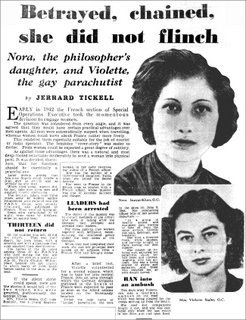
Whenever I passed the Baker Street tube station in London, it was the thought of Sherlock Holmes that sprang to my mind. Until I read about the WWII - SOE operations centre at Baker Street and the life of an extraordinary spy who uttered the words above.

The SOE, but for a couple of officers, believed otherwise.
Driven by ideals of freedom and calling herself Nora Baker, she volunteered for SOE, which specialised in dropping agents behind enemy lines. Trained at the secret Baker Street headquarters, she proved a poor recruit, being too clumsy, too emotional and too scared of handling weapons… Her finishing report, which the official historian of F Section found in her personal file long after the war, read: She has an unstable and temperamental personality and it is very doubtful whether she is really suited to the work in the field."

Nobody knows if it was just idealism or if it was a broken engagement that drove Norah to volunteer. But she did, spending a rigorous year in training and was then dropped behind enemy lines in France, Code name Madeline, Cover name Jean Marie. France was known territory, a place she had grown up in, and here she worked in constant danger, moving constantly avoiding detection, as the only woman radio operator spying & reporting on the German movements.


At the critical moment before the D-Day landing in Normandy she remained the last radio operator on the Continent, ensuring the last link between the Allied Headquarters and the French Underground. The life and death of millions and the fate of generations after the war was to depend upon one spirited by the vocation of a hero who accepted the risk of the supreme sacrifice: torture.

Incredibly enough, the girl eluded the dreaded Gestapo for many months, cycling, with transmitter in tow, from one 'safe house' to another. It was even reported that she solicited the help of an enemy officer to string up her antenna - telling him, of course,
that it was a clothes line!"'

She was instrumental in keeping a steady flow of information to the allies. But it was not to be, the Gestapo was catching up and eventually her friend’s wife betrayed her for a few francs. She was jailed, beaten, chained and interrogated. Stoic & brave by day, sobbing at night, probably fearing the betrayal and compromise of her intelligence operation (which it did), she resisted interrogation for many months though trying unsuccessfully to escape a couple of times. She was not destined to live, however, Hitler had decreed that escaping agents should be shot after interrogation.

She never talked, and her courage so impressed at least one of the Gestapo,
Josef Kieffer, head of Gestapo HQ in Paris, that at his trial he is said to have broken down in tears when questioned about her death. "The Germans had learnt nothing from her - not even her real name."

On the fateful day,
The SS undressed the girl and she was terribly beaten by Ruppert all over her body. She did not cry, neither said anything. When Ruppert got tired and the girl was a bloody mess he told her then he would shoot her. She had to kneel and the only word she said, before Ruppert shot her from behind through the head, was `liberté'." She was 30 years old. Dachau 1944.

A French military band still plays outside her home in the suburbs of Paris every July 14. The country she worshipped, India, hardly knows her.

Noor unissa Inayat Khan – the great great great granddaughter of Tippu Sultan. Her father Hazrat Inayat, a man with a mission, to spread Sufism around the world, left India for America, met & married Ora-Ray Baker (Begum Sharada Ameena Baker). Tsar Nicholas II through Rasputin invited them to Russia and it was here that Noor was born in 1914. The Bolshevik revolution was brewing in Kremlin and it forced the family to move, destined for France where they settled and where Noor grew up, excelling in languages. Tragedy struck, Pir Inayat returned to India and died from illness. Noor was slowly settling down to become a writer (her published works – 20 Jataka tales is still available
on Amazon), but when the Germans reached France, the remaining family fled to Britain where Noor became Nora and decided to join the war cause, along with her brother. But she was clear that she would work for the Allies during WWII to defeat Fascism and that she would go back to India after the war to join the freedom struggle against the British!!

At a memorial service in Paris, General de Gaulle’s niece summed up her achievement: “Nothing, neither her nationality, nor the traditions of her family, none of these obliged her to take her position in the war. However, she chose it. It is our fight that she chose, that she pursued with an admirable, an invincible courage.”

Noor’s comment about military distinction proved prophetic:
at the "VE" and "VJ" days to mark the anniversary of the end of World War II, an astonishing fact came to light at the roll call, that it was Indians who outnumbered even the British as the largest recipients of Victoria and George Cross medals, the highest British awards for bravery.

SS Trooper Wilhelm Ruppert was tried for war crimes and executed by the Americans on May 29, 1946.

Update August 2007 - Shyam Benegal is planning on directing an upcoming movie on Noor Inayat Khan - The princess spy, based on Basu's book.

Further reading


Noor Inayat Khan - WikipdeiaMadeline – Jean fuller
Spy Princess The Life of Noor Inayat Khan - Shrabani Basu
The Tiger claw – Shauna Singh Baldwin
Noor Appreciation siteThe women who lived for danger – Marcus Binney

Emden & Pillai

Posted by Maddy Labels:

While I was writing this, I wondered for long – How would Hitler have addressed Champakaraman Pillai? Well, he obviously did as he gave Pillai an apology of sorts for his demeaning comments about Indians in Mein Kempf (they are people incapable of governing themselves, he said). Food for thought, I guess – Herr Schampak maybe?

And the following lines that Ganesan (he learnt it in his kid days) once used, repeatedly spun around in my mind "Emden vitta gundu, adhil erindha tank rendu.."

All this started as I was musing about my days in Madras in the early 80’s, the walk to Marina beach up the Pycroft’s road and the Presidency College on the shore. And then I remembered the shell on the High court wall and Emden, the German ship. I thought I would research a bit more of that story and it was thus that this amazing tale came to light, I had not the slightest clue until then, no history book or patriotism class had taken me there, but first a bit about the ship…

Even today people in North Kerala call dark stout guys ‘Yumunden’ without knowing that the origin of the name was the hulking WW1 German frigate SMS Emden. SMS Emden’s story is well covered on
Wikipedia. But we will focus on the day it steamed into Madras Harbour.

Late at night on September 22, 1914, Emden quietly approached the city of Madras on the east side of the Indian peninsula. Once in range Emden opened fire on many large Burmah Shell fuel oil tanks that the British kept near the city. After firing 130 shells the oil tanks were burning and the city was in a panic. Although the raid did little damage, it was a severe blow to British morale and thousands of people fled Madras, thinking that Emden might be planning another attack. Emden then sailed southwards down the east coast of Ceylon (Sri Lanka), causing panic among the British .Sri Lankan mothers frightened their children with the Emden bogeyman, and to this day a particularly obnoxious person is referred to as an Emden. Emden supplied new words to many South Indian Languages. Malayalam word Emandan meaning 'a big and powerful thing' or 'as big as Emden' derived from Emden following its successful attack on Madras Port.

Emden’s story is a classic war adventure, there are many a book written on it. In the end seventy-eight (some say 60) British ships were required to run her down. The adventures of the ship are chronicled in the book
Last Corsair.

I thought the story ended there, but it did not….

Incredible as it may seem, the Emden had a very strong Malayali/Tamil connection. I was amazed when I stumbled upon this, well, to sum it up in a simple line; this anti imperialist attack was apparently directed by the Ship’s engineer Champakaraman Pillai, assisting the captain Helmut Von Mueller. (This is quite a bit of fiction, Pillai was not involved at all, as I can add after more research)

S Muthaiah states - Fanciful legends abound of his (Pillai) being Mueller's second-in-command, of his directing the firing on specific targets in and around Madras Harbour, and of his rowing ashore at Cochin to greet his family and admirers! Authentic records of the voyage of the Emden do not corroborate any of this, but they do speak of his work aboard the cruiser and his post-War attempts to gather in Germany an anti-British group of Indians, a forerunner to the Indian National Army. His volunteer force, another legend has it, was the inspiration for Netaji Subash Chandra Bose's Indian National Army.


Pillai was among those who first gave the slogan of "Jai Hind" to the people of India and to the many Indians abroad who were struggling for the cause of Indian Independence. He had the privilege of being the Prime Minister of the Provisional Government of India set up in Afghanistan in December 1915, with Raja Mahendra Pratap Singh of Kabul as President. However, the defeat of the Germans in the war shattered the hopes of the revolutionaries

Dr. Chembakaraman Pillai
died in Germany in 1934 (poisoned or tortured to death by Nazi’s) and, after his death, his wife Lakshmibai, a Manipuri, who is said to have suffered at the hands of the Nazis herself, returned to India and lived in Bombay till her death in 1972. The most intriguing part of the Chembakaraman story is the mystery of his missing papers. J. V. Swamy, a nephew of the doctor, claims that shortly before Lakshmibai's death, the Bombay Police visited her flat and took away 17 boxes containing her husband's papers…

The story does not end here too. After many a success, Emden had to be destroyed, the ships crew were well aware that their time was up, they were finally chased & cornered by as many as 60-80 Allied ships --------The ship was finally sunk (Von mueller’s repor
t is interesting reading).

But Von Müller’s landing party at the Cocos Islands managed to steal the 97-ton copra schooner ‘Ayesha’ and sailed to Penang. From here they made their way to Istanbul, which I believe, is another fascinating story. They survived numerous threats to make it to the Arabian Peninsula, where they travel by camel caravan and survive an attack by Bedouin tribesman before reaching safe haven in Istanbul.

So much behind that Emden attack on Madras, a luminary called Chebakaraman Pillai, Hitler, Imperialism, the ship SMS Emden and the British…What a story!!

Note: regretfully, the connections between Pillai and Emden and Jai Hind seem to be the result of fertile imagination. More research is required to uncover Pillai's eventful life.

RKN has written a short story ‘Emden’ in his collection of short stories ‘Old & New’

In lighter vein, there’s a movie called Emden mahan (re-titled Em mahan)in Tamil
A couple of stories about the ship and the voyage

Courtesy – Hyperlinks above, for the pictures

Sahib and Collector

Posted by Maddy Labels:

Sayippum Collectrum

In colloquial Malayalam, Sayip is loosely associated with a Western (white) foreigner. However I discovered that it is mostly a usage conveying respect. Did it originate from the word Sahib? Perhaps! Anyway I have heard the usage ‘Sayip’ associated with one of these two gentlemen who I will venture to introduce to you.

Tellichery – a place once called the Paris of Kerala, the city of cricket, circuses, tennis and cakes. So many great luminaries came from this birthplace of Malayalam literature. There was a time and period in Malabar (The original Malabar in Kerala not Malabar-Florida) when two great persons lived in the same town, in a country and locale totally alien & mysterious to both. They ended up loving the town, the very region itself and easily merged with the local populace. The city gratefully honored them, one with a road and the other with a statue. One of them is Gundert Sayip, the other William Logan. Both have become part and parcel of Kerala and are always the first to be quoted when people dredge the annals of Malayali history. Both came to India for purposes different from what they are known for today. Malayali’s will always respect and love them for taking pains in recording their place & times in the world’s documented history.

William Logan (1841-1914) – Sadly, other than the few notes that Logan was a Scotsman sent by the British East India Company to the Madras Civil service, not much information about the person himself or his life exists in the public domain. Starting as a Judge in 1873 at Tellichery (and elsewhere since 1855), Logan became the Malabar collector in 1875 and lived at East hill Calicut. I believe his bungalow is now the VKKM museum. However, his name to fame was the authorship of a fine 1200 page manual in two parts by 1887 called the Malabar manual, in which he recorded all that he could about the people of Kerala, their history, culture and varied practices. (‘A Collection of Treaties, Engagements And Other Papers Of Importance Relating To British Affairs In Malabar’ written by him is sometimes referred to as the Part3) He was supposedly pretty good at spoken Malayalam, Telugu and Tamil. In history, Logan is titled the Gazetteer of Malabar. Now what was a Gazetteer supposed to do? Gazetteers became popular in Britain in the 19th Century, many of whom were Scottish, documenting activities to meet public demand in Britain for information on an expanding Empire. Logan simply put, produced in ‘Malabar manual’, the work of an enlightened administrator, an assiduous scholar and an authority on British affairs in the region. People of Tellichery have not forgotten him. A road with his name can be found in the town.

Beginning 1836, several Mappila outbreaks were reported till the end of the century, in which Mappila tenants killed the Hindu landlords. Strong measures were taken to suppress the Mappila unrest. In 1855, four Mappilas killed H.V. Conolly, the District Magistrate of Malabar at Calicut. One of the grievances of Mappiilas was said to the lack of sites for Mosques and burial grounds. William Logan was appointed as the special Commissioner to enquire into the land tenures and tenant rights in Malabar and highlighted the agrarian discontent and poverty among the Mappilas as the causes of the unrest.


Logan with all humility states in the preface of his work "I shall consider that I have failed in one main object if I do not succeed in arousing a feeling of interest on many points whereon I have necessarily touched, but briefly in this work." He was appointed Collector of Malabar in 1875, at a crucial stage of the history of Malabar, and he was well equipped for the role, having served the area for more than 20 years as judge, special commissioner, and magistrate, and had gained a wealth of knowledge in the process. Logan loved the land and the people, and his tenure made him a real "Kerala man.
Noted historian and former chairman, Indian Council of Historical Research, Dr. M. G. S. Narayanan opines "Logan was sincere and serious about the task entrusted to him. He was an efficient Collector who had an affinity with the people of Malabar. The personal contribution is evident all along. The details given by Logan with regard to dress, festivals and other social customs go a long way in providing insights on the social history of Malabar. The cultural heritage of Malabar, the race for hegemony in the trade of pepper and spices, the Mysorean invasion, and finally British supremacy find mention in his book”.

Those who want to take a peek at the exhaustive accounts of life in Malabar in those days can try out the Malabar manual,
here.

Taj Residency Calicut has a Logan suite that has a Scottish flavor & a Logan’s bar; well I guess that is one way of remembering the man!!

Rev. Dr. Hermann Gundert (1814 –1892) Dr. Gundert was born at Stuttgart
in Germany on February 4, 1814. Educated at the grammar school there and the Maulbronne seminary later, he studied Protestant theology and philosophy at the Tubingen University. It is said that his desire was to be a soldier, but his sister’s sudden death changed his priorities and he took up evangelical work. In 1836, he left Germany for India to work as a private tutor. He traveled extensively in the erstwhile Madras province with an unquenchable passion for learning the languages and cultures of the people. It was after his marriage to Julie Debois from Switzerland that Gundert joined the Basel Mission in 1838. On an invitation from the Basel Mission to take over the mission establishment at Thallassery - Malabar, Dr. Gundert moved to his Illikkunnu residence in 1839, where he lived for 10 years, if not for anything else, but also to enrich Malayali literature and the educational system.

Gundert's bungalow today is a tourist attraction, which also houses part of the Nettur Technical Training Foundation - a unique institution started by the Swiss Foundation. Before 1839, he was posted in Chittur in Andhra Pradesh, Nagerkoil, Thiruvananthapuram and Kochi. From 1849 till 1856, Dr. Gundert was posted in Chirakkal near Kannur where he stayed till he was transferred to Mangalore in 1856.In 1857 the British colonial administration appointed Gundert as school inspector of Canara and Malabar. By 1859, however, poor health forced Hermann Gundert to return to Germany, where he went on to manage the Calw publishing house from 1862 until his death in 1893. The revered German priest and lexicographer compiled a Malayalam grammar book, Malayalabhaasha Vyakaranam (1868), the first Malayalam-English dictionary (1872), and translated the Bible into Malayalam.Gundert also published the first ‘Patamala’ textbooks for children.

Gundert was no ordinary Pietist missionary. Not only was he fluent in English, German, French, and Italian, but he was just as capable of preaching in Hindi, Malayalam, and Bengali. He was almost as fluent in Kannada, Telugu, and Tamil, and was familiar with at least ten other languages.

Gundert was commonly known as Gundert Sayip – the person created the first Malayalam to English Dictionary – In his own dictionary completed in 1872, he defines Sayip as ‘a lord or a Gentleman’. That he sure was…a fine Gentleman!!! The people of Thalassery have honored him by a statue in the city

Some very interesting notes – Gundert published the very first formal and free (actually the Malayala Panchangam was the first published paper) Malayalam newspaper ‘Rajya samacharam’(though quite evangelical in tone) in 1847? He continued on with another newspaper, the more popular paper Paschimodayam (Malayala Manorama started theirs in 1890). It was Gundert’s intent to publish a newspaper that influenced the need to standardize grammar & text. In 8 years, i.e. by 1855, he had mastered the Malayalam language, for example by going to the markets and listening to people conversing. Such was his love for the people he worked with. Through his paper, he introduced people to life in the West, about English folklore, Germany, Netherlands, the French revolution and so on…

I studied at the BEM School at Palakkad for some 4 months before I moved on to Sainik School. Little did I know that BEM schools had much to do with our beloved Gundert Sayip. Herr Gundert’s BEM’s were the first to start schools as early as
1847 in Kallayi!

How many of you know that our revered Gudert sayip is the grandfather of Nobel Prize winner Herman Hesse? Hesse's mother Marie Gundert (1842-1902), was born in Tellichery. Hesse's fascination for Indian philosophy and Buddhist mysticism is reflected in the famous book "Sidhartha".
Herman Hesse said of Gundert, his grandpa - He understood all of the languages of man, more than thirty, and perhaps even those of the gods, perhaps of the stars as well, he could read and write Pali and Sanskrit, he could sing songs in Kanarese, Bengali, Hindustani, Singhalese, he knew the prayers of the Muhammadans and Buddhists, although he himself was a Christian and believed in the triune God, he had spent years and decades in eastern, hot, dangerous lands, had journeyed by boat and by ox cart, on horseback and mule, no one knew as well as he that our town and land were but a small part of the earth, that there were a thousand million people with different beliefs to our own, with different customs, languages, skin colours, gods, virtues and vices.

Those interested in his original Malayalam-English dictionary can download it
here. Those who are interested in the first newspaper may read this exhaustive report on it.

Sayippinum collectorkum Malayalikalude nandi..


Pictures - from here & there - thanks to the originators & posters!!

Connollys teak and canal

Posted by Maddy Labels:

Lt Henry Valentine Connolly was the Malabar Collector roughly between 1840 and1855.

Connolly is honored with his name being used for the Connolly (In Calicut they say ‘Canoli’ canal ) Canal that connects the Kallayi river (See my noting on Kallayi in an earlier blog) to the Elattur river. Built in 1948, the 3 mile long canal provides water communication between Beypore & Badagara (BTW the land where the canal crosses Eranhipalam was acquired from my wife’s family!!). These days you have boat tours through the canal!!

Conolly (who was Dist Magistrate during the earlier part of the Moppila outbreaks that lasted from1835-1921) was tragically murdered in 1855 by Moplah fanatics at the start of the Moslem revolt in Malabar. T. This story is recounted by Nick Balmer in his blog Malabar days ……

Connolly lived at that time in the Collector’s bungalow at West Hill. The bungalow is still around and is the home for the Pazhassi (Kerala Varma) Raja museum and they have a Connolly garden in the premises. This is also the location of the VK Krishna Menon museum.

One of Connolly’s tasks was to ensure a steady supply of teak to British shipbuilding yards. For this reason he went about creating up a teak plantation in Nilambur in 1844.

Nilambur is today famous for its teak plantations. Nilambur also a seat of the Zamorins, is famous for a cluster of kovilakoms or residences of the local rajas of earlier days. These houses are famous for their beautiful frescoes and artworks in wood. The oldest teak plantation of the world, the Connolly's Plot is just 2 Kms. from Nilambur town. The Teak Museum at Nilambur chronicles the history of the tree and explores its scientific and artistic uses. The oldest teak tree, Kannimari, is a rare attraction at the Connolly Plot. The plot extends across 2.31 hectares beside the Chaliyar River at Aruvakode, where a country boat ferries visitors across.


Conolly - Image provided by Anusha
How Connolly went about the task of setting up the plantation is very interesting and shows how meticulous a person he was. This strength of character was to put him in good stead for the arduous works that were to be entrusted to him in the future by the East India Company. He started his experiments at teak planting in the 1830’s around Beypore, but the seeds did not germinate. Various other trails were conducted in removing the outer covering of seeds, burning them, getting ants to chew them, planting roots and so on. Finally Connolly requested for a trained arboriculturist, but was told to find one locally and pay him Rs 50 per month (I assume this is when he found Chatu Menon). Various different methods were tried and saplings produced and planted. Connolly complained to his HQ that his methods were based on previous inconclusive studies and his own limited study of the booklet called ‘Forester’s guide’ which was not really the appropriate way to go. However his listening to the local people about the aftermath of forest fires and experimenting with Chatu Menon on pre-burning the seeds seemed to provide best results. Connolly complained thus ‘the more I read, the older the plants become’ and requested more support. Two or more inspectors were sent to inspect the Nilambur experiments and they too prepared exhaustive reports supporting Connolly’s plea. I understood that it was 1860 when action was finally taken and grants provided to improve the plantation.

Teak felled at Nilambur, was floated on through the rivers and canals to Kallayi (just off Calicut town)where they were loaded onto the giant ships headed for Britain. During late 19th century and early 20th century, the Chaliyar River was extensively used as a waterway for carrying timber from the forest areas in and around Nilambur to the various mills in Kallayi near Calicut. Rafts made of logs were taken downstream during the monsoon season to Kallayi, where these were sawn to size in the timber mills dotting the banks of the river. During this period, Kallayi was one of the most important centers (2nd largest) in the world for timber business.
Sir Chathu Menon, the forest officer (titled native sub conservator) under Connolly, who took up the hectic task of single handedly planting teak, was laid to rest in the Teak garden in Connolly's Plot. Chathu Menon, now known as the father of Indian teak plantations, raised more than a million teak plants between 1842 and 1862. He was presented an ornamental woodman’s knife and belt by Lord Harris in Nov 1958. Chatu Menon subsequently trained others to create similar plantations in Canara.

All that being said, why so much emphasis on Teak as timber for ship building? It has its origins in history, and is known for its strength ( called ironwood by the Chinese)longevity spanning thousands of years. A research article states that teak was found in the ruins of an ancient city in Vijayanapur, Southern India. A temple was built on teak planks only 1 1/2 inches thick, but when examined in 1881, the planks were found to be in excellent condition despite 500 years of exposure to the elements. Other evidence of teak's amazing durability is found in cave temples in Salsette, India, where the 2,000-year-old teak remains in mint condition. Mariners regard teak as the most versatile and durable hardwood. Even the decks of the ‘Titanic’ were made of teak and the salvaged teak is still usable. Teak does not warp, twist or expand. The technoqunines in teak naturally repel termites and other bugs. It grows harder with age and is the wood of the ships.

Sadly Connolly’s teak plantations are now on the decline. Much of it is felled and gone, never to be replanted. The land is being used for other purposes. A story about teak thieves can be read here.

A good article about the plot & museum in Nilambur

References - The Forests and Gardens of South India - By Hugh Francis Clarke Cleghorn, Hugh Cleghorn

Connolly’s teak plantation pics – various web sites.

1488 - The Royal Spy arrives in Calicut

Posted by Maddy Labels:

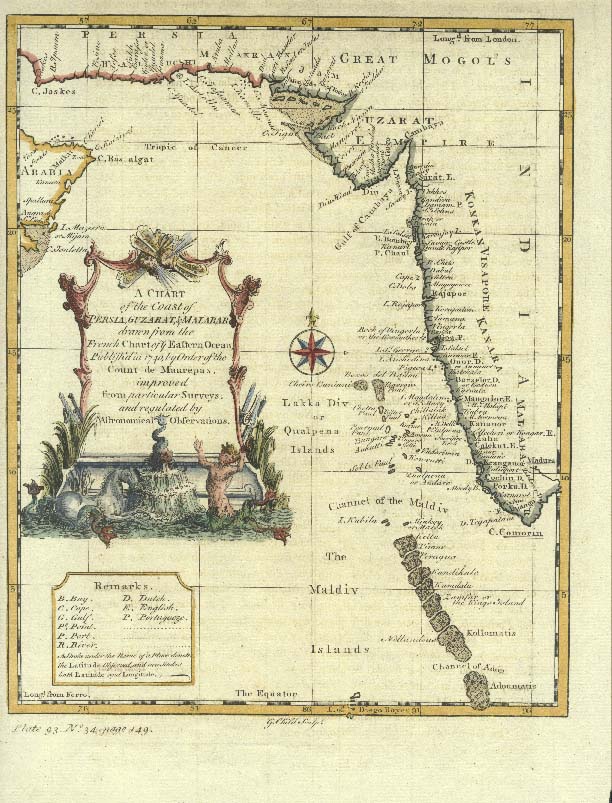
Many years ago, in the cool winters of the latter part of the year (November 1488), a Moorish ship set anchor at Calicut. Amongst the various merchants from Arabia who alighted, there was one who looked and spoke like an Arab. He was a spy in their midst, on a commission from the King of Portugal. His name: Pero De Covilha. Pero who was trained at Morocco and Moorish Spain, spent many months, probably close to a year touring Calicut and Goa, recording the spice trade in and around Calicut. Pero a fluent Arabic speaker was astounded by the many sights of the splendid port and its people. It was a full eight years before the Vasco De Gama and his ships reached Calicut to change history. Perhaps, it was Covilha who laid the very keel for the ships journey; however like most spies he received no public credit for his work though his story proves a very interesting read.

It was a part overland trip that started in May 1487. Pero Da Covilha and Alfonso de Paiva, great friends themselves, were dispatched by King John II, to record the routes and happenings at various places in the Malabar area and primarily to find the mythical land of Prestor John. Barthalomeow Diaz on the other hand was sent to find the routes by sea. Traveling through Naples, Rhodes, Alexandria and Cairo overland, they blended with Arab caravans before reaching Aden at the mouth of the Red sea. Pavia left for Ethopia and Covilha left for India. Alas, the great friends were never to meet again. Pavia fell ill and died during his travails in Ethiopia.

Pero da Covilhã eventually reached Calicut (modern Kozhikode) and Goa on the Malabar Coast of southwestern India, where he witnessed a prosperous trade in Arabian horses, spices, fine cottons, and precious stones. After completing his assessment of the European trade with India, Covilhã sailed for home in February 1489. He passed through Ormuz at the entrance to the Persian Gulf and the port of Sofala opposite Madagascar before traveling north to Cairo in 1490. While in Cairo, two Jewish emissaries(Rabbi Abraham and Shoemaker Joseph – or was it Jose Lamego?) from King John II gave Covilhã a letter instructing him, if he had not already done so, to travel to the kingdom of Prester John to gather intelligence and promote an alliance. Before he left, Covilhã induced a messenger José de Lamego to carry a letter to King John II that described all he had learned of Arab seafaring and the Indian markets. Six years after leaving his home in Portugal, Pero da Covilhã reached Ethiopia in 1493, where he discovered a land ruled by Alexander, "Lion of the Tribe of Judah, and King of Kings." Covilhã so impressed the Ethiopian monarch that Alexander considered him a "Portuguese Marco Polo" and refused to let him leave. Covilhã married and settled down to live the rest of his life in the once mythical land of Prestor John.

Peter Koch notes - Calicut at that time was one of the richest ports of the world. It was the commercial hub for Arab Muslim and Asian traders. Fleets of junks from China and the Indies sailed to its crowded ports, and once docked, unloaded their abundant cargoes of precious gems, silks and spices that were to be sold at destined local markets. Anxiously awaiting their arrival were numerous Arab traders willing to pay a handsome price for just about any goods shipped from the orient. Once purchased, these were shipped through the Persian Gulf or Gulf of Aden, and from there, they were distributed to markets in Africa, Middle East and Europe.

Pêro da Covilhã, while in Africa, noted and informed Paul II that if the extreme south tip were rounded by Portuguese mariners they could easily reach Calicut from Sofala or Malindi and take possession of the spice trade. In ten years’ time, this observation by Pêro da Covilhã would convince Vasco da Gama to sail from the east coast of Africa directly to Calicut. In 1487, financed by a letter of credit from the Florentine banker Bartolommeo Marchioni, he was sent by João II of Portugal to investigate a northerly route to India . Covilhã continued to Socotra and Cannanore (in India) in an Arab dhow, then to Calicut (1488), Goa and back to Hormuz (winter 1489)


Arriving at Calicut in Nov 1488, Covilha was astounded seeing gentle elephants on the streets carrying burdens, presumably wood. Here is an account of his notes

He makes friends with an Indian merchant, telling him that he was an emissary from the sovereignty of Fez in the Maghreb, on a journey to India to investigate the possibilities of entering the spice trade. The merchant shows him the city, not only its opulent palaces, temples, gardens and artificial lakes but also an immense settlement of thatched huts, a disease-ridden pocket of the city where the pariahs, the lowest of the low, are dying from sickness and starvation. The Zamorin (ruler) still practises the Hindu religion but is already surrounded by many Muslim advisers. The merchant guarantees that the majority of spices produced in India, plus those that come from the East, pass through Calicut, which is what causes the city to be so busy. Pêro is surprised, as he thought that all the spices were produced in India.


“No, that’s not true,” says the merchant. “For example, cinnamon comes from Ceylon, an island to the south of India, while nutmeg and cloves come from Malacca.”
“Malacca?”
“The capital of the Kingdom of Malaysia.”
“Where is that?”
“It is in the east, 40 days’ journey from here, if the wind is in the right direction.”
“So Malaysia produces nutmegs and cloves?”
“No, no, they are produced in Ternate and the other Spice Islands, which are even further to the east. They are produced there but concentrated in Malacca, which exports them to India, mainly to Calicut.”


The Spice Islands will later be called the Moluccas, a corruption of the Portuguese word for malucas (crazy). They will be given this name because, owing to local alterations in the earth’s magnetism, it will be difficult to fix their co-ordinates; they appear to be here, they appear to be there, hence the crazy islands. But this will only happen later. For now, Pêro da Covilhã is just learning about the existence and produce of the Spice Islands, the locality of Ceylon and Malacca, the supremacy of Calicut in the Indian spice trade. He is surprised by such supremacy:


“I don’t know how it is possible - a navigator told me and ascertained that this is a dangerous port, with many sandbanks.”

“That’s true,” replies the merchant, “but in spite of them, that’s how it is - you’ll see.”
And see he does. He visits Cannanore, Goa and Ormuz,(An island close to Iran actually) magnificent cities on the Malabar Coast, but there the commercial activity is much less than in Calicut.


Pêro da Covilhã notes, “The majority of the spices leave Calicut for Cairo, crossing the Red Sea. From Cairo they go on to Venice. If one day we want to take on this trade for ourselves, we simply have to block the Moorish ships’ access to the Red Sea.”
The information provided in Pero’s letter complemented the information from the sea expedition of Bartholomew Diaz and convinced John II that it was possible to reach India by sailing around the southern end of Africa. When B Diaz returned to Lisbon the Portuguese had mixed feelings, because the trip around Africa had turned out to be so much longer than expected. Was his eight-month journey worth repeating? Could anyone make a profit over distances like these? It took the news of Christopher Columbus discovering new lands across the Atlantic to decide the argument; if Spain could find a fortune overseas, Portugal could too.

Later, in 1493 a Genoese, Geronimo de Santo Stefano, a private entrepreneur, arrived at Calicut from Aden. His journey continued to Ceylon, Burma, Malacca and Sumatra. On his return trip he passed through the Maldives, Cambay and Ormuz. He wrote a woeful account in 1496 of his travels, physical hardship, financial disaster and the life around Calicut. I must also mention here that two other noteworthy people visited Calicut before Covilha, they are Afanasii Nikitin around 1460 and Venetian Nicolo Conti in 1419.

And with that the plans for formal plunder of the East Indies, started. Manuel I assumed the throne in 1495 and completed the preparations for the voyage to India. On July 8, 1497, a fleet of four ships commanded by Vasco Da Gama set sail from Belém on the outskirts of Lisbon, bound for Malabar.

Noteworthy is the fact that these were people who arrived and lived at Calicut before Vasco Da Gama, who unfortunately takes most popular credits for being the first of the Europeans to reach Indian shores.

Picture of Covilhas route – from CNN

References
Beckingham: The travels of Pero da Covilham and their significance
Diffie & Winius – Foundations of the Portugese Empire
The History of Portugal By Edward McMurdo