


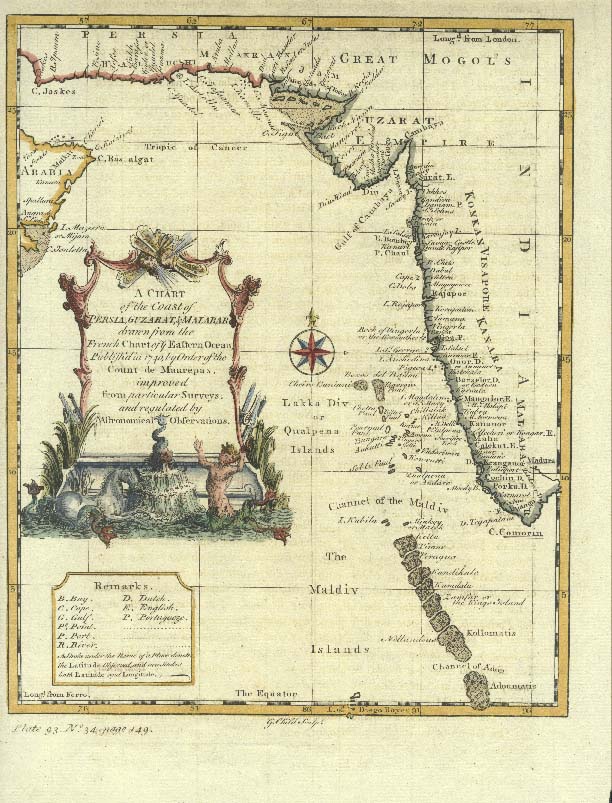
Most of us have heard and read about the famous Kunhali Marakkar and his exploits, but one question remains, where did they come from? There have been many questions about their real origins, were they Moplahs of Arab extract from Pantalayani Kollam (South of Calicut); were they of Sri Lankan origin, were they Tamil Marakkars or were they from Tulunad? The research was quite interesting and the result obtained cannot be termed fully conclusive but was quite revealing. For those here, and only interested in Kunjali’s story, this does not cover the life and times of any of the famous Kunhali’s but hovers only around theories of their possible origin.
The Name and title
Let us first look at the name Marakkar. Note that this is different from Marakkayar though we will observe the connections after a while (Marikkar and Maricar are other spellings used in history books). According to many other historians, Moppila or Moplah is Maha Pillai (great son) and Marakkar means (Marakkalam is a wooden boat) ‘boatmen’. Thurston in his Tribes of S India, states the following - The word Marakkar is usually derived from the Arabic ‘Markab’, a boat. The story goes that, when the first immigrants of this class (they were apparently driven from their own country by persecutions) landed on the Indian shores, they were naturally asked who they were, and where they came from. In answer they pointed to their boats, and pronounced the word Markab, and they became in consequence Marakkars, or the people of Markab.
Was it also a titular name for seaborne traders? KVK Iyer clarifies in his history of Kerala that Marakkar was a prized title given by the Zamorin of Calicut. Derived from Marakka Rayar it signifies the captain of a ship Rayar (Captain) of Marakkalam (ship). According to him Kunjali after the destruction of Ponnani by Almeida approached the Zamorin and asked to fight the Portuguese. Impressed by his courage he was given this title by the Zamorin. It appears that the people who carried the title used a special silk turban on their heads. Don Lach & Ed Levy quoting Laval in the book ‘Asia in the making of Europe’ states that Marakkar means ‘viceroy’.
NM Nampoothiri quoting the Granthavaris of Calicut - Zamorin confirms the honorific title - In 1687 the Kuliyoti Kottakal Marakkayar was given the title Marakkayar. Another man, Kunnikkalathor was given the title Kunnali Marakkayar in the same year.
The period
P Kunhabdulla in an article opines that the Marakkars came from Arabia in the 7th Century. This poses a question, where on the Malabar coastline did they settle down? Assuming for a moment that they came around the 11-13th century, the trade links with the Arab lands was in the Cranganore region, with Muziris (A tantalizing question – could all this connect up to Vavar Swami?). However another scenario is more probable. If one were to study the history of Quilon, it will be evident that the trade between Arabia and wealthy Quilon was controlled by the Chinese with their vessels. But by the turn of the 12th century we read that the Chinese were forced out and the Moplahs take their place. This is possibly where the Marakkars first settled, thence moving to Cranganore & Cochin. Here they would have settled to provide the trade support to the new entrants of the Portuguese. A group of them had migrated to Tuticorn earlier and settled down to conduct trade with Ceylon, Java & Malay. They also controlled the lucrative pearl fishery subjugating the Paravas for that purpose. Finally they took the reins of the horse trade with Arabia, supplying the horses to the Muslim rulers in the Tamil Nadu & Vijaynagar.
When the Portuguese encroached on their supplier base in Malacca in 1524 or so, the fighting between these two communities started in right earnest. The Marakkars of Cochin had to leave their base in Cochin and move to Ponnani & Kottakkal, with the support of the Calicut Zamorin. According to Logan in Malabar Manual, the Marakkars moved to Thikkodi following Henry Menzez’s destruction of the Moorish colony in Cochin and then to Kottakal where they became prominent. They then became the admirals of the Zamorin, leading the wars against the Franks, but by the turn of the 17th century had been subdued by the determined Portuguese with their bigger & better armed ships. Mayimama Marakkar was once an ambassador of the Zamorin.
Logan feels they were originally from P Kollam. Krishna Iyer states that they originated from Ponnani and spread to Tanur, Agalapula etc. Pyrard Laval and DeCouto state that Kunhali was from Pantalayalni Kollam, moving to Tikkodi later in 1525.
Pius provides a detailed account and three theories. One was the increase in prominence of the Casados or Portuguese married to Indians and the support for private trade conducted by them around 1515. Then it occurred that Albuquerque died and the passes/permits or ‘cartazas’ for trade stopped being given to the Muslim traders. The marakkars, especially Kunhali who had started a joint trade with Gov Diogos Lopes suddenly found that Lopez simply appropriated his own laden vessel and goods bound for the Red sea ports. It was this act in 1522 that turned Kunhali against the Portuguese. By 1524, Kunjali, Mohammad Ali and Ahmed Ali, all Marakkars moved to Ponnani. Pate Marakkar, Kunjali’s cousin was another Marakkar who went against the Portuguese. This action is a long way from the days of 1513 when Dom Manuel bestowed special privileges for Cherina & Mamale Marakkar. The second reason was the take over of Malacca trade by the Casados. The third reason was a drop in customs duties for Casados in the Cohin port that enabled the Kings family to broker deals between Casados and non Muslim traders.
Some prominent Marakkars and their trade
 The Marakkars were the leading business group of the region when the Portuguese arrived in Kerala. They had settled at Cochin and were believed to be the descendants of the Arabs who migrated to Kerala. If they were Arabs, are they Yemeni Hadhramites or Egyptians? Mecca – By Francis Peters (P173) & Logan (P308) mention a wealthy Egyptian trader named Khoja Mehmed Marakkar, who was ill treated by Vincent Sodre at Cannanore, thus signifying a possible but lone Egyptian connection (I understood that Sreedhara Menon also makes such a Cairo connection but I could not find it). As we saw they were driven out of Cochin by the heavy handed actions of the Portuguese.
The Marakkars of Cochin as we saw earlier, had ships & factories in the Cochin & Coromandel area according to Portuguese sources as early as 1504 and supplied the Portuguese with spices from Malaysia (Malacca) before the Portuguese themselves established themselves in Malacca (KS Mathew). They also had a monopoly over the Maldives trade.The interaction between the Ceylon, Ramanad and Kayalpatanam Marakkars is often quoted by historians and writers of the times such as Sheikh Zainuddin and Barbosa. It does appear that they also conducted commodities trade, especially rice. Ismail marakkar for example handled rice trade in Calicut, and there were the famous Pachachi marakkar, Pattu (Pate) marakkar etc. Varthema mentions Mamale Marakkar of Cannanore, the richest merchant of Malabar. In later days, i.e. Tipu’s times, the Dewan of Travancore was supported at sea by Pokku Moosa Marakkar.
Pate Marakar of Cochin approached Zamorin after they are troubled at Cochin and received no support from the local Cochin king (Starthern). Until then Mamale marakar (Lord of Maladives) was the one fighting the Portuguese, he was killed by Sodre in 1525.
KS Mathew an Indo Portugues specialist identified Mamale Marakkar in Cochin during the 1504 period. Between him and Genieve Bouchon, they list the following Marakkars of Cochin in the 16th century. Cheria naina, Naina (note here that the Naina marakkars were later prominent in Burma & Malacca), Mitos, Chilary (Cheria ali), Mohammed, Mamali, Pate, Icimale & Belina. Sheikh Zainuddin mentions the four admirals or Kunji Ali, Ali Ibrahim, Kutti Ibrahim and Mohammed Ali Marakkars. Mathew also confirms that these Marakkar’s of Cochin had their own factories in the Coromandel Coast and traded with the Portuguese until 1511 when the latter conquered Malacca. Zainuddin confirms that these Marakkars had sailed often to Kayal but that they also fought with the Portuguese when attacked. The King of Kayalpatanam, a Marakkayar who was a subject of the queen of Quilon had his Kayal kingdom with many other Malabar settlers. These people according to JBP More eventually became the Marakayars (note now the change of spelling) of Tamil Nadu. Pius Malekandathil states that it was the Marakkar traders, especially Mitos Marakkar who were the chief suppliers of Cinnamon to the Portuguese in Cochin. One interesting fact also comes up that the boat of Cherianaina or Mamaly Marakkar was attacked by Cabral at the behest of the Zamorin (Sanjay Subramaniam Pg 180) due to a complaint that his war elephants were on board that ship.
Marakkars and Marakkayars
JBP More points out to spoken words, marriage customs etc which strongly connect the Marakkayars of Tamil to the Malabar Marakkars. It is also pointed out in his book that Malabar Marakkars had relations with the communities in the Kayalpatanam (Tuticorin) region, a group which conducted trade with Burma, Malacca and Indonesia.
To determine the origins of the Marakkars, JB More used another yardstick, their family system. Both the Tamil Marakkayars and Malabar Marakkars practice marumakkathayam (matrilinear system of inheritance) and settle in the bride’s house. More thus believes that the Tamil Marakkayars came from Malabar.
It was only towards the 17th century that the Tamil Labbais came to the fore, as the boatmen & the fishermen. In another wave of migration, many Muslims left the Tamil country during the late 14th century in Marak Kalams (Wooden Boats) and landed on the coasts of Ceylon. Because they came in Marak Kalams the Sinhala people called them Marakkala Minissu.
Summarizing, the elite Chuliah (Kling to Malays) Muslims constituted the Maraikkayar caste in the early 14th century. This Tamil group were Sunni’s and maintained ships and had strong relations with their Arab brethren as well as the holy cities of Arabia (The Labbias were the lower Sunni strata comprising fishermen, pearl divers etc). The Kayalpatanam Marakkars controlled the Indian Ocean pearl trade. The Labbias and Rowthers conducted inland trade.
However, Arthur Coke Burnell states that the Mopilah and Labbai are of the same descent, it is just that Labbais settled in the Tamil areas. Though they kept apart from each other in South India, elsewhere they had links - Let us look at this Malay name to define such a connection- Sheikh Labbai nainar Marakkar ibnu ahmad labbai. These Labbai Marakkars have been living in places like Malaysia since the 10th century. Did they come from the Labbai Iraqi stock? Or is it a rare case of intermingling?
Susan Bayly states in her book ‘Saints Goddesses and Kings’ (pg80) that Tamil Marakkayars have always looked down upon converted Muslims and had a higher social standing, being directly linked to Arabs. She states the Sunni Shafi Madhab connection to Arabia as proof of their identity. They (marakkars) maintained the sect by intermarriage between the Marakkayars of Malabar & Tamil Nadu strictly. She states that Labbais are Hanafi sect followers are follow rules like marrying father’s sister’s daughter (Murapennu- a popular south Indian ‘kalyana murai’). Nagore, Kayalpattanam, Kilakkarai, Adiramapattanam are the main centers with old mosques and remains of ancient Sahabi saint.
Bayly mentions Patattu marakkayar signifies a title or Pattam having been granted to one of these families. Could that be the Pattu marakkar that we know from Cochin? The Kayal Patanam Quadiri Sufis had connections with the Calicut Sufi families. This sort of confirms the connection between the Calicut, Cochin & Kayal Marakjkayar families and the Arabic links. The Marakkayar port of Porto Novo (Mahmud Bandar) was a popular and busy port in the later years. In Ramnad however, the Marikkars mainly handled trade for the Setupati royal family.
Labbai are one of the four Muslim groups in Tamil Nadu State. The Ravuttan, Marakkayar, and Kayalan form the rest of the Islamic community. Labbais and Ravuttans follow the Hanafi School, a branch of the Sunni sect. Marakkayars & Kayalars belong to the Sunni Shaafi branch of Islam which spread from the coasts of southern Yemen. Kayalar seems to be a subdivision of Marakkayar. Kayalars and Marakkayars are found primarily along the Coramandel coast. Labbais and Ravuthars predominate in the interior, Ravuthars mainly in the south and Labbais mainly in the north of the state
Marakkars of Kotakkal
Let us start with the first major Maraikars of Cochin. They were the two families, namely Cherian Marakkar and Mamally marakkar. Cherian was an agent of Malik Ayaz of Gujarat, whereas Mamally (strangely he is also called Mamally Mappila) excelled in trade based from Cannanore. As the Portuguese tightened trade controls, these Muslim traders moved to take residence near Calicut. Lakshmi Subramaniam opines that this is when (1524) Ahmed Marakkar, Uncle Mohammad and his brother Ibrahim moved up towards Ponnani and Kottakkal. Mohammed Marakkar was accorded the title Kunjali by the ruling Zamorin thus cementing the families relationship with the Zamorins until the reign of the 4th Kunjali by when a wedge was driven into this relationship by spite, jealousy and cleaver manipulation of the Zamorin by the Portuguese. Between 1500 and 1600 the Zamorin’s naval operations were overseen by the Kunjalis.
The Kunjali IV (Kunhali is more modern. The older historians call him Kuttiali) was executed by the Portuguese in March1600 and with that ended the Malabar Marakkar clan. The study of the collapse of the family also signifies that they were Marakkars for they did not marry from the local Muslim clans, apparently the last Kunjali adopted a Nair girl (this Nair woman relationship, an elephant’s tail hair and a purported castration of a Nair were the main tools the Portuguese used to drive the wedge between the Zamorin and the Kunjali) and got her married to a senior Muslim sea captain.
Back to origins
So the question still remains. If the Marakkar traders originated from Cochin, where did they come from? According to SV Muhammed, in his book ‘Charithrathile Marakkar Sannidhyam’, the Marakkar family (Kunhali) originated from the Konkan and they were rice merchants. According to him Marakkar was the family name and Kunhali was the titular name given by the Zamorin. PPM Koya believed that the family line originated from Tunisia and reached Kerala in the 12th century. Moplahs have been in Kerala since the 9th century according to others, though not the Marakkars (PP Mohammed Koya – history of Calicut Muslims). Mammu master believes that they are ‘margakkar’ or converts. The Margakkar became marakkar over time.
But if the Marakkars are Arab, how are they different from the Moplah of Malabar? The Moplas in general had forefathers from Arabia and mothers of local descent. They comprise both the Sunni and the Shiah groups and include converts. The Arabs are believed to come from many regions notably from the Red Sea coastal areas and the Hadhramaut region of present day Yemen. Many present day Mappilla Muslims are Shafi however it could have been so that they claimed a direct lineage to an Arab trading group without converts. Some scholars opine that the migration to Tuticorin came about only in the 15th or 16th century after Portuguese persecution, though trade documentation indicates that many existed in those ports even earlier. Many of the present-day Tirunelveli Muslims claim to be descended from the Kerala Mappilas and follow Malabari religious teachers and social culture. To summarize, the Marakkars are Moplas, though probably differing in exact origin and sub sect. They were always conductors of trade and migrated also to Tuticorin, Ceylon, Indonesia, Philippines and Mayasia.
Dr Ochanthuruth of Calicut University questions claims that Marikkars were Mappila Muslims, and contends there is no evidence to support the belief that Marikkars lived in Pantalayani - Kollam, then in Tikkodi and then in Kottakkal, which was their last headquarters. “Available evidence suggests Marikkars were of Tamil origin and many of them were Parathava converts from Coramandel,” Dr. Ochanthuruth claimed.
Finally one has to mention the so called matrilineal ‘Kudi maraikkars’ of some South Indian and Ceylon settlements. Here the term maraikkar is for the head of the Muslim populace dealing with fishing. They are covered in detail in the book Crucible of Conflict - Dennis B. McGilvray and these websites. They are also Moplah migrants from Malabar. In addition to Kudi Marakkars, there are plenty of regular Marakkar trading families as well in Ceylon.
Note: It may now be news to some that our beloved ex-president Dr Abdul Kalam is a Marakkar himself.
References
Muslim Identity, Print Culture, and the Dravidian Factor in Tamil Nadu - J. B. Prashant More
Medieval Seafarers of India - Lakshmi Subramaniam
India & the Indian Ocean world – Ashin Das Gupta
Saints Goddesses and Kings – Susan Bayly
Moors of Sri Lanka
Political Evolution of Muslims in Tamil Nadu and Madras - J. B. Prashant More
Kerala Muslim History – PA Syed Mohammed
Tuhfat Al Mujahideen – Zainuddin Makhdum
Charithrathile Marakkar Sannidhyam – SV Mohammed
Kunjali Marakkar – Kerala Calling Malabar & the Portuguese – KM Panikkar
Castes & tribes of S India – Thurston
Portuguese Cochin & the Maritime trade of India – Pius Malekandathil
The Career and Legend of Vasco Da Gama - Sanjay Subrahmanyam
46 comments:
An exhaustive study of Marakkars. It was really interesting to note the punch line "ex-president Dr Abdul Kalam is a Marakkar himself.
Thank you sir.
Very interesting article
Maddy,
I was about to comment about APJ and you mention that as well in the post.Exhaustive, to say the least.
Random stupid question:
Calicut and Tirunelveli connection, you mentioned. Both places are famous for the Halwas. Any thoughts? Or leave it.
-Nikhil
Thanks PNS, Rajesh & Nikhil..
Nikhil - Halwa as such originates from The Turkic Middle East regions of today. So if the Moplahs had origins from Arabia and maintained relations with them in the medieval periods even food habits would have spread. But having been to those places, I can say that the Helwa you get there is nothing like the Halwa in Kerala or Tamil Nadu.
True. Even the Halwa of Calicut is entirely different from that of Tirunelveli. Karaikkal Halwa is also a famous variety and Karaikkal also happens to have considerable Muslim population. Interesting and informative article.
"Marakkar" most probably may be from Male dive islands.God knows better.It may please be noted that all these discussions does not mention the sea farers from male dives islands. Male dives was also known as "Dheevu Maari" in old times meaning island Maari.so marakkar may be maaning as maarikkar ie. people from the island of maari.
Sudheer..
thanks a lot for your kind comment..
As far as I know, the marakkars used to have trade in the maladives, especially mamammly marakkar. he was called the lord of the maladives.
let me investigate further. And the connection of the Portuguese, marakkars & maladives is interesting, i will get to it shortly..
One Mr. Abdul majid of Maledives royal family has clarified that "Duuva maari " means islands in the ocean. so maari means ocean also.Incidently nautical science is called "Maarikkanakku" in Agatti, lakshadweep. Also to be noted is that the descendants of Kunjali writes "Marikar" and not marakkar.
very interesting sudheer..
that is quite explanatory - mari-kar...maybe that is another link, let me investigate further..
intereesting i am a muslim where my grandfather moves from kumili border of kerala and settled in dindigul. he had elaichi estate in thekkadi kerala which is gone unclaimed because he passes away young age leaving small childrens and buried in near kumili busstand .eager to study any articles regarding the migration of mulsims in various part of tamilnadu
Hi
I am from Marakkar Family, my Grand monther link to Marakkar in Kottakkal, our Ancestor's house still there. As per my ancestors openion they were Arabs.
Regards
Riyas
ptriyas@hotmail.com
Maddy - So interesting reserch. I think the Marakkar, Marikar, Maricar, Marakkayar all are related and part of Moor Clan. The Andalus fell in to the hands of cristians by 1498 and the Moors were good Mariners as well. Srilankan Moor’s history is known only from 17th Century (Back to the reign of Kandyan Sinhala King Rajasinghe - II 1635 – 1685 but in Kochi we have from 1504. I left it to you Regards, Abdul Salam M
An excellent accounts on Marakkars. To the best of my knowledge, the Marakkayars of TN corromandel coasts are not traders, but people living out of sea- fishing, pearl culture, collection of various items including sea weeds etc, of late. The origin traced to APJA is intersting. Has he ever opined on this subject ever?
There is a mention of Marakkar as the naval chief of Zamorin as late as 1687. I thought the title was withdrawn after the hanging of the Kunjali IV at Goa in 1594 or thereabouts.
Commander GVK Unnithan,
Indian Navy (Retd), Mumbai.
Thanks Cmdr GVKU...The Labbai's were the fisher folk according to anthropologists, while the Marakkars were a level higher..mainly trading. But the problem is that over time the dividing line blurred...
As regards APJAK..well, it is stated so in all kinds of places. The great man himself has not bothered to comment on things like caste & creed, I guess..
Regarding the Zamorin and the title, I have clarified the same under the fist subtitle..see para 3
Cmder GVKU - here is a link to teh marikkar link for APJAK
http://www.asiantribune.com/news/2002/08/03/bsri-lankan-uncle-hesitates-send-greetings-indian-president-kalamb
Brothers,
I happened to see some interesting article about marikar. I am from a coastal town called kayalpatnam from tamil nadu filled with shafi sunnis. my street name is marikar palli street. i always tries to search for the history behind our town, as people used to connect our origins with yemen/egypt. but i notice that we have a different food culture close to malaysians/kerala/sri lankans and we look pretty different than typical tamils(like nadar or any other), our tamil is bit different mixed with arabic. very interesting things i read from your article. my grand mother used to call me marica however my name is not so.
regards,
minhaj
Marakkars could have come from Morocco as traders and settled in Kerala coast. Those from Morocco would have been called "Moroccokkar" which over time easily transformed into Marakkar. They could even be from the most important and historic ic town of Marrakech of Morocco. Explains the Arab origin as Riaz claims
Thanks Prabha..
It is indeed a hypothesis just as Hon P Ramnathan in his 1888 article stated that Ceylonese moors are most probably of Egyptian origin and originally settled in Kayalpatanam. But for a Moroccan community to sail to Malabar or Kayal is not so easy (and I cannot recall any great turmoil in Morocco for that to happen) , they inhabited the waters near their land and traded with the moors of Spain!!
Dear Maddy,
This is Rahim again from the historical town of Kayalpatnam. Our town is densily populated with Tamil muslims. As my friend Minhaj noted, me too always serach for our origins in the net and the resemblences for Maraickars made in many articles in Wikipedia and others are reflecting our culture very closely and even in some articles, it is clearly mentioned that we KAYALITES are very much MARICKARS; but our community certificates reads as LEEBAIs????.We are SUNNI SHAFI TAMIL SPEAKING MUSLIMS and have a strong origin from Egypt. We marry only within our community circle and we do live in the bride's house after marriage as most of the MARICKARS does.Kindly give us a detailed study on our Kayalpatnam which will give more interesting on the subject taken by you. We were told by our ancestors that we are all MARICKARS and our ancestors were from EGYPT. We will be pleased to hear from you, Sir.... With eager, Mohamed Rahim
Hello rahim..
I have already provided detaqils under the heading'Marakkars & Marakkayars' in teh article.
the best source is JBP More's book
Hellow,
I also belong to the Markkar family. Our roots are in Chaliyam, near the city of Calicut. I also am very eager to know my family history. The most crucial obstacle in the study of our family history, as I felt is the Marumakkathaya system that had been followed in the family. Is there any way to trace the history genration by generation? I also would like to do some ametuer research in history. I know the man Bichikoya Marakkar came from Chaliyam to the town near Kondotty where our family reside now. The father of Bichikoya was Kunjahammed Kutty Magistrate. I want to know if such a magistrate existed in History. I think the family histories transferred from generation to generation are very much prone to error.
thanks Rahim..
tracing a family tree is ardrous work and takes much time and patience.In our world where birth & death records did not exist before the British, it is pretty tough, but there may be some Palli records in your case, keep at it, you should be able to go some way back into the past.
My grand mother from kottakkal marakkar family
thikkodi [mother's mother]our tharavad name splited houses in all kerala different name,karukantakath/karuventavide/peramantavide/bydyarakath/ANP/cherachamveetil/musliyarakath/koyappathodi,ext.ext..
K.V.MOHAMAD KUTTY 26/02/2012
thanks Mohd Kutty
for the interesting information
Salaam,
Thank you for sharing this. I also belong to Marakkar Family. My grandmother's father is Kither Sahib Maricar, he was a gem merchant and the Kapitan Keling of Tamil Muslim community in Singkawang, Indonesia, during Dutch colonisation. My grandmother said that her father was originally came from Madras, India. She also said that my great grandmother was the second wife, and my great grandfather's first wife live in Madras. I really want to find my grandmother's stepfamilies. Hopefully, someday, I would have the opportunity to get to know them.
Thanks Sally..
it is always great to retrace your roots. you never know the sacrifices and journeys your ancestors took, just in order to get you to where you are...
Maddy thanks for everything.
Any idea about the musliyar family from vaipur Kerala?
Fantastic and comprehensive ...just what I was looking for for my research....thank you. And you have also provided a list of references. Very grateful. Many thanks,
Greetings.Let me introduce my name rihan fajri maricar of indonesia, this is my grandfather from my father is a maricar of nagore of India called m.b. gunjally maricar and have a father named bawasahib maricar.He also understand about pedigree but unfortunately he passed I want to find out more the nature of maricar, but my grandfather said that the origin of his arab hadramauth of yemen but still a confusing until now, but my descent maricar in indonesia really want to know the origin of maricar for yourself whether there is still the blood of prophet muhammad.
Saya juga keturunan maricar dari surabaya indonesia kakek saya benama m.b.gunjally maricar bin bawasahib maricar
Saya juga dari indonesia surabaya
Rihan
I don't believe the marakkars had any direct links to the prophet Muhammed.
I come from maraicar lineage of kayalpatnam with shafi school of thoughts background. I have tested my DNA from multiple testing labs and found zero Arab dna matching. Through the Dna matching, I do find relatives among Malayalam and srilankan (sonakar) background and also finding relations among Pillais, vellalar background. My DNA is 99.7% comes from Indian subcontinent with some reference to gujarat / sindh area as well.
There was one Muthaliyar Pillai Marakkalayar in ~1750 who headed the negotiation with Portuguese (or Dutch??) on behalf of Naickar government for the retrieval of idols from Tiruchendur temple after it was looted and the idols were taken away to Galle in Srilanka. The historical note suggests that there were kayalpatnam Muslims and Hindus were part of the team that negotiated with the Europeans.
Although there aren’t anything to be found in today’s kayalpatnam, one of the historical note suggests that there was a Portuguese (or Dutch) garrison in kayalpatnam which was allowed by Naickar government through the peace treaty which was signed to evict the Europeans from the Tiruchendur temple.
I don’t believe maraicars as an Arab descendants. I come from the same maraicar palli street and have many of my relatives with last name as maraicar. My DNA reports found no trace of Arab lineage.
Good article
Yes...Marakkars primary language is Tamizh and traces their origin from present day Tamizh Nadu areas including Kayalpattinam, Kilkarai, karaikal, kulasekarapattinam. They have migrated to Cochin during 14th Century for trading during the drought in southern Tamizh Nadu.
I don't know for sure, but in my grandfather's notes in the lineage it is written that he has a relationship with the king Sheikh Abdul Qodir Jailani from baghdad basrah iraq
My grandfather wrote genealogies and a bit of history from his ancestors, his name was mb kunhali bin bawasahib bin muhammad naina bin kunhali (he was the first person in our family to be called a maricar because he was a merchant and received recognition from the governors of England, France and the kingdom of Johor Alam Shah. Aceh and his name was immortalized as a street name in India) bin Hakim Shah Nagutha bin Sultan Abdul Qodir bin Syed Hasan with marriage to Muhammad Beevi / Meer Tayar binti syed pir Muhammad Qs brother of Syed Wajhuden Sultan Abdul Qodir His grave is in Paranggi Pettai named Hakka Sahib
Syed Hasan, who is married to Muhammad Bevvi / Mier Tayar, has 5 children Abdul Qodir, Kamaludien, Zamaludien, Fakhrudien, Jalaludien That Sultan Abdul Kadir is following the steps of his grandfather Syahawajahudien Syed Abdul Kadir, who has already gone to the next city in Parangipettai. Kota Calikot With his mother Muhammad Beewi Binti Pir Syed Muhammad Qs His younger brother Zamaludien & Fakhrudien he sailed until Kajal Patlinam near the island of Srikangka Fakrudien continued to sail between islands where it was written also Finally to Aceh married the daughter of the king of Zohor Alam Shah and he did not return again Meanwhile, jalaludien to India in the center of the city of Bellari to become scholars who spread Islam have a sacred place and become auliya '
Does the word Maraykkar have to do with the word Maraykkan and Maraykkathi? Is maraykkar the same word used with respect?
Jose Mathew, I did not quite understand your question, pls elaborate. In this context Marakkar is connected to marakkalam - i.e. ship/boat
sorry, i get it now - Yes Marakkan and Marakkathi - fisherfolk usages in malayalam, are of course connected to Marakkam - boat.
I am a Sri Lankan Moor, and all of my immediate ancestors born before 1900 carried the name Marikkar. For generations, our family practised intermarriage among second-generation relatives, a tradition that continued until quite recently. We are among the few families who can still read Arwi, or Arabu Tamil, a fascinating creole of Arabic, Tamil, and Malayalam. Sadly, this unique tongue is now giving way to English, Sinhala, and Tamil among the younger generation.
Through available records and a basic genetic test, we have traced part of our family’s journey. Our ancestors migrated from Hadramawt in Yemen to the Malabar coast, before moving on to Sri Lanka following the betrayal of the Zamorin, who sided with the Portuguese. Along the way, some of them married in Tamil Nadu. We trace our lineage back to Ahmad Al Yemani, a descendant of Khalifah Abu Bakr (rali). One branch of the family even married into the Al Hosary family in Egypt.
There are further Yemeni ties as well. My cousins are descendants of the Prophet Muhammad (sal), their ancestor having arrived from Yemen during the British era. Around the same time, another Yemeni Arab married into our family, strengthening those connections even more.
Hi rihan ...how are you
Am Hassan Maricar from nagore - Nagapattinam
One of our relatives in 1940s, went to aceh indonesia and married for fourth time ...his family exists still ...he had a sister in nagore - Nagapattinam too
Post a Comment