The Porlathiri Epoch

Posted by Maddy Labels: ,

The reign of the Porlathiris at Calicut is one of the complicated periods in Malabar history, not well documented but mainly covered under legends and myths. It was therefore difficult to get more information than the oft mentioned takeover of Calicut by the Zamorin. I had to dig around quite a bit to get a wee bit more and thought it would add some balance to many of the Malabar accounts posted thus far.


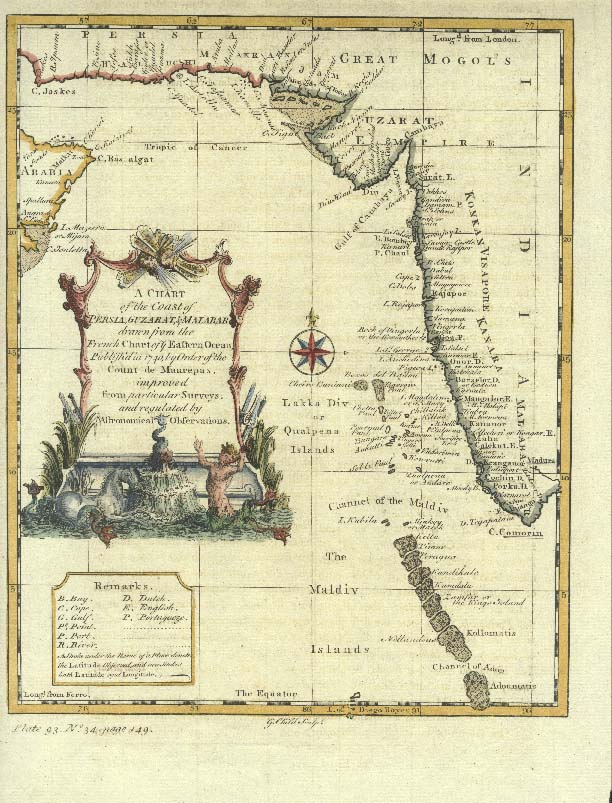
Malabar History discussions these days tend to cover the period after the Chera rule and the Cherman Perumal’s retirement. A look at the two maps (sourced from C Radhakrishnan’s site with many thanks) provides an idea of the area the Zamorins or the Nediyirippu Swaroopam of Eralnad annexed, to form their vast reach over medieval Malabar. While each of the old dynasties or swaroopams has their stories, let us try to glean over what we know about Polanad.

As we understand, the city of Calicut and its suburbs formed part of the Polanad Kingdom ruled by the Porlatiri, sometime around the end of the 13th century, the period when a number of things were changing, such as the floods of Periyar, the rise of Cochin and so on. But the overriding aspect was the move of coastal trade from Quilon and Muziris to more Northerly ports and the movement of the various wealthy Arabs - Pardesi Muslim traders and Moplah community towards the coastal ports in the Malabar Coast line North of Ponnani. I will cover the reasoning behind the emergence of Calicut as a port in a separate post, and its connections to events in the Arab Middle east, such as the drop in Gulf trade after the fall of Baghdad, and the emergence of stronger links in the longer and perhaps richer Red sea trade with Mamluk Egypt. One could question when the Porlathiri’s were dispossessed by the Zamorin. Well we have no dates but can only assume that it was some time between 900-1200AD.

Were the Muslim traders behind the decision of the Eranad (Nediyirippu or Kunnala) Thamburans to seek a location near the coast for economic reasons? Were they the reason behind the Eradis forsaking the norms of war and accessing the land of another? The Eradis did have an empire building strategy, so the desire to form coalitions with the wealthy Muslim traders was important, so also the financing by way of export trade. It is conjecture that this strategy was behind amalgamation of a mercantile state around Calicut. One could also summarize, the Eradis of Nediyirippu in Ernad (somewhere around present Kondotty) were land-locked and sought an outlet to the sea to initiate trade and commerce with the distant lands. Perhaps a determination was made that an appropriate port or combination of ports existed around Calicut between Ponnani and Pantalayani Kollam. The location that came into the crosshairs of the Zamroin juggernaut was of course Polanad, many times bigger than Eranad, but not well utilized or developed. As we know from the legends, two Eradis brothers known as Manikkan and Vikraman established the ruling family at Nediyirippu. Who led the efforts to take over Polanad is not clear, but we do know that the Nediyirippu Thamburans led the attack of Polanad. As they say, to accomplish their aims, the Eradis marched with their Nairs towards Panniankara and besieged the Porlatiri in his headquarters, resulting in a 50-year long war called Samoothiri - Polarthiri Wars (the reasoning as to why it stretched so long is interesting and deals with the way a war was fought in those days, we will cover it in another article). While we will try and cover a little bit of the highlights in succeeding paragraphs, the result was that the Eradis subsequently moved their capital to the coastal marshy lands and established the city of Kozhikode, then also called 'Thrivikramapuram'. It is also interesting that the original Calicut palace at that time was not the Vikramapuram palace that we described in the earlier article, but a palace near the beach. Perhaps that was where the Zamorin lived and met the Vasco Da Gama. Perhaps that is the palace attacked by Coutinho and covered in an earlier article.

We will get to all that presently, but let us start with the division of the Chera Empire by the Cheraman Perumal. According to The Keralolpatti KUP version translated by Gundert, the kingdom of Polanad had the following specialties, after its formation.


To the Porlathiri king was granted the good land of Polanadu and 10,000 nairs born to the ‘Human’ classification in 3 groups and 76 Tharas or settlements along with 5 guardians to oversee 3 kathams ( 30 miles) of land. (This is roughly from kallayi to Ealttur according to Krishna Iyer). From the Malur Kovilakom, 18 acharams (activities) had to be followed. They were Skins (?) I would assume war attires, Legs – I would assume marches, Kana – Institutions, karimbadam – right to wear a blanket, Ankham – Duels ( I wrote about this earlier…SEE…), Viruthi , Chungam, Ezha, Kozha – Taxes, tolls, duties and bribes, Ana, Vaal – Elephants and swords, Veerachangala – Hero’s chains, Viruthu – titles, vadyam – music, Niyamavedi, Nettipattam- ceremonial fireworks, forehead ornaments ( for elephants), Pata pidam, pata vidu – battle seats and homesteads, Para, Koothu – measuring vessel and folk dances, Munnil thali, Chirutha vili – sprinkling of cleansing water in front, announcements….these were the mandated customs of Polanad.

Now we come to the next chapter of the KUP – The times of the Thamburans…

A careful study of the old Malayalam text reveals many plots and subplots in the Nediyirippu attempt to annex Calicut. It starts with an explanation that the forerunner among the Nediyirippu is the Kunnala Konathiri or the lord of the hills and the seas. Interesting is the fact that the preceding section uses the phrase 10,000 Nairs but the next section mentions the Nediyirippu befriending of the Lokars of Polanad. So is it correct to assume as some historian’s state, that Lokars are the same as Nairs?

As it happened, the Zamorin met the local chiefs of Chavara and Puthukot at the Panniankara gate where he was encamped and obtained their oath of agreement by a handshake that they will support him in his attempt to annex Polanad. The purpose of course was to marshal their forces in battle (The KUP text lists the various chieftains and their forces). From then a battle of 48 years was fought against the Polanad 10,000 and the 5 closely knit (as though blood related) groups of the Polanad bodyguards. The battles continued, but the Nediyirippu was not victorious and so he decided to pray to the Porkalli Bhagavathy. The long prayer lasted six months (some say 41 days) after which the goddess appeared before the Zamorin, who requested that she accompany him. The goddess did, as an apparition behind a ceremonial door that was carried by the Nediyirippu since then into all battles (Now – that brings up a very interesting conjecture. Was this the door that Continuo tried to carry away – in order to nullify the power of the Nediyirippu in battle? Perhaps – unless he was misled to pick up the heavy main palace door, for the Nediyirippu was already away at battle and must have had the door with him). Another corollary states that as soon as the Nediyirippu saw the goddess he tried to touch her and so she disappeared. Hence he carried around the door of the temple. Yet another version states that the Nediyirippu (which one?) was the door keeper of the Cheraman Perumal, and so had an affinity to the old palace door which he carried around (kind of silly – right?).

The next plan was to win over the Polanad 10,000. Accordingly Unnikumaran Menon and Para Chankaran Nambi were sent to invite them for a meeting under the Perumplavil tree near the Ganapati idol. The Nediyirippu (note here that we are talking about both the Manikkan and Vikraman) vowed to support them in the future if they moved with him and would treat them as their own.

But that still did not provide the Nediyirippu the clinching hold. For that the favorite Menokki (Menon) of the Porlathiri chief was won over with promises of lordship over two regions and many other inducements. While all these discussions took care of the outside staff, a victory could be claimed only after the Nediyirippu entered the Nalukettu , palace or Kovilakom of the Porlathiri and fired three (kathanas) rounds of fireworks. How could the Porlathiri enter the fortified palace without any bloodshed?

The strategy was an interesting one. The Chalappuram Kovilakom senior mother or Chalappurathamma of the Porlathiri place who was aligned to the Nediyirippu met the senior lady of the Porlathiri household and offered her 4 elephants and 40,000 gold panams for advice. If she also helped in keeping the doors open at the opportune time, she would be made head of four lineages and made the 4th in line for the succession to the throne as part of the Zamorin family.
Soon an opportune event presented itself. The Porlathiri sent his nephews and other members of his family to the Kolathiris area while remaining at the Polur palace (Now I am confused, we hear of the Malur and the Polur kovilakoms – which is right? Some books also mention that the Porlathiri was ensconced at Kuttichira, but will get to clarifying it later). The Nediyirippu people had in the meantime set out to Calicut. Anyway the Porlathiri was at his pond, having his bath when the doors were opened and the Nediyirippu people got inside and set the three rounds or fireworks signifying the takeover of the Polur palace.

Again books differ in their storytelling after this event; they say he ran to the Kolathiri sanctuary from the pond. However the KUP provides the following detail. The Porlathiri did not complete his bath, but went indoors and had a leisurely indoor bath, and had his usual ample breakfast after which he summoned people from Kizhalur and Kurumbatur and cursed the traitors of Polur and Cherupatta (all this while the Zamorins forces were around the kovilakom??). Then he slunk away to Talassery with the Kizhalur nairs. Here again there is a conflict of words. The text mentions that the Porlathiri had asked his nephews and relatives to come to Kolathunad to meet his brother, and not to Calicut. So was he planning to abscond to Talassery himself even before all this happened? Perhaps….


The Porlathiri was pacified by the Kolathiri and granted a 30 mile square area to live and govern at Kadathanadu with 3,000 Nairs. At Calicut the Kizhineer Menokki was allowed to live in the Porlathiri palace and titled an Earand Menon. Later friction cropped up in the ranks and the Mangat achan was responsible for reconciling two factions within the defected.

I feel this stuff about the Chalappurathamma confusing to say the least. First of all it is not clear if she was the previous Portlathirs wife or the new Thamburan’s, it could very well have been the previous Thamburan’s wife. If the 10,000 and the chief minister had been won over, and the Nediyirippu men plus his Muslim help was ringed around the palace, what was the problem in getting into the house? Probably to end it all peacefully, but even that contradicts the issue for they had anyway been fighting a war for 48 years, so there had been ample bloodshed already. As it is, we know that the Porlathiri had sent his family off to Tellicherry in anticipation of what was to come. So he was prepared for the event. The door opening was perhaps symbolic. We also see that the Porlathiri did not even skip his breakfast, instead had an ample one at that. So when other historians talk of betrayal by the women of the house, take it with not a small but a big pinch of salt. It is just playing to the gallery as they say.

But do all other historians concur with the KUP? Logan and Innes do, in the Malabar Manual. Sreedhara Menon mentions that the Kottayam King and the Kolathiri sided with the Eradis. KVK Iyer confirms that it was the disadvantaged position of being cooped up in Eranad and being cut off from the profitable trade with the Arabs and Chinese that made the Zamorin want more from his landlocked interior position. He also provides an aside that the Porlathiri and the Kolathiri had marriage connections cementing their families whereas the Eradis the Kottayam family and Kurumbranad families were in alliance.

Krishna Iyer explains that after setting up base in Panniyankara, the Nediyirippu crossed the Kallayi River to Invade Polanad. It was eventually based on the advice of the Kottayam king that the Zamorin prayed to the Kottayam tutelary goddess at Porkali. About then that the Mangat Achan a feudatory of the Kottayam raja joined the Zamorin. He however does not mention the return after praying, with a door, but states instead that it was with a sword. Iyer then explains that the turnaround came when the new Porlathiri who had succeeded the older one at that time was unpopular and thus did not get help from the Kolathiri at the time of danger. All that the Zamroin wanted was a small space near the Kallayi port which the Porlathiri would not provide. The Zamorin threatened bloodshed, and the Mangat achan negotiated for a peaceful settlement. This was when the Porlathiri send his nephews and family to Kolathunad and remained by himself in the Kuttichira (or Polur?) palace. Once he found that he had no respite, he too fled to Tellicherry or Chirakkal. The Porlathiri 10,000 became the Zamorin’s personal guard and received many privileges. Iyer also clarifies that the Zamorin subsequently moved to Calicut, and brought along with him the door panel (Pallimaradi) from Eranad. Iyer now states that the palace or Siva temple at Kuttichira was then handed over to the Muslims by the Zamorin for they had supported him during all these endeavors. This became the Kuttichira mosque. If that was the case, that perhaps would be the oldest building of Calicut.

PCM Raja’s accounts are pretty interesting. He opines that the Porlathiri was requested to provide some land near the beach (perhaps for the Moplah traders). The Porlathiri scoffed – “you who profess antagonism with us will not even be given space equivalent to a needle hole. Thooshi kuthanulla idampolum vashiyil kazhiyunna ningalkku kittilla”. So he had a fight with the Zamorin’s forces who were lined up behind the Durga temple of Panninyankara. Porlathiri himself was based at the Kuttichira Siva temple. The war was lost and the Nambuthiri’s and Brahmins deserted the defiled temple. Subsequently the temple became a mosque. However even though the Polathiri ran away, his wife – the Chalapurathamma remained and she was treated honorably by the Zamorin and resettled. The Zamorin’s forces increased thus to 30,000. The Kallayi harbor was reinforced with a stone lining (Kallu Azhi thus became Kallayi). All this happened during 900-1000AD. The date of 948-950 is a possibility due to the fact that the Bhageerathi-Kolathiri wedding and the Nileswaram creation came about in that year.

A good amount of text detailing the Tali temple problems from the Nambis after the departure of the Porlathiri is provided in some of the texts, but it would be more appropriate to cover it separately. This episode also covers the relationship between the girl from the Zamorins house (Nilakeshini or Bhageerathi) and the boy from Kolathiri living at Kannivakay. A brief introduction to this episode had already been provided in the Revathi pattathanam article.

Balakrishna Kurup provides a slightly different explanation. According to his opinion, the Zamorin first entrenched himself at Beypore and Chalium and built forts there with the help of the Arab traders and Moplahs. Then he settled near the chullikad allocated to him, near Calicut. Next he incited the Moplahs of Kuttichira to harass the Porlathiri at his residence there. The Kuruthedathu Nambuthiris left the Porlathiri due to this (Kurup cites Padmanabha Menon’s writings in support). Kurup continues with the comments that many of them converted to Islam (Were they the Koyas of Malabar?) at that time and were aligned under the Shabander koya. The Porlathiri palace became the Juma’ath mosque. The Zamorin built a palace close to it and this was where he met the Vasco Da Gama and this was the palace that Coutinho tried to destroy. This Zamorin’s palace became the Muchundi mosque later. Later the fine Mishqual mosque was built in the same lines.

Perhaps with all this background, if you look at the pictures of these mosques and the picture of the Zamorin’s palace at Vikramapuram (you can notice the similarity), you can get a good idea how the major buildings of that time looked like.

Well, according to Kurup, the Porlathiri was on the run, first moving to his house in Panniyankara and then to Polur where the Chalapurathamma betrayal supposedly took place. Now the Porlathiri has two choices, either to live under the suzerainty of the Zamorin or leave in exile. He chose the latter.

PCM Raja now explains that the chullikad we talked about earlier was actually granted to the Nediyirippu Thamburan by the Perumal, so the war actually started when the Porlathiri tried to destroy it to spite the Eranad family. Even though the Polatiri was dispossessed, the 10,000 nairs of the Polathiri later formed the Zamorin’s own elite bodyguard.

Now a quick update on where the Porlathiri resettled. They went to Kadattanad. Quoting here from the various treaties listed by Logan….

The "Bavnor (lit. Valunnavar, ruler) of Badagara" herein mentioned was the hereditary governor of Kadattanad. The family is traditionally descended from the Porlattiri family of Polanad, the country lying round Calicut. It is said that when the Zamorin dispossessed them of Polanad they fled northwards into the Kolattiri domains. The Kolattiri Tekkalankur (Southern Regent of Kolattanad), who resided at Putuppattanam nearly opposite Kottakkal on the Kottai river, espoused one of the women and gave to his son by her the governorship of Kadattanad, i.e., the southern portion of the Kolattiri dominions lying between the Mahe river on the north and the kotta river on the south. The family thus founded has two kovilagams, viz., Ayyanjeri and Edavalatta and the eldest female of the two branches is still theoretically the head of the house. The two eldest males also hold athanam rank. The fact that Kadattanad belonged to the Kolattiri dominions is specifically alluded to in I—LXVI, and the family is therein mentioned as being of the Adiyodi caste. The eldest male certainly still assumes the title of Porlattiri, and at one time he claimed the high sounding title of "Lord of the sea."

References

Kerala Ulpatti – Gundert version
Zamorins of Calicut – KV Krishna Iyer
Malabar Manual – Logan, Innes
Samoothirnaad – NM Nampoothiri
Samoothirimaar – PCM raja
History of Kerala – KV Krishna Iyer
Kozhikodinte charithram – Balakrishna Kurup
Chronological history of Kerala – C Ramachandran http://c-radhakrishnan.info/malabar.htm
Collection of Treaties – Logan


Some explanations on the Symbolic Door

1. NM Nampoothiri explains -
Ancestors of Zamorins conquered the Calicut port and occupied the Valayanattu kaavu and established a planned port city. It is proven that there existed an irregular port at Calicut .It belonged to the Porlathiri according to tradition. Zamorins were Eralanattu Taiyavar during Kulasekhara period. Their ancestral village was Nediyiruppu in Kondotty, a remote internal area of Malappuram District. They moved to Valayanattu Kaavu area for improving maritime trade. They adopted the deity of Valayanatu kaavu as their principal deity. During their royal visits it was customary to take a wooden door by name Palli maaraati in front of the Royal procession .This piece of wooden door is believed to be the abode of the deity.( Palli is a honorific prefix to maaraati. MaaRaatuka in this context seems to mean ‘make abode or hide’. It means that there was a sacred grove as a nodal point).

2. Chespeak however provides yet another ‘door’ explanation..
Quoting Chespeak - For example, the arrival of Samuthiri to the north from his original seat of Nediyirippu near Kondotty is described in the chronicle. It says the conspiracy to open the local ruler Porlathiri's gates from within to allow entry for the intruder Samuthiri was hatched at the vathilmatom, the door place, of this temple which was the only public place available in the region at that time. And of course the conspirators lost no time to put their plans into practice, thus helping the inauguration of the long reign of Zamorins in Kozhikode…As the Samuthiri shifted his seat to Kozhikode and launched forth his rule, one of the key officials in his establishment was known as Pallimaradi, or the Eradi -official- in charge of guarding royal doors. Who could say the Samuthiri did not learn his lessons from history?

3. BM John in his thesis on Aliraja of cannanore, section The Rajas of Kolathunadu however explains
The Zamorin’s, rulers of the nearby Calicut, carried pallimaradi (door panel draped in silk) in front of their army marching against Vellattiri, the rival ruler, because it visualized the presence of goddess ‘Tirumandhamkunnu Bhagavati’, which assured their victory over the enemy.

Maps – Courtesy C Ramachandran

The Zamorin’s Palace - Calicut

Posted by Maddy Labels:

The original Calicut Vikramapuram palace is no more to be seen, nor are the palace grounds or other structures. The Zamorin’s family after the destruction of the palace post Hyder’s arrival and the then Zamorin’s immolation, moved to distant Southerly parts of Kerala, and the land has since then been sold off to house businesses and other institutions such as the commonwealth Trust after they came back. I had written about the story of the Zamorin’s death some months ago.

But then I have always wondered about the main palace, the kovilakom or the fortress as writers chose to term it. Of course there were many other related structures around it or close to it like the other major kovilakoms, the treasury, the horse stables, the tank (which still remains) and so on, but let us for now start with the palace, a.k.a. Vikramapuram palace at Kottapuram.

Where would it have been? Many of you would jump to the answer; it was adjoining the Mananchira area of Calicut. Well, that is correct. But how many of you know what it looked like and how big it was? I provided some clues in earlier articles, especially in the ones covering the Portuguese visits such as Vasco Da Gama’s audience with the Zamorin, the sketches of the visit and so on. Nevertheless, let us take a look. Calicut’s skyline was dotted with some fine houses with tiled roofs but mostly homesteads with hay thatched roofs as you can see in the early sketches (1572).


Coming to the place where the Zamorin lived, you reach to the Manachira area. Of course we all know that the Manavan chira was the pond used by the palace for water and for various other purposes. In front of the pond, if you draw a square of 40 acres which would correspond to 1320’x1320’, you would cover the four walls of the palace grounds. It is not known when the palace was built, but mentions from the 15th century indicate a royal palace existed in those environs. The Eastern corner is roughly the GH road; the western side adjoins the KP Kesava Menon Rd, the Southern side somewhat beyond the Court road (close to the Palayam stand) and the Northern side just adjacent to the Manachira pond. The royal procession street stretched from the court road westwards. Adjoining the palace were the various Kovilakoms (denoted by their situation with respect to the Tali temple) such as the Padinjare, Kizkahkke, Ambadi, etc and also the minister’s homestead. After the establishment of supremacy by the Zamorin over the Polathiri, the first of the buildings constructed near the Tali temple was the Ambadi Kovilakom. Later the Kizhake and Puthiya kovilakom were built and also the Poonthanam palace. Somewhere in the 15th century the main Vikramapuram palace and its fortifications with low walls were built as the riches came in.
According to Krishna Iyer, the Vikramapuram palace stood a furlong North of Ambadi kovilakom, at Kottapuram, separated from it by an extensive garden, registered in the revenue records as Punthottam. The Kizhakke kovilakom came up at Chintavilappu, North of Zamorin’s college, then came the Puthiya kovilakom (replacing the old Polathiri palace), west of the Tali tank. Then came the Chalappuram (Erampiri) kovilakom and later after the much talked about liaison of the Zamorin princess with the Kolathiri prince (see STORY ) occurred the establishment of the Nileswaram Kovilakom. Around 11704, there were no heirs, the planned adoption from Tekkankur south of Cochin did not happen and the Nileswaram adoptions took place. The girls came to the Kizhakke and Putiya kovilakom. However a third sister chose not to remain in Neeleswaram and came down to Calicut, on her own. The Padinjare kovilakom was created for her. After the Mysore invasions and the accession of the British, the exiles came back, the Padinjare kovilakom was resituated at Mankavu, the Putiya kovilakom at Tiruvannur and the Kizhakke kovilakom at Kottakkal or Venkatakotta ( see the Vencaticota ola story) .

The palace was finally consigned to flames after close to three centuries by a desperate Zamorin who had no way of standing up to the Mysore Sultan. The later Zamorins never rebuilt the Vikramapuram palace, perhaps for financial reasons, perhaps due to the ill luck resulting from an untimely and ill-fated death in the location. Instead they lived in the Tiruvacchira (Meenchanda) residence or their respective maternal kovilakoms. What we can thus summarize is that the palace built in the 15th century lasted for roughly three centuries, till Hyder Ali chose to mess around with Malabar and the palace was burnt down in April 1766. Let us read extracts from what certain important visitors stated about the area.

Abdur Razak 1442
When I obtained my audience of this prince, the hall was filled with two or three thousand Hindus, who wore the costume above described; the principal personages amongst the Mussulmauns were also present. After they had made me take a seat, the letter of his majesty, the happy Khakan, was read, and they caused to pass in procession before the throne, the horse, the pelisse, the garment of cloth of gold, and the cap to be worn at the ceremony of Nauruz.

Vasco Da Gama 1498
Vasco de Gama and his retinue were conducted to the palace of the Zamorin. It was built of mud, but was pleasantly situated amidst trees and gardens…..

Joseph the Indian 1501
The Zamorin had a huge palace which housed 7000 men. 300 of them guarded the palace at night by taking rounds as it was not fortified. In the Zamorin’s palace there are four halls, one each for Hindus, Mohammedans, Jews & Christians.

Varthema 1505
The palace of the king is about a mile in circumference. The walls are low, as I have mentioned above, with very beautiful divisions of wood, with devils carved in relief. The floor of the house is all adorned with cow dung. The said house is worth two hundred ducats or thereabouts. I now saw the reason why they could not dig foundations, on account of the water, which is close to them.

Francois Pyrard of Laval 1607
His principal seat is at Calecut, where he hath a very handsome and well-built palace, all enclosed with good walls and moats, with drawbridge to the gates, and water all around in the moats. A large number of soldiers day and night guard the gates, which are four in number. They admit no one unless he is well known, nor such a one without questioning him, and conducting him or having him conducted to the part of the interior whither he desires to proceed. If he wishes to speak with the king, he is passed from one guard to another until he arrives at the door of the apartments where is stationed what you might call the bodyguard, and these gain him speech of the king. I have said there are four gates at the four great entrances; but before reaching the apartments of the king you have to pass three gates on each avenue, and at all points soldiers are on guard, without counting those at the doors of the king's apartments. Besides all these guards, there is a strong body in the middle of the palace, in a covered place built expressly for the purpose, and all the other guards take their orders from this one. Overhead is a great bell, which only sounds for the assembling of men-at-arms at the palace, and about the king when he hath need of them. At all the gates of the palace there are spaces with closed barriers and palisades round about, for fear lest the crowd should approach the gates. Outside these barriers, and near the gates, are men whose only duty it is to give fresh water to all the thirsty that ask it; and when anyone wants a drink, whatever his quality or religion, they give it him in the manner described.

There are plenty of wells in the country districts, and even at the king's palace; but it is not permitted to drink at them, for they are guarded, and only certain priests may draw water there for their superstitious observances. All the avenues of the palace are marvelously beautiful and delightful. All the roads are straight, like pall-mall alleys, and relieved on both sides by high terraces and palisades covered with trees of all sorts, among others, many of the trees they call tristes, of which they make saffron. Throughout all the country their roads are of this fashion, or nearly so.

The prisons are all at the king's palace; and the Malabars and all manner of foreigners are subject to the jurisdiction of the Nair kings, albeit one hears of but few lawsuits among them.

Between the town and the palace is about a quarter of a league, the road being as described, with fine mansions on either side; in front of the gate of the palace is a great square, where the market is held every day in the morning of all kinds of merchandise of the country, but not foreign. It is opened at seven o'clock, and one of the king's officers has the duty of sounding a bell to warn the king's servants and purveyors to go buy what is necessary for his house, for none would dare buy anything ere the king's household was supplied. That done, the bell is sounded a second time to call the merchants; but before the merchants enter, the tax farmers take their dues off even the smallest of the goods. Before the king's officers have taken what is due to them, no one would dare to go near or touch any goods, least of all anything eatable. Even after that, unless they be Bramenis or Nairs, they would not dare so much as touch any goods that are for sale ere a price has been made, and then they are obliged to take them. Care has to be taken also in going through the market, where all those that sell are seated, not to touch either their persons or their goods, unless they be of the same caste and religion. This market lasts only about three hours or more, and they come from all parts of the town and elsewhere to buy, in order afterwards to sell at the great market or Bajar, which is held every day and all day. After ten o'clock you see no one in the market near the palace, and everyone goes about freely. At that place, too, besides the shops and warehouses of particular trades, there are three or four large spaces for the people, wherein to bargain and sell their goods. All these houses and shops are used solely to hold the merchandise, yet throughout all the rest of the town there are great and rich merchants, who never come to this Bajar, having their own warehouses full of goods, which they sell not by retail, but wholesale.

Near this large square where the market is held is a large building where the king's money is struck, which is current on all the Malabar Coast. This consists of gold pieces with his effigy on one side and a pagoda or idol on the other.

But to return to the king's palace: it is a very large enclosure, and contains many blocks of houses, all detached and well built, of many stories and galleries, with flower-beds, and orchards, tanks, fish-ponds, and canals, all fitted and paved with stone, and constructed on all sides of stone steps leading to the bottom. Add to these many springs and fountains, whose water is cold and excellent to drink. In the palace, too, is a magazine or arsenal, full of arms, cannon, powder, and munitions of war. But the great and chief arsenal of the king is at Panany, for that is his chief war town.

Hard by there is a block of buildings allotted to the secretary and clerk to the king, for keeping all the registers. The order and system is most admirable herein, and I have oft-times wondered to see the great number of men with no other duty or work all day but writing and registering. These posts are of much honour; the clerks all reside in the palace, but in different apartments, and they have different duties. Some make entry of all goods arriving for the king; others, the dues and taxes paid day by day; others, the expenditure of the king's household; others, the most notable incidents of each day, both what happens at court and in the rest of the kingdom; in short, all news, for he has everything registered; and each clerk has his separate room. They keep also a register of all strangers who come there, taking their names and nationalities, the time of their arrival, and the business that has brought them, and so they did with us. It is a wondrous thing to observe their number and the perfect order that exists among them, and how fast they write on their palm-leaves, as described: these are of the length and breadth of the leaves of coco-trees, but thicker and stiffer. They make of them a kind of book, by means of holes in the thicker ends of the leaves, through which they pass a fillet, and thus bind together as many as are required.

The king hath the like writers in all towns, ports, harbours, and frontier passages of his kingdom, who render account to those of the palace, all being well organised and in obedience one to another, each having his proper superior. Throughout the whole Malabar coast there is the same manner of writing and the same ordering thereof.

Pond - After that he straightway rubs his body all over with odoriferous oil; this lasts about an hour, and then he goes to bathe in one of the ponds within the palace closeless he be of their religion, caste, and quality. When he comes forth of his bath he most often goes to the temple, and thence to his food in another palace within the same enclosure, which is a part of the grand palace, devoted entirely to that purpose. While he takes his repast he sits upon a piece of well-polished wood, and eats off balsam leaves, like the other Bramenis. After his dinner he despatches his business, and then changes his apartment, going to another prepared for him to receive all comers; and it is not that wherein he sleeps, takes his leisure, or eats. Here he is, as it were, exposed to public view, and if any would speak with him he may; if no affairs present themselves, he passes the time with his lords, and is much amused with buffoons and mountebanks, whereof he has always a goodly number. The Nair kings and lords often play a game of chance, which is a kind of chess, played with dice. He takes pleasure also in seeing the Nairs fence with one another with sword and buckler, whereat they sometimes get wounded; others, again, use pikes.

As for the queen, she lives in a separate palace, yet within the same enclosure as the great palace. She never eats with the king, and is seen but rarely, and then only at the windows and galleries of her palace or of the king's, whither she frequently proceeds by a gallery which communicates between the two, and there they see each other in private. She bathes in the same manner and with the same ceremony as the king, and in the same pond; but they cannot see each other, for they each have their own end of the pond with a space covered in. She has ordinarily her ladies about her, who pass the time for her. The pond where they bathe is well enclosed and locked, and none but the king and queen do bathe there; there is a gallery whereby the queen descends on her side, and another for the king on his side. The ladies who are present to wash the queen do not enter the water, but remain in the closets and pavilions that are upon the pond, where the oiling, drying, and perfuming is done; and these ladies use all the same artifice and ceremony towards her as the lords use towards the king. The queen is of the Brameny race as well as he. She has her own Pagode, where she betakes herself with her ladies, then to her own apartments to take her food, and so on, as with the king. Only great ladies are about her person, and she has the pavements or boards, and the walls and passages where she goes, cleaned with this cow-dung of which I have spoken. I must not forget to mention, in passing, and as the opportunity arises, the great honour rendered by these people to cows, however low-bred, filthy, and all covered with dirt and dung they may be. They are allowed to enter the king's palace, and whithersoever their way leads, without anyone disputing their passage; even the king himself………….

Delle Valle 1624
The first and principal gate of the Palace opens upon a little Piazza, which is beset with certain very great trees affording a delightful shade. I saw no Guard before it; it was great and open ; but before it was a row of Balusters, about four or five palms from the ground, which served to keep out not only Horses and other Animals (this contradicts the comment of Pyrard Laval) but also Men upon occasion. In the middle was a little flight of Stairs, outside the Gate, leading into it and another within on the other side. Yet, I believe, both the Stairs and the Balusters are movable, because 'tis likely that when the King comes forth the Gate is quite open; otherwise it would not be handsome, but this is only my conjecture. We enter'd this Gate, ascending the Stairs above the Rails, where we were met by the Messenger whom the above-said person had sent to the King and who again invited us into the Palace by the King's Order. Within the Gate we found a great Court, of a long form, without any just and proportionate figure of Architecture; on the sides were many lodgings in several places, and in the middle were planted divers great Trees for shade. The King's chief apartment, and (as I believe by what I shall mention hereafter) where his Women were, was at the end of the Court, opposite to the left side of the Entrance. The Edifice, in comparison of ours, was of little consideration; but, according to their mode, both for greatness and appearance capable of a Royal Family. It had a covered porch, as all their structures have, and within that was a door of no great largeness leading into the House…………….

Nor was it long before an Order came from the King for us to enter, and accordingly we were introduced into that second Gate ; and passing by a close room like a chamber, (in which I saw the Image of Brahma on his Peacock and other Idolets) we enter'd into a little open Court, surrounded with two rows of narrow and low Cloysters, to wit one level with the ground and the other somewhat higher. The pavement of the porch was also something raised above the plane of the Court, so much as might serve for a man to sit after our manner.

The second thing that made me laugh was that, when the King enter'd into the little Court, the door, whereat he and we had enter'd before, was immediately made fast with an Iron Bar, people also standing continually to guard it; and so likewise when anyone came in, or was sent out by the King, it was 'presently shut with diligence.

Many others made passing mentions of the palace, but after 1766 it was no more to be seen. Hamilton – Sea captain 1607 states that the palace is built of stone and there is some faint resemblance of Grandeur to be seen about his Court. K Balakrishna Kururp opines that the Gama perhaps met the Zamorin at the Kuttichira palace ( which later became a mosque) . The details of the dismantling and sale of the property were covered by Prof Raghava Varier and some details can be gleaned from this article.

PCM Raja in his book also provides an interesting insight to the Mananchira tank. He comments that the seashore some 1000 years ago was closer to the locale. The Zamorin later had the tank called Manavedan chira dug and finished with eight sides. This later became Mananchira or Manavancheri chira. He also clarifies that there were many kovilakoms in the area, a major palace at Ponnai, another at Kottakkal and of course many more around Malabar where the Zamorin lived during his field trips.

And with all that background, let us summarize how the palace would have looked.

The palace grounds were enclosed by low walls with wooden inlays, there were perhaps some moats around the walls (I doubt it), that the walls had four gates and were well guarded. The palace was in the middle and the courtyard housed other buildings such as the women’s quarters, the main meeting halls etc. the roads within were lined with tress, ponds and so on, and some of the buildings were multistoried with tiled roofs. There were bathing ponds within the palace and outside, the Manachira tank provided water supply to the large numbers of people employed. The manachira grounds hosted competitions and bazaars often. Close by was the Tali temple, the mint and the stables.

Now you may want to look at a plan of the grounds as they existed. Well, we do have one, thanks to Pietro Delle Valle. See images below.
And finally – how would the palace have looked like? It took me a lot of effort to get my hands on this image dated 1604, courtesy the VOC & Steven Van der Hagen, Atlas of Mutual Heritage. The complete woodcut shows a ridiculous picture of a very muscular Zamorin in a grass skirt.


References

The travels of Ibn Batuta – HAR Gibb
Zamorins of Calicut – KV Krishna Iyer
Malabar studies – NM Nampoothiri
Calicut History – K Balakrishna Kurup
Samoothirmaar- PCM Raja
India In the eyes of Europe – Donald F lach
The voyage of Francois Pyrard of Laval
The travels of Pietro Della Valle
Durate Barbosa travels – ML Dames

Pics – Various web sources, acknowledged with thanks. Google for Google maps and Atlas of mutual heritage for the palace picture.

The Sorry Story of Antonio Fedinando

Posted by Maddy Labels:

And his role in the Anglo Scottish Union 1705-07

Many a year ago, in 1705 to be precise, Scotland joined the British union, after an acrimonious period of four or five years, to create Great Britain. What if I told you that the incident which hastened it and that one of the persons who was key to the incident was a person of Malabar origin? Well, it is so and you can now read that story, a story that has been under wraps for ages. In fact the whole story went out of circulation after the turn of the 18th century. Why such an important event never got more attention is queer, though a few books have covered the subject in passing and one somewhat rare to find book covers much of the details. But the event and the write-ups focused on the Englishmen involved and the Scotsmen who precipitated the issue, but not really on the person who was the scapegoat. I will cover his story not because he was innocent, but because I felt the poor man was set up and coerced into doing what he did. Then again, it could be so that he was not wrong after all. So we will get deeper into this story, but first a few paragraphs detailing the background and the times.

For that, we will hover around Scotland and then zoom down to Panama. Later we will move quickly to the Malabar Coast line and then head back to Scotland. We will learn about the Darien scheme, learn a little bit more about some piratical adventures, the financial misfortunes of the Scots, the opportunistic maneuvering of the EIC and debacle at Firth of Forth and Leith sands. In passing we will also learn a little of the part played by the small port town of Kayamkulam or Caliquilon and the EIC factory at Calicut in this misadventure. So let us quickly head to those port towns and the waters. Wear your oilskins, lest you get drenched, listen carefully, but don’t get too close to the action, and stay well away from the danger.

If you recall my previous article, Capn Kidd was around in Calicut during 1698. By May 1701 he had been tried and hanged and pirates (as defined by the EIC) had a bad name in press and with the public. This story is set close to that period and around 1703 again around the same Malabar coastline. But before we set the heading to Malabar, we will go to Scotland.

Around 1690, Scotland, still a kingdom, desired to enter the realm of profitable trade like their powerful British neighbors. Though under the British crown, Scotland had it own parliament and treasury. But the coffers were empty; the harvest had proved a disaster. What else to do than focus on trade? The wise or the not so wise, decided that colonization was perhaps a quicker scheme. Soon a colony was planned in New Caledonia or the Isthmus of Panama. The money required for this venture , as high as a quarter of the Scottish monetary worth was advanced by a number of wealthy nobles (originally a number of anti British countries and private citizens subscribed to the capital, but due to British pressure they dropped out leaving only Scottish capitalists). The company that oversaw all this was called the Darien Company. By 1698 the first ships moved to Panama for the colony set up, but it soon turned out to be a disaster and in 8 months the colony was abandoned. Of the 1200 that left Scotland, only 300 returned with heads hanging low. Pride as you will see runs high in Scotland and the situation as you saw was not very nice. A second expedition also failed and the settlers further lost the war to the Spaniards. Much more intrigues took place, but we are not talking about the misfortunes of the Darien Company here. One of the men who took leadership position in this colonization effort was a Thomas Drummond and his activities were later defined as far from satisfactory. The money was gone, the lords were unhappy, Scotland was in the doldrums and something had to be done quickly to recoup the lost capital. The publicly funded company lost more than £232,000, crippling and demoralizing Scotland. English propaganda depicted the fiasco as proof that the Scots were useless and unfit for sovereignty and the Darien plan soon picked up a new name, the Darien fiasco. The still wise racked their brains and decided, what else, but head out to Malabar and plunder or profit in the name of conventional trade?

Two ships, the Speedy Return and the Continent were sent out to Malabar. The Speedy return was captained by Robert Drummond and the aforementioned Thomas Drummond accompanied him as Super Cargo (manager for trade) & advisor. The Continent was lost off the Malabar Coast in a fire. Instead of selling the Scottish goods for gold, the Speedy Return exchanged it for slaves who were traded in Madagascar for a profit. Here they met a pirate named James Bowen who appropriated the Speedy Return. Nothing more was heard from the Drummond brothers for a long time after this event. A British ship Annabelle was then commissioned by the Scots, but it was soon confiscated by the EIC on the grounds that all English sailors should only work for the EIC (apparently the Captain Ap Rice quarreled with his Scottish owners and led the British to the seizure). Naturally the Scottish ire at these failures was directed against the EIC. The spearhead of all this anti British rhetoric was a Darien company bloke and company secretary named Roderick Mackenzie. It was during this inopportune time, around mid 1704 that a ship named Worcester captained by Thomas Green laden with goods, and coming from the Malabar Coast, sailed into the Leith harbor, blown off course into Scotland.

So as we read, the Scottish leased Annabelle had been impounded, and Mackenzie on behalf of the Darien Company, decided that the British flagged (though not EIC owned) Worcester should be seized in Scotland as compensation, which he did. The officers of the defunct Darien Company (not the Scottish government) seized the ship on 12th Aug 1704. The reason attributed was the attempted clandestine sale of EIC goods in Scotland and the claim that the Worcester carried a counterfeit copy of the Scottish Darien company seal. Captain Green of the Worcester always hoped that the situation would be sorted out, but nothing happened for three months. Before he knew what was happening, he and his crew were put behind bars for piracy and murder. Later it turned out that it was due to Green’s (and other crew’s) drunken boast of piracy, plunder, other nefarious activities and burning of a ship. Rumors started flying that the attacked ship was the yet to return Speedy return with the Drummond brothers. Despite a total lack of real evidence, Green and two of his crew, John Madden and James Simpson, were sent for trial. Many a thing turned up at the trial, many a thing did not. Due to the fact that some amount of hushing up was done after the trail, some aspects are not traceable anymore. It was not that the Judges were unaware of the discrepancies, but the public mood and the level of Scottish resentment of the British were running so high that it was the best decision to allow the massacre of a couple of Englishmen.

Let us see how it went. As I retell the story, I will slip back and forth between Malabar and Leith or Edinburgh in Scotland. I will not get into too many details of the sordid affair, for it was that, but will cover it as an overview and focus on the Malabar aspects mainly.

As Kelly explains - The conviction of Green and the others was secured solely on the evidence of the Worcester's Christian Malabari cook, one Antonio Ferdinando. After joining the ship on the Malabar coast, Ferdinando said he witnessed an engagement between the Worcester and another ship crewed by English-speaking white men which lasted three days. He claimed that, when the stricken vessel was boarded, those in the sloop (a smaller sailing ship attached to the main ship), who then came aboard, did take up those of the crew of the said ship from under deck, killed them with hatchets, and threw them over board . . . Captain Green, Captain Madder, and James Simpson the gunner were three of these who went aboard and killed the men. Ferdinando said he believed about ten men were killed, and that after the struggle was over a few goods were transferred into the Worcester. The prize vessel was according to him, disposed of afterwards in Caliquilon. Ferdinando claimed he received a wound to his arm during the action and that the coat he was wearing in court was taken out of the prize.

Antonio’s testimony was the basis of subsequent convictions of Green and two others. Of course, it was supposed that the prize vessel was the Scottish owned Speedy return and that the murdered included the Drummonds, but as the trial progressed, it turned out that it was not. Nevertheless, the trial moved on in its strange and singular course towards culmination into a guilty verdict for the Worcester’s captain and crew. The British crown tried hard to find supporting evidence for the Worcester crew and though a trifle late produced it for study by the Scottish courts. But the situation was clouded due to the boasts by Green and his crew of the illegal activities they themselves (perhaps) committed in Malabar. Whether it was dealing with pillaged goods or piracy of another ship is not clear from the papers, but they were not involved with the Speedy return. The case finally veered off to general piracy, not a specific act and the crew was convicted.

So now we hear a name – Antonio Ferdinando. Who was he? How did he turn up at the courts in Scotland as a witness? What language was he speaking? Before we get to the answers, let us trace the path of Worcester, after it left Britain. The formal journals themselves, were confiscated and lost in Scotland after the Worcester's seizure, and are not available for analysis, but some details are available from British records.

As I held the book ‘Tragedy of the Worcester’, in its first printing from 1930, in my hands, a rare and difficult to find book, now part of my library, I could feel the anguish of the author Richard Carnac Temple. It provided me some information on Ferdinando, the cook’s mate from Malabar, who according to the Temple, possibly used tales current at the Malabar coast to concoct the allegations against Thomas Green. And there was another person of Indian origin in the ship (perhaps from Bengal), one Antonio Francisco who backed Ferdinando’s story. Three other white sailors Linstead, Haines and Bruckley also confessed, supporting Ferdinando’s version, though Haines retracted his some years later.

The Worcester left England in March 1702 with around 35 people on board. Some two years later, when the Scots seized it as it returned to the isles, 14 of the original crew were dead. All of those14 died at the Malabar coast, which itself is peculiar, due to the high mortality percentage. There were plenty of British representation on the coast by then and the Worcester as you will see called on all of them periodically. There was no real medical calamity on board reasoning their deaths, so did they die fighting? We will have to assume so. Interestingly one of the sailors died after a dog bit him near Calliquilon. The ship also brought back two Malabar slave boys, one of whom was purchased by the Duke of Queensborough, whereas the other was purchased by the Earl of Rothe.

The Worcester reached the Malabar Coast on Nov 14th 1702. Between this time and 1704, they were involved in trading activities around Madagascar and Malabar, selling Candy for pepper, asafetida and so on… but related actions were later to cast a slant on their characters.

Ferdinando joined the ship around Nov 1702 when the ship reached Malabar. He sailed with the Worcester since, passing Quilon, Cochin, Calicut, Tellicherry & of course Calliquilon. It was somewhere between Calicut and Tellicherry that Ferdinando, during a couple of clear days in Jan/Feb 1703, claimed he saw Green’s sloop boarded another British flagged ship, manned by English wearing British colors. All of this was deposed through an official interpreter George Yeaman a merchant in Dundee a sworn interpreter.

Kelly explains - The prize vessel was disposed of afterwards in Caliquilon to one Kwaja Kammudi, a Moplah trader. Ferdinando claimed he received a wound to his arm during the action and that the coat he was wearing in court was taken out of the prize. The prosecution used the evidence of Charles May, the Worcester's surgeon, to corroborate Ferdinando's story.

Any story like this will have complications. A document from the shore stated that Ferdinando had boarded the ship only in May 1703. Antonio who was injured in the boarding of the said ship fractured his hand (hit by a shell) and was treated at Cochin, but initially stated that the covered up (plaistered) injury was due to a snake bite (he was threatened by the crew and not allowed to tell the truth – so what were they hiding?). According to him the attack of the ship took over two and a half days and the testimony also states that he was born to Christian parents and joined the ship at Calliquilon though he is not too sure about the date.

The witnesses Francisco and Ferdinando when produced before the court were termed Negros or blacks, not considered real Christians and their names as stated were not considered real. They were for these reasons not considered equivalent to ten pound Scots. Nevertheless, their depositions were the basis for later judgment, Ferdinando’s being the clinching eyewitness testimony augmented by supporting evidence by the others. It appears that he provided his testimony either in Malayalam. Imagine the irony, the destiny of Scotland was decided by a few words in Malayalam!! The translations in court were provided by George Yeaman.

I checked out Yeaman next. What kind of an interpreter was he? As one can see, he was key to the correctness of the testimony. It appears that he had spent 16 years on the coast of Malabar prior to the trial. That means that he came to Malabar in 1684 or so. He returned to Dundee and started a shop ‘Yeamans shore’ in 1700. Yeaman tried a hand at getting into politics subsequently, was successful and continued with various matters until 1715 in many important positions till he died in 1733. His bio is provided by the Scot parliament site below. Perhaps he did know a smattering of Malayalam.

A representative of a long line of merchants and shipowners in Dundee, Yeaman made his fortune in exotic climes. The Jacobite agent Scot referred to him in 1706 as ‘Captain Yeaman, a wealthy merchant, lately come from the West Indies’, while at the trial of Captain Green in Edinburgh the year before, one ‘Captain Eman of Dundee’ had acted as ‘interpreter for the blacks’ on board Green’s ship. It was said that he had ‘spent 16 years on the coast of Malabar, and spoke to them in lingua franca’. Yeaman had re-established himself in Dundee by 1700 and was soon a leading participant in trade, a shipowner and the proprietor of ‘Yeaman’s shore’ along the waterside. He acquired a country seat at Murie, formerly in the possession of the Ramsays.

Later reports provide a little more information on Ferdinando, that he was a devout Christian, with perhaps a father of obscure Portuguese origin, that he said his prayers regularly as a roman catholic, and trained (and provide Christian instructions) the two slave boys on board. One of the key moments of the trial was the display of the coat that Ferdinando wore (Francisco complained that while Ferdinando had one, he had to shiver without one in that lousy Scottish jail where only bread and water was given to these two prisoners). It appears that this coat was taken from a sailor of the ship that Green boarded and was convicted of. The prosecution tried to say that it was nothing more than pieces of an old Scottish rug.

Seventeen of the eighteen defendants were convicted. The verdicts were secured on the evidence of Ferdinando and the other confessors. Green, Madder, Simpson, and two others were sentenced to hang.

Ferdinando as we saw provided the required testimony that went against the Green crew and was subsequently taken back to his cell. Soon after, some say the same day, some say four hours later, some say the next, some say 10 days after, Antonio Ferdinando the sole eyewitness, was dead of poisoning. The person suspected of this murder was none other than the person who precipitated the whole matter, Rod Mackenzie. As a British sympathizer claimed, Ferdinando was seized by guilt and told Mackenzie who visited him that he was sorry to see Green being sentenced to death and that he was forced to say what he said by Dr May, the ships surgeon. Mackenzie soon came back according to Francisco, with a bottle of wine, a glass of which was provided to Ferdinando who drank it with gusto. Soon after he was seized with belly spasms and died shortly as evidenced by Antonio Francisco. Thus came to naught the desire of Ferdinando to lead a better life, wear better clothes and enjoy a future in Scotland. The local press tried to write it off as though Ferdinando came ashore with a hectic fever and died 10 days following the trial, from his pre-existing illness. Thus ended the short life of the Malabari whose actions were was to later change the course of Scotland.

Many a person questioned the testimony of the Malabari cook’s mate. Some opined that he was having flights of fancy, retelling stories he had heard of other pirates, some reconstructed the story as the tale of the Worcester meeting the EIC ship Aurang-Zeb (and just firing gun salutes which was construed as fighting by the delirious Ferdinando) , which was in the neighborhood. Some others like the esteemed Alexander Hamilton, who met Green and his crew in Calicut, did write that he had heard rumors of Greens pirate activities off the coast of Malabar and the tale of Green’s sinking a ship while he himself was in Calliquilon. So it is difficult to take in completely all of what Temple writes in his book, where he concludes that the entire trial was purely a witch-hunt ending up in wrongful conviction of Capt Green and two others, the others having been let free. Circumstantial evidence pointed to a lot of mischief on the side of the Worcester, like evidence of the contraband goods on board, Ferdinando’s coat, the conflicting comments by the crew, Haines blabbering to his new girl friend Anne, Green’s own comments after a few pints. But the question as to which vessel (if one was sunk) sank in Malabar waters during that event is unanswered till now.

Queen Anne intervened personally to secure a stay of execution to allow her ministers time to consider matters. But, on 11 April, the final day of the postponement, events in Edinburgh got out of hand when people started to feel that the Queen might interfere and acquit the convicted persons.

Daniel Defoe – author of Robinson Crusoe, a pamphleteer, wrote -The Streets filld with incredible numbers of men, women and children, calling for Justice upon those ENGLISH Murtherers. The Lord Chancellor Seafield's Coach happening to passby, they stop'di t, broke the Sashes, haul'd him out, and oblig'd him to promise Execution should speedily be done before he could get from 'em... According to the Chancellors promise, soon after, on the same day, being Wednesday, Captain G reen, Madder, and Sympson were brought out, and convey'd to Execution, which was at Leith Road upon the Sands, and all the way was Huzza'd in Triumph as it were, and insulted with the sharpest and most bitter Invectives…

But, as the rope went taut around Green's neck, the mob (80,000 armed men as a witness put it) underwent an apparent change of heart. 'No sooner was the Sacrifice made, and the Men dead', reported Defoe, 'but even the same Rabble, so sickly is the Multitude, exclaim'd at their own Madness, and openly regrated [sic] what they had done, and were ready to tear one another to pieces for the Excess. Although the mob was appeased, Green's execution now became a focal point for anti- Unionist propaganda. In Scotland, opponents of the Union celebrated the outcome as a symbol of national autonomy.

The next batch of the convicted were due to be executed the following Friday, but the anger having been satiated by the three executions, the latter was postponed and eventually the rest of the Worcester’s crew was released. The ship however was given to the Scottish Darien Company and all the goods, including the possessions of the crew, were sold. As Kelly puts it - In England, Green and his men were hailed as martyrs. An unaccountable delay in producing the official trial report in Edinburgh sparked off a vicious pamphlet war. English pens sought to discredit the Scottish judiciary, while the Scots tried any means to deflect criticism until the report could be published. The whole affair hastened the Union of 1707, for it was a choice of Union or war between the two nations.

So whatever happened to the Speedy return? It was earlier pirated off the Malabar Coast by another pirate John Owen and the Drummonds due to their involvement went undercover in Madagascar, living there for many years. But some questioned it. Was the story of the piracy by John Owen a work of fiction by Daniel Defoe to help the English? Was Drury’s book on Owen and the Drummonds death in Madagascar ghost written by Defoe as some felt? That is another matter.

Hamilton writes - The unfortunate Captain Green, who was afterwards hanged in Scotland, came on board my ship at sunset, very much overtaken in drink and several of his men in the like condition (at Calicut, February 1703). He wanted to sell Hamilton some arms and ammunition, and told me that they were what was left of a large quantity that he had brought from England, but had been at Madagascar and had disposed of the rest to good advantage among the pirates. I told him that in prudence he ought to keep these as secrets lest he might be brought in trouble about them. He made but little account of my advice, and so departed. About ten in the night his chief mate Mr. Mather came on board of my ship and seemed to be very melancholy.... He burst out in tears and told me he was afraid that he was undone, that they had acted such things in their voyage that would certainly bring them to shame and punishment, if they should come to light; and he was assured that such a company of drunkards as their crew was composed of could keep no secret. I told him that I had heard at Coiloan (Quilon) that they had not acted prudently nor honestly in relation to some Moors' ships they had visited and plundered and in sinking a sloop with ten or twelve Europeans in her off Coiloan.

We do not know what happened to Antonio Francisco. Maybe he survived in Scotland and his lineage flourishes. Daniel Defoe went on to write Robinson Crusoe’s tale. Roderick Mackenzie had a miserable end. In August 1707 the family of John Madder was awarded £460 compensation for his death.

But the Worcester had yet another interesting story to tell. On Feb 6th 1703, the Worcester entertained the factor at EIC’s offices in Calicut. On Feb 8th the records indicate this interesting incident – Being Munday, riding at anchor at Callicute, a moor merd belonging to Shackmaker passing by, he saluted us with 5 guns, we returned in like manner and he gave us three for thanks. Moor merd means a Persia-man or Moplah vessel. Shackmaker is Sheikh Maraikkar. Now did that mean that were others who continued to hold the Marakkar title after the 1600 Kunhali?

References

The tragedy of the Worcester – Richard Carnac Temple
The Worcester Affair – James Kelly
Celebrated criminal trails in Scotland – Arnot Hugo
The Tryal of Capt Thomas green and his crew

British Scottish relations – A very brief note

England and Scotland were separate states for several centuries before eventual union, and English attempts to take over Scotland by military force in the late 13th and early 14th centuries were ultimately unsuccessful. England and Scotland were ruled by the same king for the first time in 1603 when James VI of Scotland also became the king of England. However they remained two separate states until 1 May 1707.

Quoting from the BBC site - The largest component of customs dues was levied on the colonial trade. But this trade faced significant disruption from Scottish commercial networks which circumvented the Navigation Acts contrived to protect English domestic and overseas trade. English feelings that Scotland was acting as a rogue nation contributed greatly to William’s willingness to sabotage the Darien Venture through which Scotland attempted to establish an entrepôt for the East and West Indies on the Panama Isthmus in the late 1690s. English desires to control the Scots became more acute after the accession of Queen Anne, particularly as the Scots seemed reluctant to accept an eventual Hanoverian succession. Morover, England had insufficient manpower to fight wars, sustain manufacturing and expand its empire. The Scots were a ready reservoir.

Some Scots nobility petitioned Westminster to wipe out the Scottish national debt and stabilise the currency, which was eventually done. United Kingdom thus came into being...

The Infamous Portuguese Cartaz

Posted by Maddy Labels: ,

In many of my previous articles, I mentioned in passing the so called Cartaz or pass system instated by the Portuguese who controlled Malabar and Indian west coast trade. Perhaps it is time now to get into some details of what exactly it was and how the Cartaz policy and system was introduced and enforced.

Its name could have been derived from the Arabic "qirtas" and may have had a previous use in both the Indian Ocean and the eastern Mediterranean seas, many centuries ago. Perhaps it even had Indian antecedants, for Ibn batuta mentioned it as present in Barkur or Faknur.

Quoting Ibn Batuta – The Hindu ruler of Barkur (“Fakanur”) “possesses about thirty warships, commanded by a Muslim called Lula , an evildoer who robs at sea and plunders merchants on the sea.” The passage continues: It is a custom of theirs that every ship that passes by a town must anchor at it and give a present to the ruler. This they call the right of the harbor [haqq al-bandar]. If anyone omits to do this, they sail out in pursuit of him, bring him to the port by force, double the tax on him, and prevent him from proceeding on his journey for as long as they wish.

As Prange explains - This system of enforced tribute can be seen as an indigenous precedent of the Portuguese Cartaz system. The similarities are striking: both systems forced ships to call at specific ports in order to tax them; both claimed a legal underpinning; and both were ultimately founded in the threat of maritime violence. Earlier studies have pointed out that the Portuguese Cartaz had indigenous precedents in safe-conduct passes issued sporadically by coastal rulers in the Red Sea and the Indian Ocean,in fact, Cartaz is likely a loanword from the Arabic qirtas, meaning “paper” or “document.

The Portuguese Cartaz system seems to have started with Vasco Da gama’s second voyage in 1502. The first two Portuguese voyages of Gama and Cabral were mainly related to reconnaissance and small trade as well as making a nuisance of themselves with the local rulers with intent to impress them with their naval might. During the second voyage, Gama defeated the king of Bhatkal and declared that the Portuguese were lords of the ocean and that anybody who used the ports controlled by the Portuguese should pay them tribute. Some other conditions were that the ports or ships should not trade in pepper, should not admit ships of Turks or ships from Calicut. The Bhatkal king agreed to pay 1500 bags of rice per annum and that was when the first Cartaz was issued to the king of Bhatkal. A series of papal bulls mainly the Romanus Pontifex of Nicholas 5 in 1454 gave Portuguese the power to impose the system.

The Cartaz was typically a permit valid for one year and obtained after paying a fee for its issue. The fee varied depending on the ships destination, and was obviously higher for overseas trade. Overseas Cartazes were issued only in Goa (after the ship reached there with a coastal Cartaz) and Cartazes for coastal trade could be obtained from any Portuguese fort or factory or possession. The Portuguese armada controlling these seas had absolute control and every king, lord or emperor followed the rules, except of course the moors of Calicut and Ponnani who never agreed with the policy (Cochin, Quilon and Cannanore agreed). The Portuguese used the system effectively on all Indian rulers, until the other western powers like the Dutch and English made their appearances in the 17th century. The Portuguese argument was that the rules were only for infidels and not for followers of Christ and thus the british and the Dutch were not required to take Cartazes ( this was actually because the Portuguese did not want to have any clashes with the other naval powers).


The Cartaz was a detailed document detailing the ship, name, masts, its owners, the tonnage, sailors and officers, guns etc. The Cartaz also detailed the rules the sailing ship had to follow such as – not to carry royal monopoly articles such as pepper and horses, Christian slaves, should not be destined to an enemy port of the Portuguese, and could not change destination. Copper and iron as well as naval stores were sometimes prohibited. In any case, an application for a Cartaz by kings were not always successful, it was quite difficult to obtain one and there are instances where Adil Shah was refused Cartazes until heavy bribing was resorted to. Sometimes the Cartaz was granted only for political expediency and as a favor for somebody whose support was desired by the Portuguese. This was common after Angre and Shivaji appeared on the scene and the Portuguese needed support from Adil Shah. Ships plying the Arabian Sea without a Cartaz were captured and frequently burnt. This set of ships that checked the others plying the sea for trade were classed as the high sea armada and the red sea armada. The Gulf armada, the Malacca armada, and a few others protecting the northern and southern ports of India were the others who patrolled the seas. So as you saw, when an escort was provided, it was in the form of a convoy or cafila while travelling to the Goan or Malabar coasts and beyond.

However, Correa states that the first Cartazes were actually issued in 1502 to ships from Quilon, Cochin, Cannaore etc, i.e. those ports friendly to Portuguese. Later, the Cartaz or permit system actually routed ships to Portuguese ports so that it became a revenue generation system (Sanjay Subramaniam – Portuguese empire in Asia) by way of customs duties. And as we saw it became a diplomatic instrument and later, even as a perquisite by officers to raise irregular incomes for themselves.

The amount charged for a Cartaz varied from nominal to exorbitant as we saw while talking about the Rahimi and other Moghul ships. The customs duty charged at Goa varied from about 6% ad valoreum until 1569 to 7.5% later. It was higher in Chaul and lower in Diu. In Malacca, a 7% amount was charged for any ship passing through the straits. The main payers of Cartaz to the Guajarati’s who without support of their rulers, decided that the amount charged was not worthy of argument. However it turned out from ledger records that this was actually the only profitable part of the Portuguese trade administration, otherwise the trade vessel was a very leaky one with corrupt officers, parallel trading and rampant dishonesty..all traits they taught the people who worked with them and we see all too often in India.

What if a ship did not have a Cartaz? It was confiscated; the crew put to death or sent o the galleys, or set afire. If indeed a ship disobeyed the conditions of its Cartaz, it was again raided and retained at the Portuguese port till penalties were paid. This was also a very lucrative trade because the captain and the crew of the ship seizing such an errant vessel were entitles to fair shares of the booty. In one case a Gujarati ship was raided because it had 6 Turks on board.

The free Cartaz was the diplomatic Cartaz that was granted to a local ruler. Some had as many as four or six, such as the king of Bijapur, whereas Akbar the emperor had just one. It is not exactly clear if a ship carrying pilgrims really needed a Cartaz, for one was needed only for merchant ships. The armada varied between about 50 ships in the early 16th century to about 120 and finally averaging to some 90 ships in the late 16th century. The cafilas or convoys were herding or escorting many hundred small ships during the 17th century.

It is apparent that while the cost of Cartazes was a few rupees in most cases, the Moguls had to pay much more. In fact in their case, even pilgrimage ships were taxed, presumably due to the fact that they carried traders who brought back returns from trade or carried even a small amount of expensive goods like gems and jewels for sale to the high and mighty in Arabia. The rate was as high as 3000-8000 mamudis. In 1573, Akbar finally got one free Cartaz after agreeing not to shelter or encourage Malabar ‘pirates’. And that was how the Portuguese patrolled over 15000 square miles of coast lines to safeguard their trade returns, mainly due to disinterest from the coastal rulers who did not quite take to the sea, perhaps due to the age old rule of staying away from the ocean waters. The losers were the Guajarati and other konkan traders as well the Arab traders of Malabar and the supporting moplah entourage and the marakkar sea captains.

The captain majors of the ships reported directly to the viceroy, and the east coast was also monitored by the armadas or harmads as they were called in the east coast. It is also sad that to administer rteh rule of the Cartaz, the Portuguese were incredibly cruel, killing, maiming the sailors in any captured ship. In one case an island names Bet off Diu was captured by the Portuguese and every person butchered. It was since then, called the island of the dead.

JR Mohammed opines - The Mohamaden ships were special objects of Portuguese fury. Even with Cartazes, their ships were not safe. The Portuguese sea-men demanded heavy bribes; if it is not given the ships were confiscated". To quote an example a ship captured at the port of Kayalpattanarn in 1526 by Manuel de Gama, then the captain of Coromandel, was confiscated and the Muslim Nagudha and his family sold to slavery.

Not that the Armada ships were fully manned by Portuguese. They had Gujarati pilots, local lascars who sometimes sailed with their family. As we saw they even had a number of Malabarese soldiers in their ranks as time progressed.

The Portuguese stronghold could have been broken with ottoman intervention, but the situation was too complex for that. While the Malabar kings such as the Zamorin petitioned their support through Arab traders, the Mughal emperor Akbar was anti ottoman. The ottoman sultans therefore were half hearted in their support for the Zamorin rebellions against the Portuguese. Akbar, as you may recall, disgusted by the disagreement between various Muslims, brought in what was known as the infallibility decree whereby the Sultan or caliph was not recognized as the absolute power. The person who had the deciding authority in Islamic matters was the emperor and not the ulma. Interestingly the ottomans sued for peace and sent a diplomatic delegation asking for his support in their fight against the Hapsburgs. However it was at a juncture where Akbar had just signed the agreement with masceranhas about the free Cartaz and not supporting Malabar. Akbar imprisoned the entire ottoman delegation and banished them to a jail in Lahore, bound in chains. However the ottoman call met with some support in Surat and some other locations and that was when the first plan to build a Suez canal came up in the ottoman council. But then that is another story.

So how did the Cartaz system survive legal requirements valid in the western world? To get to that one has to understand the Grotius 1609 Mare Clausum (the Right and Dominion of the Sea). While the world acted in general according to the Grotius theory – which argued that the sea was openly navigable by all countries for trade, British John Selden as well as the Portuguese countered that the sea was as subject to a country’s private dominion as land. Ultimately, the inexorable growth of global trade favored the cause of Grotius. Well, anyway the Portuguese by virtue of quasi possession of the maritime are of the Estadio Da India, declared the area to be mare clausum. Newitt in his accounting also mentions that before getting a Cartaz, traders had to leave a security for payment of duties on the return before the onset of the main voyage.

It is not that the Cartaz was a big problem for traders, for they were in those trading with commodity that had a ready market and thus a price increase on the account of Portuguese taxes by about 5% (or was it 20% or a fifth – I am still not sure, it sounds too excessive) did not really upset the applecart. The buyer paid up easily. The problem was only for independent ships operated by Arab owners and those in Malabar who were considered Portuguese enemies. Gujarati ships quietly agreed and purchased the Cartaz, but once outside the Portuguese armadas control operated in a way they chose. Anyway the situation was somewhat complex and with the methods of hawala, hundi and so on for effecting payments and recording values, it was not very easy at the end. Maybe that is when undervaluation became a norm.

One could summarize that the system resulted in institutionalized plunder under the legal pretext of the Cartaz system as time went by and the Portuguese at Goa became very corrupt, but on the whole, the Portuguese looked on Cartazes as giving them a right of intervention for violations (Now you can decide who was the pirate and who was pirated), a right to regulation, acknowledgement of their Sovereignty and so on over the sea. Vineeta Shankar concludes - As a result by 1530 or so a new alternative system of trading routes connecting those points not controlled by the Portuguese emerged. Hence while Portuguese ships called at Malacca, others specially the Muslim traders went to Johor or Aceh.

In 1612, however, the Mughal emperor Jahangir (1569-1627) allowed the English to establish a trading post in Surat, and in 1620 a similar concession was made to the Dutch. Then we saw that Mughals in 1632 conquered Ahmednagar, and this was to bring the Portuguese forts at Chaul, Bassein, and Daman under their protection. Later, in 1637 the English and the Dutch strengthened their presence by setting up factories in neighboring Bijapur. However, the most serious blow to the Portuguese Estadio, both in terms of finances and prestige, was the conquest in 1622 of Hormuz by Shah Abbas of Persia, who thereafter allowed English and Dutch companies to establish trading posts in Bandar Abbas, the port of Isfahan (in present-day Iran).

Interestingly, corsairs or pirates as defined then, such as Kanhoji Angre also issued Cartaz’s to ships and when he prowled the seas, it was prudent to have one of them…But Kanhoji’s story is best recounted in more detail another day.

References

Commercial Policy (Essays on Indian history – HVS Moorthy)- BS Sastry
Essays In Goan History edited by Teotónio R. de Souza
Studies in Indian History: Historical Records at Goa - By Surendranath Sen
Portuguese Empire in Asia, 1500-1700: A Political and Economic History - By Sanjay Subrahmanyam
Foundations of the Portuguese Empire, 1415-1580 - By Bailey W. Diffie, George D. Winius
Merchants and Rulers in Gujarat: By Michael Naylor Pearson
History of the Portuguese Navigation in India, 1497-1600 - By K. M. Mathew
The Ottoman Age of Exploration - By Giancarlo Casale
The First Portuguese Colonial Empire - By M. D. D. Newitt
A Trade of No Dishonor : Piracy, Commerce, and Community in the Western Indian Ocean, Twelfth to Sixteenth Century – Sebastian Prange

Text of a Cartaz (from Studies in Indian History referred above Page 64) – An example

A Pirate in Malabar

Posted by Maddy Labels:

A Scottish American privateer at Calicut and Kayamkulam

These days we have an interesting story with a couple of Italian pirate hunters killing two Kerala fishermen off the Malabar coast and spending time in prison, eating pizza and creating a lot of fodder for the TV and newspaper men. The Italians agreed to compensate the families of the dead and the case seems destined for quick closure, the cost per dead being a measly $189,000. But imagine the situation in Calicut in 1697 when news reached the sleepy town that a pirate Capn Kidd and his ship were docked close to port at Kallai..

Well, other readers must be wondering what Kayamkulam has to do with Kidd. Read on and you will also figure out the link. Many of you may not know who Captain Kidd was; he was considered a notorious pirate of the late 17th century. William Kidd was born in Scotland in about 1645 and migrated to New York very young. A man desiring high adventure, he was soon enlisted by the British authorities and American backers, to hunt down pirates and left for London in 1696. A number of unfortunate events ended up with his earning a reputation as a ruthless pirate. He returned later to New York, was imprisoned and consigned to London, deserted by his sponsors, interrogated by the British Parliament before being convicted for piracy and murder. He was hanged in 1701, coated with tar and hung out for years to be eaten away by hungry birds. Kidd was a founder of Trinity Church, which still stands near Ground Zero, in New York. Some days ago Calicut heritage forum covered him in a couple of blogs and as it was a topic that I had been researching, thought it a good idea to cover Kidd’s Malabar sojourn in a little more detail.

Some people have the most beastly luck. If you read the ‘real’ story of Captain Kidd, a New York Sea Captain, you will agree, and reaffirm that he was caught in the cross hairs of political salvos between the Mughal Empire, the British crown and the EIC. He ended up sadly a victim of vicious rumor mongering slander and political wrangling. But I will not venture into the whole story, and would recommend that anybody interested read the book by Zacks instead of the many lopsided articles out on the net. I will however provide some detail of the period when Kidd’s ship first limped into Calicut and the time they spent at the Malabar Coast between Tellichery and Cape Comorin.

But to get to the beginnings of the story, I have to remind you of my previous article about the Rahimi and the pirate activity in the seas lapping Western India. Even though history books talk less about these western pirates, they try to explain off the activity as Malabar pirate/corsair activity, implicating instead the Moors of Calicut (headed by the marakkars). In fact pirate ships flying French, Danish, British or Portuguese flags were, in those Mughal days, actually the ones preying on ‘the fat Jeddah ships’ as they were called.

Why were they called fat ships (aka Moghul ships) in Pirate parlance? These big (across the bows) and slow ships ferried as many as hundreds to a thousand pilgrims from Surat to Jeddah for the Hajj pilgrimage to Mecca and carried trade during other times. I must add of course that by the time Aurangzeb got to the throne, few of the ships were smaller, in better shape and were three masted outriggers. Some of these travelers aboard were traders who loaded their wares into those ships and sold them to other pilgrims and buyers at Mecca at a great profit. The return voyage thus had traders bringing back a good amount (perhaps they were also bringing back the payments from previous shipments) of gold and silver that was eagerly sought by the pirates. The slow ships were no match for the fast pirate ships with some 150-200 men and 20-40 guns. If raided, these pilgrim ships were destined for misery. The holds were plundered, many pilgrims were butchered and the women were molested gleefully by the lusty pirates. On shore the story was a bit different. These ships were owned by wealthy nakhudas who were well connected and in some cases, had ownership vested in the royal family as we saw in the case of Rahimi. Also a good amount of trade goods and returns sometimes belonged to nobles of the Agra court or the Mughal royal family. Thirdly it was also the emperor’s responsibility to safeguard a successful Hajj pilgrimage. So an attack on these pilgrim ships created huge uproar and the western diplomats currying for business and trade partnerships in Agra were in hot waters facing large compensation claims and threats of immediate expulsion by the Mughal emperor who believed that these pirate ships were being state sponsored.

As it turned out in the case of the Rahimi and later, ships flying the British flag or with a British master were also involved in piracy and the EIC were faced with a tough decision of keeping it in check. The British EIC and crown had two options, one to employ privateers to hound the pirates off or to launch their own anti piracy ships. It was into this situation that the enterprising Scottish American sea captain William Kidd sailed into, as a privateer with the intent to tackle pirates. As it turned out, he lost his life and fortunes in the process, for the British eventually made him the scapegoat.

Captain Kidd’s story is certainly interesting, in fact it covers all the ingredients, adventure, thrills, love, backbiting, theft, piracy, lust….. Anyway as we read, it was 1695, piracy by ships flying western flags was becoming rampant, the emperor at Agra was livid and privateers were needed to chase and capture them. Kidd formed a joint venture with American Livingston and Lord Belmont. Soon after signing the Agreement, Kidd received two special commissions. As the writer in the USS Kidd memorial site explains, one was a letter of marquee empowering him to capture any ships or goods belonging to France. The other was a commission from the King to seize pirates, but also included a warning that ". . . you do not, in any manner, offend or molest any of our Friends or Allies, their Ships or Subjects."

One of the problems that were to plague him was his choice of American crew, who were unfortunately not the honest type and who had previous connections with piracy (he had to entice them with large salaries that he could ill afford). His ship Adventure galley and the venture had bad luck all the way through and faced problems with the British government from the outset. First was the instance when they got into trouble for not saluting a navy yacht in 1696, then he had problems securing supplies and new sail at Cape Town during the run towards the Red Sea. Then he lost a number of crew to illness and not a single penny had been earned so far, not a single piracy act checked. The crew was getting mutinous, for they had dreamed of quick riches. A number of events and non events were to happen next, but we will get into none of that. It was 1697 already, over a year after they set out, with no returns. The ship hung on, only due to the sheer force of Kidd’s personality as a strict captain. But the strings holding him to his 150 or so crew were becoming tight, after the arduous sea voyage and disappointments and had to burst sooner or later. They finally decided to leave the Red Sea ports and head to Damman off the Indian coast near Goa.

At the end of August 1697 off the Malabar Coast, Kidd encountered a small Moorish twin masted ship Mary of two hundred tones headed to Bombay from Aden. The ship was commanded by an English captain – named Parker, with five Portuguese monks on board, a Portuguese navigator, and manned by Malabar crew. While Kidd and Parker were having a long desired drink, Kidd’s quarter master Walker and some of his former pirate crew ransacked the Mary and tortured the Malabar crew trying to find out if any gold was on the ship. Soon Kidd came out and put a stop to it and had everything returned. But the events were to create no end of trouble later for the Portuguese monks filed a report that Kidd was a pirate and the instigator of the crime but that the stolen goods were returned ( the latter part of the admission was not used during Kidd’s trail). Parker accompanied Kidd after the event. Soon the A Galley docked at Karwar for Kidd needed supplies and water desperately. The EIC agents at Karwar, Pattle and Harvey reported to Bombay that the pirate Kidd had berthed. Deserters from the ship meanwhile, complained about Kidd. Then again, Kidd’s men wanted to sample the famous dancing girls of Karwar but Kidd did not let anyone ashore and that made them angrier. Some of the deserters soon landed up in Goa and informed the Portuguese that Kidd’s ship was in Karwar. The Portuguese sent out two men of war to hound the Adventure Galley. Using some excellent captaincy, Kidd escaped as the Portuguese ships neared, later destroying one of his pursuers. His next port of call was the Laccadive Islands.

They had some problems there with the locals, and ended up having to flee again, this time headed for Calicut. He needed water and supplies and hoped that the agent at Calicut would supply him the required stuff. He worte his first letter of the voyage to the station chief at Calicut, one Mr Thomas Penning, requesting for food and water, in the name of the Crown, while anchored at Calicut’s post (the place was then called Calicut road). Penning having already heard rumors of piracy down the grapevine believed that Kidd was perhaps an imposter of a privateer and more a pirate, refused to supply him the supplies.

Kidd was desperate, his crew getting even more mutinous. It was during this tense period that a Dutch ship passed by. The crew wanted to attack & pillage the ship but Kidd refused permission. Kidd then had a major disagreement with the quartermaster and ringleader of the mutinous crew, the same William Moore and ended up swiping him with a bucket. The bucket hit Moore on the head and he was soon dead. He was then buried at sea in Calicut. Penning would still not provide the supplies and so Kidd finally left Calicut after a few days and sailed his ship to Tellicherry road. A cabin boy deserted and fed tales that Kidd had murdered his quartermaster and that he was forcing his crew to become pirates plus the tale that the unhappy crew wanted to create a mutiny. Kidd thus did not get any supplies from the EIC Tellicherry factory as well. His crew was parched and supplies had hit rock bottom. It was November 1697 and Kidd was now flying a French flag. Around this time they encountered a Dutch ship and captured it with the passes and permission he had, renaming it the Maiden. It had little by way of booty, and Kidd had to find a place to sell whatever he got to buy some supplies.

And that is how he set foot at Kayamkulam or Kalliquilon, popularly known as the smugglers den or Smugglers port. The goods were sold for £150 and Kidd finally managed to get some rice and supplies they desperately needed. He then spent two months based at Kayamkulam sailing back & forth on the Malabar waters, looking for pirates, but saw none. Many a merchant ship plied the routes from Bengal to Malabar ports and Surat. One such ship was the Quedgah Merchant. This time as it moved past the Kayamkulam waters, it was heavily loaded, with cloth, brown sugar, opium, silk, iron, saltpeter and a large amount of jewels. The date was January 30th, 1698. The ship owned by Armenian or Parsi merchant Corgi Baba Sulthanam with an English master John Wright (but using a French alias Pilot Rette)

Kidd was not sure what to do with the 400 tonne, 18 cannon ship flying an Armeinan flag. He followed it and caught up with it at Cochin. As he boarded the ship, it hoisted a French flag. Kidd using his British pass said that he had a right to capture a French ship and the Frenchman who was on board negotiating did not argue with Kidd who mastered a ship with 36 guns. But Kidd did not see Wright, nor did he know it was being captained by an Englishman. The ships good were valued at Rs 4 lakhs or £50,000. Kidd found in the captain’s cabin a chest full of diamonds, rubies, gold nuggets. He did not tell anybody about this find, perhaps his selfishness took over here. As the privateers were making merry, Kidd found out that the ship was actually British brokered and captained by Wright. He was thus in a quandary and in the borders of legitimacy even with the permits to privateer. So he offered to sell the captured ship back to the Armenian owners who offered Rs 20,000. Kidd’s crew did not agree. Kidd thought he could get his way through on this one as he had the French paper of the Quedgah Merchant, but what he did not know was that much of the goods actually belonged to a noble or for that matter the Mughal emperor himself. The ships were taken back to Kayamkulam.

Kidd had to pay his crew and buy his supplies, so he had no choice but to sell the booty at Kayamkulam. He sold the silk and opium at to a renegade EIC factor for £10,000, but this was just a small portion of the ships goods and to sell the rest of the goods would take him more days. But business was going well.

That was not to be, for soon Kidd espied two large EIC and two Dutch merchantmen headed towards his ships. Kidd decided to flee and thus left Kayamkulam taking with him the Quedgah merchant, never to return again to the Malabar shores. The three leaky ships fled to St Mary’s in Madagascar, water pumped out by the seven Moplah’s who were on board as the ship was being unloaded. At St Mary’s, Kidd encountered a regular pirate named Culliford. Most of Kidd’s crew abandoned him and joined Culliford for more piratical adventures. Only 13 people remained true to Kidd.

The worm eaten leaky Adventure Galley was soon scuttled and Kidd sailed to the Caribbean on the Adventure Prize and with the Quedgah merchant in tow. At about this same time, letters from the East India Company reached Britain, talking about the acts of piracy by Kidd. A squadron of vessels from the Royal Navy was dispatched to the Indian Ocean to capture him. Confident in the French passes as evidence that he did not betray his commission, he sailed for New York to contact Lord Bellomont. Prior to his meeting with Bellomont, he dispersed the remaining treasure amongst several widely scattered caches, the largest of which was buried in the orchard of Gardiner's Island at the eastern tip of Long Island. Finally by May 1699, four years after he started, he reached back in New York. But it was not the end. The Moghul king was angry; he threatened to get rid of the Englishmen from Indian trade and demanded the ship, its contents and the head of pirate captain Kidd who had pirated the Quedhgah merchant.

After interviewing the captain, Bellomont had him arrested and jailed at Stone Prison. His treasure was tracked down, recovered, and shipped back to London. He was put on trail and taken to the gallows and hanged on 23 May 1701,But bad luck followed him to the bitter end. Following tradition the crowds passed him rum and Kidd was blind drunk when he swung from the gallows" When the trap doors sprang open, Kidd fell, only to have the rope snap under his weight, and send him crashing to the ground. He was brought up the ladder once more and hanged a second time.

Whatever happened to the treasure aboard the Quedgah merchant?

Ginger Roigers from Long Island states

The Quedgah Merchant carried a vast amount of fabrics, spices, jewels, and gold rumored to be worth 400,000 British Pounds Sterling, according to Cordingly. Kidd had sold most of the goods by the time he arrived in Long Island, but many believe Kidd buried a large share of his profits while sailing around Eastern Long Island. It is known that Kidd buried some of his treasure on Gardiner’s Island, which to this day remains a privately owned island. A portion was returned to Bellomont after Kidd’s death, but many believe the majority is still hidden around Long Island. In addition to Gardiner’s Island, some of the local legends have focused on locations in Long Island such as Plum Island, Money Pond, Fisher’s Island, and along the Long Island Sound, including an undisclosed rocky place on the North Shore called Kidd’s Ledge. Some of these places embrace the legend, such a neighborhood in the town of Mattituck bearing the name "Captain Kidd Estates."

Sarah Kidd, his wife had to fight hard to retain their Manhattan house. Three weeks after his arrest, Bellomont’s men recovered the treasure Kidd buried on Gardiner’s Island. Totally, he shipped 1111 ounces of gold, 2353 ounces of silver, less than a pound of gems, 57 bags of sugar, and 41 bales of cloth to the English Treasury. The British valued it around £5000 !!

As for the ship named after a port in Malaysia, the Quedgah Merchant, which had vanished, was finally discovered in 2007 by archaeologists from the University of Indiana. Remarkably, it has turned up in 10ft of crystal clear waters just a short paddle from the shore of Catalina Island in the Dominican Republic. The winners were the English. They got some of the wealth of the ship doing little other than arresting Kidd, placed the fault on Kidd and continued on with EIC activity. We do not know if they compensated Aurangezeb or the owners. Cogi Baba got £585 as compensation, the rest of the proceeds were taken by the British admiralty as perks. But a good amount is perhaps at large, where is it? Some of what it originally carried was sold in Kayamkulam, some of it auctioned in New York and some still perhaps buried around the east coast of US. I have a niggling doubt. The only place where Kidd spent time on shore was Kayamkulam. What happened to the gem and gold chest? Did he perhaps bury this treasure chest in Kayamkulam? Maybe.. who knows…perhaps his ghost frequents the shores of Kayamkulam still watching over it…..

Why was the ruler of Kayamkulam trading pepper with Kidd as Dutch Zwaderkroon reported? Well, The Dutch tried to put up a monopoly on all pepper purchase at certain rates and that irritated some rulers and traders. It was perhaps into this situation that Kidd arrived and he found a way of making money. But I am not too sure of what actually happened. Kidd may have acquired some pepper. But we know that he had no money and possessed just the passes. So how did he buy pepper, on credit? According to Dutch documents, this went on for some time. But he was virtually on the run each day as we saw except for the two months before the Quedgah came by. If he did buy pepper, whom did he sell it to? Or did he just load the stuff into his ships for future sale in New York? This would mean that the Kayamkulam ruler must have got his returns when Kidd came back with the Quedgah merchant’s treasure. Is there a phase of Kidd’s stay in Kayamkulam that we do not know about? Perhaps…

Back to Delhi..Why was Kidd taken to task and why did the British legal system bend the rules to convict him? It appears that three ships Genj-i-sawai, Fatehi Mohammed and now the Quedgah merchant had been plundered by English pirates, so the Mughals were hopping mad..

Let us check the interview provided by leading historian Dr. Sebouh Aslanian. The first ship appears to have belonged to Mughal Emperor Aurangzeb (who ruled in 1658–1707) and was returning with pilgrims from Mecca when it was plundered by Captain Avery. The Fatehi Mohammed, also plundered by pirates on its return voyage from the Red Sea with a cargo of pilgrims and silver, was owned by the "merchant prince" Mulla Abdul Ghafur, the most influential Muslim merchant of Surat. The plunder of these ships sent shock waves in Surat's mercantile community and even provoked the ire of the Mughal court. The British factory in Surat came under intense pressure from the Muslim Governor of the city to compensate for losses and provide secure convoys for Surati shipping. Of these, however, the capture of the Quedah seems to have been the event that finally tipped the scale against the East India Company. The Quedah was no ordinary vessel. Mukhlis Khan, an eminent Mughal nobleman and a leading member of Emperor Aurangzeb's court, appears to have been heavily invested in the ship's cargo. When news of the Quedah's capture reached Surat, an Armenian merchant who had a stake in the Quedah's cargo had immediately gone to Delhi to complain to the emperor. He had informed Mukhlis Khan of the events and the fact that he had seen the English pirate's letter of marque from the English Crown. This revelation further reinforced the Mughal Court's convictions that all pirates were Englishmen (so-called "hatmen") and that, moreover, they were operating with the blessing of the English government and the East India Company. The news soon spread through the streets of Surat. The city's Muslim governor took strong measures to isolate the English factory. The mobs outside the compound began to whip up anti-European sentiment (already on the rise after rumors that pirates had violated Indian Muslim women aboard the Fatih Mohammed, returning from their hajj to Mecca). Faced with mounting opposition and violence to its presence in India, Company officials in Surat appealed to the Court of Directors in London to increase pressure on Parliament to pass strict legislation outlawing piracy.It was in this context that the High Court of Admiralty in London issued an arrest warrant for Kidd. Though the Court had offered a general pardon for pirates that same year, Kidd was exempted from this amnesty since he had become notoriously implicated in the fate of the company's trade in India.

And so Kidd met his death at the gallows, wondering how unkind fate could be. Kidd’s body was left on the scaffold for the River Thames to wash over it three times, as was the custom. Then his corpse was dipped in pitch tar and hung in an iron cage along the Thames at Tilbury point. Here it stayed for over two years, until it was totally rotted and picked clean by the birds: "As a great Terrour to all Persons from Committing ye like Crimes".

People of Kayamkulam in Aleppey may not remember Captain Kidd or the hectic activities on their shores during the end of the 17th century. However, slightly over a century later, on those very shores, another brigand was to create a legend – Kochunni aka Kayamkulam Kochunni.. Kochunni was a famed highwayman. He is said to have stolen from the rich and given to the poor (like Robin Hood). Kochunni died in a British jail in 1859. But that is another story..

References

The Pirate Hunter – Richard Zaqcks
CHF blog
Yandunts – Emil Sanamyan on the Quedgah Merchant